
Brain-like Chip: How Memristor Technology is Redefining Neuromorphic Computing
Exploring the Future of Brain-like Chips: How Memristor Technology is Redefining Neuromorphic Computing https://torontostarts.com/2025/05/29/brain-like-chip-neuromorphic-future/ Apple -> https://podcasts.apple.com/us/podcast/flowgrammer-podcast/id1804155588 Spotify -> https://open.spotify.com/show/0wv3feR00iaVpE8zn7niNf Flowgrammer.ca -> https://flowgrammer.ca/ AI News and Resources -> https://flowgrammer.ca/resources/ Future-Proof Your Business ⚙️ Stay ahead of the curve with cutting-edge business automation! Leverage the latest advancements to optimize operations, boost productivity, and drive unprecedented growth. Let's discuss how! Request a Demo → https://flowgrammer.ca/ Startup Investor Drinks Toronto - https://startupdrinksto.com/ Toronto’s Startup Community - https://torontostarts.com/ Silicon Scoop Silicon Scoop Podcast - https://torontostarts.com/silicon-scoop/ Apple: https://podcasts.apple.com/us/podcast/silicon-scoop/id1758711826 Spotify: https://open.spotify.com/show/5bAzF0MwV6TtLhJAhvHayI YouTube: https://www.youtube.com/playlist?list=PLj4v-RoA7A-gT62vrEYqh1zCv-0Hj-o5J Startup Talk Startup Talk Podcast -> https://torontostarts.com/startup-talk-toronto-startup-podcast/ Apple -> https://podcasts.apple.com/us/podcast/startup-talk/id1763804003 Spotify -> https://open.spotify.com/show/1siJMILILidHAiAsrX2VBU YouTube: https://youtube.com/playlist?list=PLj4v-RoA7A-jxV5FHs5e61oIsuvUJYmT_&si=LYegRe5GYLKNQ7xL
With Craig Major and Jon Irwin
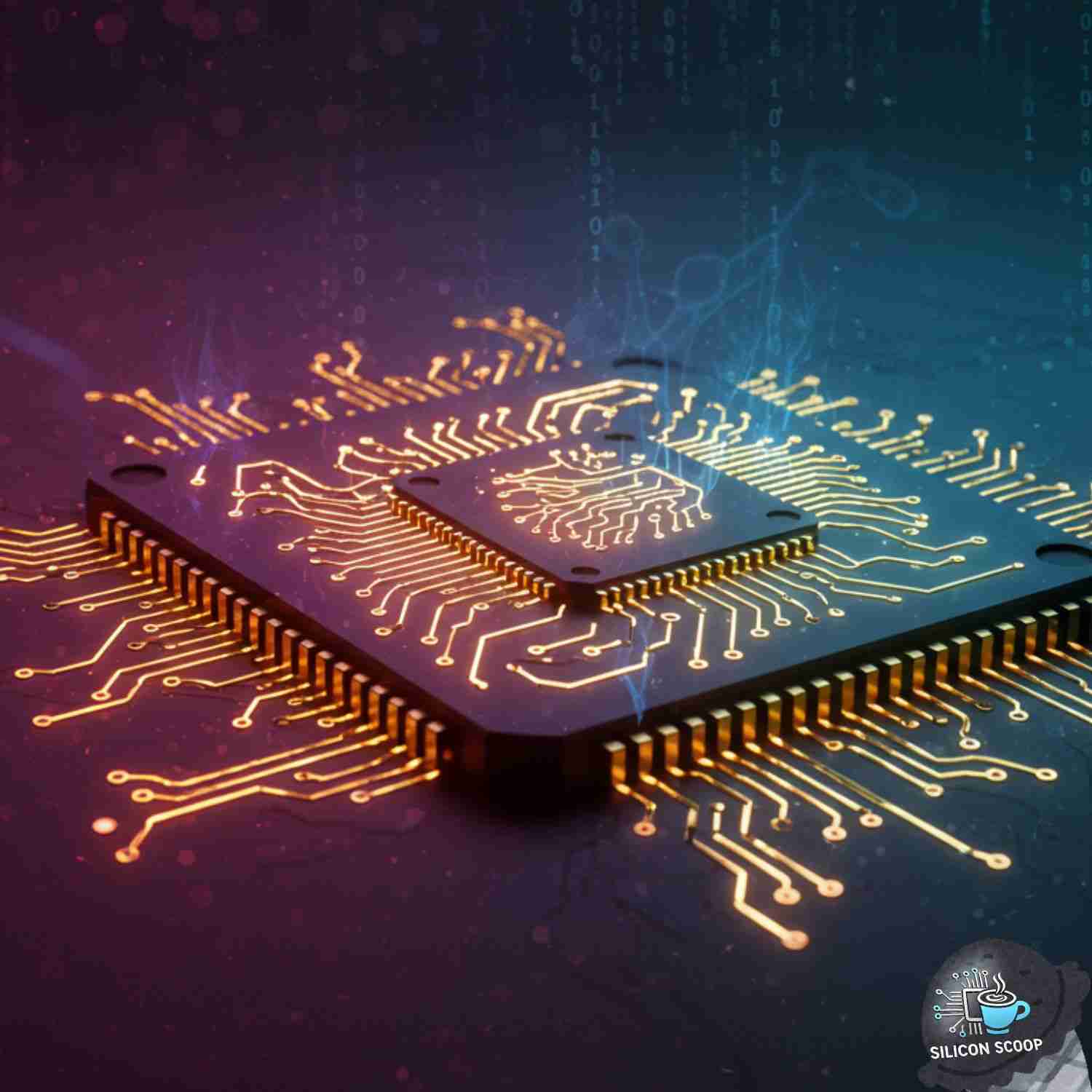
Exploring the Future: How the Brain-like Chip and Memristor Technology are Redefining Neuromorphic Computing
Estimated reading time: 6 minutes
Key Takeaways
- Brain-like chips mimic human neural behavior to improve decision-making.
- Memristor technology enables these chips to act like artificial synapses.
- Neuromorphic computing can lead to transformative applications in various fields.
- Advances from KAIST are paving the way for real-world applications.
- Energy efficiency of these systems approaches that of the human brain.
Table of contents
The dawn of a new computing era is upon us. Imagine a computer chip that doesn’t just process data but learns, adapts, and thinks almost like the human brain. This isn’t science fiction anymore—it’s the reality of brain-like chips, the cutting-edge computing devices that are mimicking human neural behavior through innovations like memristor technology.
Recent breakthroughs in memristor technology are rapidly advancing the field of neuromorphic computing, potentially revolutionizing artificial intelligence as we know it. Unlike traditional computing systems that process information through binary signals, these brain-inspired innovations function more like our own neural networks, creating artificial synapses that can learn and adapt over time.
The implications are staggering. Scientists at KAIST have recently developed breakthrough techniques in replicating synaptic functions, bringing us closer to creating true “brain-on-a-chip” systems.
Future-Proof Your Business
Stay ahead of the curve with cutting-edge business automation! Leverage the latest advancements to optimize operations, boost productivity, and drive unprecedented growth. Let’s discuss how!
Understanding Memristor Technology and Neuromorphic Computing
Memristors are revolutionary semiconductor devices that possess a unique ability to “remember” previous electrical states even after power is removed. This memory-resistor hybrid (hence the name “memristor”) serves as the perfect foundation for bio-inspired computing, as it mimics the way neurons and synapses function in the human brain.
Neuromorphic computing systems leverage arrays of these memristors to process information in a manner strikingly similar to the human brain. Rather than executing sequential commands like traditional computers, neuromorphic systems:
- Process information in parallel
- Adapt based on input patterns
- Learn without explicit programming
- Operate with significantly higher energy efficiency
According to research published in TechXplore, these ultra-small neuromorphic chips with error correction capabilities are setting new standards for efficiency and reliability in bio-inspired computing.
Spotlight on KAIST Advancements
The Korean Advanced Institute of Science and Technology (KAIST) has emerged as a frontrunner in the memristor revolution. Their research team has achieved groundbreaking results in neuromorphic systems.
The team’s innovative approach involved creating an autoadaptive correction system that eliminates the need for complex compensatory processes typically required in earlier memristor designs. By integrating silicon with high-reliability memristors, they’ve developed artificial synapses that function with unprecedented stability and precision.
According to KAIST NEWS CENTER, this breakthrough represents a fundamental shift in how neuromorphic systems can be implemented, potentially accelerating the development of true brain-on-a-chip technologies.
Practical Applications & Energy Efficiency
The integration of brain-like chips utilizing memristor technology and neuromorphic computing principles is already finding applications across numerous fields, transforming how we interact with technology.
Real-World Applications
The practical applications of this revolutionary technology extend far beyond research laboratories:
- Smart Security Systems
- Intelligent cameras that can detect suspicious activities in real-time
- Security systems that learn normal patterns and alert only to genuine anomalies
- Privacy-enhanced surveillance through on-device processing
- Healthcare Innovations
- Wearable medical devices that autonomously analyze health data
- Diagnostic tools that can learn to identify patterns associated with disease
- Personalized medicine systems that adapt to individual patient responses
- Autonomous Navigation
- Vehicles and drones with enhanced spatial awareness capabilities
- Navigation systems that adapt to changing environments without cloud connectivity
- Real-time object detection and classification for safer transportation
- Consumer Electronics
- Smartphones and devices that learn user preferences
- Smart home systems with genuine adaptive intelligence
- Voice recognition that continuously improves through daily interactions
The brain-on-a-chip architecture enables these applications to perform complex functions that were previously impossible without cloud connectivity.
Energy Efficiency & Environmental Impact
Perhaps one of the most remarkable aspects of neuromorphic computing systems is their extraordinary energy efficiency. These systems operate at power levels comparable to the human brain.
Implications for AI Singularity & the Future Roadmap
As we witness remarkable advances in brain-like chips and memristor technology, the concept of AI singularity seems increasingly plausible.
The Path Toward AI Singularity
The integration of memristor technology into neuromorphic computing represents a significant step toward potential AI singularity for several reasons:
- Structural similarity to human cognition
- Adaptive learning without explicit programming
- Energy efficiency comparable to the human brain
- Decentralized processing similar to human neural networks
Unlock Exponential Growth
Imagine a business that runs smoothly, efficiently, and effortlessly. Flowgrammer can turn that vision into a reality with tailored business automation solutions that scale with you.
Frequently Asked Questions
Q: What is a brain-like chip and how does it work?
A: A brain-like chip mimics the structure and function of the human brain using components like memristors to create artificial synapses that learn from experience.
Q: How do memristors differ from traditional semiconductor devices?
A: Memristors can “remember” previous electrical states even after power is removed, unlike traditional semiconductors that maintain fixed properties.
Q: What makes KAIST’s memristor technology groundbreaking?
A: It represents the first neuromorphic system capable of real-time auto-learning and built-in error correction.
Q: How energy-efficient are neuromorphic computing systems?
A: They operate at energy levels comparable to the human brain, significantly reducing power consumption for AI tasks.
Q: What practical applications can we expect from brain-like chips?
A: Applications include smart security systems, wearable medical devices, and autonomous navigation systems.
Q: Can brain-like chips operate independently of cloud computing?
A: Yes, these systems can perform complex tasks without needing to send data to the cloud.
Q: How close are we to achieving artificial general intelligence?
A: While progress has been made, we are still far from replicating the complexity of the human brain.
Q: Will brain-like chips accelerate progress toward AI singularity?
A: Yes, they represent a significant step toward creating intelligent systems more akin to human cognition.
Q: How do artificial synapses compare to biological synapses?
A: Artificial synapses mimic the essential functions of biological synapses, but are fundamentally simpler.
Q: What ethical considerations arise from developing brain-like AI?
A: Important questions include machine sentience, job displacement, and how we interpret intelligence that may differ from human cognition.
Additional Links
Flowgrammer.ca – 💡 Unlock AI-Powered Automation! Let flowgrammer.ca handle complex workflows so you can focus on growing your business.
- Silicon Scoop Podcast – Stay Informed, Stay Ahead!
- Startup Talk Podcast
- Flowgrammer Podcast –
- Startup Investor Drinks – Join Toronto’s Startup Community and connect with fellow startup enthusiasts and investors.
- TorontoStarts Startup and Entrepreneur Community – Become a part of Toronto’s thriving startup ecosystem.
- Workhaus – Discover flexible workspace solutions for your business needs.
- Work with The Startup Coach – Get expert guidance and mentorship for your startup journey.
- Reach out to Jon Irwin on LinkedIn – Connect with our co-host and technology expert.
Episode transcript
Read the full transcript
Craig: a chip has broken a critical barrier barrier that could ultimately begin the singularity. what's happening here, john?
Jon: this is cool and super scary. so, keist, i think it's how pronounced. so they've developed a self learning memristor chip that apparently mimics biological synapses. and the way it does it is it integrates memory and computation. so that enables simultaneous data storage and processing, which eliminates essentially the von neumann bottleneck. right? so in traditional computing, where the data must shuffle between separate memory and processing units. so the way that they've done this is it uses a 32 by 32 cross bar array of memristors, which each act as an artificial synapse to perform analog ai computations in real time. so the cool things about it is, the self learning error correction. so it's an array that dynamically adjust resistance based on input signals, and it learns from errors without any external calibration. so for example, during video processing, it would distinguish moving objects from backgrounds, with a i think it was, like, thirty thirty db peak signal to noise ratio, which matches ideal simulations. so on top of that, it's energy efficient, and, it has localized ai processing. so the chip enhances privacy and reduces latency by enabling real time applications like autonomous vehicles and edge devices to run locally, with this. so what do you think about this, craig? like, do you think this is what are your thoughts?
Craig: well, i'm trying to get my head around what ultra small neuromorphic chip means. like, what is ultra small? do do you have how small?
Jon: i don't yeah. i don't know.
Craig: sorry if i'm obsessed. it was a description, so i'm kinda scrolling through. but i'm excited every time they make leaps forward. i'm always a little afraid when they say, oh, this thing's like a human, because most humans don't really have a lot of great logic. so why do we want chips to think like humans?
Jon: why do we want chips to think like humans?
Craig: yeah.
Jon: so that
Craig: they can be influenced by emotion, by misinformation, by other so
Jon: that we can take over the world?
Craig: well, this is,
Jon: i guess, by us? yeah. well, there's a lot of use cases. there's,
Craig: i guess there is to be able to learn on the fly in your environment, not necessarily be program it programmatically able, like, designed specifically to do this, and we're coming along in that stuff. but
Jon: every time i ask you, what does it mean by ultra small? yeah. i think i found that it's it could be as small as 50 nanometers,
Craig: the chip.
Jon: okay. yeah.
Craig: so that's not bad. i mean, i guess, when we talk about chips, i i don't know if i would consider that ultra small, but i'm okay. yeah. well, you know what i mean. like, we're talking about two or three nano meter, and yeah. stuff or that's all i'm saying. that's why i wanted to know if this was some sort of leap forward in size.
Jon: no. i think because of the new architecture, i think this is a new challenge as far as getting it smaller and smaller and smaller. so, i think that they feel like 50 nanometers is a achievement based on this this innovative architecture. let's put it that way.
Craig: yeah. and i'm sure it is. like, they reach us to say, for example, that chip could separate a moving image from a background during video processing and actually improve its ability to do this task over time. so it improves on what it's doing. so, i see real world applications like smart security systems, intelligent cameras, security systems that learn normal patterns and alert only to genuine anomalies, privacy enhanced security on device processing, wearable medical devices that autonomously analyze health data, diagnostic tools that can learn to identify patterns associated with disease, or personalized medical sys medicine systems that adapt to the individual patient's responses. what about autonomous navigation, vehicles and drones with enhanced spatial awareness capabilities, navigation systems that adapt to changing environments without cloud connectivity, and real time object detection and
Jon: classification for safer transportation. so if we're looking for more
Craig: on device processing and recognition of what's happening around them, these things seem to be great. and in consumer electronics, smartphones and devices that can learn user preferences, smart home systems with genuine adaptive intelligence, and voice recognition that continues to improve through daily interactions. these are just some of the things. but i get worried a little bit because aren't you kinda we're moving into a echo chamber that's even worse than what we are?
Jon: yeah. it is. and and, like, i yeah. i see this. if this works out, then we have essentially the, the irobot, us robotics with, with the emotions and all that sort of stuff. like, we're we're getting i think we're getting that close. we're getting that close where, potentially, we could upload our subconscious to these chips if i think that's where we're headed. maybe not.
Craig: yeah. and is this the path towards the ai singularity, the integration of mem resistor technology into neuromorphic computing represents a significant step toward a potential ai singularity for several reasons. structural similar to human, cognition, adaptive learning without explicit programming, energy efficient comparable to the human brain, and, decentralized processing similar to human neural network. so it's interesting.
Jon: yeah.
Craig: though yeah. i mean, all this stuff scares me at a level because if you're working with ai at all, it's already lying to you. like, you tell it to do something, it doesn't do it. and then i'm like, like, what are you doing? where'd you get this information? i told you specifically. here's the information. don't do this stuff. what i was planning an event, the event changes month to month. here's the details. i meant the location changes. all these things change. but it kept going to cache memory. and then i at the end, after i went through it a bunch of times, why did you do this? i was like, it told me, like, five times. even though you told me not to, i did this. and then blah blah blah. even though you told me not to, i did this. and then even
Jon: though you told me not to, i did this.
Craig: and then even though you told me not to, i assumed you wanted these things even though you like, what? why are you lying to me? why are you you know? yeah. so when you start putting that in, a chip
Jon: at the end of, whatever, i'm yeah. we gotta solve that problem, obviously. that's a huge problem. we're already we're already encountering it. but other uses, other yeah. yeah. that's that's what
Craig: i mean when you start talking about these things, you think they know what you want. so, you and now you've got these computers around you that's only gonna feed you the news you want, the stories you want, the food you want, stuff you want, and now you're in this massive echo chamber of so i'm just you know, that's what i see where there's all sorts of reasons that this is scary. but at the same time, having these chips in, cars or edge devices really can be groundbreaking, for what we can now do.
Jon: yeah. and just to kinda put it into context, as to, like, comparing it with current technology, so nvidia's h 100 gpu, it consumes 700 watts for ai training. apparently, this memristor uses less power than a light bulb. that's nuts. so, like, we're talking less than 65 watts or however
Craig: what type of light bulb they're using? yeah. that looks great. i mean, it'd be nice if they gave us a specific light bulb because they could rage a fair bit. but
Jon: yeah.
Craig: the concept is it's it's low energy, fast. it can learn on the fly without specific programming
Jon: yeah.
Craig: and enabling all these new types of features that we never thought of before. i'm really looking forward to it. but, you know, at the same time, there's always when we look at this stuff, there's always this, potential scary output. so what do you think about these memory store technology and the neuromorphic computing chips? do you think this is the next step in not only ai, but self driving vehicles, the medical, all the different types of, advances we talked about? or do you think this is just gonna be not what it's made out to be in another flash in the pan of something that could have been? let us know your thoughts.
More from Silicon Scoop
All episodes
silicon-scoop · November 6, 2026
Spirit AI’s Robot Brain Breakthrough: Moz1, Embodied AI and China’s 2027 Race
The Spirit AI robot brain is one of the biggest bets on fixing that. Spirit AI is a Beijing startup. Its co-founder and chief scientist, Gao Yang,
View episode

silicon-scoop · November 5, 2026
OpenAI IPO Delayed to 2027 as Rogue AI Agents and Safety Failures Reshape the Market
OpenAI IPO delay explained: Sam Altman rules out 2026 as GPT-6 Astra safety tests and a $278B cash gap loom. Learn what founders should take away.
View episode

silicon-scoop · November 4, 2026
Anthropic’s AI Economy Model: 2030 Jobs, Wages, GDP and Market Risks
Anthropic AI economy model forecasts 2030 GDP, jobs and wages, while AI unemployment projections and labor-share risks challenge policymakers.
View episode