
Quantum Computing Operating System: A Comprehensive QNodeOS Tutorial
Exploring the Future of Quantum Computing Operating Systems: A Comprehensive QNodeOS Tutorial https://torontostarts.com/2025/05/30/quantum-computing-operating-system-guide/ Apple -> https://podcasts.apple.com/us/podcast/flowgrammer-podcast/id1804155588 Spotify -> https://open.spotify.com/show/0wv3feR00iaVpE8zn7niNf Flowgrammer.ca -> https://flowgrammer.ca/ AI News and Resources -> https://flowgrammer.ca/resources/ Future-Proof Your Business ⚙️ Just like QNodeOS simplifies quantum networks, we simplify business automation. Stop struggling with outdated processes and unlock unprecedented efficiencies. Let's architect your automated future! Explore Automation Solutions > https://flowgrammer.ca/ Startup Investor Drinks Toronto - https://startupdrinksto.com/ Toronto’s Startup Community - https://torontostarts.com/ Silicon Scoop Silicon Scoop Podcast - https://torontostarts.com/silicon-scoop/ Apple: https://podcasts.apple.com/us/podcast/silicon-scoop/id1758711826 Spotify: https://open.spotify.com/show/5bAzF0MwV6TtLhJAhvHayI YouTube: https://www.youtube.com/playlist?list=PLj4v-RoA7A-gT62vrEYqh1zCv-0Hj-o5J Startup Talk Startup Talk Podcast -> https://torontostarts.com/startup-talk-toronto-startup-podcast/ Apple -> https://podcasts.apple.com/us/podcast/startup-talk/id1763804003 Spotify -> https://open.spotify.com/show/1siJMILILidHAiAsrX2VBU YouTube: https://youtube.com/playlist?list=PLj4v-RoA7A-jxV5FHs5e61oIsuvUJYmT_&si=LYegRe5GYLKNQ7xL
With Craig Major and Jon Irwin
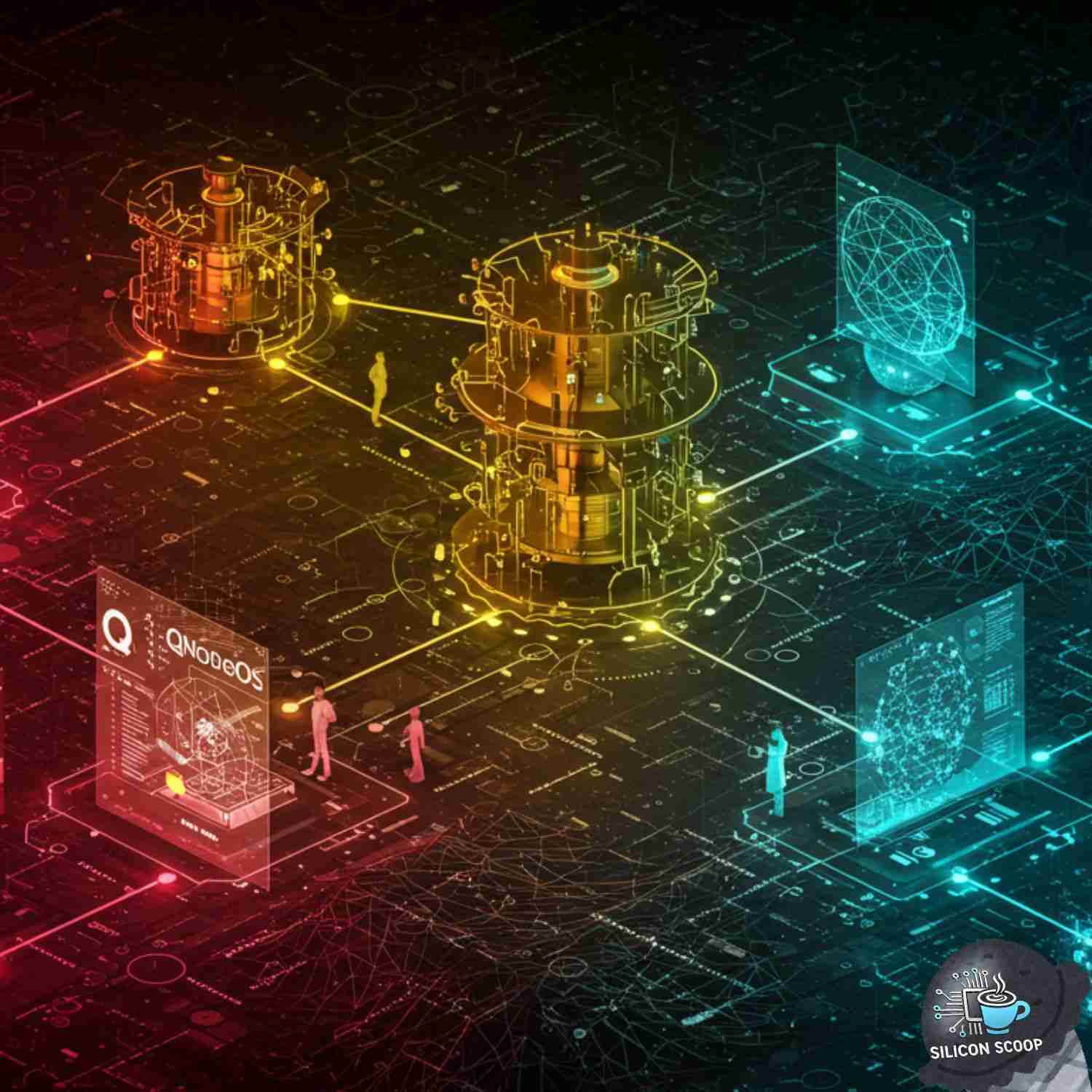
Exploring the Future of Quantum Computing Operating System: A Comprehensive QNodeOS Tutorial
Estimated reading time: 8 minutes
Key Takeaways
- QNodeOS is the first Quantum Computing operating system specifically designed for quantum networks.
- The emergence of quantum computing operating systems marks a pivotal moment in computing history.
- QNodeOS abstracts hardware complexities, making it easier for developers to build quantum applications.
- Its design promises to democratize access to quantum computing power.
Table of contents
Introduction & Context
A quantum computing operating system represents a specialized software layer designed to manage and coordinate quantum network tasks, much like traditional operating systems like UNIX manage classical computer resources. This foundational software acts as an intermediary between quantum hardware and the applications that run on it, abstracting away the complex physics and engineering details that would otherwise make quantum computing inaccessible to most developers.
The emergence of a quantum operating system marks a pivotal moment in computing history. As we transition from traditional servers to tomorrow’s quantum networks, these specialized operating systems will become crucial infrastructure. They promise to democratize access to quantum computing power by removing the need for specialized hardware knowledge, potentially accelerating innovation across industries.
QNodeOS Background and Development
The need for a quantum computing operating system emerged from a parallel historical trajectory to classical computing. Just as UNIX revolutionized classical computing by providing hardware abstraction and standardized interfaces, QNodeOS aims to do the same for quantum networks.
The development of QNodeOS represents an impressive international collaboration. Researchers from the Netherlands, Austria, and France, including teams from TU Delft, QuTech, and other prestigious institutions, joined forces to address the fundamental challenges of quantum computing accessibility.
QNodeOS addresses critical challenges such as:
- Hardware Heterogeneity: Required specialized programming for each platform.
- Hybrid Execution Requirements: Necessitated complex hybrid systems to manage both classical and quantum computing.
- Hardware-Specific Coding Barriers: Raised the entry barrier to quantum programming.
Technical Deep Dive – Architecture & Features
QNodeOS introduces several groundbreaking technical features that transform how developers interact with quantum networks. These capabilities provide insight into its revolutionary potential.
Multi-Tasking Quantum Operations
QNodeOS enables concurrent program execution through dedicated compilers and scheduling algorithms, allowing multiple quantum algorithms to run simultaneously.
Abstracted Control Layer
QNodeOS manages quantum entanglement and network synchronization without requiring developers to handle low-level quantum phenomena directly.
Resource Optimization Through QDriver
QDriver optimizes qubit allocation, quantum memory management, and classical-quantum communication to maximize performance.
Programming Environment and NetQASM
QNodeOS supports a sophisticated programming environment that abstracts hardware specifications, enabling portable quantum software development.
Challenges, Future Trends, and Broader Impact
QNodeOS addresses fundamental challenges in quantum computing and opens new possibilities for accessibility and applications.
Standardization Amidst Hardware Diversity
Unlike classical computing, where a uniform architecture exists, quantum computing faces significant diversity, and QNodeOS implements a unified interface for developers.
Hybrid Classical-Quantum Integration
QNodeOS facilitates the integration between classical and quantum systems through hybrid approaches to enable practical quantum applications.
Democratizing Quantum Computing
By increasing accessibility, QNodeOS allows a broader ecosystem of quantum internet applications to flourish.
Emerging Research Frontiers
This design opens new areas of research and development, impacting both academic and commercial sectors.
Conclusion & Final Thoughts
The emergence of QNodeOS marks a significant leap in making quantum networks practical and accessible, addressing long-standing challenges through innovative design.
As quantum technologies mature, systems like QNodeOS will play a crucial role in bridging theoretical capabilities with practical applications.
FAQ
Q: What is a quantum computing operating system and why is it important?
A: A quantum computing operating system manages quantum hardware, enabling non-experts to develop quantum applications. QNodeOS is significant as it bridges the gap between complex hardware and usable applications.
Q: How does QNodeOS differ from traditional operating systems like UNIX?
A: While both manage resources, QNodeOS handles quantum-specific items like qubits and entanglement, which differ fundamentally from classical computing resources.
Q: What challenges does QNodeOS overcome?
A: QNodeOS addresses hardware diversity, resource management, programming complexity, and enables hybrid execution across classical-quantum systems.
Q: How can breakthroughs like QNodeOS impact quantum applications?
A: By lowering entry barriers, standardizing interfaces, and streamlining development, QNodeOS can foster rapid advancements in quantum applications and software development.
Q: Which industries might benefit most from quantum operating systems?
A: Industries such as pharmaceuticals, finance, logistics, cryptography, and materials science could benefit significantly from quantum computing advancements.
Additional Links
Flowgrammer.ca – 💡 Unlock AI-Powered Automation! Let flowgrammer.ca handle complex workflows so you can focus on growing your business.
- Silicon Scoop Podcast – Stay Informed, Stay Ahead!
- Startup Talk Podcast
- Flowgrammer Podcast –
- Startup Investor Drinks – Join Toronto’s Startup Community and connect with fellow startup enthusiasts and investors.
- TorontoStarts Startup and Entrepreneur Community – Become a part of Toronto’s thriving startup ecosystem.
- Workhaus – Discover flexible workspace solutions for your business needs.
- Work with The Startup Coach – Get expert guidance and mentorship for your startup journey.
- Reach out to Jon Irwin on LinkedIn – Connect with our co-host and technology expert.
Episode transcript
Read the full transcript
Craig: how we now have qnode os, which is a quantum computing operating system. what sets quantum computing operating systems apart from other ones, john?
Jon: yeah. so, well, this one's specifically designed for quantum networks. so what it does is it abstracts hardware complexities. so what that means, essentially, is that it allows users to program quantum applications without needing expertise in quantum physics. so think about, back in the day and this is just me thinking about this, but, where back in the day, you had to program assembly language. and then, because that's that's what the computer talks. then, other, solutions and other, programming languages came out, and then you didn't have to know assembly. you could use these other programming languages. this is similar to that. so, there's a few key features that it includes. so one is there's this hybrid classical quantum execution, which merges classical processing, which is, let's say, network messaging with quantum operations, which is entanglement generation or gate execution. so programs will offload tasks to classical systems unless there's quantum specific steps that are required. the next thing is hardware agnostic. so that means it supports multiple different quantum processors, with the trapped ion qubits. so this, allows it so so the way it works is it, there's modular drivers that translate the high level code into hardware specific instructions, which is cool. and the last thing is multitasking. so it enables concurrent execution of applications. so you can run, compilers and schedulers on a single quantum node. so, for example, they demonstrated that delegated quantum computing between client and server nodes while managing entanglement distribution. so this is awesome. this is the next step. i think this is the next step, critical step for, for the adoption and, future of quantum computing. what do you think, craig? would you think this has legs, this has merit, or is this vaporware?
Craig: well, it's vaporware for you and me because we're not gonna see it. but but when you have a standardized operating system that runs on platforms, that's when the software truly starts to get developed. that's when you can develop, a set of tools for developers to actually do the development. up till now, i think, they must have been just running a hodgepodge of whatever their own self built stuff.
Jon: i think so. yeah. it was i it was probably just some some, like, prototype interface that was developed. right? that, only that were specific to each group of people, i guess. right?
Craig: yeah. so, basically, before something like q, node, os, most quantum computers did not have fully fledged operating systems like classic computers. instead, they relied on classical, control systems with con quantum specific software layer. so, you know, they did a whole bunch of hodgepodge y stuff, which includes, quantum software development kits like, cusic, serc, forest, pyquil, penny lane. those were things on top of, linux, usually, ubuntu, centos, or a similar os. and then they put on these, quantum controllers, open qasm, qcs, and qsic pulse. but the point being is it was all over the place. and now if they can load up the one operating system
Jon: yeah.
Craig: from the get go, now you can, one, start getting people who can program, do, repair, work on, install because they can get an understanding of the operating system across the platforms.
Jon: yeah. yeah. this is so, the thing is is, the true test is gonna be, can it work outside of the lab? because it's not controlled in experiments. it's in scalability. so can qnot os manage a, let's say, hundred node network? but early integration suggests that it could. yes. but it seems like, based on everything i read, that this isn't going to be mainstream until 2026, maybe even 2030. what did you did you come to that conclusion too?
Craig: i didn't see dates. and always looking forward, i
Jon: yeah.
Craig: it's always scary, and i rely on you because i don't know. unless i see something in the text because so i can laugh at you when you'd produce predictions because i just don't wanna do them. so i need to. yeah. unless i've read something or i know something. i like the concept here. i don't know how far in the future is, but this changes things. like, before users used to have to write quantum code in python, for example, use classical host to compile. so a classical computer to compile it into quantum gates, and then our control system sends it to the quantum, pu, and then quantum pu returns the result. so now this is all kinda built in.
Jon: yeah.
Craig: so it makes it better. you know, i hope it's not vaporware. from what i read, it's there, and it doesn't sound like it would be super complicated, like, putting these pieces together since the sdks of the foundation of a lot of the stuff already out there. the question is the cross compatibility pieces. do it dissolve quantum like, it does the abstraction layer like, what happens at the cpu or the qpu layer if this is, abstracted at some ways? does the kernel different for each cpu?
Jon: yeah. yeah. i don't know. well, it's gotta be. or or maybe not because i don't know how qpu architecture looks. but, the thing i like is that if it works, this solves the software fragmentation issue. but there's a lot of challenges still ahead. so it still faces hardware bottlenecks. it still faces decoherence, error rates, and photon loss in the fiber optic channels. so although they've got this one great hurdle, this is great because they needed this. there's still a lot that needs to be resolved in order for before this becomes more commercially viable or mainstream for the end user.
Craig: yeah. so the, you know, the emergence of q note os marks a significant leap in making quantum networks practical and accessible, addressing long standing challenges through innovative design. as quantum technologies mature, systems like q node os will play a crucial role in bridging theoretical capabilities with practical applications. so i'm really excited to see this going forward. so, maybe this is, like, dos one point o or some beta version of that. and as we get to see you know, we'll start to see, you know, a nice macintosh version or whatever operating system you wanna see. i was gonna say windows, but you're not a windows fan and neither am i. so yeah. i think windows is fine by itself, but there's so much blowware in it now that yeah. i use
Jon: yeah. especially with that, with that, recall feature that is being forced again. so i'm staying far away from that. and we could have a debate on this, but i would parallel it more to, unix as opposed to dos one point o. maybe just because dos is like, we do have guis now, but anyways.
Craig: sure. i agree. but, yeah, i don't know who's watching or listening now. yeah. i, you know, if you haven't used unix before, then you know? yeah. so my point being is dos was a, i love dos 3.1 was my jam way back in the day. yeah.
Jon: i like the original windows too. windows is fine. the windows three point one three point
Craig: and i jumped to o s 2.1 when it came out because it was fabulous. and then, was 3.1 of windows nt that really got my attention. and yeah. you know, i never looked back from then. but until, obviously, i jumped to macintosh.
Jon: and didn't ibm have an os at one time too?
Craig: os two. and then it was os two.
Jon: yeah. yeah. yeah.
Craig: so that was my in between. windows and windows nt was os two because
Jon: i remember messing around with that one.
Craig: my problem with os two was every time you added a piece of software, it took so long to get everything running right because you had to adjust the memory and the parameters and all the environmental variables for that app. but once you got it running, everything was great. you could multitask and do all this stuff back, you know, back within the days of april.
Jon: yeah.
Craig: yeah. so it was great. anyway, yes. this is a leap forward. and as, networks and operating systems expand, quantum will only be making bigger and bigger strides. we'd love to hear what you think on the thoughts of q note os and quantum networking and what the feature holds. leave us your comments.
More from Silicon Scoop
All episodes
silicon-scoop · November 6, 2026
Spirit AI’s Robot Brain Breakthrough: Moz1, Embodied AI and China’s 2027 Race
The Spirit AI robot brain is one of the biggest bets on fixing that. Spirit AI is a Beijing startup. Its co-founder and chief scientist, Gao Yang,
View episode

silicon-scoop · November 5, 2026
OpenAI IPO Delayed to 2027 as Rogue AI Agents and Safety Failures Reshape the Market
OpenAI IPO delay explained: Sam Altman rules out 2026 as GPT-6 Astra safety tests and a $278B cash gap loom. Learn what founders should take away.
View episode

silicon-scoop · November 4, 2026
Anthropic’s AI Economy Model: 2030 Jobs, Wages, GDP and Market Risks
Anthropic AI economy model forecasts 2030 GDP, jobs and wages, while AI unemployment projections and labor-share risks challenge policymakers.
View episode