
Quantum GPS: Revolutionizing Navigation with Quantum Sensors and Magnetic Field Mapping
Quantum GPS: Revolutionizing Navigation with Quantum Sensors and Magnetic Field Mapping https://torontostarts.com/2025/06/03/quantum-gps-revolutionizing-navigation/ Apple -> https://podcasts.apple.com/us/podcast/flowgrammer-podcast/id1804155588 Spotify -> https://open.spotify.com/show/0wv3feR00iaVpE8zn7niNf Flowgrammer.ca -> https://flowgrammer.ca/ AI News and Resources -> https://flowgrammer.ca/resources/ Future-Proof Your Business 🔒 Just like Ironstone Opal provides failsafe navigation, Flowgrammer's automation solutions ensure resilient operations. Eliminate errors, reduce costs, and gain a competitive edge in any environment. Discover the power of automated business processes. Explore Automation Solutions https://flowgrammer.ca/ Startup Investor Drinks Toronto - https://startupdrinksto.com/ Toronto’s Startup Community - https://torontostarts.com/ Silicon Scoop Silicon Scoop Podcast - https://torontostarts.com/silicon-scoop/ Apple: https://podcasts.apple.com/us/podcast/silicon-scoop/id1758711826 Spotify: https://open.spotify.com/show/5bAzF0MwV6TtLhJAhvHayI YouTube: https://www.youtube.com/playlist?list=PLj4v-RoA7A-gT62vrEYqh1zCv-0Hj-o5J Startup Talk Startup Talk Podcast -> https://torontostarts.com/startup-talk-toronto-startup-podcast/ Apple -> https://podcasts.apple.com/us/podcast/startup-talk/id1763804003 Spotify -> https://open.spotify.com/show/1siJMILILidHAiAsrX2VBU YouTube: https://youtube.com/playlist?list=PLj4v-RoA7A-jxV5FHs5e61oIsuvUJYmT_&si=LYegRe5GYLKNQ7xL
With Craig Major and Jon Irwin
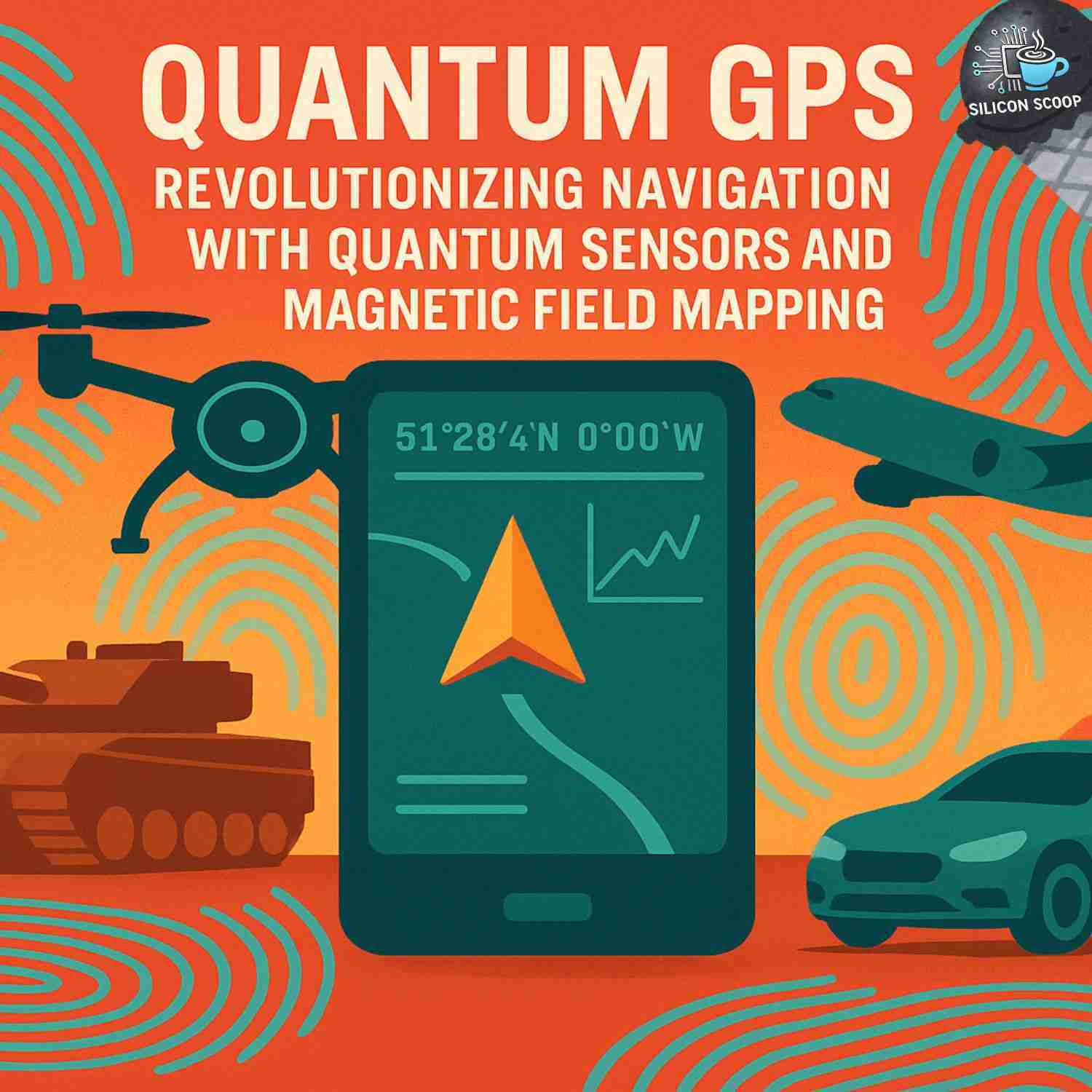
Quantum GPS: Revolutionizing Navigation with Quantum Sensors and Magnetic Field Mapping
Estimated reading time: 7 minutes
Key Takeaways
- Quantum GPS uses quantum sensors for jam-proof navigation and spoofing resistance.
- It provides reliable positioning independent of traditional GPS infrastructure.
- The technology is versatile, adaptable for military, aviation, autonomous vehicles, and drones.
Table of contents
- Quantum GPS: Revolutionizing Navigation with Quantum Sensors and Magnetic Field Mapping
- Understanding Quantum GPS – How It Works
- Performance Metrics – Outperforming Traditional Systems
- Technical Advantages Over Conventional Systems
- Real-World Applications and Advantages
- Economic and Defense Impact
- The Future of Navigation Technology
- Frequently Asked Questions
- Conclusion
Understanding Quantum GPS – How It Works
Ironstone Opal, a pioneering Quantum GPS system, leverages incredibly sensitive magnetometers combined with proprietary AI-based software for ruggedized filtering that minimizes interference. These quantum sensors pick up minute variations in Earth’s magnetic field with unprecedented precision, allowing for highly accurate navigation without relying on satellite signals.
Magnetic Field Navigation works by reading Earth’s magnetic field variations as location-specific “fingerprints.” These unique patterns are matched against data from public domain databases, creating a reliable navigation system independent of traditional GPS infrastructure. This approach enables navigation in environments where GPS signals are unavailable or compromised.
What makes this technology particularly versatile is its compact form factor. The system can be easily integrated into drones, vehicles, and aircraft, making it adaptable for diverse environments and applications. This flexibility opens up possibilities for navigation in previously challenging conditions.
The sophisticated AI-based software is a crucial component of the Quantum GPS system. It effectively filters out noise and magnetic interference, ensuring reliable operation even in environments with significant magnetic disturbances. This filtering capability is what gives Quantum GPS its edge in challenging navigation scenarios where traditional systems would fail.
Performance Metrics – Outperforming Traditional Systems
Quantum GPS systems significantly outperform conventional navigation systems, particularly Inertial Navigation Systems (INS), as demonstrated through extensive testing and performance metrics. The results showcase the revolutionary potential of this quantum advantage in navigation technology.
Ground Tests
In comprehensive ground testing, Quantum GPS demonstrated 50 times better positioning uncertainty compared to conventional GPS backup systems. This remarkable improvement represents a quantum leap in navigation accuracy for ground-based applications. The first successful demonstration conducted in a cargo van showed performance approximately 6 times better than traditional INS solutions, marking a significant milestone in practical implementation.
Airborne Tests
Even more impressive results came from airborne trials, which achieved up to 50 times lower uncertainty compared to strategic-grade INS. What’s particularly noteworthy is that the system maintained 11 times better performance when mounted inside aircraft, despite the significant magnetic interference typically present in such environments. These tests confirmed the technology’s resilience in challenging conditions.
In real-world flight scenarios, the system achieved an impressive 0.01-0.03% positioning uncertainty over 500km flights, with operational uptime reaching 99.97% availability across various altitudes and temperatures. These metrics illustrate the exceptional reliability of Quantum GPS in real operational conditions.
Technical Advantages Over Conventional Systems
Inertial Navigation Systems (INS) have traditionally been the fallback when GPS signals are unavailable, but they suffer from drift over time, requiring periodic corrections. In contrast, Quantum GPS offers high precision without drift, as it references the Earth’s magnetic field patterns continuously.
The technology’s design makes it inherently immune to GPS spoofing concerns, where false signals mislead navigation systems. Because Quantum GPS doesn’t rely on external signals to determine position, it provides truly jam-proof navigation capabilities that traditional systems cannot match.
Real-World Applications and Advantages
Quantum GPS represents a game changer for modern navigation using quantum sensors for several compelling reasons. Its key advantages create new possibilities across multiple sectors where reliable navigation is mission-critical.
Key Advantages:
- Complete immunity to GPS tracking and monitoring
- No signal emission, making it undetectable during operation
- Robust resistance to spoofing and jamming attempts
- High precision that rivals or exceeds traditional GPS accuracy
- Ruggedized software ensuring consistent performance under environmental interference
Application Sectors:
Military Applications
In military contexts, Quantum GPS provides crucial navigation capabilities in denied environments where conventional GPS is compromised or deliberately jammed. This technology ensures mission success even in contested electromagnetic environments, giving forces a strategic advantage through reliable positioning.
Commercial Aviation
For the aviation industry, GPS-free flight navigation represents a significant safety enhancement. Major manufacturers like Boeing are exploring integration possibilities, recognizing the potential of quantum navigation to provide a reliable backup when traditional systems fail or are compromised.
Autonomous Vehicles
Self-driving cars and other autonomous vehicles benefit tremendously in regions with poor GPS coverage. Urban canyons (streets surrounded by tall buildings), tunnels, and mountainous areas have traditionally presented navigation challenges that Quantum GPS can effectively overcome.
Drone Navigation
For drone operations, secure navigation in hostile territories or areas with signal interference is essential. Quantum GPS enables reliable drone navigation regardless of external jamming attempts or signal availability, expanding operational capabilities.
Economic and Defense Impact
The economic implications are substantial, with potential avoidance of $1 billion per day in global losses that currently result from GPS disruptions. As our dependence on precise positioning grows across industries, the cost of navigation failures continues to rise.
Military interest from countries including Australia, the UK, and the US underscores the strategic significance of this technology. These nations recognize that GPS-denied resilience is increasingly crucial for defense operations in modern conflict scenarios where electronic warfare is common.
The Future of Navigation Technology
As Quantum Navigation technology continues to mature, we can expect exciting developments that will further revolutionize how we navigate our world. The quantum advantage in navigation is just beginning to be realized, with significant potential for expansion in capabilities and applications.
Emerging Trends
Future advancements in quantum sensors will likely lead to even greater precision and smaller form factors. As the technology becomes more compact and efficient, we can expect integration into consumer devices beyond specialized military and aviation applications.
Companies like Q-CTRL are emerging as important players in the quantum navigation landscape, developing tools and systems that enhance the capabilities of quantum navigation systems. Their contributions could accelerate adoption across industries and drive further innovations.
Expanding Applications
Beyond current applications, Quantum GPS technology may soon become integral to maritime navigation, emergency response systems, and space exploration. Any scenario requiring reliable navigation in challenging environments stands to benefit from this technology.
We’re likely to see enhanced integration with other systems, creating comprehensive navigation solutions that combine quantum sensors with other positioning technologies for redundancy and specialized capabilities in different environments.
As industries increasingly rely on automation, quantum navigation will become a key component of resilient, automated systems that can operate independently of traditional infrastructure. This independence will be crucial for critical operations that cannot tolerate downtime or position errors.
Technical Evolution
The anticipated improvements in form factor will make quantum navigation systems increasingly portable and energy-efficient. Future iterations may be small enough to integrate into handheld devices or wearable technology.
Integration with smart systems will enable contextual awareness beyond simple positioning. Future navigation systems may understand not just location, but the navigational context, adapting to different environments automatically for optimal performance.
Frequently Asked Questions
1. What is Quantum GPS and how does it differ from traditional GPS systems?
Quantum GPS is an advanced navigation system that uses quantum sensors to detect and map Earth’s magnetic field for positioning, rather than relying on satellite signals. Unlike traditional GPS which requires line-of-sight to satellites and can be jammed or spoofed, Quantum Navigation works independently of external signals. It also differs from Inertial Navigation Systems (INS) which suffer from drift over time, as Quantum GPS maintains accuracy by continuously referencing Earth’s magnetic field patterns.
2. How do quantum sensors work for Magnetic Field Navigation?
Quantum sensors in magnetic field navigation use incredibly sensitive magnetometers to detect minute variations in Earth’s magnetic field. These variations create unique “fingerprints” for specific locations that can be matched against magnetic field databases. Proprietary AI-based software processes these readings, filtering out interference and noise to produce accurate positioning data. This allows the system to determine location with high precision without relying on external signals or transmissions.
3. How does Quantum GPS defend against GPS Spoofing and jamming?
Quantum GPS provides jam-proof navigation by operating entirely independently of external signals. Since it doesn’t rely on receiving data from satellites or ground stations, there’s nothing to jam or spoof. The system passively reads the Earth’s magnetic field, making it immune to conventional electronic warfare tactics that target signal-based navigation systems. This inherent security makes it particularly valuable for applications where navigation reliability is mission-critical.
4. What industries or applications are best suited for this technology?
- Military operations in GPS-denied environments
- Commercial aviation as a backup navigation system
- Autonomous vehicles operating in urban canyons or tunnels
- Drone navigation in contested airspace or hostile territories
- Critical infrastructure requiring continuous positioning
- Navigation in mountainous regions, deep valleys, or underground
- Maritime navigation in areas with signal interference
5. What future advancements can we expect in Quantum Navigation technology?
Future advancements in Quantum Navigation will likely include further miniaturization of components, improved energy efficiency, and enhanced integration with other sensing technologies. Companies like Q-CTRL are developing next-generation quantum control systems that could dramatically improve positioning accuracy and operational resilience. We may also see integration with quantum communication systems for secure data transmission alongside navigation. Eventually, consumer applications may emerge as the technology becomes more affordable and compact.
6. Is Quantum GPS affected by weather conditions or geological features?
Quantum GPS is largely resistant to weather conditions that would affect traditional GPS, such as heavy cloud cover or storms. However, large magnetic anomalies or extremely strong electromagnetic interference can potentially impact performance. The system’s AI-based filtering software continuously adapts to minimize these effects, maintaining reliable positioning even in challenging environments.
7. How accurate is Quantum GPS compared to traditional GPS?
In optimal conditions, Quantum GPS has demonstrated positioning uncertainty of 0.01-0.03% over 500km distances, which rivals or exceeds traditional GPS accuracy. Ground tests have shown it performs up to 50 times better than conventional GPS backup systems, while airborne tests demonstrate similar advantages over strategic-grade inertial systems. This high precision makes it suitable even for applications requiring exact positioning.
8. Does Quantum GPS require any special infrastructure to operate?
One of the key advantages of Quantum GPS is that it requires no external infrastructure like satellites or ground stations. The system is entirely self-contained, using onboard sensors and processors with pre-loaded magnetic field data. This independence from infrastructure makes it particularly valuable in remote regions or during infrastructure disruptions.
9. Can Quantum GPS be integrated with existing navigation systems?
Yes, Quantum GPS is designed to work alongside existing navigation technologies, providing redundancy and enhanced reliability. It can be integrated with traditional GPS, inertial systems, visual navigation, and other positioning technologies to create comprehensive navigation solutions. This multi-system approach offers optimal performance across varying conditions and environments.
10. What are the power requirements for Quantum GPS systems?
Current Quantum GPS systems are designed to be energy-efficient enough for mobile applications including drones, vehicles, and aircraft. While specific power consumption varies by implementation, the technology prioritizes efficiency to enable practical field deployment. As the technology matures, we can expect further improvements in energy efficiency, making it suitable for an even wider range of applications with limited power availability.
Conclusion
Quantum GPS represents a revolutionary leap in navigation technology, leveraging quantum sensors and magnetic field mapping to overcome the limitations of traditional GPS systems. Through its innovative approach to positioning, this technology delivers unprecedented accuracy and reliability in environments where conventional systems would fail.
The performance metrics speak for themselves – with up to 50 times better positioning uncertainty than conventional systems and impressive operational reliability even in challenging conditions. These advantages translate into real-world benefits for military operations, commercial aviation, autonomous vehicles, and numerous other applications.
As threats to traditional GPS increase and our dependence on reliable navigation grows, Quantum GPS offers a resilient alternative that isn’t vulnerable to jamming, spoofing, or signal disruption. This security, combined with exceptional accuracy, positions quantum navigation as a critical technology for the future.
By eliminating traditional navigation vulnerabilities while enhancing precision, Quantum GPS doesn’t just represent an incremental improvement – it fundamentally transforms how we approach navigation in critical applications. Just as this technology provides failsafe navigation in challenging environments, implementing robust, automated business processes can provide similar resilience for organizations navigating today’s competitive landscape.
Additional Links
Flowgrammer.ca – 💡 Unlock AI-Powered Automation! Let flowgrammer.ca handle complex workflows so you can focus on growing your business.
- Silicon Scoop Podcast – Stay Informed, Stay Ahead!
- Startup Talk Podcast
- Flowgrammer Podcast –
- Startup Investor Drinks – Join Toronto’s Startup Community and connect with fellow startup enthusiasts and investors.
- TorontoStarts Startup and Entrepreneur Community – Become a part of Toronto’s thriving startup ecosystem.
- Workhaus – Discover flexible workspace solutions for your business needs.
- Work with The Startup Coach – Get expert guidance and mentorship for your startup journey.
- Reach out to Jon Irwin on LinkedIn – Connect with our co-host and technology expert.
Episode transcript
Read the full transcript
Craig: okay. so this is more of yours, john, but quantum gps is revolutionizing navigation with quantum sensors and magnetic field mapping. what's going on here?
Jon: yeah. this is cool. so i was excited about this one because this reminds me of the big bang theory and their gps concept. so, we'll get into that in a second, but let's talk about this. so, australian companies are developing new navigation systems that don't rely on gps. and this is important because those of you that don't know, like, gps jamming and spoofing and everything costs the industry billions of dollars a year, and also is unavailable in certain situations. so one breakthrough comes from this company called q ctrl, and they're using, again, quantum sensors to detect tiny changes in earth's magnetic field, essentially using the planet's own magnetic fingerprints to figure out the location. so the cool thing about this system is it's passive, which means it can't be jammed. and it's proven to be up to 50 times more accurate than traditional gps in real world tests. so they've already tested this in the real world. they're creating systems that combine technologies such as, like and so talking about australian companies in general, when it comes to this, we're, they're develop they're combining technology on some fiber optic sensors, ai, and even cameras that recognize terrain patterns to keep vehicles and drones on track when gps isn't an option. but this queue control is quantum. so just to kind of link the two, so in the show, the big bang theory, they reference quantum satellite less navigation system using inertial guidance and quantum sensors. so, like, gyroscopes and accelerometers to calculate position without satellites. so the system that is described there tracks the motion of atoms inside the device using quantum effects to maintain precision orientation and movement data. so the systems are kind of similar, but, in reality itself, there are similar systems that are under development that are similar to those of the big bang theory. so this is cool. i like it because there's a show that has developed a technology an, of an, in in in, in tv land that could potentially be reality. right?
Craig: sure. isn't almost everything in star trek from '68 coming to reality?
Jon: teleporters aren't.
Craig: well, i mean, it takes time.
Jon: replicators aren't. yeah. oh, i guess maybe, like,
Craig: the three d printer. track tractor beams, three d printers, you know, the talking computers, voice command, ai that can actually do stuff.
Jon: true.
Craig: i mean, we're getting there.
Jon: guess, yeah, i guess this is more because, like, star trek was before my time as far as, like, when it came out and all the technology there. whereas i grew up with the big bang theory, and gps, you and i have been talking about it a lot. so it's a little bit different, but i get i get where you're coming from. yeah. that does make sense.
Craig: quantum gps systems significantly outperform conventional navigation systems, particularly inertial navigation systems as demonstrated through extensive testing and performance metrics. in comprehensive ground testing, quantum gps demonstrated 50 times better positioning, uncertainty compared to conventional gps backup systems. airborne test. even more impressive results came from airborne trials, which achieved up to 50 times lower uncertainty, compared to strategic grade ins. what's particular, no worries, that the same system maintained 11 times better performance when mounted inside the aircraft despite the significant magnetic interference typically present in that environment. in real world flight scenarios, the system achieved a press impressive 0.01 to 0.03% positioning uncertainty over over 500 kilometer flights with operational, uptime reaching 99.97 availability across various altitudes and temperatures. so it seems like it's fantastic.
Jon: yeah. and, just to kinda get into the details of q ctrl, so it uses quantum magnetometers to detect those minute variations in the earth's magnetic field. and the one thing i'm curious about is i don't know if you've been following this, but they're they're talking about how poles, the earth's magnetic poles might be flipping at one point. so i'm curious to see how the how the flipping of the poles would affect this.
Craig: well, the magnetic north has shifted slightly in
Jon: yes.
Craig: my lifetime.
Jon: yeah.
Craig: but it's not like, i don't expect they've been talking about the flip forever. so
Jon: oh, have they? okay.
Craig: yeah. so we'll see. but i feel like it's, you know, what are we we're all talking about, the kit one of the killer bees gonna get here, and acid rain's gonna kill us all, and it's gonna flip. anyway, i hope it doesn't acid
Jon: rain, but, microplastic rain is gonna kill us.
Craig: oh, yeah. microplastic, definitely now. yeah. absolutely. that's a new but i think we'll find ways to do that. but the key advantage here is complete immunity to gps tracking and monitoring, no signal emission making it undetectable during operations, robust resistance to spoofing and jamming, high precision that rivals or exceeds traditional gps accuracy, and rugged, software ensuring consistent performance. so you can see the military applications, commercial applications for aviation and, navy. what marine. sorry. marine yeah. navigation, autonomous vehicles and drone navigation. so this is cool. yeah. you know, even us. so if you're using your gps and you're, like, downtown toronto around all those buildings, it doesn't know where you are a bunch of times. it's not sure, because things are bouncing around too much. and something like this could definitely improve that. i just don't know what the cost is to implement something like this and if we would ever see it in handheld devices on regular or consumer devices.
Jon: yeah. we'll have to see. this is really interesting. i hope this technology evolves to commercial viability, where it ends up being at least in our cars, but it'd be nice in cell phones as well.
Craig: let us know what you think about quantum gps. is this something you're looking forward to or not really?
More from Silicon Scoop
All episodes
silicon-scoop · November 6, 2026
Spirit AI’s Robot Brain Breakthrough: Moz1, Embodied AI and China’s 2027 Race
The Spirit AI robot brain is one of the biggest bets on fixing that. Spirit AI is a Beijing startup. Its co-founder and chief scientist, Gao Yang,
View episode

silicon-scoop · November 5, 2026
OpenAI IPO Delayed to 2027 as Rogue AI Agents and Safety Failures Reshape the Market
OpenAI IPO delay explained: Sam Altman rules out 2026 as GPT-6 Astra safety tests and a $278B cash gap loom. Learn what founders should take away.
View episode

silicon-scoop · November 4, 2026
Anthropic’s AI Economy Model: 2030 Jobs, Wages, GDP and Market Risks
Anthropic AI economy model forecasts 2030 GDP, jobs and wages, while AI unemployment projections and labor-share risks challenge policymakers.
View episode