
The Robot Marathon: How Humanoid Robots Fared in a Half-Marathon Showdown
The Ultimate Robot Marathon: How Humanoid Robots Fared in a Half-Marathon Showdown https://torontostarts.com/2025/06/04/robot-marathon-humanoid-robots-performance/ Apple -> https://podcasts.apple.com/us/podcast/flowgrammer-podcast/id1804155588 Spotify -> https://open.spotify.com/show/0wv3feR00iaVpE8zn7niNf Flowgrammer.ca -> https://flowgrammer.ca/ AI News and Resources -> https://flowgrammer.ca/resources/ Beyond the Human Limit: Automate Your Business While robots are testing their limits, your business doesn't have to. Flowgrammer brings you cutting-edge automation to outpace the competition and unlock unparalleled efficiency. No overheating, just pure performance. Discover Automation Solutions https://flowgrammer.ca/ Startup Investor Drinks Toronto - https://startupdrinksto.com/ Toronto’s Startup Community - https://torontostarts.com/ Silicon Scoop Silicon Scoop Podcast - https://torontostarts.com/silicon-scoop/ Apple: https://podcasts.apple.com/us/podcast/silicon-scoop/id1758711826 Spotify: https://open.spotify.com/show/5bAzF0MwV6TtLhJAhvHayI YouTube: https://www.youtube.com/playlist?list=PLj4v-RoA7A-gT62vrEYqh1zCv-0Hj-o5J Startup Talk Startup Talk Podcast -> https://torontostarts.com/startup-talk-toronto-startup-podcast/ Apple -> https://podcasts.apple.com/us/podcast/startup-talk/id1763804003 Spotify -> https://open.spotify.com/show/1siJMILILidHAiAsrX2VBU YouTube: https://youtube.com/playlist?list=PLj4v-RoA7A-jxV5FHs5e61oIsuvUJYmT_&si=LYegRe5GYLKNQ7xL
With Craig Major and Jon Irwin
The Robot Marathon: How Humanoid Robots Fared in a Half-Marathon Showdown
Estimated reading time: 12 minutes
Key Takeaways
- 21 humanoid robots participated in the world’s first-ever robot marathon alongside over 12,000 human runners.
- The best performing robot completed the half-marathon in 2 hours and 40 minutes, while elite human athletes finished in under 1 hour and 15 minutes.
- Battery management and overheating were significant issues for the robots during the race.
Table of contents
- Background & Event Overview: The First Humanoid Robot Marathon
- Detailed Robot and Human Performance Analysis: The Gap Remains
- Challenges Faced by the Robots: Durability and Overheating
- Technological Significance and Future Directions: Lessons from the Race
- Conclusion and Final Thoughts
- Frequently Asked Questions (FAQ)
Background & Event Overview: The First Humanoid Robot Marathon
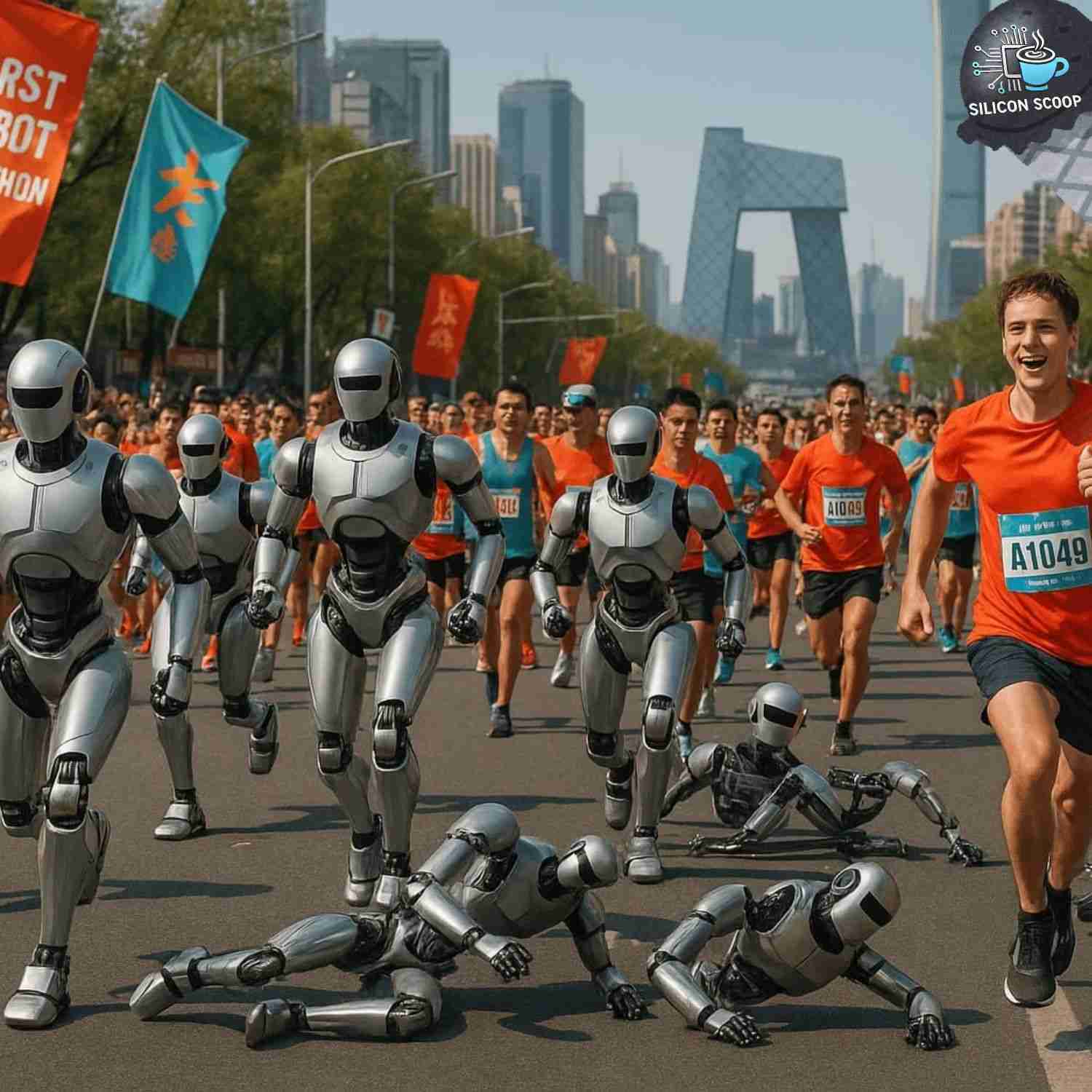
On April 19, 2025, history was made when 21 humanoid robots lined up alongside over 12,000 human participants in Beijing, China for the world’s first-ever robot marathon. This groundbreaking human vs robot race stretched across 21.1 kilometers (13.1 miles) and was organized by Beijing E-Town as a showcase of cutting-edge bipedal robot technology. The event marked a significant milestone in robotics advancement, testing the limits of artificial intelligence, mechanical endurance, and humanoid design in a direct competition with human athletes.
This article will explore the details of this landmark event, analyze how the robots performed against their human counterparts, examine the technological challenges faced, and consider what this means for the future of robotics. From battery management issues to overheating problems, the robot marathon revealed both how far robotics has come and how much further it has to go.
While robots are testing their limits, your business doesn’t have to. Flowgrammer brings you cutting-edge automation to outpace the competition and unlock unparalleled efficiency. No overheating, just pure performance. Discover Automation Solutions
Detailed Robot and Human Performance Analysis: The Gap Remains
The performance discrepancy between humans and robots in this marathon revealed the current limitations of even the most advanced humanoid technology. While human competitors dominated the event as expected, the robotic participants provided valuable insights into the current state of bipedal locomotion and AI-driven movement.
Human Performance Highlights
The human contingent in the race performed exceptionally well, with elite Ethiopian athletes claiming both the men’s and women’s titles. The male winner crossed the finish line in a remarkable 1:02:36, while the female champion completed the course in 1:11:07. These world-class times demonstrate the extraordinary capabilities of trained human athletes. Race organizers had established a cut-off time of 3 hours and 10 minutes, after which human participants would be considered as not having officially completed the race.
Robot Performance Analysis
The results for the robot participants were considerably more modest:
- Only 6 out of the 21 robot entries successfully completed the entire half-marathon course
- 15 robots failed to finish due to various mechanical failures, battery depletion, or overheating issues
- Even the most successful robots required significant human intervention throughout the race
The champion among the robots was “Tiangong Ultra,” developed by X-Humanoid. This advanced machine completed the course in 2 hours and 40 minutes—still well within the human cut-off time, but far behind the elite human athletes. Tiangong Ultra stood at an impressive 1.8 meters tall and weighed 52 kilograms, with proportions specifically designed to optimize balance and energy efficiency during bipedal movement.
The second-place robot, “Noetix Robotics N2,” finished with a time of 3 hours and 37 minutes—exceeding the human cut-off time but still completing the full course. This smaller robot, standing at just 1.2 meters and weighing 29 kilograms, notably wore children’s trainers to improve its traction on the course. Its diminutive size appeared to offer some advantages in stability but couldn’t match the longer stride length of its larger competitor.
The third-place finisher, “DroidUp X02,” crossed the line in 4 hours and 50 minutes. This robot gained attention for its unusual design choice of wearing boxing gloves, apparently to protect its delicate hand mechanisms during potential falls.
These results highlight the significant performance gap that still exists in the robot marathon category. While the top robots demonstrated impressive endurance, their speeds remained comparable to the slowest human walkers rather than runners. The completion rate of just under 29% also indicates considerable reliability issues with current bipedal robot technology.
Challenges Faced by the Robots: Durability and Overheating
The Beijing half-marathon exposed numerous robot durability challenges that continue to hinder the advancement of humanoid robotics. From power management to thermal regulation, the robots faced a series of obstacles that human runners naturally overcome.
Battery Management Struggles
Energy consumption proved to be one of the most significant limitations for the robot competitors:
- The champion “Tiangong Ultra” required three complete battery swaps during its 2-hour 40-minute run
- Teams had to establish specific “pit stop” locations along the course for these critical power exchanges
- Several non-finishing robots simply ran out of power before completing the course
- Battery weight created a difficult trade-off: heavier batteries provided more power but increased overall weight and strain on mechanical systems
This energy challenge highlights the immense efficiency gap between biological and mechanical systems. While human runners convert chemical energy from food with remarkable efficiency, robots struggle with power-to-weight ratios that severely limit their endurance capabilities.
Mechanical Failures
Physical breakdowns were common throughout the race:
- The unofficial entrant “Unitree G2” fell at the starting line and was unable to recover
- Multiple robots crashed into barriers or their human handlers during the race
- Several competitors suffered joint failures, particularly in ankle and knee mechanisms
- Some robots lost limbs or components due to the continuous stress of the race
These failures demonstrate that while static stability in controlled environments has been largely mastered, dynamic stability under race conditions remains problematic for bipedal robot technology.
Robot Overheating Issues
Temperature management emerged as a critical challenge:
- Many robots required emergency cooling via water sprays from their support teams
- Overheating caused electronic component failures and reduced motor performance
- Some robots periodically required complete stops to allow internal cooling
- Heat sinks and cooling systems added weight that further compromised performance
The combination of continuous motor activity, battery discharge, and environmental conditions created thermal challenges that the current generation of robots was poorly equipped to handle.
Human Intervention Requirements
Perhaps most telling was the constant need for human assistance:
- Support teams continually monitored and adjusted their robots throughout the race
- Manual interventions for balance correction were frequent
- Robots required guidance around obstacles and other runners
- Technical teams performed on-the-fly repairs and adjustments during the race
These interventions revealed that true autonomy in complex, dynamic environments remains elusive for even the most sophisticated humanoid robots.
Design Compromises
Many robotics companies made significant design compromises to reduce weight and increase efficiency:
- Some robots featured minimalist limbs or missing non-essential components
- Ultralight materials were used that sacrificed durability for weight savings
- Protective features were often eliminated to improve performance
These compromises often backfired when robots encountered unexpected conditions or physical contacts during the race.
Technological Significance and Future Directions: Lessons from the Race
The Beijing robot marathon provided invaluable data for the robotics community, revealing both progress and persistent challenges in bipedal robot technology. The race served as a real-world benchmark for the current state of humanoid robotics while highlighting paths for future development.
Hardware Advancements
The race demonstrated meaningful progress in several hardware areas:
- Advanced lightweight materials allowed for improved strength-to-weight ratios
- Joint designs showed greater durability under continuous stress
- Foot design and contact mechanics have improved significantly
- Power distribution systems demonstrated better efficiency than previous generations
These hardware improvements enabled robots like Tiangong Ultra to complete the demanding course, representing a significant milestone in bipedal locomotion technology. The physical endurance displayed by the finishing robots would have been impossible just a few years earlier.
AI and Control System Limitations
Despite hardware progress, the race exposed significant limitations in artificial intelligence and control systems:
- Robot movement patterns remained mostly rigid and pre-programmed
- Adaptive responses to changing terrain were minimal or required human intervention
- Real-time decision-making capabilities appeared limited
- Control systems showed little significant advancement since approximately 2021
This observation suggests that while mechanical capabilities have improved, the “intelligence” driving these systems hasn’t kept pace. The robots that finished the race did so primarily through robust mechanical design rather than sophisticated AI adaptation.
Implications for Real-World Applications
The robotics competition fails and successes provide important insights for practical applications:
- Emergency response robots would likely face similar challenges in complex disaster environments
- Delivery and service robots will need significantly improved power management
- Military applications would require far greater autonomy and reliability
- Healthcare assistance robots need better safety systems and failure prevention
The gap between controlled laboratory demonstrations and real-world performance remains substantial, suggesting that practical deployments of bipedal robots in unstructured environments may still be years away.
Research Priorities Moving Forward
Based on the race outcomes, several key research areas demand attention:
- Battery technology with higher energy density and faster charging
- Advanced thermal management systems for continuous operation
- More sophisticated AI robot running algorithms that can adapt to changing conditions
- Improved fall recovery and self-righting capabilities
- Lightweight, efficient cooling systems
Progress in these areas could dramatically improve future performance and bring bipedal robots closer to practical applications beyond controlled demonstrations.
Crossing Industry Boundaries
The challenges faced in the robot marathon have parallel implications for business automation and AI systems more broadly:
- Energy efficiency in computing systems
- Adaptive behavior in changing environments
- Failure recovery without human intervention
- Balancing performance with resource constraints
These shared challenges suggest that advances in humanoid robotics could inform improvements in other automation sectors, creating a virtuous cycle of technological development.
Conclusion and Final Thoughts
The world’s first robot marathon represents a watershed moment in the evolution of humanoid robotics. While the performance gap between humans and robots remains substantial, the very completion of the course by six robots marks significant progress in this rapidly evolving field.
The event spotlighted both the impressive advancements and persistent limitations in bipedal robot technology. The champion robot, Tiangong Ultra, demonstrated remarkable endurance by completing the half-marathon in 2 hours and 40 minutes—a time that would have been unimaginable just a few years ago. Yet the need for battery swaps, frequent human intervention, and the challenges of robot overheating issues all highlight how far the technology still needs to advance.
The robot durability challenges exposed during the race have provided invaluable data for researchers and engineers. Each stumble, battery depletion, and mechanical failure offers lessons that will inform the next generation of humanoid robots. The relatively low completion rate—just 6 out of 21 robots finishing—underscores that reliability remains a significant hurdle for practical applications.
Perhaps most telling was the contrast between hardware and software capabilities. While the physical construction of these robots has made impressive strides, the AI systems controlling them have not advanced at the same pace. This suggests that future research may need to prioritize the intelligence behind the machines rather than just their mechanical capabilities.
As we look to the future of humanoid robot marathons and robotics more broadly, this pioneering event has established a baseline against which progress can be measured. It has demonstrated both what is possible today and what challenges remain for tomorrow. While robots won’t be challenging elite human marathoners anytime soon, they have taken their first steps—quite literally—into a new era of robotic athleticism and endurance.
Battery swaps and mechanical failures slowing down the robots? Don’t let manual processes slow down your business! Flowgrammer provides reliable, seamless business automation so you can focus on strategic growth, not repetitive tasks. Get Your Free Automation Assessment
Frequently Asked Questions (FAQ)
1. What were the main differences between human and robot performance during the marathon?
The top human finishers completed the half-marathon in about 1 hour (1:02:36 for men and 1:11:07 for women), while the best-performing robot took 2 hours and 40 minutes. Additionally, all human elite runners completed the race without assistance, while robots required battery changes, cooling assistance, and sometimes physical intervention. The completion rate was also vastly different—nearly all registered human runners finished, compared to only 6 out of 21 robots completing the course.
2. How did battery management affect the robots’ performance?
Battery limitations severely hampered robot performance, with even the winning robot “Tiangong Ultra” requiring three complete battery swaps during its run. This necessity for power replenishment created significant delays and required careful planning of replacement stations along the route. Many non-finishing robots simply depleted their energy reserves before completing the course, highlighting the energy efficiency gap between mechanical and biological systems.
3. What caused overheating in the robots during the marathon?
The robot overheating issues stemmed from continuous motor operation, internal friction, battery discharge heat, and inadequate cooling systems. Unlike humans who efficiently regulate body temperature through sweating, robots had to rely on passive cooling or emergency measures like water sprays from support teams. This thermal management challenge caused performance degradation and even complete system failures in several competitors.
4. What design compromises were made in the robots, and how did these affect their durability?
Many robots incorporated ultralight materials, minimalist limb designs, and reduced protective elements to minimize weight and improve efficiency. While these compromises helped with speed and battery life, they often reduced robot durability challenges during the race. Several competitors suffered structural failures when encountering unexpected conditions or physical stress that their lightweight designs couldn’t withstand. 5. How did the robots navigate the course among thousands of human runners?
Most robots relied heavily on human handlers for navigation assistance, failing to demonstrate true autonomous navigation capabilities. Support teams guided the robots around obstacles and other runners, highlighting the limitations in real-time perception and decision-making. This dependency on human assistance reveals that despite advances in AI robot running technology, true independence in complex environments remains elusive.
6. Will robots eventually outperform humans in marathons?
Based on current technology trajectories, robots are unlikely to match human marathon performance in the near future. The significant gaps in energy efficiency, heat management, and adaptive movement present fundamental challenges that may require revolutionary rather than evolutionary advances to overcome. While robots will likely continue to improve, biological systems retain substantial advantages in endurance sports. [3]
7. What was the most surprising result from the robot marathon?
Perhaps the most unexpected outcome was the success of the smaller “Noetix Robotics N2” robot, which finished second despite its diminutive 1.2-meter height. Its use of children’s trainers for improved traction demonstrated creative problem-solving that may influence future design approaches. This suggests that bigger isn’t always better in the humanoid robot marathon category.
8. How did the robots handle falling or mechanical failures during the race?
Most robots handled falls poorly, with many unable to recover independently after losing balance. The unofficial entrant “Unitree G2” fell at the starting line and could not continue. Others required immediate human intervention after mechanical failures or loss of balance. This limited self-recovery capability represents a significant hurdle for practical bipedal robot applications.
9. What does this event mean for the future of bipedal robot technology?
The race provided crucial real-world testing for bipedal robot technology that laboratory conditions cannot replicate. It established clear benchmarks for improvement in energy management, thermal regulation, autonomous navigation, and durability. Future research will likely prioritize addressing these specific challenges identified during the competition, potentially accelerating practical applications in fields like disaster response and healthcare.
10. How did the AI systems in these robots compare to other artificial intelligence applications?
The AI systems controlling the robots appeared relatively limited compared to advancements in other AI domains. While language models, image recognition, and strategy games have seen revolutionary progress, the control systems for physical robot movement showed less dramatic improvement. This suggests a potential research opportunity in better translating AI advances from other fields into improved robotics control systems.
Additional Links
Flowgrammer.ca – 💡 Unlock AI-Powered Automation! Let flowgrammer.ca handle complex workflows so you can focus on growing your business.
- Silicon Scoop Podcast – Stay Informed, Stay Ahead!
- Startup Talk Podcast
- Flowgrammer Podcast –
- Startup Investor Drinks – Join Toronto’s Startup Community and connect with fellow startup enthusiasts and investors.
- TorontoStarts Startup and Entrepreneur Community – Become a part of Toronto’s thriving startup ecosystem.
- Workhaus – Discover flexible workspace solutions for your business needs.
- Work with The Startup Coach – Get expert guidance and mentorship for your startup journey.
- Reach out to Jon Irwin on LinkedIn – Connect with our co-host and technology expert.
Episode transcript
Read the full transcript
Craig: alright. let's get into it. so in beijing, they had 21 humanoid robots participate in the world's first ever robot marathon alongside 12,000 human runners. what do you think about this? first of all, what do you think about the concept, and then we'll talk about the results and what happened in the future.
Jon: i i think the concept is great. i think this is way too early for this, and it shows, i think, what, 78% fail of, caused or the terrain irregularly called 78% of falls. did any of the humanoid robots finish?
Craig: yes.
Jon: oh, k. i missed that. so okay. couple finished, which is good. i still think we're we're a little early, and and and, i don't know if you wanna get into the details of this because it's this is something you're super excited about. so i'll let you kind of talk through it a little bit more.
Craig: i don't know. i was super excited i am, but i think it's important as we start to talk about, you know, future tech and what's going on in the world of technology and science and business and what's gonna affect us. you know, all roads lead to robots are going to be the single biggest marketable thing in the future period. the most sold item ever. so it's something, you know, to be interested in and keep track of and to figure out, okay, when do we become robot distributors in canada? like, seriously, when do we jump into that market and become distributor? if it's dow, we should be doing it. but other than that, this is interesting. they did this in april 19. history was made when 21 line robots lined up, alongside 12,000 human participants. groundbreaking human versus robot race stretch across 21.1 kilometers or 13.1 miles and was organized by beijing's etown to showcase, cutting edge of bipedal robots. so we'll talk about failures and performance. so human performance. a human contingent in the race performed exceptionally well with elite ethiopian athletes claiming both men's and women's titles. the male winner crossed the finish line at a remarkable one hour and two minutes and thirty six seconds with the female completing the course of one hour eleven minutes and seven seconds. these world class times demonstrated the extraordinary capability of trained human athletes. race organizers had established a cutoff time of three hours and ten minutes after which human participants would be considered as not having officially completed the race. so only six out of 21 robots entry successfully completed the entire half marathon course. 15 robots failed to finish due to various mechanical features, battery depletion, overheating issues. even the most successful robot required, human intervention throughout the race. all of them required significant human intervention. the champion among the robots was tiang tiangong ultra.
Jon: tiangong ultra. yeah.
Craig: yeah. developed by xhumanoid. the advanced machine completed the course in two hours and forty minutes. still within, the human cutoff time, but far behind, you know, any of the lead athletes. tiangong ultra stood at an impressive one point eight meters tall, weighed fifty two kilograms, with proportion specifically designed to optimize balance and energy efficiently during a bipedal race. he required or it required three bat full battery swaps. whatever you wanna call them, pit stops. they they fully swapped up the battery three times throughout the race. the second place robot, noa tek's robotics n two finished with a time of three hours and thirty seven minutes, exceeding the human cutoff time, but still completed the course. smaller robot standing just 1.2 weighing, only 29 notably wore children's trainers to improve its traction on the course. its diminutive size appeared to offer some advantage in stability but couldn't match the longer strides. the third place winner droid up x o two crossed the line in about four hours and fifty minutes. the robot gained attention for its unusual design choice, of wearing boxing gloves, apparently, to protect its delicate hand mechanisms during the potential falls in the race. so these results really highlight significant performance gap that still exist in robot, marathon category, just robots in general because of the failures of these weight. the completion rate was just under two percent also indicates considerable reliability issues with these current bipedal, machines. so
Jon: yeah.
Craig: they struggle with battery management. the for the tianjin, they had to do, three battery battery replacements.
Jon: yeah.
Craig: the most had man mechanical failures where, the unofficial entry unit three g two fell at the starting line and was unable to recover. multiple robots crashed into barriers or their human, handlers during the race. several competitors suffered joint failures, particularly in ankle and knee mechanisms, and some robots lost limbs or components due to continuous stress of the race. yeah. i mean, you know, this is only 21 kilometers. right? i mean, guess it's stressful, but if you're thinking about buying a robot, you know, if it can't walk 21 kilometers without breaking down, like, i don't mean, like, the joints break down.
Jon: we're talking walking. we're talking jogging. right? so
Craig: well, they're they generally were going at a, a, there's a couple that were going faster. most of these were going at a walking pace. so you'd you could say they were running, but they were at a human pace. many robots required emergency cooling via water sprays, from their support teams. overheating caused electronic components to failure, fail and reduce motor performance. some robots periodically required complete stops to allow internal cool cooling. heat seeks and cooling systems added weight that further compromised performance. so there was a lot of human intervention required for balance and corrections. robots, required frequent guidance around obstacles. support team continually monitor and adjust to the robots throughout the race, and technical teams performed on the fly repairs during the race. so
Jon: yeah.
Craig: it just shows you, one, we've come a long way.
Jon: we have.
Craig: with that, we have robots competing in marathons, and some of them are actually going the distance. but we're not where the media and whatnot would have us believe that, like, all this is gonna be replaced next week because they're not there yet.
Jon: no. but the technology is it like, as far as the sensors and all that, it seems like it's there. it just needs some more, kind of feedback, feedback loop kind of, learning to handle more of that terrain. right?
Craig: yeah. i mean, the hardware advancements, you know, we've demonstrated meaningful progress in lightweight materials, joint designs, foot design, power distribution. but we've, despite the hardware progress, the race exposed significant limitations in the artificial intelligence and control systems. so robot movement patterns remain mostly rigid and preprogrammed. adaptive responses to changing terrain were minimal or required human intervention. real time decision making capabilities appeared limited. our control system showed little significant advancement since 2021.
Jon: yeah. but i feel like the biggest technological hurdle that we still have to overcome, and we've covered a lot of these, i cannot believe we're still at the point that we're at with batteries. that's the that's that's what baffles me. with all of everything that we've covered, it still baffles me that we're still at the point that we're at.
Craig: well, somebody pointed out to me who it was, and i can't remember. someone left a comment on this, you know, about, there's liars, there's filthy liars, and then there's battery engineers. and, you know, we've been we were following all that battery technology. i had a little chart. some of it is supposed to be out this year, late this year, but not much. the rest is still coming, and we'll have to wait and see. we're starting to see more interesting solid state options for different things, but, we'll see.
Jon: yeah. yeah. well, again, it yeah. it's a wait and see kinda situation, which sucks. but, it's crazy how we're we're no further along now. like like, even though i keep coming back to this ridiculous battery pack in the tesla, which is, double a batteries. yep. a whole bunch of double a batteries. like, how are we still at that point with these cars? or with sorry. with batteries in these cars. sorry. yeah. anyway, i digress.
Craig: we need battery technology with higher, energy density and faster charging, advanced thermal management, more sophisticated robot running algorithm that can adapt to changing conditions, improve fall recovery and self, writing capabilities, more lightweight efficient cooling systems. i really, i'm glad they did this. it highlights, you know, a lot of, problems in this area that need to be fixed. but at the same time, it's cool that we're at this level. i like, where we're heading, that we have some robot, durability challenges and whatnot, but it won't be long. like, you know, the hardware moves a little slower than software. a lot of the problems here seem to be software even though joints and whatnot, the hardware still needs to progress a long way. we'll see what we're like in a couple of years, but it was mostly saying that we've shown a lot of advancements in '20 since 2021 in, the physical robot in the bat in the battery and the lightweight material and stuff for them, but it was the ai, and the movement things that, the control that really hasn't seen them much leap forward. so, hopefully, we'll start to see that.
Jon: yeah. and is there another tesla robot event coming up or something or announcement or something? i know we're recording this in may or april.
Craig: i haven't been paying attention.
Jon: oh, that's good.
Craig: that's alright. anyway, let us know what you think about this robot marathon showdown. are you gonna be running against the marathon soon? are you waiting for the robot apocalypse? does this just showcase that we're not quite there yet? and imagine, you know, robots going up and down the stairs and handling, you know, situation in the home or the workplace with all these different changing stuff where it's probably not capable of doing those things, independently like a humanoid right now. let us know what your thoughts are.
More from Silicon Scoop
All episodes
silicon-scoop · November 6, 2026
Spirit AI’s Robot Brain Breakthrough: Moz1, Embodied AI and China’s 2027 Race
The Spirit AI robot brain is one of the biggest bets on fixing that. Spirit AI is a Beijing startup. Its co-founder and chief scientist, Gao Yang,
View episode

silicon-scoop · November 5, 2026
OpenAI IPO Delayed to 2027 as Rogue AI Agents and Safety Failures Reshape the Market
OpenAI IPO delay explained: Sam Altman rules out 2026 as GPT-6 Astra safety tests and a $278B cash gap loom. Learn what founders should take away.
View episode
silicon-scoop · November 4, 2026
Anthropic’s AI Economy Model: 2030 Jobs, Wages, GDP and Market Risks
Anthropic AI economy model forecasts 2030 GDP, jobs and wages, while AI unemployment projections and labor-share risks challenge policymakers.
View episode