
Conscious Perception: The Role of the Thalamus in Awakening Awareness
Exploring Conscious Perception: The Role of the Thalamus in Awakening Awareness https://torontostarts.com/2025/06/06/exploring-conscious-perception-thalamus/ Apple -> https://podcasts.apple.com/us/podcast/flowgrammer-podcast/id1804155588 Spotify -> https://open.spotify.com/show/0wv3feR00iaVpE8zn7niNf Flowgrammer.ca -> https://flowgrammer.ca/ AI News and Resources -> https://flowgrammer.ca/resources/ Unlock Hidden Business Potential 🧠 Just as researchers are unlocking the secrets of the brain, Flowgrammer can unlock hidden potential within your business. Automate workflows, eliminate bottlenecks, and see significant improvements. Let's optimize your business today! Discover Automation Options https://flowgrammer.ca/ Startup Investor Drinks Toronto - https://startupdrinksto.com/ Toronto’s Startup Community - https://torontostarts.com/ Silicon Scoop Silicon Scoop Podcast - https://torontostarts.com/silicon-scoop/ Apple: https://podcasts.apple.com/us/podcast/silicon-scoop/id1758711826 Spotify: https://open.spotify.com/show/5bAzF0MwV6TtLhJAhvHayI YouTube: https://www.youtube.com/playlist?list=PLj4v-RoA7A-gT62vrEYqh1zCv-0Hj-o5J Startup Talk Startup Talk Podcast -> https://torontostarts.com/startup-talk-toronto-startup-podcast/ Apple -> https://podcasts.apple.com/us/podcast/startup-talk/id1763804003 Spotify -> https://open.spotify.com/show/1siJMILILidHAiAsrX2VBU YouTube: https://youtube.com/playlist?list=PLj4v-RoA7A-jxV5FHs5e61oIsuvUJYmT_&si=LYegRe5GYLKNQ7xL
With Craig Major and Jon Irwin
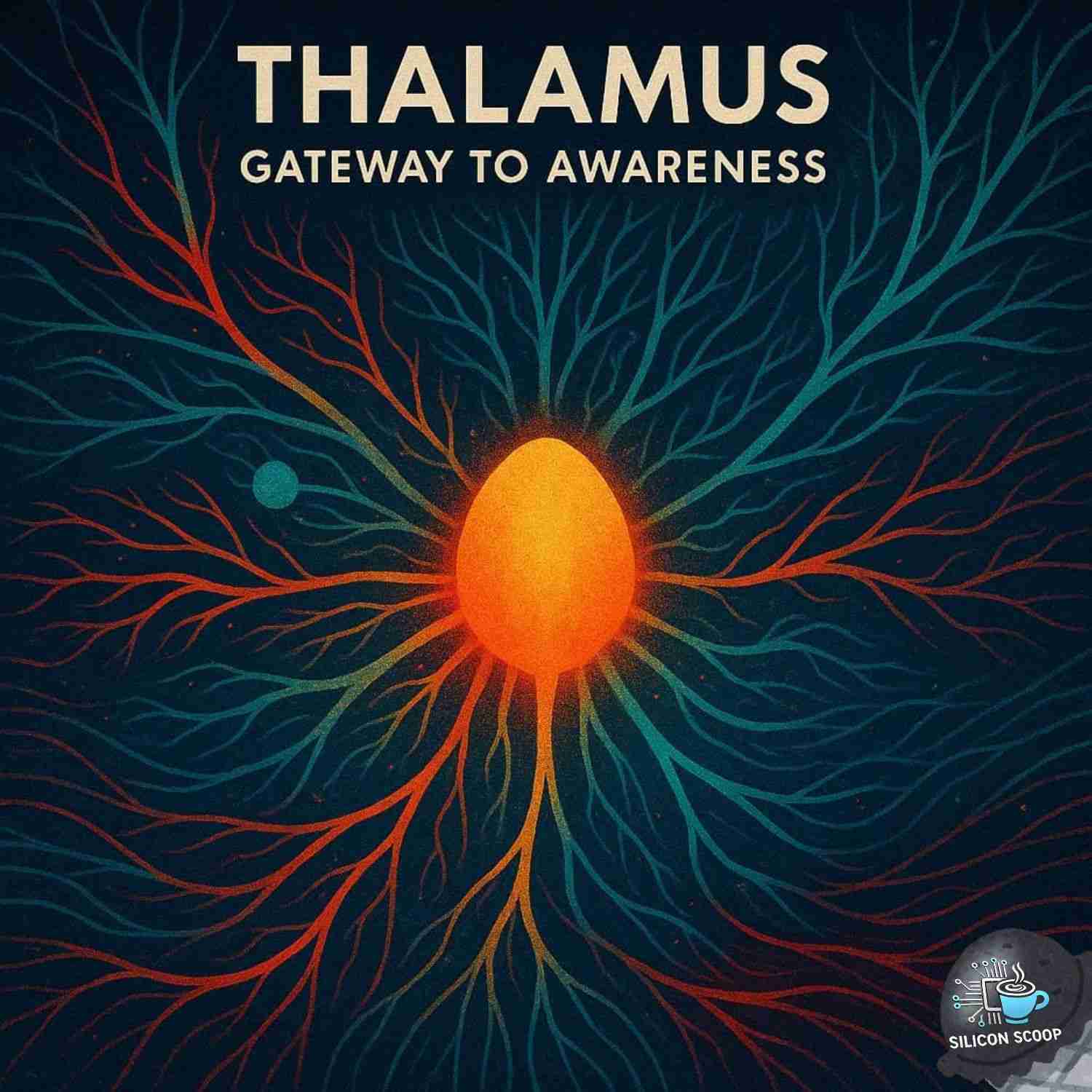
Conscious Perception: The Thalamus as the Gateway to Awareness
Estimated reading time: 15 minutes
Key Takeaways
- The thalamus acts as a critical gateway that filters sensory signals and determines what enters our conscious awareness.
- Research reveals that the intralaminar and medial thalamic nuclei are early activators in conscious perception.
- Thalamic activation consistently precedes cortical firing during moments of awareness, suggesting the thalamus initiates conscious perception.
- The findings challenge traditional views of consciousness that focus on the cortical regions alone.
Table of contents
Introduction
Conscious perception is the fascinating process by which our brains filter and process sensory information into awareness. It’s the subjective experience that allows us to distinguish between what we consciously notice and what we ignore in our environment. While many assume that consciousness primarily resides in the outer layers of the brain, groundbreaking research is revealing that a deep brain structure called the thalamus plays a critical role in determining what enters our conscious awareness.
The thalamus acts as a crucial gateway, filtering incoming sensory signals and determining which information reaches the conscious mind. This relationship between thalamus and consciousness fundamentally shapes our brain activity and awareness, yet has remained somewhat mysterious until recently.
Exciting new research led by Mingsha Zhang at Beijing Normal University has shed light on the early neural signals within the thalamus that precede awareness. These studies have revealed that specific regions called the intralaminar and medial thalamic nuclei act as early activators in conscious perception, challenging traditional views of how consciousness emerges.
As we delve deeper into the neural mechanisms and research insights, we’ll explore how this small but mighty brain structure may hold the key to understanding one of neuroscience’s greatest mysteries: how consciousness arises.
Overview of Thalamic Functions in Conscious Perception
The thalamus is a small, egg-shaped structure located deep within the brain that serves as much more than a simple relay station. Often described as the brain’s “switchboard,” this structure plays a sophisticated role in determining which sensory information reaches our conscious awareness and which does not.
Structure and Active Filtering
Unlike earlier views that portrayed the thalamus as a passive sensor, current research reveals it functions as an active filter that determines which sensory inputs deserve attention and which should be ignored. This filtering mechanism is essential for brain activity and awareness, as it prevents our consciousness from being overwhelmed by the constant barrage of sensory input.
The thalamus contains multiple nuclei (clusters of neurons) that process different types of information:
- Sensory nuclei handle visual, auditory, and tactile information
- Motor nuclei coordinate movement-related signals
- Limbic nuclei process emotional content
Initiating Conscious Awareness
Recent studies have transformed our understanding of how conscious thought processes begin. Research consistently shows that thalamic firing often precedes cortical activity during moments of awareness, suggesting that the thalamus doesn’t just relay information but actually initiates the signals that lead to conscious perception.
This revelation challenges the traditional cortical-centric model of consciousness, which assumed awareness primarily emerged from the cortex. Instead, the neuroscience of conscious perception now recognizes that consciousness may begin deeper in the brain.
Particularly important in this process are the intralaminar and medial thalamic nuclei, which research has identified as early activators in conscious perception. These specific regions appear to trigger the cascade of neural activity that ultimately results in awareness.
Detailed Research Insights and Experimental Methodologies
Groundbreaking Study Overview
The innovative research led by Mingsha Zhang at Beijing Normal University has provided unprecedented insights into the neural basis of conscious perception. This study took a unique approach by working with episodic headache patients who had depth electrodes implanted as part of their therapeutic treatment. This rare opportunity allowed researchers to directly measure neural activity from deep brain structures that are typically inaccessible in human studies.
Participants in the study performed a visual detection task where they watched for icon flashes on a screen. The task was carefully calibrated so that conscious perception occurred in approximately 50% of trials – sometimes participants consciously saw the flashes, and other times they missed them, despite the physical stimulus being identical. This design created the perfect conditions to compare neural activity between conscious and unconscious processing.
Methodological Approach
The researchers employed a sophisticated experimental approach:
- Simultaneous neural recordings were taken from both the thalamus and cortex during task performance
- Neural signals were precisely time-locked to stimulus presentation
- Advanced analysis techniques compared activity patterns between trials where conscious perception occurred versus when it did not
- Statistical methods isolated the neural signatures specific to conscious awareness
This methodology allowed for an unprecedented look at the temporal relationship between thalamic and cortical activity during the emergence of conscious perception.
Key Research Findings
The most striking discovery was that thalamic activation consistently preceded cortical firing during moments of conscious perception. When participants reported seeing the visual stimulus, researchers observed a distinct pattern: neurons in the thalamus fired first, followed by activation in the cortex. This temporal sequence establishes the thalamus as a true “gateway” to awareness, triggering the processes that lead to conscious experience.
In contrast, during trials where participants failed to consciously perceive the stimulus, researchers observed asynchronous firing between the thalamus and cortex. This finding suggests that successful communication between these brain regions is essential for conscious perception to occur.
The study also revealed fascinating “loop dynamics” where synchronized signals between the thalamus and prefrontal cortex (PFC) create a feedback cycle. The prefrontal cortex activity doesn’t just passively receive information from the thalamus but engages in a dynamic conversation that sustains and shapes conscious awareness. These findings challenge traditional cortical-centric theories of consciousness that overlooked the critical role of subcortical structures.
Several important patterns emerged from the data:
- Thalamic regions, particularly the intralaminar and medial nuclei, initiate conscious awareness through synchronized signals to the PFC
- The strength of thalamus-cortex synchronization directly correlates with the clarity of conscious perception
- When thalamic activation fails to properly synchronize with the cortex, conscious perception does not occur
Methodological Considerations and Future Directions
While groundbreaking, the research has faced some methodological critiques. Some scientists question whether the experimental task fully captured “conscious experience” as opposed to merely measuring attentional processes. The distinction between attention and consciousness remains a complex issue in neuroscience.
To address these concerns, the research team has planned further validation studies in both human subjects and macaque monkeys. These follow-up investigations will employ more diverse paradigms to distinguish between attention and consciousness while maintaining the ability to record from deep brain structures.
Neural Mechanisms – Thalamus and Prefrontal Cortex Interaction
The Dynamic Loop of Consciousness
The evidence from recent research reveals a sophisticated relationship between the thalamus and prefrontal cortex that goes far beyond simple signal transmission. This relationship creates what neuroscientists call “loop dynamics” – a cyclical feedback system between subcortical (thalamus) and cortical (PFC) structures that contributes to sustained awareness.
This neural conversation forms the foundation of the conscious thought process. When functioning optimally, the thalamus not only activates early but works in harmony with the prefrontal cortex through continuous information exchange. This bidirectional communication allows for:
- Initial filtering of important sensory information by the thalamus
- Elaboration and contextual processing by the prefrontal cortex
- Feedback from the cortex that further modulates thalamic filtering
- Sustained activation patterns that maintain awareness over time
These interactions create the rich tapestry of brain activity and awareness that we experience as consciousness.
Temporal Dynamics in Neural Firing
One of the most compelling findings from the research is the precise timing of neural activity during conscious perception. Recording techniques with millisecond-level precision have shown that thalamic firing consistently occurs before cortical firing during awareness, emphasizing the thalamus’s role as an initiator in conscious perception.
The temporal sequence follows a clear pattern:
- Sensory information reaches the thalamus
- The thalamic nuclei activate, with particularly strong responses in the intralaminar and medial regions
- This activation triggers a cascade of neural firing that travels to the prefrontal cortex
- The prefrontal cortex activity then expands the processing to other cortical regions
- The initial thalamic signal continues to modulate ongoing cortical activity
This temporal comparison shows that the thalamus isn’t merely passing information along but actually initiating the neural symphony that produces conscious awareness.
Challenging Classical Models of Consciousness
These findings represent a significant shift in how we understand consciousness. For decades, the neuroscience of conscious perception focused almost exclusively on cortical networks, particularly the prefrontal cortex and parietal regions. The thalamus was often relegated to the role of a simple relay station.
The new research compels us to revise this model by showing that:
- Subcortical regions like the thalamus play an active, initiating role in consciousness
- The thalamus doesn’t just relay information but actively decides what information becomes conscious
- Thalamus-cortex interactions form a unified system rather than a hierarchical one
- Consciousness emerges from the dynamic interaction between brain regions rather than from any single area
This thalamus and consciousness relationship represents an important evolution in our understanding of how awareness emerges in the brain.
Implications, Broader Impact, and Future Directions
Reconceptualizing Consciousness
The recognition of the thalamus as a gatekeeper of conscious perception has profound implications for neuroscience theory. By validating models that emphasize subcortical-cortical interactions, this research challenges us to move beyond cortical-centric views of consciousness.
This shift in perspective opens new avenues for understanding consciousness as an emergent property of dynamic interactions between different brain systems rather than as a product of a single brain region. Much like how a symphony emerges from the coordinated efforts of many instruments, consciousness may arise from the precisely timed interactions between the thalamus, prefrontal cortex, and other brain regions.
Clinical Applications and Therapeutic Potential
The implications of this research extend far beyond theoretical interest, offering concrete potential for clinical applications:
- New diagnostic tools for disorders of consciousness (like minimally conscious states or persistent vegetative states) could focus on thalamic function and thalamus-cortex connectivity
- Treatment approaches for consciousness disorders might target thalamic nuclei directly through electrical or pharmacological interventions
- Anesthesia protocols could be refined by directly monitoring and modulating thalamic activity
- Recovery from brain injury might be better predicted by assessing thalamic function
Ming-sha Zhang’s neuroscience research provides a foundation for these clinical developments by identifying specific thalamic regions and activation patterns associated with conscious perception.
Future Research Directions
This groundbreaking work opens up numerous paths for future investigation:
- Further validation of the thalamus and consciousness relationship across different sensory modalities (beyond vision)
- Exploration of how thalamic function relates to different aspects of consciousness (content awareness versus self-awareness)
- Investigation of how thalamic dysfunction contributes to specific consciousness disorders
- Development of non-invasive methods to modulate thalamic function for therapeutic purposes
- Integration of these findings with other prominent theories of consciousness
The research also validates previous animal studies on thalamus-cortex projections in awareness, building a bridge between findings in rodent models and human consciousness. This convergence of evidence across species strengthens the case for the thalamus’s central role.
As technology continues to improve, allowing for more precise measurements and interventions in deep brain structures, our understanding of conscious perception will continue to evolve. The thalamus, once overlooked in consciousness studies, now stands at the forefront of this exciting frontier in neuroscience.
Conclusion
Our exploration of conscious perception has revealed the thalamus as much more than a simple relay station – it functions as a true gateway to awareness, initiating and modulating the neural processes that give rise to consciousness. The research led by Mingsha Zhang and others has transformed our understanding of how the brain generates conscious experience.
We’ve seen how the intralaminar and medial thalamic nuclei act as early activators in the process of conscious perception, firing before cortical regions become active. This temporal relationship establishes the thalamus as an initiator rather than merely a participant in consciousness.
The sophisticated loop between the thalamus and prefrontal cortex creates a dynamic system that filters sensory data, determining what enters awareness and what remains below the threshold of consciousness. This thalamus-PFC relationship represents a fundamental neural mechanism underlying our subjective experience of the world.
These findings have profound implications for neuroscience paradigms, clinical applications, and our philosophical understanding of consciousness. By recognizing the central role of the thalamus in conscious perception, we open new avenues for addressing disorders of consciousness, improving anesthetic techniques, and developing targeted neurological interventions.
As research continues to advance, we can expect even deeper insights into the neural basis of awareness. The thalamus, once overshadowed by cortical studies, now stands revealed as a crucial player in the emergence of our conscious experience.
Frequently Asked Questions
1. What exactly is conscious perception and how does the thalamus contribute to it?
Conscious perception is the subjective awareness of sensory information – the experience of seeing, hearing, or feeling something and being aware of that experience. The thalamus contributes by acting as a filter and gateway, with research showing that intralaminar and medial thalamic nuclei activate early in the process. These nuclei determine which sensory signals are important enough to reach conscious awareness and which should remain unnoticed, essentially deciding what enters our conscious experience.
2. How do the thalamus and prefrontal cortex interact during awareness?
The thalamus and prefrontal cortex engage in a dynamic feedback loop during conscious awareness. Research shows that thalamic neurons fire first, sending signals to the prefrontal cortex. The prefrontal cortex then processes this information and sends feedback to the thalamus, creating a continuous conversation. This loop sustains awareness and allows for more complex processing of information. The timing is crucial – thalamic firing consistently precedes cortical activation during conscious perception, while asynchronous firing between these regions results in information not reaching awareness.
3. How does this research change our understanding of consciousness?
This research fundamentally shifts our understanding from a cortical-centric model (where the cerebral cortex was considered the primary source of consciousness) to a model that recognizes the critical role of subcortical structures like the thalamus. It suggests consciousness emerges from the interaction between brain regions rather than from any single area, with the thalamus playing a crucial initiating role. This challenges decades of neuroscientific thinking and opens new avenues for understanding how awareness emerges in the brain.
4. Could this research help people with disorders of consciousness?
Yes, this research holds significant promise for helping people with disorders of consciousness such as coma, minimally conscious states, or locked-in syndrome. By understanding the thalamus’s role in consciousness, researchers may develop new diagnostic tools to better assess awareness levels in non-responsive patients. Additionally, it opens possibilities for therapeutic interventions that might target thalamic function directly, potentially helping to restore aspects of consciousness in certain patients with brain injuries.
5. How were researchers able to study the thalamus in humans?
This research took advantage of a unique opportunity to study patients who already had depth electrodes implanted in their brains for medical reasons (treating episodic headaches). These electrodes happened to be positioned in a way that allowed recording from both the thalamus and cortical regions simultaneously. This rare access to deep brain structures during conscious perception tasks provided unprecedented insights that wouldn’t be possible with non-invasive techniques like fMRI or EEG, which can’t precisely pinpoint activity in deep brain structures.
6. What are “loop dynamics” and why are they important for consciousness?
Loop dynamics refer to the cyclical patterns of neural activity between the thalamus and cortex that sustain conscious awareness. These loops involve bidirectional communication: the thalamus initiates signals, the cortex processes and elaborates on them, and then sends feedback to the thalamus, which modifies its activity in response. This continuous feedback loop is critical because consciousness isn’t a one-time event but a sustained state. These dynamics explain how consciousness persists over time and how it can adapt to changing sensory information.
7. How does the thalamus decide what information becomes conscious?
The thalamus contains specialized nuclei that evaluate incoming sensory information based on several factors: the strength of the signal, its relevance to current goals and needs, emotional importance, and novelty. When information passes a certain threshold of importance, thalamic nuclei synchronize their activity and transmit signals to the prefrontal cortex, triggering the cascade that leads to conscious awareness. Information deemed unimportant is filtered out, preventing the brain from being overwhelmed by the constant flood of sensory input.
8. Does this research help explain phenomena like selective attention?
Yes, this research provides insights into selective attention – our ability to focus on specific information while ignoring other stimuli. The thalamic filtering mechanism appears to be a key neural basis for selective attention, determining which information reaches consciousness based on its relevance to current goals. This explains how we can focus on a conversation in a noisy room or notice our name being mentioned across a crowded space – the thalamus gives priority to information that matches patterns we’re actively seeking or that have special significance.
9. How might this research influence artificial intelligence development?
This research could significantly influence artificial intelligence by suggesting new architectures for machine consciousness or awareness. Current AI systems lack the equivalent of a thalamic filter, which may be why they process information differently than humans. Future AI systems might incorporate thalamus-inspired “attention gateways” that prioritize information processing based on relevance and importance, rather than attempting to process all available data equally. This could lead to more efficient and human-like artificial intelligence systems.
10. What are the limitations of the current research on thalamus and consciousness?
While groundbreaking, this research has several limitations. First, it relies on data from patients with medical conditions requiring brain implants, who may not represent typical brain function. Second, distinguishing between attention and consciousness remains challenging, as the two processes are closely related but not identical. Third, current technologies still limit our ability to simultaneously record from all relevant brain regions at the necessary temporal resolution. Finally, translating these findings into effective clinical applications for consciousness disorders will require significant additional research and development.
Additional Links
Flowgrammer.ca – 💡 Unlock AI-Powered Automation! Let flowgrammer.ca handle complex workflows so you can focus on growing your business.
- Silicon Scoop Podcast – Stay Informed, Stay Ahead!
- Startup Talk Podcast
- Flowgrammer Podcast –
- Startup Investor Drinks – Join Toronto’s Startup Community and connect with fellow startup enthusiasts and investors.
- TorontoStarts Startup and Entrepreneur Community – Become a part of Toronto’s thriving startup ecosystem.
- Workhaus – Discover flexible workspace solutions for your business needs.
- Work with The Startup Coach – Get expert guidance and mentorship for your startup journey.
- Reach out to Jon Irwin on LinkedIn – Connect with our co-host and technology expert.
Episode transcript
Read the full transcript
Craig: conscious perception is the fascinating process by which our brains filter and process sensory information into awareness. it's the subjective experience that allows us to distinguish between what we consciously notice and what we ignore in our environment. while many assume that consciousness primarily resides in the outer layers of the brain, groundbreaking research is revealing that a deep brain structure called the thalamus plays a critical role in determining what enters our conscious awareness. yeah. what do you think about this new breakthrough on consciousness?
Jon: well, the thing is we're always learning new things about the brain. like, the brain is such a, an undiscovered undiscovered like, before we thought we were only using, what, 10% of our brain, and now we figure out that's not true. and so i love these new discoveries. so they discovered that the thalamus seems to act like a filter for consciousness awareness. so it helps to decide which sights, sounds, and other sense sensations actually reach our awareness and which ones get ignored, which is kind of scary. so even though our brains are constantly flooded with information from the world around us, we only consciously notice a small fraction of it, like the taste of chocolate or the sound of someone voice someone's voice. and i'd like to pause there for a second, and i'd like to ask you, craig, does this change for people with adhd? do you think it's different for people with adhd? now this is a whole new discovery. so, like, there's a lot more to be discovered. but based on what i just described there, do you think that the thalamus acts differently for people with adhd?
Craig: okay. yes and no. so as we go through this, and you're kinda jumping ahead a little bit, the thalamus does all that's alright. the thalamus has already been always acted as a filter, and we've been aware that, you know, the relationship between the thalamus and, is, you know, filtering incoming sensory signals determining which information reach our conscious mind. so, like, you know, the thought process of you walk into an office, you get off the elevator, you know where you're going, you go get a coffee, and then you go to the office, like, to meet whoever you're gonna and you sit in the office. now you don't remember how many people were in the lobby, the color of the chairs, what paintings were on the wall. like, unless you've been there multiple times, there's things you don't but, you know, like, your brain processes all that information and decides whether that's something it needs or not. and the thalamus is filtering this stuff out. so keep that in mind. but now as we talk about this, and then we're gonna get into where adhd gets into. recent studies has formed our understanding of how consciousness thought process begin. so research consistently shows that the thalmic filtering often precedes, cortical activity during moments of awareness, suggesting that the thalamus doesn't just relay information, but actually initiates the signals that lead to conscious perception. and so the relate this revelation challenges a traditional cortical centric model of consciousness, which assumes awareness primarily emerges from the cortex. instead, the neuroscience of conscious perception now recognizes that conscious may begin deeper in the brain. so, particularly, this is a chemical process that goes back and forth that determines our consciousness. and i think as the thalamus talks to other parts of the brain, that's when the adhd part, kicks in. i yeah. that's where i believe. because from a lot of people, the way an adhd person's brain is structured is different. and, because in the brain, there's the everything lines up. the disc lines up, and generally memories and thought process goes straight down. and there's rows and rows of them, and i'm not making a good but in a adhd brain, sometimes the space of the going down rows the, or the and the columns are different enough that the thought process will jump a column and jump a column so that, adhd persons, instead of going down like this, goes like this.
Jon: yeah.
Craig: and so it's different. and so sometimes that means, we can remember things better. sometimes it's worse for different things. sometimes we see visually and learn, but it's just being aware of how it is. and so understanding how the brain talks to the thalamus and those other parts, i'm fairly certain that if there's gonna be differences, it'll be in those interactions.
Jon: yeah. so then my next question to you is, like, we're talking about, like, your thalamus kinda decides what you what you what your consciousness sees or what you see. right? so does that mean that spies that, you know, they they can like, where i'm going with this is, does this mean that, like so spies can like, they see a whole bunch of things. they capture a whole bunch of things. like, when they walk into a place, they observe all the exits. they observe a whole of things. does that mean your thalamus can be trained, you think?
Craig: absolutely. as long as, you know, everything else is generally normal. i'm not yeah. i can't speak to everything. but you can train yourself for those things. like, you're not gonna ever train yourself to be photographic memory, but you can train your memory better. but you can also train yourself to be hyper vigilant. mhmm. you know, there are times in my life where i was hyper vigilant for specific things when i was a bouncer in different things where i would be aware of the exits, what's going on, and how, like, everybody is you know, when someone's tensing up, you can feel it, and you're looking, and you're just being aware because this is your job. and if you're not aware, things get out of hand too fast. yeah. so there's things that you can train yourself to or you put yourself in the situation, and i'm sure shoulders and whatever get trained that way. but there are some people who are better at it than others. but it's kind of a, okay. there's five things in this room i have to keep tabs on, and mentally
Jon: do that.
Craig: and it's a training thing.
Jon: yeah. yeah. so i love this. this is cool. i'm curious to see what they're gonna kind of where they're gonna go next with this. like, because, like, in order for them to to to figure this out is they use what's called a millisecond precision intracranial recording, and they did it across 15 thalamic subregions. right? so they're using newer technology in order to do this. so as technology evolves, hopefully, we get more discoveries like this, which is really cool.
Craig: yeah. the most striking discovery was that the thalmic activation consistently preceded cortical firing during moments of conscious perception. so when participants reported seeing visual stimuli, researchers observed a distinct pattern. distinct pattern. neurons in the thalamus fired first followed by activation in the cortex. the temporal sequence establishes the thalamus as a true gateway to awareness, triggering the process that lead to the conscious experience. so the study also reveals a fascinating loop dynamic where synchronized signals between the thalamus and the prefrontal cortex create a feedback cycle. the prefrontal cortex activity doesn't just passively receive information from the thalamus, but engages in a dynamic conversation attains and shapes conscious awareness. these findings challenge traditional cortical centric theories of consciousness that have overlooked, the critical role of the subcortical structure. so that's what i was talking about by those conversations, and, the back and forth seems to really cause consciousness according to this new study.
Jon: yeah.
Craig: so i'm really excited about this because the more we know about this, the more we can potentially solve some of these problems, you know, when i say problems. let's, clinical applications. new diagnostic tools for disorders of, consciousness, like minimal conscious states or persistent vegetative states could focus on the thalamic function and the thalamic cortex connectivity. treatment approaches for conscious disorders might target thalamic nuclei directly through electrical or pharma pharmacological interventions. anesthesia protocols could be refined by directly monitoring and modulating the thalmic activity. recovery from brain injury might be better predicted by assessing a thalmic function. so there's a lot potential happen here, and i love it when we start moving things forward like this and get a greater understanding of what's really happening.
Jon: yeah. me too. always love positive, emotion on this.
Craig: our exploration of conscious perception has revealed that the thalamus as much has a much more, sorry. our explanation of conscious perception has revealed the thalamus as much more than a simple relay station. it's functioned as a true gateway to awareness, initiating and modulating the natural processes that give rise to consciousness. the research led by mingxia zhang and others has transformed our understanding of how the brain generates conscious experience. these findings have profound implications for neuroscience paradigms, clinical applications, and our philosophical understanding of consciousness. by recognizing central role of thalamus and condition conscious perception, we now have avenues for addressing disorders of consciousness, improving anesthetic techniques, and developing targeted neurological dimensions. so as research continues to advance, we expect even deeper insights into, neuro basis of awareness. the thalamus, once overshadowed by cortical studies, now stands revealed as a crucial player in the emergence of our conscious experience. let us know what your thoughts are on this.
More from Silicon Scoop
All episodes
silicon-scoop · November 6, 2026
Spirit AI’s Robot Brain Breakthrough: Moz1, Embodied AI and China’s 2027 Race
The Spirit AI robot brain is one of the biggest bets on fixing that. Spirit AI is a Beijing startup. Its co-founder and chief scientist, Gao Yang,
View episode

silicon-scoop · November 5, 2026
OpenAI IPO Delayed to 2027 as Rogue AI Agents and Safety Failures Reshape the Market
OpenAI IPO delay explained: Sam Altman rules out 2026 as GPT-6 Astra safety tests and a $278B cash gap loom. Learn what founders should take away.
View episode

silicon-scoop · November 4, 2026
Anthropic’s AI Economy Model: 2030 Jobs, Wages, GDP and Market Risks
Anthropic AI economy model forecasts 2030 GDP, jobs and wages, while AI unemployment projections and labor-share risks challenge policymakers.
View episode