
New Color Discovery: How ‘Olo’ is Redefining Human Color Perception
Exploring the New Color Discovery: How 'Olo' is Redefining Human Color Perception https://torontostarts.com/2025/06/10/new-color-discovery-olo-hue/ Apple -> https://podcasts.apple.com/us/podcast/flowgrammer-podcast/id1804155588 Spotify -> https://open.spotify.com/show/0wv3feR00iaVpE8zn7niNf Flowgrammer.ca -> https://flowgrammer.ca/ AI News and Resources -> https://flowgrammer.ca/resources/ Don't Let Your Business Be Limited! Just as researchers pushed the boundaries of human vision, uncover hidden efficiencies in your business. Flowgrammer’s automation solutions lets you see possibilities you never knew existed, giving you a competitive edge. Discover Your Potential → https://flowgrammer.ca/ Startup Investor Drinks Toronto - https://startupdrinksto.com/ Toronto’s Startup Community - https://torontostarts.com/ Silicon Scoop Silicon Scoop Podcast - https://torontostarts.com/silicon-scoop/ Apple: https://podcasts.apple.com/us/podcast/silicon-scoop/id1758711826 Spotify: https://open.spotify.com/show/5bAzF0MwV6TtLhJAhvHayI YouTube: https://www.youtube.com/playlist?list=PLj4v-RoA7A-gT62vrEYqh1zCv-0Hj-o5J Startup Talk Startup Talk Podcast -> https://torontostarts.com/startup-talk-toronto-startup-podcast/ Apple -> https://podcasts.apple.com/us/podcast/startup-talk/id1763804003 Spotify -> https://open.spotify.com/show/1siJMILILidHAiAsrX2VBU YouTube: https://youtube.com/playlist?list=PLj4v-RoA7A-jxV5FHs5e61oIsuvUJYmT_&si=LYegRe5GYLKNQ7xL
With Craig Major and Jon Irwin
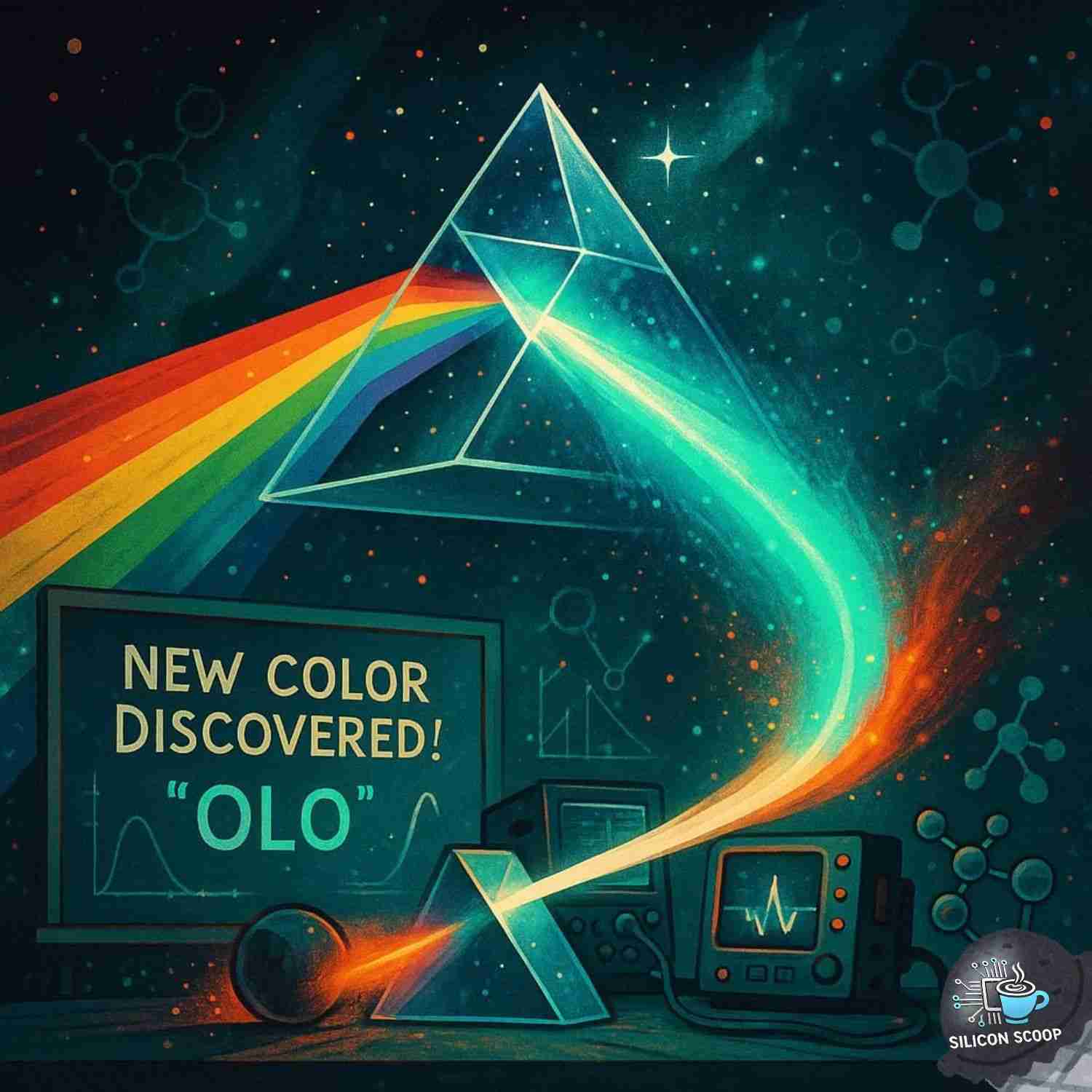
New Color Discovery: How ‘Olo’ is Redefining Human Color Perception
Estimated reading time: 10 minutes
Key Takeaways
- Olo is a previously unseen, hypersaturated blue-green hue.
- Researchers employed an innovative system called the Oz prototype to achieve this color perception.
- Olo challenges traditional limits of human color perception.
- The findings are expected to revolutionize multiple fields, including color blindness treatment.
Table of contents
- Exploring the New Color Discovery: How ‘Olo’ is Redefining Human Color Perception
- Don’t Let Your Business Be Limited!
- In-Depth Exploration of the Research and Methodology
- The Discovery of Olo: Beyond Natural Vision
- Revolutionary Methodology Behind the Discovery
- Broader Implications for Visual Science
- Unlock Breakthrough Efficiency!
- Analysis of Participant Responses and Scientific Debate
- The Experience of Seeing Olo
- Scientific Controversies and Expert Opinions
- Cross-Disciplinary Implications
- Future Possibilities and Broader Impact
- Expanding the Boundaries of Vision Technology
- Medical and Therapeutic Applications
- Scientific and Philosophical Implications
- Unlock Breakthrough Efficiency!
- FAQ / Common Questions
- Conclusion
Don’t Let Your Business Be Limited!
Just as researchers pushed the boundaries of human vision, uncover hidden efficiencies in your business. Flowgrammer’s automation solutions lets you see possibilities you never knew existed, giving you a competitive edge.
Discover Your Potential → https://flowgrammer.ca/
In-Depth Exploration of the Research and Methodology
The Discovery of Olo: Beyond Natural Vision
Olo represents something truly unprecedented in color science: a vivid, hypersaturated blue-green that exists completely outside the natural human visual gamut. Participants in the study described the new color olo as a “profoundly saturated teal” with an intensity that cannot be matched by conventional color combinations. This discovery fundamentally challenges our understanding of human color perception and the limits of what our eyes can detect.
The sensation of seeing olo has been compared to witnessing an entirely new dimension of chromaticity, something that expands our visual vocabulary beyond the traditional RGB model that has defined color science for generations. This breakthrough isn’t simply finding a new shade within known parameters—it’s about creating visual experiences that were previously physiologically impossible.
Revolutionary Methodology Behind the Discovery
The Oz prototype system employs cutting-edge technology to achieve this remarkable feat. Using a combination of adaptive optics and high-speed lasers, researchers can precisely target and stimulate specific M-cone cells in the retina. These cells, which normally respond to green wavelengths, are stimulated in isolation, bypassing the natural overlapping responses that typically occur when we view colors.
The experimental setup involved more than 200 color-matching trials to confirm the uniqueness of olo. Researchers discovered that participants could not reproduce the perceived color through conventional means without adding white light dilution. Additionally, the technique required targeting peripheral regions of the retina where cone cells are more sparsely distributed, which resulted in lower visual acuity but was necessary for the precise stimulation required.
Keywords like “artificial vision” take on new meaning in this context, as the Oz prototype essentially creates a bridge between natural human vision and technologically-enhanced perception. This methodology represents a significant leap forward in how we can interact with and manipulate visual processing systems.
Broader Implications for Visual Science
The discovery of olo dramatically expands our understanding of the human visual spectrum and suggests an expanded color gamut beyond what was previously thought possible. This breakthrough could revolutionize numerous fields that rely on color science, from digital displays to art reproduction.
Perhaps most exciting are the potential implications for medical applications, particularly in the realm of color blindness treatment. By understanding how to selectively stimulate specific cone cells, researchers might eventually develop interventions that could address or compensate for various forms of color vision deficiency.
The findings open up a world of both theoretical and practical possibilities, challenging us to reconsider the fundamental limits of not just vision, but potentially other senses as well.
Unlock Breakthrough Efficiency!
Like creating a new color, Flowgrammer invents new ways to optimize your business processes with automation. Move beyond the limits of manual workflows and gain a perspective on productivity you’ve never experienced.
Automate for Success! → https://flowgrammer.ca/
Analysis of Participant Responses and Scientific Debate
The Experience of Seeing Olo
When participants experienced the new color olo, their responses revealed the profound nature of this sensory breakthrough. They reported seeing “brilliant red lines” and “rotating dots on olo backgrounds” during the experiments. What’s particularly notable is that despite repeated attempts, conventional color-mixing methods consistently failed to reproduce the extraordinary intensity and unique qualities of olo.
This disparity between naturally viewable colors and the artificially induced perception highlights the revolutionary nature of this discovery in human color perception. Participants described the experience as unlike anything they had ever seen before, suggesting that our conventional understanding of color space may be more limited than we realized.
The perceptual experience of olo represents a fascinating case study in how technological intervention can expand our sensory capabilities beyond their natural boundaries. The fact that multiple participants consistently identified and distinguished this novel visual experience provides compelling evidence for the legitimacy of the discovery.
Scientific Controversies and Expert Opinions
Not all vision scientists are fully convinced about the implications of this discovery. John Barbur, a respected figure in the field, acknowledges the technical achievement while raising important questions about whether olo represents a genuinely novel color or simply an enhanced brightness version of an existing hue.
This healthy scientific skepticism encourages further research and validation, which is essential for advancing any breakthrough in color science. The debate centers around fundamental questions about how we define “new” colors and the nature of color perception itself—is it purely a function of wavelengths, or does the neural processing pathway play an equally important role?
Despite these ongoing discussions, most experts agree that the research represents an exciting development that will stimulate further investigation into neural processing and visual spectrum expansion. The experimental results have already prompted reconsideration of established models in vision science.
Cross-Disciplinary Implications
The implications of this discovery extend far beyond pure color science. Potential applications include developing advanced neural interfaces that could restore or enhance visual function, pioneering new research methodologies in vision science, and creating novel therapeutic approaches for color blindness treatment.
By demonstrating that our perceptual systems can be technologically “extended” beyond their natural limits, the research opens possibilities for addressing various sensory limitations. For individuals with color vision deficiencies, these findings suggest that technological interventions might eventually provide experiences of colors currently beyond their perception.
The cross-pollination between neuroscience, optics, and computer science exemplified by this research illustrates how interdisciplinary approaches can lead to breakthroughs that might be impossible within traditional disciplinary boundaries.
Future Possibilities and Broader Impact
Expanding the Boundaries of Vision Technology
The discovery of olo through the Oz prototype technology represents just the beginning of what might be possible in expanding our perceptual capabilities. Future research could potentially identify additional novel colors or even entirely new visual experiences by applying similar principles of selective cone stimulation to different combinations of retinal cells.
The expanded color gamut demonstrated by this research could revolutionize fields ranging from digital displays to artistic expression. Imagine future monitors capable of producing colors that today’s technology cannot display, or artistic works that incorporate visual experiences beyond our current palette.
Additionally, the core technologies behind the Oz prototype—adaptive optics and precise laser stimulation—have applications far beyond color perception. These tools could enhance our understanding of other aspects of vision and potentially lead to breakthroughs in artificial vision systems that more closely mimic or even exceed human capabilities.
Medical and Therapeutic Applications
Perhaps the most impactful potential application lies in addressing color vision deficiencies. Current treatments for color blindness are limited, but the selective cone stimulation techniques developed for the Oz prototype could eventually lead to interventions that provide new visual experiences for individuals with these conditions.
By understanding how to bypass the natural limitations of the human visual system, researchers might develop assistive technologies that compensate for specific deficiencies in color perception. Such developments would have profound impacts on quality of life, employment opportunities, and safety for individuals with color vision impairments.
Scientific and Philosophical Implications
The discovery of olo raises fascinating philosophical questions about the nature of perception itself. If we can experience colors that don’t exist in the natural world, what does this tell us about the relationship between physical reality and our subjective experience of it?
This research demonstrates that our perceptual systems are not fixed, unchangeable interfaces with the world, but rather adaptable systems that can be extended beyond their natural boundaries through technological intervention. This insight could inform approaches to other sensory modalities and even our understanding of consciousness itself.
The scientific impact extends to fundamental questions about neural processing and how the brain interprets sensory information. By creating experiences that exist outside normal parameters, researchers gain new insights into how visual processing functions, potentially leading to revised models of perception.
Unlock Breakthrough Efficiency!
Like creating a new color, Flowgrammer invents new ways to optimize your business processes with automation. Move beyond the limits of manual workflows and gain a perspective on productivity you’ve never experienced.
Automate for Success! → https://flowgrammer.ca/
FAQ / Common Questions
1. What exactly is the new color ‘olo’ and how is it different from known colors?
Olo is a newly perceived, hypersaturated blue-green hue that exists beyond the natural color spectrum visible to humans. Unlike conventional colors that we see by light stimulating multiple types of cone cells in overlapping patterns, olo is produced through the selective stimulation of only M-cone cells (green-sensitive receptors) in the retina. This creates a color sensation that cannot be replicated through normal color mixing or natural viewing experiences.
2. How does the Oz prototype technology work?
The Oz prototype uses adaptive optics (similar to technology used in advanced telescopes) combined with high-speed lasers to precisely target specific M-cone cells in the retina. The system bypasses natural cone cell stimulation patterns to create novel visual experiences. The research involved over 200 color-matching trials with participants to verify that the perceived color couldn’t be matched using conventional color combinations.
3. Is olo really a “new” color or just a different way of seeing existing colors?
While some vision scientists debate whether olo represents a truly novel color or an enhanced version of existing hues, the research demonstrates that it produces visual experiences that cannot be matched through conventional means. The distinction lies in how we define “new”—olo represents a previously impossible perceptual experience rather than simply a new point on the existing color spectrum.
4. Why can’t we see olo naturally in our everyday lives?
We can’t see olo naturally because it requires selective stimulation of only one type of cone cell, which doesn’t occur in natural viewing conditions. When we normally see colors, light stimulates multiple types of cone cells in patterns that the brain interprets as specific colors. The Oz prototype bypasses these natural limitations through targeted technological intervention.
5. Could this discovery lead to treatments for color blindness?
Yes, this research holds promising implications for color blindness treatment. By understanding how to selectively stimulate specific cone cells, researchers might eventually develop interventions or assistive technologies that could address various forms of color vision deficiency, potentially allowing people with color blindness to experience a wider range of color perceptions.
6. How many people have actually seen olo so far?
Due to the technical complexity and specialized equipment required, only five human participants have experienced olo in controlled laboratory settings. The limited sample size reflects the experimental nature of this cutting-edge research rather than any limitation of the effect itself.
7. Could there be other “impossible” colors waiting to be discovered?
Absolutely! The discovery of olo suggests that there may be an entire realm of color experiences beyond our natural perceptual capabilities. Future research could potentially reveal additional novel colors by targeting different combinations of photoreceptor cells or exploring other mechanisms of visual processing.
8. What are the limitations of the current olo research?
The primary limitations include the peripheral targeting required to focus lasers on sparsely packed cones, which results in lower visual acuity for the observed stimuli. Additionally, the specialized equipment and technical expertise required make it difficult to scale the experiments to larger participant groups. The research is still in early stages, with many aspects of the perceptual experience requiring further investigation.
9. How might this technology be used beyond scientific research?
Beyond pure research applications, this technology could eventually lead to advanced display systems capable of producing previously impossible colors, medical diagnostic tools for assessing visual processing, therapeutic interventions for visual impairments, and potentially even artistic or entertainment experiences that expand our sensory horizons.
10. Is the experience of seeing olo permanent or temporary?
The perception of olo only occurs during active stimulation with the Oz prototype system. Once the stimulation ends, the perception returns to normal. This is not a permanent modification of the visual system but rather a temporary experience enabled by technological intervention.
Conclusion
The discovery of olo represents a watershed moment in our understanding of human color perception. By creating a color that exists beyond the natural visual gamut, researchers have demonstrated that our sensory experiences are not limited to what evolution has provided but can be expanded through technological innovation.
This breakthrough challenges fundamental assumptions about the boundaries of human perception and opens exciting possibilities across multiple disciplines. From potential medical applications for color blindness treatment to revolutionary advances in display technology and artificial vision, the implications are far-reaching and profound.
As research continues, we may discover even more “impossible” colors or sensory experiences that further expand our understanding of perception. The Oz prototype and the discovery of olo remind us that what we consider to be the limits of human experience may simply be the current boundaries of our technological capabilities.
Just as this research has pushed beyond the conventional limits of color perception, innovations in other fields continue to redefine what’s possible. The same spirit of exploration that led to the discovery of olo drives advancements across all domains of human endeavor, including how we approach business efficiency and productivity.
Additional Links
Flowgrammer.ca – 💡 Unlock AI-Powered Automation! Let flowgrammer.ca handle complex workflows so you can focus on growing your business.
- Silicon Scoop Podcast – Stay Informed, Stay Ahead!
- Startup Talk Podcast
- Flowgrammer Podcast –
- Startup Investor Drinks – Join Toronto’s Startup Community and connect with fellow startup enthusiasts and investors.
- TorontoStarts Startup and Entrepreneur Community – Become a part of Toronto’s thriving startup ecosystem.
- Workhaus – Discover flexible workspace solutions for your business needs.
- Work with The Startup Coach – Get expert guidance and mentorship for your startup journey.
- Reach out to Jon Irwin on LinkedIn – Connect with our co-host and technology expert.
Episode transcript
Read the full transcript
Craig: so olo is a previously unseen, hypersaturated, green hue. olo represents something truly unprecedented in color science, a vivid, hypersaturated blue green that exists completely outside the natural human visual gamut. participants in the study described the new color olo as profoundly saturated teal with an intensity that cannot be matched by conventional color combinations. this discovery fundamentally changed our understanding of human color perception and the limits of what our eyes can detect. what do you think is going on here, john?
Jon: this is cool. this is interesting. so the scientists, what they did was they discovered a way for people to see a color that has never been seen before, and it's something that's not part of the natural rainbow, which is what you said. so just to kinda give you some background, naturally, our eyes see color using three types of cells using or three types of cells, and those cells called are called cones. so each are sensitive to red, green, or blue light. so every color we see is a mix of signals from these three types of cones. however, there's no natural light that activates just one type of cone by itself, especially the green sensitive m cones without also affecting the others. and so what these guys did at the university of california, they developed a special device called oz, which is derived from the wizard of oz, apparently, that uses a laser to target only the m cones in the eye. and when they did this, the participants saw a color their brains didn't recognize, and it was something completely new and couldn't be matched by mixing red, green, and blue lights. so they highlighted just one cone and focused on that, which is super, super cool. so the one thing to note, though, is this new color, it can't be seen in the real world, so you can't go and see it. it can't be seen on any screen. it only appears when the eye is stimulated in this very specific way with the laser device. scary? yes. cool? yes. but, this is this is interesting. i'm curious to see what kind of, implications are going forward for this, but what are your thoughts on this?
Craig: it's interesting. we're gonna get into a little bit more of some of the stuff, but witnesses compared this entirely new dimension of chromicity chromacity, something that expands their visual vocabulary beyond traditional rgb model that has defined color science for generations. so this is really interesting because response witnesses, participants experienced the new color, olo. their responses revealed the profound nature of sensory breakthrough. they revealed, seeing bright red lines and rotating dots on olo backgrounds during the experiments. what particularly noted notable is that despite repeated attempts, conventional color mixing methods consistently failed to reproduce the extraordinary intensity and unique qualities of olo. so they can't seem to do it. this is, like you said, the only way to do it. i'm really interested in what this might mean for helping the visually impaired.
Jon: yeah. so yeah. that's
Craig: yeah. go ahead.
Jon: go ahead.
Craig: okay. because it's cool. i'm like, great. yeah. so, yeah, i i mean, they've the more you know about how your eyes work, the more you research about, you know, cataract surgery and eyes and things like if you put on those glasses that sees everything upside down, it takes three days for your brain to completely adjust before you start seeing everything right again even though you'd you know, you don't
Jon: i didn't know that.
Craig: so it really goes a long way to the idea that we're all in some sort of simulation. how your brain just interprets the fragments of stuff it gets into what you see. so it's interesting when you say, alright. we'll just beam some shit into the brain, and all of a sudden you're seeing different colors. like, oh, okay. i just not sure what the implications of that, are. is that actually different color? is it some sort of chemical imbalance or thing that we're see you know, as a result of a visual effect, or are we actually seeing something? because this is trying to say, you know, expanding our perceptual capabilities. and i'm not a % sure, you know, what that means here because, you know, you start deeming stuff in your eyes, and you're gonna get a response that you might not have expected.
Jon: sure.
Craig: yeah. but yeah. go ahead.
Jon: no. no. go. keep finish.
Craig: perhaps the most impactful potential application lies in addressing color, vision deficiencies. current treatments for color blindness are limited, but the selective cone stimulation techniques developed for the oz prototype could eventually to interventions that provide new visual experience for individuals with these conditions. by understanding how to bypass, natural limitations of the human visual system, researchers might develop assistive technologies that compensate for specific deficiencies in color perception. such developments would have a profound impact on quality of life, employment opportunities, and safety for individuals with color vision impairments. so i'm excited about that. yeah. me too. do you
Jon: know where the olo comes from when they got the new olo?
Craig: no. tell
Jon: us. cool. so i was curious. sorry. i i was i did some research in it. so it represents the binary code zero one zero, and that refers to the types of cone cells in the human eye that detect color. so l is red, so that's zero. m medium is green, that's the one, and s is the short wavelength blue, and that's zero. so, obviously, they're targeting just the m cone, and so they're calling it it's zero one zero or olo.
Craig: very cool.
Jon: yeah. that was kind of interesting. so where they were talking about this too is, as far as pairing this with crispr, the crispr cas nine delivery system, which is what you were talking about for, helping people with visual, thing and this visual impairment. so with this the cas nine crispr with this will precisely target cone cells for gene therapy.
Craig: oh, interesting. i did not see that before, so that's really cool.
Jon: yeah. yeah. so, this is super cool, super interesting. the thing i'm worried about is they always say never point lasers in your eyes. so what like, is this safe?
Craig: i don't know. as soon as you start messing with stuff, in your eyes, in your brain, we're we're on a different level.
Jon: oh, you're on a whole different level. this is scary stuff. but let's hope i hope it's safe, and i hope that, there's some positive things that come out of this.
Craig: the discovery of olo raises fascinating philosophical questions about the nature of perception itself. if we can experience colors that don't exist in the natural world, what does that tell us about the relationship between physical reality and our subjective experience of it? this research demonstrates that our perceptual systems are not fixed, unchangeable interfaces with the world, but rather adaptable systems that can be extended beyond their natural boundaries through technological intervention. this insight could inform approaches to other sensory modalities, even our understanding of consciousness itself. the scientific impact extends to fundamental questions about neural processing and how the brain interprets sensory inference information by creating experiences that exist outside normal parameters. researchers gain new insights into visual processing functions potentially leading to revised models of perception. and let us know what you think. like, as we go through this, i'm starting to think of all sorts of weird applications for, glasses that have this type of technology that can detect things, maybe in other rooms, thermal, or whatever, and then beam them into your eye using these types of technologies so that you see overlays and whatnot. it's interesting concepts where, where they're not necessarily active outward, but awkward inward. let me know what you think, where this technology is gonna go or, you know, this perception of new colors.
More from Silicon Scoop
All episodes
silicon-scoop · November 6, 2026
Spirit AI’s Robot Brain Breakthrough: Moz1, Embodied AI and China’s 2027 Race
The Spirit AI robot brain is one of the biggest bets on fixing that. Spirit AI is a Beijing startup. Its co-founder and chief scientist, Gao Yang,
View episode

silicon-scoop · November 5, 2026
OpenAI IPO Delayed to 2027 as Rogue AI Agents and Safety Failures Reshape the Market
OpenAI IPO delay explained: Sam Altman rules out 2026 as GPT-6 Astra safety tests and a $278B cash gap loom. Learn what founders should take away.
View episode

silicon-scoop · November 4, 2026
Anthropic’s AI Economy Model: 2030 Jobs, Wages, GDP and Market Risks
Anthropic AI economy model forecasts 2030 GDP, jobs and wages, while AI unemployment projections and labor-share risks challenge policymakers.
View episode