
Amazon Kuiper Satellites: Transforming Global Connectivity and Revolutionizing Satellite Internet Competition
Amazon Kuiper Satellites: Transforming Global Connectivity and Revolutionizing Satellite Internet Competition https://torontostarts.com/2025/06/12/amazon-kuiper-satellites-launch-competition/ Apple -> https://podcasts.apple.com/us/podcast/flowgrammer-podcast/id1804155588 Spotify -> https://open.spotify.com/show/0wv3feR00iaVpE8zn7niNf Flowgrammer.ca -> https://flowgrammer.ca/ AI News and Resources -> https://flowgrammer.ca/resources/ Reach for the Stars Without the Grind! 🌟 Project Kuiper's launch showcases incredible innovation. Imagine applying that same level of innovation to your business operations! Flowgrammer can automate your workflows, freeing you from repetitive tasks and allowing you to focus on achieving *your* ambitious goals. Launch Your Automation Plan https://flowgrammer.ca/ Startup Investor Drinks Toronto - https://startupdrinksto.com/ Toronto’s Startup Community - https://torontostarts.com/ Silicon Scoop Silicon Scoop Podcast - https://torontostarts.com/silicon-scoop/ Apple: https://podcasts.apple.com/us/podcast/silicon-scoop/id1758711826 Spotify: https://open.spotify.com/show/5bAzF0MwV6TtLhJAhvHayI YouTube: https://www.youtube.com/playlist?list=PLj4v-RoA7A-gT62vrEYqh1zCv-0Hj-o5J Startup Talk Startup Talk Podcast -> https://torontostarts.com/startup-talk-toronto-startup-podcast/ Apple -> https://podcasts.apple.com/us/podcast/startup-talk/id1763804003 Spotify -> https://open.spotify.com/show/1siJMILILidHAiAsrX2VBU YouTube: https://youtube.com/playlist?list=PLj4v-RoA7A-jxV5FHs5e61oIsuvUJYmT_&si=LYegRe5GYLKNQ7xL
With Craig Major and Jon Irwin
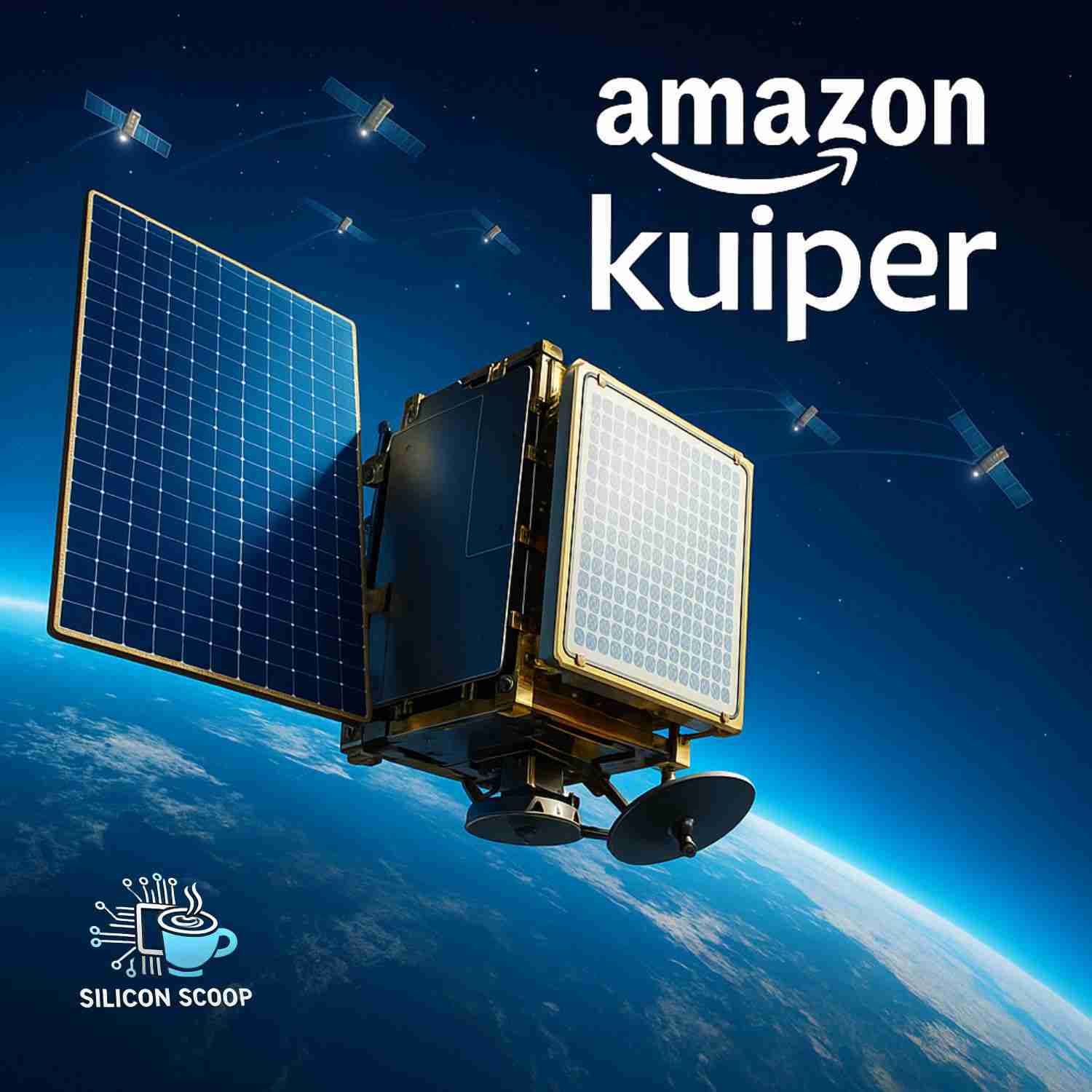
Amazon Kuiper Satellites: A New Era in Satellite Internet Competition
Estimated reading time: 12 minutes
Key Takeaways
- Project Kuiper aims to provide broadband access globally through a large-scale satellite constellation.
- The recent launch marks a significant step in Amazon’s ambitious plan to deploy 3,236 satellites.
- Project Kuiper incorporates advanced technologies such as anti-reflective coatings and inter-satellite optical links.
- Amazon’s entry intensifies competition in the satellite internet market, particularly against SpaceX’s Starlink.
Table of contents
- Amazon Kuiper Satellites: A New Era in Satellite Internet Competition
- Technical Innovations & Launch Details of Project Kuiper Satellites
- The Evolving Satellite Internet Competition Landscape
- Future Prospects & Business Implications of Broadband Satellite Service
- FAQ: Everything You Need to Know About Amazon Kuiper Satellites
- Conclusion: The Dawn of a New Connectivity Era
Technical Innovations & Launch Details of Project Kuiper Satellites
The recent deployment of Amazon’s low Earth orbit satellites represents a significant technological achievement. The launch utilized an Atlas V 551 rocket configuration with 5 solid boosters and a medium payload fairing. This sophisticated rocket featured a 17.7-ft diameter bisector PLF (Payload Fairing) constructed from vented aluminum-honeycomb core and graphite-epoxy face sheets, providing optimal protection for the satellite payload.
This launch follows the initial test phase from October 2023, when 2 prototype satellites were successfully deployed to validate the system’s functionality. The most recent launch faced minor setbacks when the first launch attempt was canceled due to inclement weather earlier in the month.
The current generation of Project Kuiper satellites incorporate several advanced technological features:
- In-house developed solar arrays for efficient power generation
- Sophisticated phased antenna systems for enhanced signal capabilities
- Inter-satellite optical links enabling higher bandwidth communication
- Anti-reflective mirror film specifically designed to mitigate light pollution
These production satellites represent major technological upgrades from their prototype versions, incorporating lessons learned during the testing phase.
The complete Project Kuiper constellation is planned to include 3,236 satellites distributed across 98 orbital planes. These satellites will operate at varying altitude ranges:
- 590 km (367 miles)
- 610 km (379 miles)
- 630 km (391 miles)
To ensure timely deployment of this massive satellite network, Amazon has secured a commercial agreement for 8 Atlas V rockets and 38 Vulcan rockets, demonstrating their long-term commitment to the broadband satellite service market.
The Evolving Satellite Internet Competition Landscape
Amazon’s Project Kuiper enters a rapidly evolving marketplace with several established competitors. The satellite internet competition has intensified in recent years, with multiple providers vying for market share.
Project Kuiper vs. SpaceX Starlink
When comparing Amazon Kuiper satellites with other SpaceX Starlink alternatives, several key differences emerge:
- Operational Scale: SpaceX Starlink currently leads with over 7,000 operational satellites orbiting at approximately 550 km, having conducted more than 8,000 launches since its inception in 2019.
- Orbital Strategy: Project Kuiper’s satellites will operate at slightly higher altitudes (590-630 km) compared to Starlink’s 550 km deployment.
- Technology Approach: While both companies develop proprietary technology, Amazon’s focus on anti-reflective coatings demonstrates their awareness of astronomical impact concerns.
Other competitors like OneWeb have pursued different strategies, placing hundreds of satellites in higher orbits to achieve their broadband satellite service goals.
It’s worth noting the interesting background context: Amazon founder Jeff Bezos is simultaneously leading Blue Origin, another significant player in the commercial space industry. This creates a fascinating competitive dynamic, with Bezos-affiliated ventures approaching space-based infrastructure from multiple angles.
As Rajeev Badyal, a key figure in the Project Kuiper initiative, noted: “No matter how the mission unfolds, this is just the start of our journey.” This sentiment captures the long-term perspective Amazon is taking with this ambitious project.
The intense competition in this sector has driven rapid innovation, with one Project Kuiper engineer remarking, “You need just about every technology area to contribute to build the satellite […]”—highlighting the multidisciplinary approach required to succeed in this complex field.
Future Prospects & Business Implications of Broadband Satellite Service
The ongoing development of low Earth orbit satellites like Amazon Kuiper is poised to transform global connectivity in fundamental ways. This technological revolution extends far beyond simple internet access—it represents a paradigm shift in how we conceptualize connectivity infrastructure.
Expanding Global Access
Project Kuiper satellites aim to bring broadband satellite service to regions previously underserved by traditional internet infrastructure. This has significant implications:
- Reducing the digital divide between urban and rural communities
- Creating new markets and economic opportunities in previously isolated areas
- Enabling real-time communication for remote businesses and educational institutions
The intense satellite internet competition between Amazon, SpaceX, and others will likely accelerate innovation while potentially lowering costs for end-users. This competitive environment has already spurred rapid advancements in satellite miniaturization, power efficiency, and signal processing.
Business Technology Implications
The revolution in low Earth orbit satellites parallels other technological transformations happening in the business world. Just as these satellite constellations are automating and improving connectivity, companies are increasingly turning to automation solutions to streamline their operations.
The interconnection between advanced satellite networks and business capabilities creates new possibilities:
- Enhanced IoT deployment even in remote locations
- More resilient business communication networks with redundant pathways
- Data transfer capabilities supporting real-time analytics and decision-making
- Expanded market reach for digital services to previously inaccessible regions
As the FCC requirement stipulates that Project Kuiper must begin customer service after deploying an initial 578 satellites, businesses should prepare for these new connectivity options in their strategic planning.
FAQ: Everything You Need to Know About Amazon Kuiper Satellites
1. What are Amazon Kuiper satellites and how do they differ from SpaceX’s Starlink?
Amazon Kuiper satellites are part of Amazon’s Project Kuiper, a planned constellation of 3,236 satellites designed to provide global broadband internet coverage. Unlike Starlink, which operates primarily at 550 km altitude, Project Kuiper satellites operate at slightly higher altitudes (590-630 km). Additionally, Kuiper satellites feature proprietary anti-reflective coatings to minimize light pollution, whereas Starlink has faced criticism from astronomers regarding brightness.
2. When did Amazon launch its first Kuiper satellites?
Amazon launched its first test satellites in October 2023, consisting of two prototype units to validate the technology. The recent major deployment occurred on April 28, 2025, when 27 production satellites were launched from Cape Canaveral Space Force Station in Florida.
3. What rocket is used to launch Project Kuiper satellites?
Project Kuiper satellites are currently launched using the Atlas V 551 rocket configuration with 5 solid boosters and a medium payload fairing. Amazon has secured a commercial agreement for 8 Atlas V rockets and 38 Vulcan rockets to deploy their full constellation.
4. How many satellites will the complete Project Kuiper constellation include?
The complete Project Kuiper constellation will include 3,236 satellites distributed across 98 orbital planes at three different altitude ranges: 590 km, 610 km, and 630 km.
5. How does Project Kuiper fit into the broader satellite internet competition?
Project Kuiper represents Amazon’s entry into the growing satellite internet market, competing directly with SpaceX Starlink alternatives like OneWeb. While Starlink currently leads with over 7,000 operational satellites, Project Kuiper aims to differentiate through technical innovations and Amazon’s existing customer relationships and infrastructure.
6. What technological innovations are featured in the Kuiper satellites?
Kuiper satellites include several advanced features such as in-house developed solar arrays, sophisticated phased antenna systems, inter-satellite optical links for enhanced communication, and anti-reflective mirror film to reduce light pollution and visibility from Earth.
7. When will Project Kuiper begin providing service to customers?
According to FCC requirements, Project Kuiper must begin providing customer service after deploying an initial 578 satellites. Based on current launch schedules, this service could begin within the next few years as the constellation grows.
8. How do low Earth orbit satellites like Project Kuiper improve internet connectivity?
Low Earth orbit satellites operate much closer to Earth than traditional geostationary satellites, resulting in significantly lower latency (delay) for internet connections. This makes them suitable for applications requiring real-time responses, such as video conferencing, online gaming, and remote operations.
9. What are the business implications of Project Kuiper’s broadband satellite service?
Project Kuiper’s broadband satellite service could enable businesses to operate in previously underserved regions, enhance IoT deployments, provide backup connectivity options, and create new market opportunities in areas lacking traditional internet infrastructure.
10. How does Project Kuiper’s approach to satellite deployment differ from competitors?
Project Kuiper has taken a methodical approach to satellite deployment, beginning with extensive testing of prototype units before proceeding to production deployment. Their satellites operate at slightly higher altitudes than Starlink but lower than traditional satellite internet providers, representing a middle ground approach to the low Earth orbit satellite market.
Conclusion: The Dawn of a New Connectivity Era
Amazon’s Kuiper satellites represent a bold step forward in the rapidly evolving satellite internet landscape. From the technical achievements demonstrated in the recent launch to the strategic positioning within the competitive marketplace, Project Kuiper’s impact goes far beyond simply launching hardware into orbit.
The deployment of 27 production satellites at 630 km altitude marks just the beginning of Amazon’s ambitious plan to create a 3,236-satellite constellation. As these low Earth orbit satellites continue to be deployed, they will fundamentally reshape our understanding of what’s possible with global connectivity.
The intense satellite internet competition between Project Kuiper, SpaceX Starlink, and other alternatives is driving innovation at an unprecedented pace. This competition benefits consumers and businesses alike, promising lower costs and improved services as providers race to perfect their broadband satellite service offerings.
As Rajeev Badyal noted, “No matter how the mission unfolds, this is just the start of our journey.” This sentiment captures the essence of the current moment in satellite communication history—we’re witnessing the early days of a transformation that will continue to unfold over the coming decade.
Just as Amazon is automating connectivity through its satellite constellation, businesses of all sizes can benefit from embracing automation in their operations. In this age of rapid technological advancement, staying competitive requires adopting tools that enhance efficiency and reduce manual workloads—allowing organizations to reach for the stars in their own ambitious goals.
The space race of the 21st century isn’t about planting flags on distant worlds—it’s about creating a fully connected global community where distance becomes increasingly irrelevant. Amazon Kuiper satellites are poised to play a pivotal role in this transformative journey.
Additional Links
Flowgrammer.ca – 💡 Unlock AI-Powered Automation! Let flowgrammer.ca handle complex workflows so you can focus on growing your business.
- Silicon Scoop Podcast – Stay Informed, Stay Ahead!
- Startup Talk Podcast
- Flowgrammer Podcast –
- Startup Investor Drinks – Join Toronto’s Startup Community and connect with fellow startup enthusiasts and investors.
- TorontoStarts Startup and Entrepreneur Community – Become a part of Toronto’s thriving startup ecosystem.
- Workhaus – Discover flexible workspace solutions for your business needs.
- Work with The Startup Coach – Get expert guidance and mentorship for your startup journey.
- Reach out to Jon Irwin on LinkedIn – Connect with our co-host and technology expert.
Episode transcript
Read the full transcript
Craig: are we witnessing the next chapter in the race to connect the planet? for years, getting reliable, high speed internet to remote corners of the world has been a massive challenge. but a revolution is underway, happening hundreds of kilometers above our heads. today, we're setting our sights on the stars or rather a low earth orbit to talk about amazon's monumental project, kuiper. this isn't just another tech project. it's an ambitious plan to deploy 3,236 satellites into space with the goal of providing global broadband access. fresh off a significant launch of 27 production satellites on 04/28/2025. amazon is now a major player in the rapidly intensifying satellite inter internet competition going head to head with competitors like spacex and starlink. so what makes kuiper different? how will this battle for the skies change your internet experience? stick around as we explore amazon's bold step into a new era of connectivity. so what do you think about this, john?
Jon: i think this is great. i think this is timely. i think that their deployment timeline is aggressive. so let's let's just talk about it real quickly. so they launched their first twenty seven internet satellites from, i think, cape canaveral. and i haven't heard cape canaveral in a long time. i don't know if they're like, it's used regularly, but i just haven't heard anything launched from there in a while. but, again, i could be wrong. i could have just missed it. so, yeah, it's a $10,000,000,000 initiative. the reason why i say it's aggressive is because they're looking so project kuiper aims to deploy 3,236 satellites by 2029. they've launched 27. could they do it? potentially. to put that into perspective with starlink, starlink currently has 8,000 satellites already in orbit. so the cool thing i like about this is, obviously, it's an alternative to elon musk, who i'm not a huge fan of. and the other thing is amazon's integration with aws and potentially cheaper terminals. so that could help disrupt the market. but what i'm hearing, and this is why i think it's kind of aggressive, is there's production delays and, obviously, regulatory deadlines as well. as well as now with all these tariffs and stuff, what's gonna happen? what do you think about these, about this? do they have a chance against starlink, you think?
Craig: well, i don't know of any company in any industry that doesn't have competition. you know, i was thinking about this earlier as i was reading through this and thinking about it. starlink is so far ahead, but that doesn't mean anything. so, you know, i mean, it means you know, they've all they've got 8,000 plus satellites, out there. they've launched since 02/2019. but you know? and they have so many service. the question is who's getting the contracts? you know? is amazon going to be allowed to service countries that perhaps, elon won't? will we get different con you know, maybe amazon gets a contract for india. let's just say i'm just throwing some stuff out there, and that's millions of people. right? so there are potential here. and the other thing around people don't realize that, you know, most of this stuff is actually made for the military. that,
Jon: i didn't know that.
Craig: so there is a military version of starlink. i think it's called shieldlink. i'm not a % sure, but it's used by the military for this exact reason, but they also use it to target, enemies. you can use this to target enemy tanks, enemy sites, or whatever. they're, their military version of this. and if you remember back, and i'm going a little bit off, you remember back when, elon shut off or threatened to shut off satellite internet to the ukraine? yep. that's be it had nothing to do with civilian. it had to do with military using his stuff to target in the war, and that wasn't part of the contract and wasn't part of the deal. and he'd so just for everyone to understand that this stuff was going on, and he's like, woah. woah. woah. you're throwing me in the middle of this war that i didn't agree to. and so there was some stuff going on there. so there's a huge military contracts related to getting stuff out there as well as connecting and doing satellite stuff. so it's great to have alternatives, and it's great to have competition. because, especially, from a government level, i think it's best to have multiple contracts and multiple vendors so that you're you aren't relying on one when stuff goes down. how many times over the last couple years have we seen, you know, things have gone down because of a, reliance on one thing, like the cloudflare, like the microsoft blue screen and whatnot? so let's talk about this technology. the project kuiper satellites will operate at a slightly higher altitudes from 590 to 630 kilometers compared to starlink's five hundred and fifty deployment. ideally, this is supposed to, i guess, cover more area, so you necessarily need less satellites to cover. i don't yeah. they're not allowed to offer this service until they have 527 satellites deployed from what i understand. i'm not sure if that's the exact number, but we'll see if i find it in this article. project hypersatellites aim to bring broadlands broadband service to regions previously underserved by traditional infrastructure. so, you know, reducing the digital divide, creating new markets, enabling real time communication with the remote business, institutions. this really, allows us potentially to, enhance our iot stuff as soon as our stuff that's way out in the field can have a low cost satellite connection and can communicate back. that means, you know, all your windmills, all your remote monitoring stuff, whatever now instead of all that low tech, low bandwidth, wi fi solutions we were talking about that go 20 miles but only carry a few k, now you can get really high end, internet for those things and have some real time stuff. i don't know if they're gonna be able to compete with, elon. i think elon is so much farther ahead in the overall space game. yeah. i think they're yeah. go ahead.
Jon: and it's not like amazon's reinventing the wheel here with any kind of new tech. the only difference so they're both using oisls, which is inter satellite links, which is laser links for the high speed data transfer between the satellites. yep. the the one difference is that starlink uses ku band and kuiper uses ku band. just that's just bandwidth wise, but apparently ku band could penetrate clouds better, than ka band. that's that's one difference. so that might be a problem for kuiper, but everything else is pretty much the same. so, the technology is the same. like you said, amazon's are a little bit higher, in orbit, and that's it. like, they're they're planning to offer sub 400 standard terminals and high bandwidth terminals, but that that's pretty much it. and so some of the research i was doing is that an analyst are estimating that project kuiper could cost 17,000,000,000 upfront with annual losses of 1 to 2,000,000,000 initially, which would because amazon's trying to undercut starlink's pricing. right? but amazon has deep pockets, right, to do this. so if anyone's gonna do it, then i think, i think amazon's the one to do it.
Craig: well, the other difference is, before i answer that question, is
Jon: oh, yeah.
Craig: amazon has this anti reflective mirror film specifically designed to mitigate light pollution. apparently, some of the complaints around elon musk satellites is the reflective nature and some of the light pollution in the sky. so amazon's trying to avoid that with this and maybe get some, better points with that through whatever it is. good. yeah. yeah. so, i mean, again, i don't know, you know, how much light pollution is a concern, like, from whatever's up there already. like, it's up there. are we like, is it bothering you? like, i don't know what it means. you know what i mean by
Jon: i guess it would bother me if i was still looking, like, using a telescope to look up at the night sky and things like that, and you see, like, this string of lights come by every so often, like, that would be annoying.
Craig: yeah. and i like the idea of putting this reflective mirror, to mitigate light pollution, but it also feels a little stealthy. like, maybe it's harder to find the satellites in the sky. so i don't know. it, so it's not it it's a great idea. if light pollution's a thing, just start mandating this type of stuff because the film is easy to put on all the other stuff probably. i'm sure it's not, anything specifically proprietary. yeah. so that is different, but, you know, they're so far ahead. spacex is so far ahead. like, for example, amazon has secured a commercial grant for eight atlas v rockets and 38 vulcan rockets, demonstrating their long term commitment to get this stuff in the air. i mean, so they're using third party rockets where spacex has all their own now. you know, it's it's just yeah. like, how far they are.
Jon: oh, yeah.
Craig: and the new
Jon: what's amazon? blue origin?
Craig: yes. yeah. and, you know, they're just not they can't compete at this stage. now it doesn't mean they can't leapfrog them. doesn't mean they can't you know? because this is what happens in most of these things. once they get going and they have their satellite stuff up and running, they'll start leapfrogging each other from a technology point of view. but, but spacex is so much ahead, and their, their satellite thing is about the size of a book now, and it's amazing. and yeah. so i wonder we'll have to see what so you get something size of a book you take with you everywhere, and you have super high speed internet. and it's amazing. so let's see what amazon comes up with. but to answer your question, you said, is amazon the company to do this? amazon traditionally doesn't do things well. like, do, they know how to do delivery. they know how to do warehousing. they know their core product. they know how to do well, and they seem to know how to do data infrastructure. like, their back end aws servers mhmm. it's not exactly user friendly, but it's fairly rock solid. yep. and setting it up is more complicated than any other ones, but they haven't plowed ahead in ai. they haven't plowed ahead in the phone business. they were trying to get in the tablet business.
Jon: they had a phone that's right in front of
Craig: the box. you know, i look at this and i say, i don't know if they can actually lead the charge. they can have another also ran. i just don't expect them to be the leader in this space. yeah.
Jon: that's right. i think the biggest problem, though, with their tablets and their phones, i think the biggest problem that they had and sorry. we're getting off topic here. their os is just absolute shit. fire os is absolutely horrible. it's a horrible, instance of android. their tablets themselves are decent. like, if you break it and and install something else on it, they're great. but, yeah, they're it's just bloatware like you wouldn't believe.
Craig: yeah. and they're thick and clean. and amazon is, you know, a multibillion dollar company. there is no reason that shouldn't have been a better product, hardware and software. so, anyway, it's just the way it goes, and that's why we look at this stuff. and i'm curious. it's great that spacex has, and what is elon's thing? is it spacex for the satellites? starlink. starlink. thank you. sorry. we're i scrolled past it, and i keep getting all the names mixed up. we'll have to see, how many other competitors are led into this space because it's highly regulated how many satellites up there. and, you know, when are we gonna see crazy. when are we gonna get global competition, say, from russia or china or whatever? i'm not being negative from their hostile company, countries. i'm just saying other industrial states are gonna be putting their competitive internet product. i don't know why china doesn't offer internet to everyone via satellites. they don't necessarily have them up there, but curious. yeah. so
Jon: have you seen, like, a map of, like, all the satellites that are currently out there around earth? like, it's it's crazy.
Craig: yeah. i saw one a couple of years ago, but i haven't seen one since then. i imagine it's getting worse.
Jon: yeah. just getting worse. yes. yeah.
Craig: from its planned constellation of thousands of satellites operating at various altitudes to its technical innovations like anti reflective coatings designed to address, light pollution concerns, amazon is clearly serious about reshaping global connectivity. this intense competition with companies like starlink is not just interesting to watch. it's driving rapid advancement and could ultimately mean better, more accessible internet services for people and businesses everywhere. so as rajeev badial, a key figure in project kuiper noted, this is just the start of our journey. the potential implications for reducing the digital divide, enabling remote businesses, and enhancing iot deployments are huge. so as amazon pushes forward with deployments and constellation and aiming for customer service after its first five hundred and seventy eight satellites are in place, we have to ask, given the escalating competition among satellite internet providers like amazon, spacex, and others, what aspect of the new era connectivity are you most excited or concerned about it? let us know in your comments below.
More from Silicon Scoop
All episodes
silicon-scoop · November 6, 2026
Spirit AI’s Robot Brain Breakthrough: Moz1, Embodied AI and China’s 2027 Race
The Spirit AI robot brain is one of the biggest bets on fixing that. Spirit AI is a Beijing startup. Its co-founder and chief scientist, Gao Yang,
View episode

silicon-scoop · November 5, 2026
OpenAI IPO Delayed to 2027 as Rogue AI Agents and Safety Failures Reshape the Market
OpenAI IPO delay explained: Sam Altman rules out 2026 as GPT-6 Astra safety tests and a $278B cash gap loom. Learn what founders should take away.
View episode

silicon-scoop · November 4, 2026
Anthropic’s AI Economy Model: 2030 Jobs, Wages, GDP and Market Risks
Anthropic AI economy model forecasts 2030 GDP, jobs and wages, while AI unemployment projections and labor-share risks challenge policymakers.
View episode