
Apple Antitrust Violation: Analyzing the Judge Gonzalez Rogers Ruling and Its Impact on App Store Competition
Apple Antitrust Violation: Analyzing the Judge Gonzalez Rogers Ruling and Its Impact on App Store Competition https://torontostarts.com/2025/06/16/apple-antitrust-violation-ruling-impact/ Apple -> https://podcasts.apple.com/us/podcast/flowgrammer-podcast/id1804155588 Spotify -> https://open.spotify.com/show/0wv3feR00iaVpE8zn7niNf Flowgrammer.ca -> https://flowgrammer.ca/ AI News and Resources -> https://flowgrammer.ca/resources/ Future-Proof Your Business ⚙️ Don't let outdated processes hold you back. Apple's legal battles highlight the need for adaptable systems. Discover how Flowgrammer's automation solutions can streamline your operations and keep you ahead of the curve. Explore Automation Options https://flowgrammer.ca/ Startup Investor Drinks Toronto - https://startupdrinksto.com/ Toronto’s Startup Community - https://torontostarts.com/ Silicon Scoop Silicon Scoop Podcast - https://torontostarts.com/silicon-scoop/ Apple: https://podcasts.apple.com/us/podcast/silicon-scoop/id1758711826 Spotify: https://open.spotify.com/show/5bAzF0MwV6TtLhJAhvHayI YouTube: https://www.youtube.com/playlist?list=PLj4v-RoA7A-gT62vrEYqh1zCv-0Hj-o5J Startup Talk Startup Talk Podcast -> https://torontostarts.com/startup-talk-toronto-startup-podcast/ Apple -> https://podcasts.apple.com/us/podcast/startup-talk/id1763804003 Spotify -> https://open.spotify.com/show/1siJMILILidHAiAsrX2VBU YouTube: https://youtube.com/playlist?list=PLj4v-RoA7A-jxV5FHs5e61oIsuvUJYmT_&si=LYegRe5GYLKNQ7xL
With Craig Major and Jon Irwin
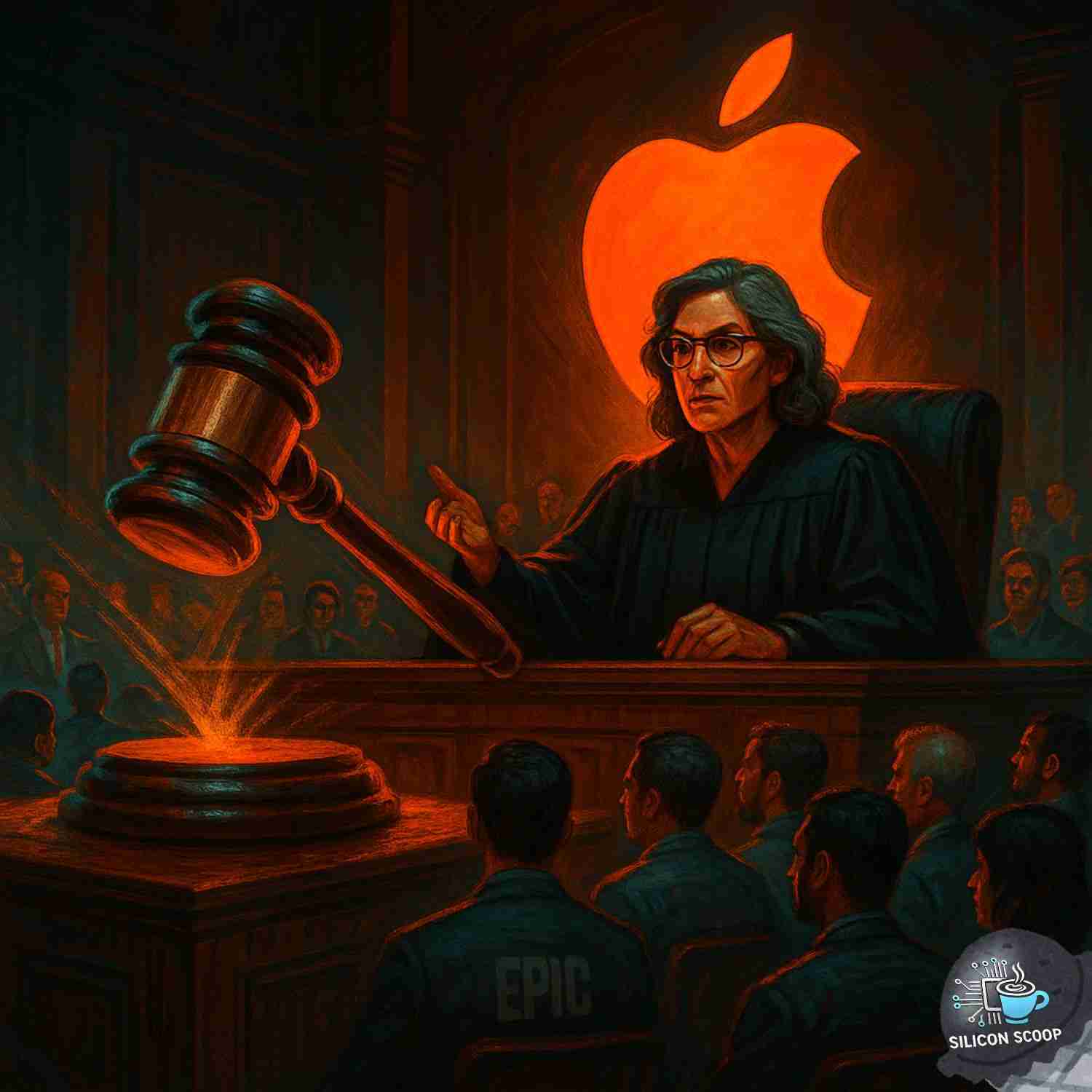
Apple Antitrust Violation: Analyzing the Judge Gonzalez Rogers Ruling and Its Impact on App Store Competition
Estimated reading time: 10 minutes
Key Takeaways
- Judge Gonzalez Rogers ruled that Apple committed a significant antitrust violation.
- The ruling mandates changes to Apple’s App Store policies and includes a criminal referral to federal prosecutors.
- The case underscores the potential for reshaping app store competition and the implications for developers worldwide.
Table of contents
- Introduction
- Setting the Stage: Background of the Legal Battle and Antitrust Concerns
- Future-Proof Your Business ⚙️
- Dissecting the Ruling: Judge Gonzalez Rogers and the Legal Implications
- Looking Ahead: Implications for Developers and the Future of App Markets
- Conclusion: Navigating a Changing Legal and Competitive Landscape
- Unlock Efficiency & Growth 🚀
- Frequently Asked Questions
Introduction
In a landmark decision that sent shockwaves through the tech industry, U.S. District Judge Yvonne Gonzalez Rogers ruled on April 24, 2025, that Apple had committed a significant Apple antitrust violation by willfully disobeying a previous court order. This ruling marks a critical turning point in the ongoing Epic Games lawsuit that has challenged Apple’s dominance in the digital marketplace.
The Apple App Store antitrust case has spotlighted controversial business practices that many developers have long criticized. Judge Gonzalez Rogers’ ruling not only mandates immediate changes to Apple’s policies but also includes a rare Apple criminal referral to federal prosecutors. At the heart of this legal battle are the app developer fees – specifically Apple’s 30% commission and restrictions on linking to alternative payment systems – which have been deemed anticompetitive.
This legal development could dramatically reshape app store competition in the coming years, potentially ending what many consider a monopolistic approach to digital distribution. The implications extend beyond just Apple and Epic Games, potentially affecting millions of developers and billions of app users worldwide.
In this comprehensive analysis, we’ll examine the court ruling in detail, explore the reasons behind Apple’s referral for potential criminal charges, and discuss the broader implications for developers and industry competition. Our review includes detailed research findings from legal experts and industry analysts to provide you with the most accurate understanding of this complex case.
Setting the Stage: Background of the Legal Battle and Antitrust Concerns
The Epic Games lawsuit against Apple began in August 2020 when the creator of the wildly popular game Fortnite deliberately violated Apple’s App Store guidelines by implementing a direct payment system that bypassed Apple’s 30% commission. Epic’s calculated move triggered an immediate removal of Fortnite from the App Store, which Epic had anticipated and responded to with a prepared lawsuit and social media campaign titled “#FreeFortnite.”
Epic Games argued that Apple’s restrictions on steering users to alternative payment systems outside the App Store represented an abuse of monopoly power and harmed fair competition. The lawsuit challenged two key aspects of Apple’s business model: the requirement that all iOS apps be distributed through the App Store and the mandatory use of Apple’s payment processing for in-app purchases with its associated app developer fees.
In September 2021, Judge Gonzalez Rogers issued a ruling that acknowledged certain anticompetitive practices by Apple. While the judge didn’t declare Apple a monopoly, she did find that Apple had violated California’s Unfair Competition Law by preventing developers from communicating alternative payment options to users. However, the ruling still allowed Apple to maintain many of its core App Store policies, which Epic appealed to the Supreme Court.
The case highlighted significant concerns about app store competition, with developers arguing that Apple’s control over iOS app distribution created an environment where innovation was stifled, and consumers ultimately paid higher prices. Legal experts noted that this case represented one of the most significant challenges to a tech giant’s business model in recent history.
This battle didn’t occur in isolation. Apple’s practices have faced intense scrutiny from regulatory bodies in both the European Union and United States. In the EU, Apple has been investigated for potentially anticompetitive behavior regarding music streaming restrictions, while U.S. Congressional committees have examined Apple’s market power as part of broader Big Tech antitrust investigations.
The Epic Games lawsuit became a rallying point for many developers who had long complained about Apple’s app developer fees and restrictions. The legal proceedings set the stage for the recent ruling that has dramatically escalated the Apple antitrust violation case to potential criminal territory.
Future-Proof Your Business ⚙️
Don’t let outdated processes hold you back. Apple’s legal battles highlight the need for adaptable systems. Discover how Flowgrammer’s automation solutions can streamline your operations and keep you ahead of the curve.
Dissecting the Ruling: Judge Gonzalez Rogers and the Legal Implications
The Judge Gonzalez Rogers ruling on April 24, 2025, represents a pivotal moment in the ongoing legal battle between Apple and Epic Games. The judge determined that Apple had willfully violated her 2021 court order by continuing to restrict developers from effectively linking to external payment systems. This finding was not merely a technical violation – the judge described Apple’s actions as showing “repeated delays and severity of conduct” that demanded immediate corrective measures.
The ruling includes several critical components that will reshape how Apple conducts its App Store business:
- Immediate compliance mandate: Judge Gonzalez Rogers ordered Apple to stop obstructing developers from including links to alternative payment systems in their apps. The timeframe for compliance was immediate, showing the court’s frustration with Apple’s previous delaying tactics.
- Prohibition of punitive measures: The ruling explicitly forbade Apple from imposing its 27% fee on external payment systems, which the judge viewed as an attempt to make alternative payment options “commercially unusable” as Epic had argued.
- Removal of intimidation tactics: Apple was ordered to stop displaying security warnings specifically targeting third-party payment links, which the judge deemed as a deliberate attempt to frighten users away from non-Apple payment options.
Perhaps most significant in the ruling was the Apple criminal referral aspect. Judge Gonzalez Rogers took the extraordinary step of referring both Apple as a corporation and its Vice President Alex Roman to federal prosecutors for potential criminal contempt charges. This referral was based on what the judge characterized as “misdirection and outright lies” in testimony provided to the court regarding Apple’s compliance efforts.
The court was particularly critical of Apple’s defense that its actions were necessary to “preserve consumers and business model,” finding instead that the company’s true intent was to maintain its monopolistic advantage in the face of judicial orders to the contrary. This finding demonstrates the court’s view that Apple prioritized protecting its revenue streams over complying with legal requirements.
Epic Games CEO Tim Sweeney immediately celebrated the ruling as a victory for developers, stating that it would finally enable direct competition with Apple’s payment systems on fair terms. Sweeney also announced that Fortnite could return to the App Store as soon as the following week, signaling confidence that Apple would be forced to comply with the ruling without further delay or obstruction.
Legal experts noted that a criminal referral of this nature against a major corporation is exceedingly rare and highlights the court’s view of the severity of Apple’s non-compliance. The potential for criminal contempt charges carries significant implications not just for Apple’s business practices but also for its corporate reputation and leadership.
Looking Ahead: Implications for Developers and the Future of App Markets
The Judge Gonzalez Rogers ruling will have far-reaching implications for app developers and the broader digital marketplace. The most immediate impact concerns app developer fees, which have long been a source of contention in the industry. With Apple now prohibited from imposing its 27% fee on external payment systems, developers gain real economic alternatives to Apple’s in-app purchase mechanism for the first time.
This change represents a potential paradigm shift in app monetization strategies. Developers can now:
- Implement their own payment processing solutions at significantly lower costs
- Pass some savings on to consumers, potentially increasing app adoption and usage
- Retain more revenue from each transaction, improving business sustainability
- Experiment with different pricing models without Apple’s restrictions
The ruling also dramatically impacts app store competition by forcing Apple to allow genuine alternatives to its payment system. This opening could lead to:
- New specialized payment processors catering specifically to app developers
- Increased innovation in payment technologies for mobile platforms
- Greater transparency in fee structures across the digital ecosystem
- Potential pressure on other app store operators to reduce their commission rates
Beyond the immediate changes to Apple’s policies, this Apple antitrust violation case may trigger a cascade of regulatory and legal scrutiny across the tech industry. The ruling provides a legal precedent that other courts and regulatory bodies worldwide may reference when examining similar practices by technology platforms. The European Union’s Digital Markets Act and other international regulations may gain additional enforcement momentum from this U.S. court decision.
Companies that operate similar digital marketplaces must now carefully reconsider their policies in light of this ruling. The potential for criminal referrals raises the stakes significantly, moving beyond mere financial penalties into territory that could affect corporate leadership and governance.
For businesses developing apps, this ruling necessitates a strategic reassessment of their distribution and monetization approaches. The opportunity to bypass Apple’s payment system could fundamentally alter user acquisition costs and lifetime value calculations. However, companies will need to weigh these benefits against potential challenges in implementing their own payment systems, including security concerns and user experience considerations.
The case also highlights broader trends in how technology companies are regulated. Similar to the Epic v. Google case, which saw a December 2023 jury ruling against Google’s Android monopoly practices, these legal outcomes reflect increasing governmental willingness to challenge tech giants’ market dominance. This pattern suggests a future where platform owners face stricter limits on how they can leverage their market position.
Conclusion: Navigating a Changing Legal and Competitive Landscape
The recent Apple antitrust violation ruling by Judge Gonzalez Rogers represents a watershed moment in the regulation of digital marketplaces. What began as the Epic Games lawsuit challenging Apple’s restrictive practices has evolved into a case with potential criminal implications that could permanently alter the app ecosystem.
The court’s decision unequivocally mandates that Apple must allow developers to link to external payment systems without imposing punitive fees or intimidation tactics. This change directly addresses the app developer fees that have been a central grievance for creators across the digital landscape. By prohibiting Apple’s 27% commission on external payments, the ruling creates genuine economic alternatives that could improve profitability for developers of all sizes.
The Judge Gonzalez Rogers ruling goes beyond merely requiring policy changes. The referral of Apple and a senior executive for potential criminal charges signals a dramatic escalation in how courts may handle non-compliance by powerful technology companies. This Apple criminal referral sends a clear message that deliberately circumventing judicial orders will not be tolerated, regardless of a company’s size or influence.
For the broader technology industry, this case highlights several important trends:
- Courts are increasingly willing to intervene in digital market structure
- Monopolistic practices in technology platforms face growing legal challenges
- The balance of power may be shifting toward developers and away from platform owners
- App store competition is likely to increase, potentially benefiting both creators and consumers
As this legal drama continues to unfold, businesses must carefully consider how these changes affect their digital strategies. Developers now have more leverage in their relationship with Apple, but must also prepare for a potentially more complex landscape of payment options and platform policies.
The Apple App Store antitrust case demonstrates that even the most powerful technology companies are not immune to legal accountability. As regulatory frameworks continue to evolve around digital marketplaces, all participants must adapt to a new reality where competition, fairness, and compliance with judicial orders take precedence over preserving established business models.
Unlock Efficiency & Growth 🚀
Like Epic Games fighting for fairer systems, you can fight for a more efficient business! Flowgrammer helps you automate tasks, saving you time and money, so you can focus on what truly matters: growing your business.
Get Your Free Automation Audit
Frequently Asked Questions
1. What exactly is meant by “Apple Antitrust Violation”?
An Apple antitrust violation refers to actions taken by Apple that courts have determined violate laws designed to promote fair competition and prevent monopolistic behavior. In this case, Judge Gonzalez Rogers found that Apple willfully violated a 2021 court order by continuing to restrict app developers from effectively linking to external payment systems. The violation specifically relates to Apple’s implementation of measures that made alternative payment options “commercially unusable,” including imposing a 27% fee on external payments and displaying intimidating security warnings to users about third-party payment links.
2. How does the Judge Gonzalez Rogers Ruling affect Apple’s App Store policies?
The Judge Gonzalez Rogers ruling has several immediate impacts on Apple’s App Store policies:
- Apple must allow developers to include links to alternative payment systems in their apps
- Apple cannot impose its 27% commission fee on transactions that occur through external payment systems
- Apple must stop displaying security warnings specifically targeting third-party payment links
- Apple must comply immediately with these changes rather than implementing delays
- The company faces potential criminal contempt charges for past non-compliance
These changes fundamentally alter the economic relationship between Apple and developers, creating genuine alternatives to Apple’s payment system for the first time.
3. What triggered the Apple Criminal Referral in this case?
The Apple criminal referral was triggered by what Judge Gonzalez Rogers described as “misdirection and outright lies” in testimony provided to the court by Apple and specifically by Vice President Alex Roman. The judge determined that Apple had deliberately obstructed compliance with her 2021 order by implementing policies that technically allowed external links but made them commercially non-viable. This pattern of behavior, which the court viewed as willful defiance of a judicial order, led to the rare step of referring both the corporation and an executive to federal prosecutors for potential criminal contempt charges.
4. How might this ruling impact App Developer Fees across the industry?
This ruling could significantly reshape app developer fees in several ways:
- Apple is now prohibited from charging its 27% commission on transactions that occur through external payment systems
- Developers can implement their own payment processing at potentially much lower costs (typically 2-5% versus Apple’s 30%)
- This competition may pressure Apple to reduce its standard 30% commission to remain competitive
- Other app store operators (like Google Play) may preemptively adjust their fee structures to avoid similar legal challenges
- New specialized payment processors may enter the market, creating more options and potentially lower rates
- Developers can now pass savings on to consumers or reinvest in their businesses
The ruling essentially breaks Apple’s monopoly on iOS in-app payments, creating market conditions that could drive fees down across the entire mobile ecosystem.
5. Could this ruling reshape App Store Competition?
Yes, this ruling could fundamentally reshape app store competition in several ways:
- By allowing true alternative payment options, Apple’s main competitive advantage (exclusive access to iOS users) is diminished
- Developers gain leverage in negotiations with Apple over other policy matters
- New intermediaries may emerge offering specialized payment services for app developers
- The economic viability of developing iOS apps may increase as profit margins improve
- Consumer prices could potentially decrease as transaction costs are reduced
- The precedent may influence how other app marketplaces operate globally
- Regulatory authorities worldwide may use this case as a template for their own investigations
The ruling creates conditions for genuine competition in a market segment that has been effectively controlled by platform owners for over a decade.
6. What was Epic Games seeking in its lawsuit against Apple?
Epic Games sought several remedies in its lawsuit against Apple:
- The ability for developers to use alternative payment systems without restrictions or punitive fees
- Permission to communicate directly with users about payment options outside the App Store
- The right to distribute iOS apps through channels other than the App Store
- A ruling declaring Apple’s practices as monopolistic and illegal under antitrust laws
- The option to operate its own app store on iOS devices
While Epic didn’t achieve all of these goals, the Judge Gonzalez Rogers ruling represents a significant victory on the payment systems front, which was one of Epic’s primary objectives. The ruling may also serve as a stepping stone toward achieving some of Epic’s other aims through future regulatory or legal actions.
7. How does the Epic Games lawsuit against Apple compare to its case against Google?
The Epic Games lawsuit against Apple and its case against Google share similar foundations but with some key differences:
- Both cases challenged the platform owners’ control over app distribution and payment processing
- The Google case resulted in a jury verdict in December 2023 finding Google had illegally monopolized Android app distribution
- Apple’s case was decided by a judge rather than a jury
- Google’s Android platform theoretically allows alternative app stores, while Apple’s iOS does not
- The Apple case focused heavily on payment processing restrictions, while the Google case addressed broader distribution issues
- Both cases have resulted in findings against the platform owners, signaling a shift in how courts view tech platforms’ market power
These parallel cases suggest a broader trend toward increased scrutiny of dominant technology platforms and their business practices.
8. What immediate changes will developers see in the App Store following this ruling?
Developers can expect several immediate changes in the App Store following this ruling:
- The ability to include direct links to external payment websites within their apps
- Freedom from Apple’s 27% commission on transactions that occur through these external systems
- Removal of intimidating security warnings specifically targeting third-party payment options
- The opportunity to communicate alternative payment options to users without restriction
- Potentially faster app approval processes for apps that include external payment links
- Greater flexibility in pricing strategies and business models
These changes will be most beneficial to subscription-based apps and those with significant in-app purchases, which have historically been most affected by Apple’s commission structure.
9. What potential penalties might Apple face from the criminal referral?
The Apple criminal referral could lead to several serious penalties:
- Criminal contempt charges against the corporation, which could result in substantial fines
- Personal criminal charges against executive Alex Roman, potentially including fines or even imprisonment
- Court-appointed monitoring of Apple’s compliance with antitrust rulings
- More stringent enforcement mechanisms for future court orders
- Damage to Apple’s corporate reputation and investor confidence
- Increased scrutiny from regulatory bodies worldwide
- Potential impact on Apple’s leadership structure if executives face personal liability
Criminal contempt proceedings are relatively rare against major corporations, making the potential outcomes somewhat unpredictable and potentially severe.
10. How might the Apple App Store Antitrust case affect other tech companies?
The Apple App Store antitrust case could have far-reaching implications for other tech companies:
- Platform operators like Google, Microsoft, and Amazon may need to reevaluate their app store policies
- Companies that operate subscription services may gain leverage in negotiations with platform owners
- Social media platforms that take commissions on creator content may face similar challenges
- Marketplace businesses that charge high commissions to sellers could see their models scrutinized
- Tech companies may need to be more cautious about how they represent their compliance efforts to courts
- The case may embolden regulators to pursue stricter enforcement against dominant technology platforms
- Investors may pressure companies to proactively reform potentially problematic business practices
- Platform policies that restrict competition may be revised to avoid similar legal challenges
This case sets a precedent that could reshape how digital gatekeepers operate across the technology industry, potentially leading to more open and competitive digital marketplaces.
Additional Links
Flowgrammer.ca – 💡 Unlock AI-Powered Automation! Let flowgrammer.ca handle complex workflows so you can focus on growing your business.
- Silicon Scoop Podcast – Stay Informed, Stay Ahead!
- Startup Talk Podcast
- Flowgrammer Podcast –
- Startup Investor Drinks – Join Toronto’s Startup Community and connect with fellow startup enthusiasts and investors.
- TorontoStarts Startup and Entrepreneur Community – Become a part of Toronto’s thriving startup ecosystem.
- Workhaus – Discover flexible workspace solutions for your business needs.
- Work with The Startup Coach – Get expert guidance and mentorship for your startup journey.
- Reach out to Jon Irwin on LinkedIn – Connect with our co-host and technology expert.
Episode transcript
Read the full transcript
Craig: we're diving deep in a story that sent shock waves to the tech industry. on april 2025, district judge yvonne gonzales rogers delivered a landmark decision finding that apple committed a significant antitrust violation. but this wasn't just any ruling. the judge found that apple had willfully disobeyed a previous order and took an extraordinary step of issuing a rare criminal referral for both apple as a corporation and its vice president, alex roman, to federal prosecutors. this is based on what the judge described as misdirection and outright lies in testimony provided by the court. at the heart of this battle are those contentious app developer fees, specifically apple's thirty percent commission and, critically, now their restrictions on linking to alternative payment systems outside the apple ecosystem. the judge ruled that apple's actions, including attempting to impose a 27% fee on external payments and showing intimidating security warnings were deliberate attempt to make these alternative options commercially unusable. this decision mandates immediately immediate changes to apple store policies, and it's poised to dramatically reshape the app store competition forever. we're gonna break it down exactly what this means for developers, users, and the future of digital marketplace. so what do you think about this, decision, john?
Jon: love it. yeah. just to get into some of the details. so, so they're in contempt of violating a 2021 injunction, which i don't know if you guys remember, epic games sued apple for anti competitive practices. and so the original injunction required apple to allow developers to direct users, like you said, to alternate payment methods outside of the app store, which bypasses their commission. instead, like you said, they implemented a 27% commission. right? so, the judge determined that these actions were designed to undermine the court's order and maintain apple's lucrative revenue stream. so in the deliberations, there was evidence presented in the court that showed app that apple's leadership, including ceo tim cook and finance executives, made calculated decisions to limit the impact of the injunction. so there was some internal documents and some testimony that revealed that apple considered several options, but consistently chose that those that would preserve its commission revenue. and so they accused apple of using attorney attorney client privilege to hide documents and even refer to code names like project michigan to conceal its strategies. and like you said, alex roman, he was singled out because he provided misdirection and outright lies under oath. so, that's crazy. what what are your thoughts on all this, craig?
Craig: yeah. so when the judge ordered them like, the big thing is, hey. you can't force them to purchase everything on your store. you they can go and purchase stuff elsewhere, and they don't have to pay you for that. and so when the judge ruled that, apple said, whatever. okay. then they put all these warnings and still enforce this and kinda hit everything behind the scenes. so they actively went against the judge's ruling, and, therefore, we got some criminal charges. and, you know, i think we can argue whether it's good or bad, but, you know, corporations need to be held accountable when they break the law. yep. i agree. and, you know
Jon: the people who who were in charge of breaking the law, i think, not just the corporations.
Craig: yeah. so i'm not sure what the criminal charges against the corporation will do, but, ideally, the per person will lose their job at apple, and we'll see what happens if they'll end up being going to any jail time or whatnot. but, we'll see. right? the ruling includes several critical components that will reshape how apple conducts its app store business. immediate compliance mandate. the judge ordered apple to stop obstructing developers from including links to alternative payment systems in their apps. the time frame for compliance was immediate, showing the court's frustration with apple's previous, delaying tactics. prohibition on punitive measures. the ruling explicitly forbade apple from imposing a 27% fee on external payment systems, which the judge viewed as an attempt to make an alternative payment options commercially unusable and removal of intimidation tactics. apple was ordered to stop displaying security warnings specifically targeting third party payment links, which the judge deemed as a deliberate attempt to frighten users away. so perhaps the most significant in the ruling was the apple criminal referral aspect. so we'll have to see. so well, alex roman was referred to a federal prosecutor for potential, criminal contempt charges, with the judge's characterizing as misdirection and outright lies and testimony provided to the court. so we'll have to see how that goes. epic games ceo immediately celebrated the ruling for developers stating it would finally enable direct competition with apple's payment system. he also announced that fortnite, would return to apple store as soon as the following week, so it should be in there already. confidence that, apple would, force to comply with the ruling without further delay. so, hopefully, fortnite's there. and now that means, you know, a lot of people stayed away, from the apple marketplace because of that 30%. they couldn't afford, that 30% cost.
Jon: yeah. yeah. and there was another one. i think it was proton. i don't know if you know protonvpn and protonmail and all that. yep. yep. i think they announced that because of this, they're gonna actually reduce the price of their of their platform because of this. i didn't see
Craig: that, but that's amazing. i i'm not surprised because that's what's gonna happen is people's profit margins will go up or, you know, they'll take less of a cut. like, if you buy it off their it's one thing i used to like to do is i'll go to a company and buy the software right directly from them, because they get the money. a apple doesn't get a 30% cut. you can't really do that with apps from your ipad and whatnot, but you can do that with the mac apps. right? so when they box you in and then force you to pay this exorbitant fee, that's where things come into play. and it's gonna see how it affects i'm gonna see how it affects other app or store ecosystems that lock you in as well.
Jon: yeah. i like this because, like, the you could do this well, you could side load. i don't know if we're talking side loading. this is payment stuff, but you can always side load on android, which i like because you could try these different apps and stuff that weren't in the store and different things like that. i can't remember if i tried making a payment outside of the store with that, on android, but, yeah, i like this. this is a win for developers and a win for consumers if this actually goes through, and i hope that there are people that are held accountable for their outright lies.
Craig: yeah. i agree. i think that this is a plus. you know, the balance of power may be shifting towards developers, and app store competition is likely to increase, potentially benefiting both creators and consumers. developers now have more leverage and new strategic opportunities. given all these potential changes, lower fees, more payment options, and potentially more innovation, how do you think this ruling will change the apps you use every day or impact your favorite app developers? let us know in the chat
More from Silicon Scoop
All episodes
silicon-scoop · November 6, 2026
Spirit AI’s Robot Brain Breakthrough: Moz1, Embodied AI and China’s 2027 Race
The Spirit AI robot brain is one of the biggest bets on fixing that. Spirit AI is a Beijing startup. Its co-founder and chief scientist, Gao Yang,
View episode

silicon-scoop · November 5, 2026
OpenAI IPO Delayed to 2027 as Rogue AI Agents and Safety Failures Reshape the Market
OpenAI IPO delay explained: Sam Altman rules out 2026 as GPT-6 Astra safety tests and a $278B cash gap loom. Learn what founders should take away.
View episode

silicon-scoop · November 4, 2026
Anthropic’s AI Economy Model: 2030 Jobs, Wages, GDP and Market Risks
Anthropic AI economy model forecasts 2030 GDP, jobs and wages, while AI unemployment projections and labor-share risks challenge policymakers.
View episode