
How the Diamond Magnetometer is Revolutionizing Navigation and Sensing Technologies
How the Diamond Magnetometer is Revolutionizing Navigation and Sensing Technologies https://torontostarts.com/2025/08/20/diamond-magnetometer-revolution-navigating-tech/ Apple -> https://podcasts.apple.com/us/podcast/flowgrammer-podcast/id1804155588 Spotify -> https://open.spotify.com/show/0wv3feR00iaVpE8zn7niNf Flowgrammer.ca -> https://flowgrammer.ca/ AI News and Resources -> https://flowgrammer.ca/resources/ Future-Proof Your Business Unleash precision and reduce errors across your operations. Discover how Flowgrammer's tailored automation solutions can elevate your business performance beyond today's standards. Request a Demo https://flowgrammer.ca/ Startup Investor Drinks Toronto - https://startupdrinksto.com/ Toronto’s Startup Community - https://torontostarts.com/ Silicon Scoop Silicon Scoop Podcast - https://torontostarts.com/silicon-scoop/ Apple: https://podcasts.apple.com/us/podcast/silicon-scoop/id1758711826 Spotify: https://open.spotify.com/show/5bAzF0MwV6TtLhJAhvHayI YouTube: https://www.youtube.com/playlist?list=PLj4v-RoA7A-gT62vrEYqh1zCv-0Hj-o5J Startup Talk Startup Talk Podcast -> https://torontostarts.com/startup-talk-toronto-startup-podcast/ Apple -> https://podcasts.apple.com/us/podcast/startup-talk/id1763804003 Spotify -> https://open.spotify.com/show/1siJMILILidHAiAsrX2VBU YouTube: https://youtube.com/playlist?list=PLj4v-RoA7A-jxV5FHs5e61oIsuvUJYmT_&si=LYegRe5GYLKNQ7xL
With Craig Major and Jon Irwin
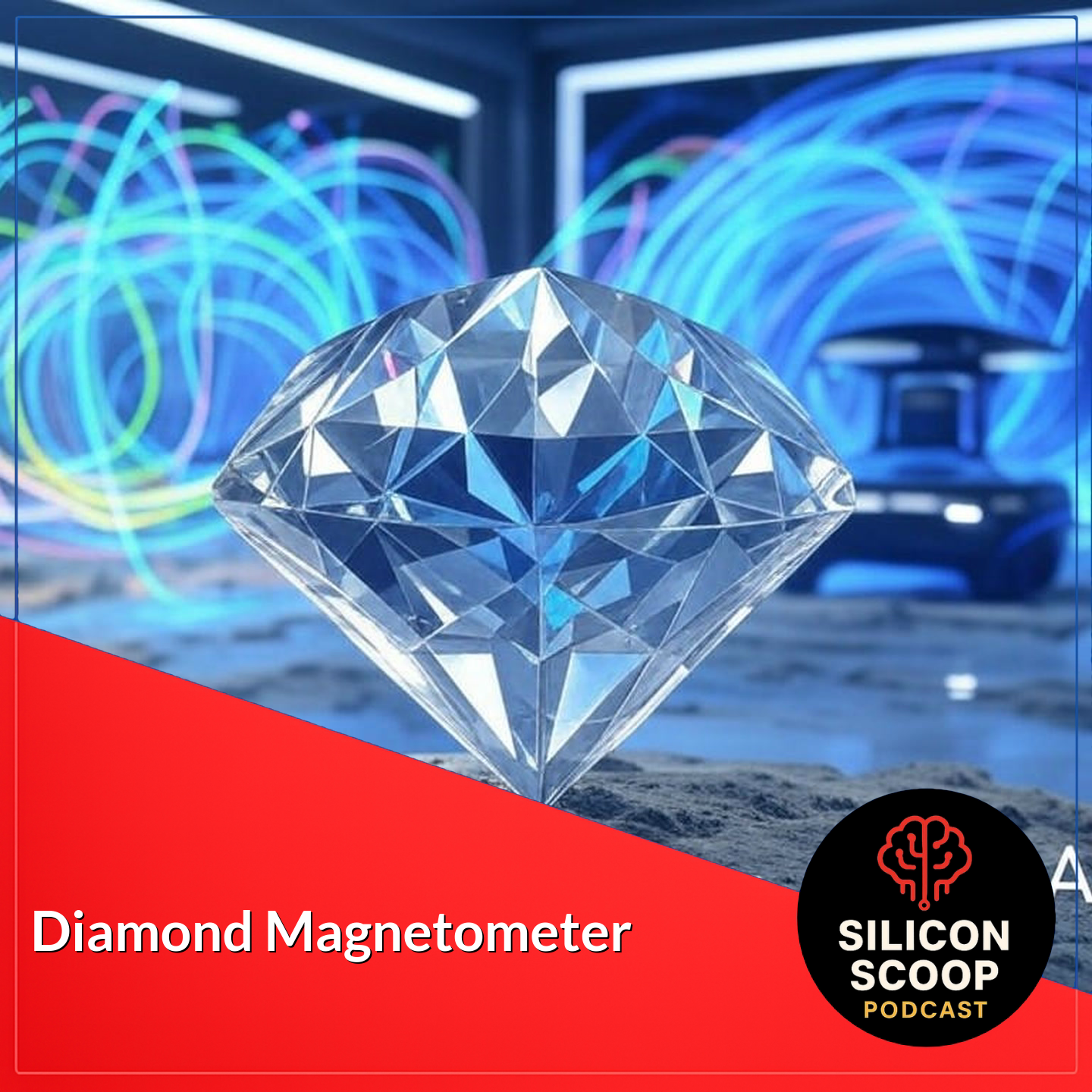
The Diamond Magnetometer is Revolutionizing Navigation and Sensing Technologies
Estimated reading time: 10 minutes
- The diamond magnetometer represents a breakthrough in quantum sensing technology that is transforming how we measure and map magnetic fields.
- At the heart of this revolution lies the nitrogen-vacancy (NV) center in diamond crystals, which enables these quantum magnetometers to detect magnetic fields with extraordinary precision.
- These advanced sensors provide unprecedented magnetic field mapping accuracy, operating at sensitivity levels that were previously impossible to achieve in compact devices.
- The technology harnesses quantum physics to measure even the tiniest magnetic variations, opening doors to applications ranging from GPS-free navigation systems to sophisticated underground mineral detection.
- This post will explore the cutting-edge technology behind diamond magnetometers, examine their remarkable technical breakthroughs, and dive into their transformative applications.
- We’ll cover how these sensors are creating new possibilities for autonomous navigation in challenging environments and revolutionizing geological surveys for mineral exploration.
Table of contents
Technical Overview of Diamond Magnetometers
A diamond magnetometer is a compact quantum device that utilizes nitrogen-vacancy (NV) centers in synthetic diamond to detect minuscule magnetic fields with remarkable precision. These quantum sensors represent a significant leap forward in magnetometry technology, combining the unique properties of diamond with advanced quantum mechanics.
Groundbreaking Work by Fraunhofer IAF
The Fraunhofer IAF has developed an integrated quantum magnetometer that uses nitrogen vacancies (NV) in diamond to achieve picotesla-level sensitivity. This breakthrough demonstrates how quantum technology can be miniaturized without sacrificing performance.
The NV centers in diamond act as atomic-scale sensors that respond to magnetic fields through quantum spin states. When exposed to magnetic fields, these centers exhibit measurable changes in their optical and spin properties, allowing for incredibly precise magnetic field detection.
Remarkable Technical Specifications
Miniaturization Achievements
The most impressive aspect of modern diamond magnetometers is their dramatic size reduction. Researchers have achieved a 30x size reduction compared to previous iterations while maintaining sensitivity levels that match optically pumped gas cell magnetometers (OPMs). This miniaturization breakthrough makes these quantum sensors practical for portable and embedded applications.
Exceptional Sensitivity Performance
These devices operate in the picotesla range, offering high dynamic range capabilities that enable detection of subtle magnetic field variations. The picotesla sensitivity means these sensors can detect magnetic fields billions of times weaker than Earth’s magnetic field, opening possibilities for applications requiring extreme precision.
Advanced Integration Density
The technology features a single sensor chip that orients NV centers in <100> diamond crystals. This integrated approach significantly reduces calibration complexity compared to traditional magnetometer systems. The four-axis orientation capability allows for comprehensive magnetic field vector measurements without requiring multiple separate sensors.
The integration of multiple sensing capabilities into a single chip represents a major advancement in sensor technology. This design eliminates the need for complex calibration procedures that plague traditional magnetometer systems.
Future-Proof Your Business
Unleash precision and reduce errors across your operations. Discover how Flowgrammer’s tailored automation solutions can elevate your business performance beyond today’s standards.
[1] https://www.fraunhofer.de/
[3] https://www.nature.com/articles/
Real-World Applications of Diamond Magnetometers
Diamond magnetometers are transforming multiple industries through their exceptional magnetic field mapping capabilities and versatility in challenging environments.
Revolutionary Navigation Solutions
GPS-Free Positioning Technology
Integrated diamond magnetometers provide autonomous navigation capabilities by mapping Earth’s magnetic field variations. This technique offers a reliable GPS alternative suitable for environments where satellite signals are unavailable or unreliable.
The technology works by creating detailed magnetic field maps that serve as navigation references. Autonomous vehicles, underwater vessels, and underground exploration equipment can use these magnetic signatures to determine their precise location without relying on satellite connectivity.
Challenging Environment Navigation
These quantum sensors excel in situations where traditional GPS fails:
- Underwater navigation for submarines and autonomous underwater vehicles
- Underground positioning in mines, tunnels, and cave systems
- Indoor navigation in large buildings where GPS signals are blocked
- Arctic and polar exploration where GPS accuracy is compromised
Advanced Geological Surveillance
Underground Mineral Detection
Diamond sensors revolutionize geological surveys through their ability to detect magnetic anomalies associated with mineral deposits. The sensors can identify subsurface ore bodies, oil deposits, and other valuable resources by measuring tiny variations in Earth’s magnetic field.
These measurements provide detailed information about:
- Depth and extent of mineral deposits
- Geological structure composition
- Underground water sources
- Archaeological sites and buried structures
Security and Safety Applications
The technology enables precise detection of unexploded ordnance using advanced depth and shape analysis. Military and civilian teams use these sensors to locate dangerous buried objects with unprecedented accuracy, making cleanup operations safer and more efficient.
Biomedical and Microelectronics Applications
Diamond magnetometers show promise in specialized fields requiring ultra-high sensitivity measurements:
- Biochemical analysis of nerve pathways and brain activity
- High-resolution measurements in microelectronic device testing
- Medical imaging applications requiring magnetic field precision
- Scientific research in quantum physics and materials science
Extreme Environment Advantages
Diamond sensors maintain performance in conditions that disable traditional magnetometers:
- High temperature environments
- High pressure conditions
- Corrosive atmospheres
- Radiation-rich environments
Superior Technical Performance
The native vector measurement capability and single-chip multisensory approach significantly reduce calibration complexity compared to traditional optically pumped magnetometers. This advantage translates to:
- Faster deployment times
- Reduced maintenance requirements
- Lower operational costs
- Improved measurement reliability
[2] https://ieeexplore.ieee.org/
[3] https://www.nature.com/articles/
Emerging Technological Advancements and Future Directions
The field of diamond magnetometry continues to evolve rapidly, with researchers pushing the boundaries of sensitivity, miniaturization, and practical applications.
Future Trends and Sensor Optimization
Sub-Picotesla Sensitivity Goals
Ongoing research efforts focus on achieving sub-picotesla sensitivities through advanced quantum control techniques. Scientists are developing new methods to enhance the nitrogen-vacancy (NV) center performance, including:
- Improved diamond crystal quality
- Enhanced optical pumping techniques
- Advanced signal processing algorithms
- Better electromagnetic shielding
Enhanced Integration Density
Future generations of diamond sensors will feature increased integration density, allowing multiple sensing functions on single chips. This advancement will enable:
- Multi-parameter sensing capabilities
- Reduced system complexity
- Lower power consumption
- Smaller form factors for embedded applications
Industrial Scale-Up in Diamond Production
Advanced Manufacturing Processes
The diamond sensor industry is transitioning from smaller 2-inch to larger 4-inch diamond wafers using sophisticated synthetic diamond production reactors. This scaling addresses growing industrial demand and enables mass production of high-quality diamond sensors.
Key manufacturing improvements include:
- Chemical vapor deposition (CVD) reactor enhancements
- Controlled nitrogen incorporation during growth
- Improved crystal quality control
- Standardized wafer processing techniques
Production Quality Control
Enhanced NV-doped diamond sensor heads ensure consistent quantum device performance across manufacturing batches. Quality control measures include:
- Precise nitrogen concentration control
- Crystal defect minimization
- Optical property standardization
- Performance verification testing
Comparison to Traditional Systems
Advantages Over Optically Pumped Magnetometers
Diamond magnetometers offer several key advantages over traditional OPMs:
GNSS-Denied Environment Operation
- Extended operation without satellite dependency
- Reliable performance in challenging environments
- Autonomous navigation in GPS-denied scenarios
- Consistent accuracy regardless of location
Reduced System Complexity
- Single-chip design eliminates multiple components
- Native vector measurement capability
- Simplified calibration procedures
- Lower maintenance requirements
Enhanced Durability
- Solid-state construction with no moving parts
- Resistance to shock and vibration
- Long operational lifetime
- Minimal drift over time
Emerging Application Areas
- Quantum Computing Support – Diamond magnetometers are finding applications in quantum computing systems for:
- Magnetic field stabilization
- Qubit characterization
- Noise reduction
- System calibration
- Space Exploration – Future space missions may incorporate diamond sensors for:
- Planetary magnetic field mapping
- Navigation in deep space
- Scientific instrument precision
- Satellite attitude control
Just like this cutting-edge tech, your business deserves pinpoint accuracy. Flowgrammer designs and implements automations that find opportunities to reduce resource use and increase ROI.
[1] https://www.fraunhofer.de/
[3] https://www.nature.com/articles/
Frequently Asked Questions
Q: What is a diamond magnetometer and how does it work?
A: A diamond magnetometer is a quantum sensor that uses nitrogen-vacancy (NV) centers in diamond crystals to detect magnetic fields with extraordinary precision. The NV centers are atomic-scale defects that respond to magnetic fields by changing their quantum spin states. When laser light illuminates these centers, they emit fluorescence that varies with the magnetic field strength, allowing for precise magnetic field measurements at the picotesla level.
Q: How does the Fraunhofer IAF’s design improve magnetic field detection?
A: Fraunhofer IAF’s design achieves a 30x miniaturization while maintaining picotesla sensitivity levels. Their integrated quantum magnetometer features a single sensor chip with four-axis oriented NV centers in <100> diamond crystals. This design eliminates complex calibration procedures and provides native vector measurement capabilities, making the system more practical and reliable than traditional magnetometers.
Q: What are the benefits of using diamond magnetometers for autonomous navigation?
A: Diamond magnetometers provide GPS alternative navigation by mapping Earth’s magnetic field variations. They excel in GPS-denied environments like underwater, underground, or indoor spaces where satellite signals are unavailable. The sensors offer consistent accuracy, require no external infrastructure, and provide continuous operation regardless of weather or electromagnetic interference.
Q: How do diamond sensors help with underground mineral detection?
A: These sensors detect magnetic anomalies associated with mineral deposits by measuring tiny variations in Earth’s magnetic field. They provide detailed information about depth, extent, and composition of subsurface resources. The high sensitivity allows detection of subtle magnetic signatures from ore bodies, oil deposits, and geological structures that traditional surveying methods might miss.
Q: What makes diamond magnetometers better than traditional magnetometers?
A: Diamond magnetometers offer superior performance through their single-chip design, native vector measurement capability, and reduced calibration complexity. They operate reliably in extreme environments, have no moving parts for enhanced durability, and provide consistent accuracy over long periods. Unlike optically pumped magnetometers, they don’t require complex gas cell systems or frequent recalibration.
Q: What industries benefit most from diamond magnetometer technology?
A: Key industries include autonomous vehicle navigation, geological surveying and mining, defense and security, aerospace and space exploration, biomedical research, and microelectronics testing. Any field requiring precise magnetic field measurements or GPS-free navigation can benefit from this technology.
Q: How sensitive are modern diamond magnetometers?
A: Current diamond magnetometers achieve picotesla-level sensitivity, meaning they can detect magnetic fields billions of times weaker than Earth’s magnetic field. Research is pushing toward sub-picotesla sensitivity levels, which would enable even more precise measurements for advanced scientific and industrial applications.
Q: What are the future developments expected in diamond magnetometer technology?
A: Future developments include further miniaturization, enhanced sensitivity reaching sub-picotesla levels, increased integration density on single chips, and scaling up production to 4-inch diamond wafers. Researchers are also working on improved diamond crystal quality, advanced signal processing, and new applications in quantum computing and space exploration.
Q: Can diamond magnetometers work in harsh environments?
A: Yes, diamond sensors excel in extreme conditions including high temperatures, high pressures, corrosive atmospheres, and radiation-rich environments. Their solid-state construction with no moving parts makes them highly durable and resistant to shock, vibration, and environmental stress that would damage traditional magnetometers.
Q: How might future enhancements impact various industries?
A: Enhanced sensitivity and miniaturization will enable new applications in medical diagnostics, scientific research, and consumer electronics. Industrial scaling will reduce costs and increase availability, making the technology accessible to smaller companies and emerging markets. Improved integration will enable multi-parameter sensing systems that can measure magnetic fields alongside other physical quantities, creating more comprehensive monitoring solutions.
Additional Links
Flowgrammer.ca – 💡 Unlock AI-Powered Automation! Let flowgrammer.ca handle complex workflows so you can focus on growing your business.
- Silicon Scoop Podcast – Stay Informed, Stay Ahead!
- Startup Talk Podcast
- Flowgrammer Podcast –
- Startup Investor Drinks – Join Toronto’s Startup Community and connect with fellow startup enthusiasts and investors.
- TorontoStarts Startup and Entrepreneur Community – Become a part of Toronto’s thriving startup ecosystem.
- Workhaus – Discover flexible workspace solutions for your business needs.
- Work with The Startup Coach – Get expert guidance and mentorship for your startup journey.
- Reach out to Jon Irwin on LinkedIn – Connect with our co-host and technology expert.
Episode transcript
Read the full transcript
Craig: you love talking about gps technology, so let's talk about this diamond magnetometer. yeah. it represents a breakthrough in quantum sensing technology that is transforming how we measure and map magnetic fields. at the heart of this revolution lies the nitrogen vacancy center in diamond crystals, which enables these quantum magnetometers to detect the magnetic fields with extraordinary precision. these advanced sensors provide unprecedented magnetic field mapping accuracy operating at a sensitivity level that were previously impossible to achieve in compact devices. so what does this mean for the industry, john, and why do we care?
Jon: yeah. so this is cool because, this is they're they're using synthetic diamonds that could replace gps, in any situation, but especially situations where satellite signals are blocked or jammed. so it's a tiny diamond chip that can sense the earth's invisible magnetic field patterns and use them like a fingerprint to determine your exact location without needing any satellites at all. because gps, for those of you that don't know, need satellites in order to determine location. so how it works? just dive into it real quickly. the earth has a magnetic field. surprise? maybe not. it's like a giant invisible magnet. think of it like that. so the field varies slightly from place to place due to underground minerals, rock formations, a bunch of different things. and these variations create essentially unique magnetic fingerprints for different locations. so the diamond magnetometer, it acts like an ultra sensitive magnet compass that can detect these tiny variations and match them to magnetic maps to pinpoint your location. so why does this matter? right? so this is great because you don't need, super cooling like what we had, covered in other satellite list gps, potential solutions. so, it could enable navigation underwater, deep canyons, inside buildings, underground, where gps signals are jammed. so there's a lot of use cases for this. now the breakthrough lies in using and i don't know much about this, but it's a nitrogen vacancy or envy centers in a synthetic diamond. so these are atomic scale defects where a carbon atom is replaced by a nitrogen atom with an adjacent vacant space in the diamond's crystal lattice. this creates a quantum system that's extraordinarily sensitive to magnetic fields. so really cool. do you think, craig, that this is a technology that's closer to commercialization than other gps technologies that we've covered?
Craig: this definitely seems, even though with the name diamond in there, it seems more inexpensive and easier to deploy than a lot of the other like, if i remember correctly, and you can correct me wrong, we talked about the quantum gps, and i thought it had, several lasers pointed at, a centimeter size device to determine micro, sensitivity movements, if is that what we're talking about? yeah. yeah. yeah. that seems like just on the surface, we don't have costing. that seems way more expensive than what's going on here.
Jon: yes. for sure. and this seems way more feasible. i think they have to super cool the other thing too. so apparently, it doesn't have to be super cool, i don't think. but it does use green laser light and emit red light that varies in intensity based on the surrounding magnetic field strength. so this one still does use lasers, but it doesn't seem as complex to develop further.
Craig: yeah. and manufacturing scales from two inch to four inch wafers to boost industrial adoption of the, diamond sensors. so i think, quantum magnetometers allow for reduced operational calls via fewer recalibrations and maintenance needs. you talked about this before, and i don't remember the number, and maybe you do. how much is lost in shipping because of that gps that we're losing stuff every year?
Jon: well, i think it was was it bill in the billions or hundreds of millions?
Craig: it was definitely in the billions, and that's why, like, when we think, like, the average consumer is like, okay. great. i'd i'd like a little bit better gps when i'm driving downtown toronto or in heavy buildings because the balance of billy doesn't quite know where i am. but other than that, it's generally good enough. why do we need this? and we sit back and say, okay. we need this because of all the things you mentioned. right? you mentioned, the technical, high temperature environments, high pressure conditions, corrosive atmospheres, you know, advanced geological surveillance, underground studies, like, all the things, which is great. and being able to do this more accurately at a significantly reduced cost is really going to boost the industry. so i do believe this is, going to be adopted faster than the other ones.
Jon: i think so. yeah.
Craig: you know, biomedical and applications benefit from noninvasive high resolution and nerve activity monitoring as an example. so, you know, we start looking at some of this. the applications for the magnetometer in this is outside of gps as well. it's amazing. i love what the accuracy. the magnetic navigation may soon rival gps thanks to real time magnetic field mapping system. so you'll be able to put this, potentially in your phones and whatnot and not necessarily have to talk to satellites anymore.
Jon: my question is, if this relies on the earth's magnetic field, right, what happens if the magnetic field reverses? will they have to just recalibrate or redevelop a whole new check?
Craig: i assume this is how it's gonna work. it's all gonna be just like you have gps maps or used to. yeah. back in the day when everything wasn't connected, you'd have to download the maps for where you're going and whatnot, but now it just gets them automatically that it would be, eye in the sky that just downloads your updates when you get in that are relevant to your area and then overall to the world depending where you are.
Jon: yeah.
Craig: so, you know, when it shifts, it'll shift, but, you know, they do because they do shift. but i think the whole point is that there are systems and networks out there. as soon as you deploy these systems, millions of them across the world that can communicate with, mother system, now you're tracking it. you can send some microshifts. you can update the database. it's just like, how waze and now google, i guess, tracks drivers in your car, how fast they're going, where the slowdowns are, and where they're not, and, you know, changes your route. it's the same thing for this type of thing where as you sense the differences in your phones or whatever your sensors out there, it'll update those maps, accordingly.
Jon: yeah. absolutely.
Craig: so i think this is really cool. i love new technology around gps and knowing where we are. and it has, you know, diamond magnum magnometers offer several advantage, extended operation without satellite dependency, reliable performance in challenging environments, autonomous navigation and gps denied scenarios, and consistent accuracy regardless of location. so, you know, single chip design eliminates multiple components, native vector measurements capability, simple calibration procedures, and low maintenance requirements, solid state con construction with no moving parts, resistant to shock and vibration, long operation lifetime, and minimal drift over time. so all of those things lead to we're gonna see something soon, and it looks like something we should be implementing.
Jon: yeah. the military like, there's a whole bunch of different militaries developing it. darpa, us air force, mit, like, nist. like, there's a whole bunch. honeywell. so they're all they're all working on something similar. so something will get to markets sooner rather than later.
Craig: and sounds like something they could use on mars for sure. elon musk and his team when they go. alright. let us know what you think about this. we'd love to hear back from you.
More from Silicon Scoop
All episodes
silicon-scoop · November 6, 2026
Spirit AI’s Robot Brain Breakthrough: Moz1, Embodied AI and China’s 2027 Race
The Spirit AI robot brain is one of the biggest bets on fixing that. Spirit AI is a Beijing startup. Its co-founder and chief scientist, Gao Yang,
View episode

silicon-scoop · November 5, 2026
OpenAI IPO Delayed to 2027 as Rogue AI Agents and Safety Failures Reshape the Market
OpenAI IPO delay explained: Sam Altman rules out 2026 as GPT-6 Astra safety tests and a $278B cash gap loom. Learn what founders should take away.
View episode

silicon-scoop · November 4, 2026
Anthropic’s AI Economy Model: 2030 Jobs, Wages, GDP and Market Risks
Anthropic AI economy model forecasts 2030 GDP, jobs and wages, while AI unemployment projections and labor-share risks challenge policymakers.
View episode