
3D Holograms Are No Longer Sci-Fi: The Future of Touchless Tech is Here
Interactive Holograms: Exploring the Future of 3D Display Technology and Human Interaction https://torontostarts.com/2025/09/04/interactive-holograms-3d-display-technology/ Apple -> https://podcasts.apple.com/us/podcast/flowgrammer-podcast/id1804155588 Spotify -> https://open.spotify.com/show/0wv3feR00iaVpE8zn7niNf Flowgrammer.ca -> https://flowgrammer.ca/ AI News and Resources -> https://flowgrammer.ca/resources/ Future-Proof Your Business Today! While others are still stuck in the old ways of working, you could be light years ahead! Let Flowgrammer automate your core business processes and unlock unprecedented efficiency. The future of work is here, are you ready? Discover Automation Solutions > https://flowgrammer.ca/ Startup Investor Drinks Toronto - https://startupdrinksto.com/ Toronto’s Startup Community - https://torontostarts.com/ Silicon Scoop Silicon Scoop Podcast - https://torontostarts.com/silicon-scoop/ Apple: https://podcasts.apple.com/us/podcast/silicon-scoop/id1758711826 Spotify: https://open.spotify.com/show/5bAzF0MwV6TtLhJAhvHayI YouTube: https://www.youtube.com/playlist?list=PLj4v-RoA7A-gT62vrEYqh1zCv-0Hj-o5J Startup Talk Startup Talk Podcast -> https://torontostarts.com/startup-talk-toronto-startup-podcast/ Apple -> https://podcasts.apple.com/us/podcast/startup-talk/id1763804003 Spotify -> https://open.spotify.com/show/1siJMILILidHAiAsrX2VBU YouTube: https://youtube.com/playlist?list=PLj4v-RoA7A-jxV5FHs5e61oIsuvUJYmT_&si=LYegRe5GYLKNQ7xL
With Craig Major and Jon Irwin
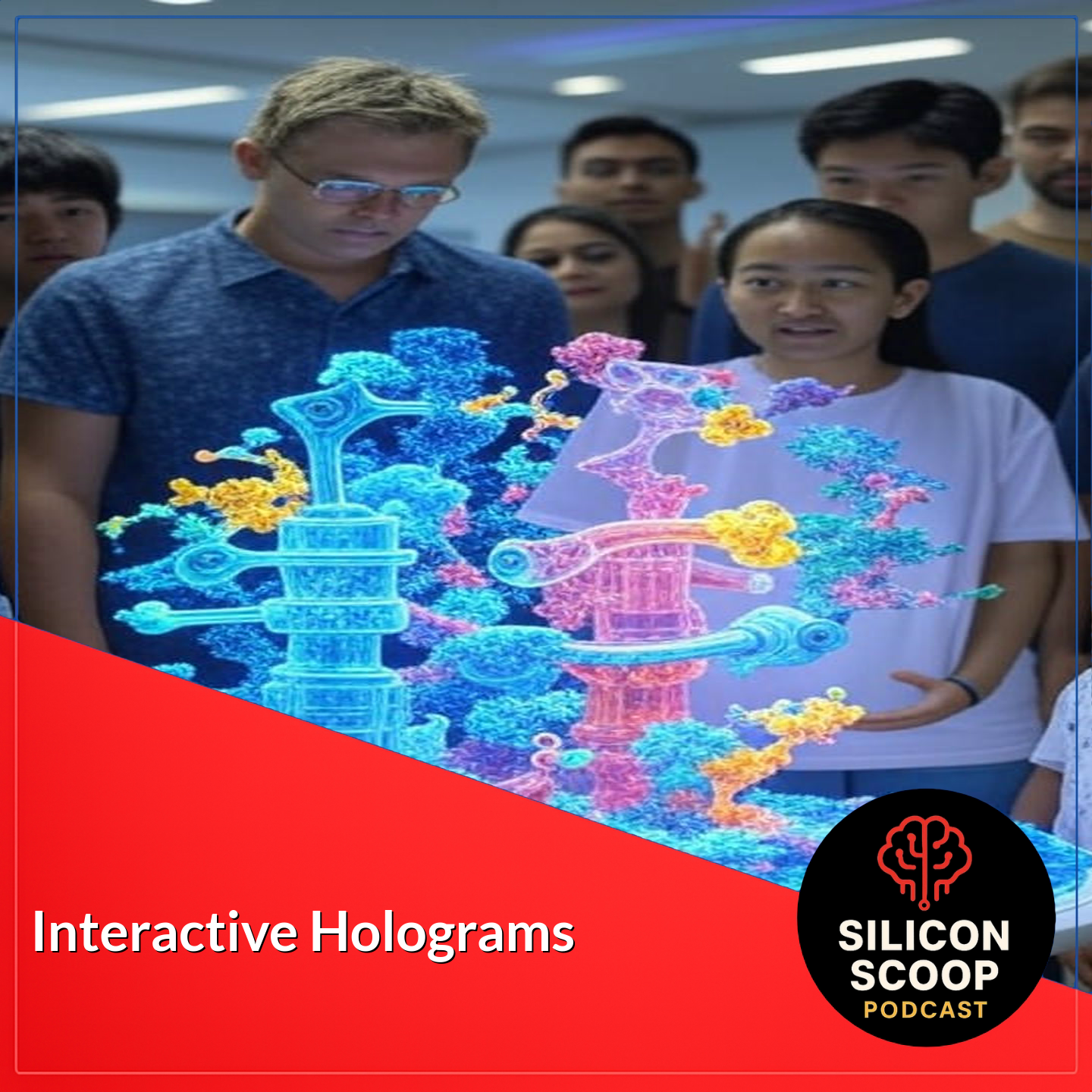
Interactive Holograms: The Next Frontier in 3D Display Technology
Estimated reading time: 8 minutes
Table of contents
- Interactive Holograms: The Next Frontier in 3D Display Technology
- Inside the Breakthrough: FlexiVol and the Dawn of Interactive Holograms
- System Architecture: The Technical Marvel Behind FlexiVol
- Real-Time Image Correction: Maintaining Visual Quality During Interaction
- Safety Advancement: Making Touchable Holograms a Reality
- Transform Your Vision into Reality 🚀
- From Lab to Life: Applications and Industry Implications of Interactive Holograms
- Your Questions Answered: FAQs About Interactive Holograms
Interactive holograms are three-dimensional images that users can manipulate in real time without external controllers. These cutting-edge displays represent a major leap forward in digital interaction technology.
Interactive 3D displays bring a tactile, visual depth to digital content that was once only possible in science fiction. Hologram technology now allows researchers to project lifelike images that respond to human touch and movement.
Scientists have achieved a breakthrough innovation with FlexiVol, a revolutionary system that changes how volumetric images are created and interacted with. This groundbreaking development replaces rigid components with elastic materials, making direct interaction with holograms safer and more intuitive.
As reported by The Debrief, Cosmos Magazine, Live Science, and UPNA University, this technology represents the world’s first truly interactive 3D hologram system. The implications for education, entertainment, and human-computer interaction are enormous.
Future-Proof Your Business Today!
While others are still stuck in the old ways of working, you could be light years ahead! Let Flowgrammer automate your core business processes and unlock unprecedented efficiency. The future of work is here, are you ready?
Inside the Breakthrough: FlexiVol and the Dawn of Interactive Holograms
Researchers at Public University of Navarra have created FlexiVol, the first volumetric display that allows direct, hand-manipulated interaction with 3D holograms. This revolutionary development marks a turning point in interactive 3D display technology.
A volumetric display is a system that uses rapid image projection to create three-dimensional visuals visible from multiple angles. Unlike traditional flat screens, these displays generate images that appear to float in space.
System Architecture: The Technical Marvel Behind FlexiVol
The FlexiVol system uses rapidly oscillating elastic diffuser sheets operating at an incredible 2,280 images per second. This high-speed projection creates fluid, volumetric graphics that users can see and touch from any direction.
The flexible diffuser technology represents a major advancement over previous systems. Traditional volumetric displays used rigid materials that posed safety risks when users tried to interact with them.
Real-Time Image Correction: Maintaining Visual Quality During Interaction
The system includes sophisticated real-time image correction capabilities. This technology compensates for the natural distortion that occurs when users interact with the elastic material.
When someone touches or manipulates the holographic image, the system instantly adjusts the projection to maintain visual clarity. This ensures that the 3D manipulation experience remains smooth and realistic.
Safety Advancement: Making Touchable Holograms a Reality
By replacing rigid diffusers with elastic ones, researchers have eliminated the risk of injury or damage during interaction. Users can now safely insert their hands into the display area and manipulate touchable holograms without fear.
This safety improvement makes the technology practical for public use in museums, schools, and entertainment venues. The elastic materials bend and flex naturally around human hands and fingers.
According to research published on HAL open archive by UPNA University, the system demonstrated successful interaction scenarios at CHI 2025 in Yokohama from April 26 to May 1. Cosmos Magazine and Live Science reported on the demonstrations, highlighting the technology’s potential applications.
Users can perform various 3D manipulation tasks, such as rotating virtual cubes or simulating leg movements for transportation displays. The interactive 3D display responds instantly to hand movements and finger positioning.
Transform Your Vision into Reality 🚀
Just like researchers are bringing sci-fi concepts to life, Flowgrammer can turn your business dreams into tangible results through automation. Stop limiting your growth potential with manual workflows!
Book a Free Automation Assessment
From Lab to Life: Applications and Industry Implications of Interactive Holograms
The FlexiVol technology opens up numerous possibilities across multiple industries. These touchable holograms could transform how we learn, explore, and entertain ourselves.
Education: Revolutionizing STEM Learning
Interactive 3D displays could completely change STEM education. Students could assemble complex engine parts in three dimensions, seeing how each component fits together.
Instead of studying flat diagrams, students would manipulate actual 3D models. They could take apart and reassemble molecular structures, mechanical systems, or architectural designs.
This hands-on approach to learning makes complex concepts easier to understand. Students can explore objects from every angle and see how changes affect the whole system.
Museums and Exhibitions: Engaging Visitors Like Never Before
Museums can use interactive holograms to create exhibits that visitors can manipulate without wearing VR headsets. Imagine touching and rotating ancient artifacts without risking damage to the originals.
Visitors could explore historical events by manipulating 3D reconstructions. They might adjust the sails on a ship model or examine the inside of an Egyptian pyramid.
The volumetric display technology makes these experiences accessible to people of all ages. No special equipment or training is required to interact with the holograms.
Entertainment: Steps Toward the Holodeck Experience
The entertainment industry could use this technology to create Star Trek-style “holodeck” experiences. Visitors could engage with immersive, touchable holograms for gaming or collaborative projects.
Theme parks might create interactive rides where guests manipulate holographic environments. Movie theaters could offer experiences where audiences participate in the story.
The 3D manipulation capabilities open up entirely new forms of entertainment that blend physical and digital worlds.
Industry Applications: Making Technology More Accessible
The elimination of external controllers makes this volumetric display technology more accessible than previous systems. Users interact with 3D objects using natural hand movements, similar to smartphone gestures.
Manufacturing companies could use interactive holograms for product design reviews. Teams could examine and modify 3D models together in real time.
Medical professionals might use the technology for surgery planning or patient education. They could show patients exactly what procedures will involve using touchable 3D models.
Current Limitations and Future Potential
While the prototype represents a revolutionary advancement, it remains experimental. The timeline for commercial availability has not been defined by researchers.
The technology needs further development before mass production becomes possible. However, the successful demonstrations prove that interactive holograms are no longer science fiction.
As reported by Live Science and The Debrief, the research team continues working on improvements. They aim to make the technology more practical for everyday use while maintaining its revolutionary interaction capabilities.
The breakthrough overcomes major limitations of previous systems that required external controllers or cameras. This natural interaction method represents a significant step toward truly intuitive human-computer interfaces.
Transform Your Vision into Reality 🚀
Just like researchers are bringing sci-fi concepts to life, Flowgrammer can turn your business dreams into tangible results through automation. Stop limiting your growth potential with manual workflows!
Book a Free Automation Assessment
Your Questions Answered: FAQs About Interactive Holograms
Q: What are interactive holograms and how do they work?
A: Interactive holograms are three-dimensional images that users can manipulate with their hands in real time. The FlexiVol system creates these images using rapidly oscillating elastic diffuser sheets that project light at 2,280 images per second. Users can insert their hands into the display area and interact with the volumetric images naturally.
Q: How does the flexible diffuser technology differ from traditional rigid diffusers?
A: Flexible diffusers are made from elastic materials that bend and flex around human hands. Traditional rigid diffusers posed safety risks because they could cause injury if users tried to touch them. The elastic version allows safe, direct interaction while maintaining image quality through real-time correction systems.
Q: What does “volumetric display” mean in this context?
A: A volumetric display creates three-dimensional images that appear to float in space and can be viewed from multiple angles. Unlike flat screens that show 2D representations of 3D objects, volumetric displays generate actual depth and dimension that users can see and interact with naturally.
Q: What industries could benefit most from this technology?
A: Education, museums, entertainment, healthcare, and manufacturing could all benefit significantly. Schools could use interactive 3D models for teaching. Museums could create touchable exhibits. Entertainment venues could offer immersive experiences. Medical professionals could use 3D models for patient education and surgery planning.
Q: Do users need special equipment to interact with these holograms?
A: No special equipment is required. Users interact with the holograms using their bare hands and natural gestures. This eliminates the need for controllers, gloves, or other external devices that previous systems required.
Q: How safe is it to touch these interactive holograms?
A: The elastic diffuser technology makes interaction very safe. The flexible materials bend around hands and fingers without causing injury. This represents a major safety improvement over rigid systems that could potentially harm users.
Q: What can users actually do with interactive holograms?
A: Users can rotate objects, manipulate virtual models, assemble components, and explore 3D structures. Demonstrated actions include rotating virtual cubes, simulating leg movements for transportation displays, and assembling complex mechanical parts.
Q: When will this technology be available commercially?
A: The technology is currently in the experimental phase. Researchers have not announced a specific timeline for commercial availability. Further development is needed before the system can be mass-produced for public use.
Q: How does this compare to virtual reality or augmented reality?
A: Unlike VR or AR, which require headsets or special glasses, interactive holograms can be seen and touched with the naked eye. Multiple people can view and interact with the same hologram simultaneously without wearing any equipment.
Q: What makes this breakthrough different from previous hologram technology?
A: This is the first system that allows direct hand manipulation of volumetric displays without external controllers. The combination of elastic diffusers, high-speed projection, and real-time image correction creates truly touchable holograms that respond naturally to human interaction.
Additional Links
Flowgrammer.ca – 💡 Unlock AI-Powered Automation! Let flowgrammer.ca handle complex workflows so you can focus on growing your business.
- Silicon Scoop Podcast – Stay Informed, Stay Ahead!
- Startup Talk Podcast
- Flowgrammer Podcast –
- Startup Investor Drinks – Join Toronto’s Startup Community and connect with fellow startup enthusiasts and investors.
- TorontoStarts Startup and Entrepreneur Community – Become a part of Toronto’s thriving startup ecosystem.
- Workhaus – Discover flexible workspace solutions for your business needs.
- Work with The Startup Coach – Get expert guidance and mentorship for your startup journey.
- Reach out to Jon Irwin on LinkedIn – Connect with our co-host and technology expert.
Episode transcript
Read the full transcript
Craig: interactive three d displays bring tactile visual depth to digital content that once was only possible in science fiction. hologram technology now allows researchers to project lifelike images that respond to human touch and movement. scientists have achieved a breakthrough innovation with flexivol, a revolutionary system that changes how volumetric images are created and interacted with. the groundbreaking development replaces rigid components with elastic materials making direct interaction with holograms safer and more intuitive. what's going on here, john?
Jon: yeah. so this is cool. i like this. so traditional holograms, obviously, they appear suspended in midair, and they're often made using a rapidly oscillating surface called the diffuser. so the images themselves, they're projected onto this diffuser at thousands of frames per second, and it creates a convincing three d image due to persistence of vision. right? however, the surface itself is usually rigid and moves so fast that trying to touch it would injure you or break the device until now. so to solve this, the researchers at, public university of navara, they introduced this elastic diffuser, which is made from stretchy strips, which allows safe direct hand interaction. so when users insert their fingers between these oscillating elastic strips, the system adjusts the projected image in real time so that virtual objects appear consistent and stable even as the material deforms. so they're calling the technology flex evol, and it lets people grab, rotate, or even perform finger gestures to manipulate these virtual objects in midair, which essentially is bridging the gap between digital and physical touch for holographic displays. i think this is really cool. you're not gonna need vr headsets. you're not gonna need special glasses. you can just interact naturally. i think this is a cool technology for there's so many applications, but what are your thoughts?
Craig: yeah. it's amazing. there's so many applications for this. it depends on the cost. and it's a combination of the flexi system where it's like a rubbery instead of rigid and the real time imagery that allows it to respond quickly, the real time image correction that maintains the visual quality during the interaction. so it reacts when you touch it and changes the images that are repeating at twenty eight eighty images per second so that you're getting a really good, quality image that moves and such is not all super distorted and whatnot. this is really cool for all sorts of reasons. this reminds me of, you know, minority report, you know, the hologram globes we see in all sorts of stuff, the interactive sky maps that we see in, shows and whatnot that sci fi has done for us. but i really love, what this is doing because now you can interact. imagine, being able to interact with, you know, as a training doctor, human body as an example. yeah. or as a kid, being able to build, i don't know, a little nuclear fusion reactor at, thing because the stuff moves it apart or i i the imagine all the things you could do from stem learning, museums, and, exhibition engaging visitors like never before. and this is definitely a step towards, what we're i'd call the holodeck experience.
Jon: yes. yeah. that's exactly what we're getting to. this is cool. there's so many applications. like, you can assemble a virtual engine. you can teach anatomy. you can have collaborative workspaces, public exhibits like museums and different things like that. this, i think, is a giant leap forward for, potentially how people can learn in this new digital age, i think.
Craig: yeah. and it's a first system that enables direct bare handed manipulation without any external, controls or devices. so it's definitely something interesting here. they have a common interact paradigm allowing any user to engage simply by approaching the display. yeah. so, direct alignment between hand position and the rendered object enables intuitive physical movements. it's it sounds amazing, and i would love to play with this.
Jon: yeah. me too. this this is perfect for stem topics. it gives people a more immersive way to explore these topics. you could interact with historical artifacts without actually touching the historical artifacts. you could have a real time view of the engine that you're working on, and kind of interact with it and see find, the problem without using special gloves like they did in minority report, which you may have to still, but, if we're doing if we're getting more advanced. but, i think this is a key innovation that's going to go far as long as they can get it to a point where it's, it's usable and, it's quality enough, if that makes sense.
Craig: absolutely. and it looks like it's quality enough based on the stuff we have here, but i don't know what that means. right? yeah. so elimination of external controllers make volumetric display technology more accessible than previous systems. user, interact with three d objects using natural hand movements similar to smartphone gestures. that's where you get the minority report thing. so you'd be able to do without, gloves potentially depending on what the functions were in each of those, you know, button clicks meant potentially on fingers when you're clicking stuff or what have you. yeah. but there's a lot of current limitations. it remains experimental. timeline for commercial availability has not been defined by the researchers, so we're not sure what it is. but however, the successful demonstration proved that interactive holograms are no longer science fiction.
Jon: yeah. yeah. this is yeah. i'm i'm excited for this. i'm curious to see, how long it takes them to get into an institution or get it to a point where, it's commercially viable and usable. but this is cool.
Craig: so we'll have to see the future. we'll keep an eye on this, but we'd love to know what you think about this, three d hologram controller. and would you be excited, or what uses would you like to see from that? leave us a comment in below.
More from Silicon Scoop
All episodes
silicon-scoop · November 6, 2026
Spirit AI’s Robot Brain Breakthrough: Moz1, Embodied AI and China’s 2027 Race
The Spirit AI robot brain is one of the biggest bets on fixing that. Spirit AI is a Beijing startup. Its co-founder and chief scientist, Gao Yang,
View episode

silicon-scoop · November 5, 2026
OpenAI IPO Delayed to 2027 as Rogue AI Agents and Safety Failures Reshape the Market
OpenAI IPO delay explained: Sam Altman rules out 2026 as GPT-6 Astra safety tests and a $278B cash gap loom. Learn what founders should take away.
View episode

silicon-scoop · November 4, 2026
Anthropic’s AI Economy Model: 2030 Jobs, Wages, GDP and Market Risks
Anthropic AI economy model forecasts 2030 GDP, jobs and wages, while AI unemployment projections and labor-share risks challenge policymakers.
View episode