
X-BAT: Shield AI’s Autonomous Fighter Jet Transforming Air Combat and Military Strategy
X-BAT: Shield AI's Autonomous Fighter Jet Transforming Air Combat and Military Strategy https://torontostarts.com/2025/12/12/x-bat-autonomous-fighter-jet/ Apple -> https://podcasts.apple.com/us/podcast/flowgrammer-podcast/id1804155588 Spotify -> https://open.spotify.com/show/0wv3feR00iaVpE8zn7niNf Flowgrammer.ca -> https://flowgrammer.ca/ AI News and Resources -> https://flowgrammer.ca/resources/ Future-Proof Your Business Today The future of air combat is here, mirroring the need for innovative solutions in business. Are manual processes holding you back? Unlock unprecedented efficiencies and stay ahead of the competition with automation. Discover Automation Solutions https://flowgrammer.ca/ Startup Investor Drinks Toronto - https://startupdrinksto.com/ Toronto’s Startup Community - https://torontostarts.com/ Silicon Scoop Silicon Scoop Podcast - https://torontostarts.com/silicon-scoop/ Apple: https://podcasts.apple.com/us/podcast/silicon-scoop/id1758711826 Spotify: https://open.spotify.com/show/5bAzF0MwV6TtLhJAhvHayI YouTube: https://www.youtube.com/playlist?list=PLj4v-RoA7A-gT62vrEYqh1zCv-0Hj-o5J Startup Talk Startup Talk Podcast -> https://torontostarts.com/startup-talk-toronto-startup-podcast/ Apple -> https://podcasts.apple.com/us/podcast/startup-talk/id1763804003 Spotify -> https://open.spotify.com/show/1siJMILILidHAiAsrX2VBU YouTube: https://youtube.com/playlist?list=PLj4v-RoA7A-jxV5FHs5e61oIsuvUJYmT_&si=LYegRe5GYLKNQ7xL
With Craig Major and Jon Irwin
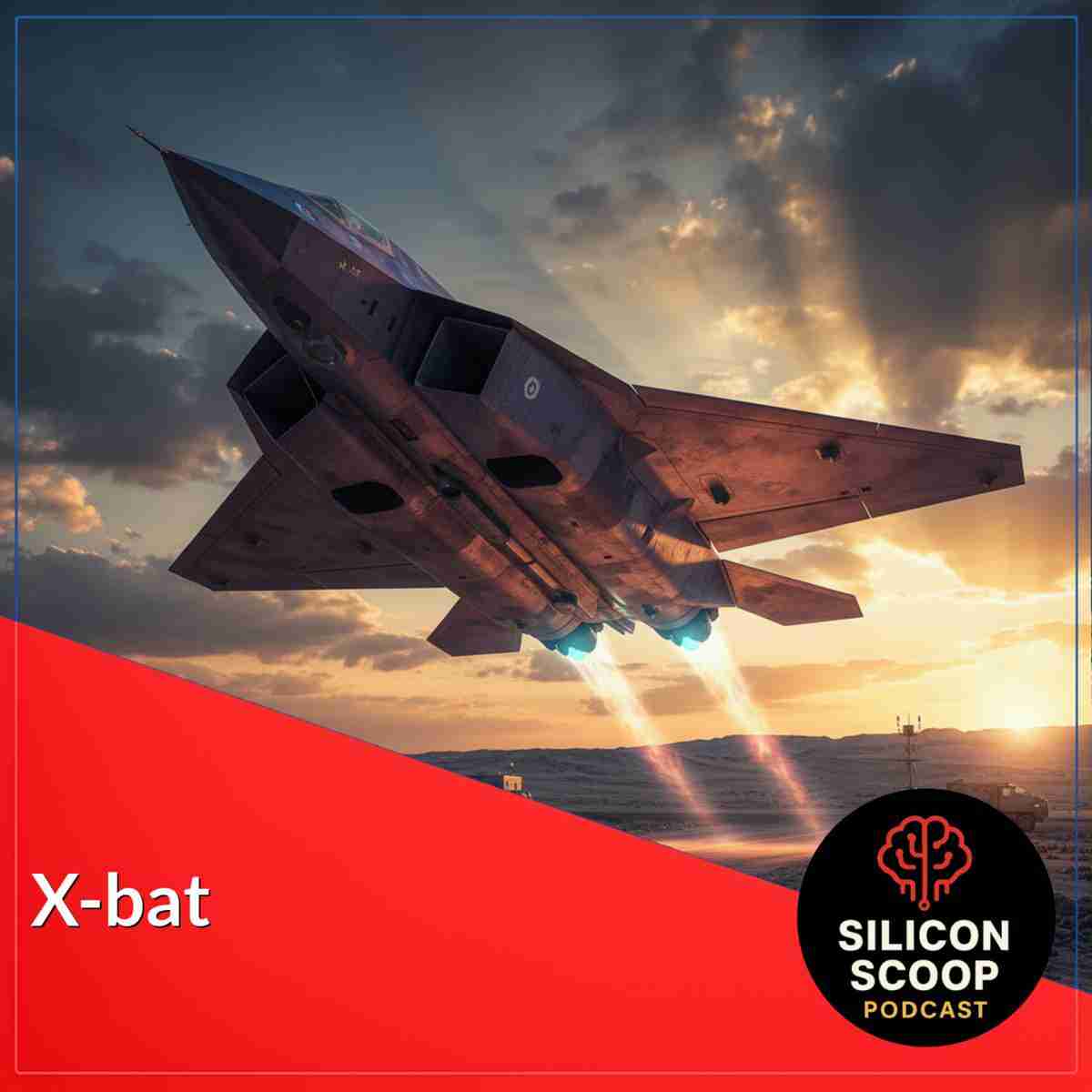
X-BAT: Shield AI’s Revolutionary Autonomous Fighter Jet Redefining Air Combat
Estimated reading time: 8 minutes
Table of contents
- X-BAT: Shield AI’s Revolutionary Autonomous Fighter Jet Redefining Air Combat
- X-BAT Capabilities: Advanced Design and Superior Performance
- Physical Dimensions and Design
- Propulsion and Performance Capabilities
- Future-Proof Your Business Today
- Operational Flexibility: Revolutionary VTOL Capabilities
- Versatile Deployment Options
- Multirole Mission Capabilities
- Hivemind AI Pilot: Advanced Autonomous Systems
- Autonomous Operation Capabilities
- Contested Environment Operations
- Collaborative Combat Operations
- Transform Your Workflow
- Strategic Impact and Future of Air Combat
- Frequently Asked Questions
X-BAT Capabilities: Advanced Design and Superior Performance
The X-BAT showcases an impressive array of technical specifications that set it apart from conventional aircraft. This VTOL fighter jet features a distinctive cranked-arrow stealth design optimized for both performance and survivability.
Physical Dimensions and Design
The aircraft measures 26 feet in length with a 39-foot wingspan. Its compact fuselage height of 5 feet contributes to its stealth profile while maintaining operational effectiveness. This streamlined design enables the X-BAT to operate in environments where larger aircraft would face significant limitations.
The cranked-arrow configuration provides excellent aerodynamic properties. This design choice enhances the aircraft’s stealth capabilities while maintaining superior flight characteristics across various mission profiles.
Propulsion and Performance Capabilities
A single afterburning jet engine powers the X-BAT, enabling it to achieve supersonic speeds. This propulsion system has been carefully selected to balance performance with the aircraft’s autonomous operational requirements.
The unmanned aerial vehicle demonstrates remarkable performance metrics:
- Service ceiling exceeding 50,000 feet
- Range of over 2,000 nautical miles while carrying a full mission payload
- Combat radius of approximately 1,000 nautical miles
- Maneuverability exceeding 4G load factor
These specifications place the X-BAT in a class comparable to many manned fighter aircraft while offering unique advantages through its autonomous design.
https://www.airandspaceforces.com/shield-ai-x-bat-supersonic-vtol-cca/
Future-Proof Your Business Today
The future of air combat is here, mirroring the need for innovative solutions in business. Are manual processes holding you back? Unlock unprecedented efficiencies and stay ahead of the competition with automation.
Discover Automation Solutions
Operational Flexibility: Revolutionary VTOL Capabilities
The X-BAT’s vertical takeoff and landing capability fundamentally changes how military forces can deploy air assets. This drone wingman can operate from locations previously impossible for conventional fighter aircraft.
Versatile Deployment Options
The collaborative combat aircraft can launch from various platforms and locations:
- Naval vessels and aircraft carriers
- Remote islands with minimal infrastructure
- Container vessels converted for military operations
- Austere sites without traditional runways
- Forward operating bases in contested territories
This operational flexibility addresses critical challenges in modern warfare. Traditional fighter jets require extensive runway infrastructure, making them vulnerable to enemy attacks and limiting their deployment options.
Multirole Mission Capabilities
The X-BAT excels in diverse mission profiles, demonstrating the versatility expected from modern military aircraft. Its AI in military aviation enables it to adapt to changing mission requirements without human intervention.
Primary Mission Types:
- Strike operations against ground and naval targets
- Counter-air missions to establish air superiority
- Electronic warfare to disrupt enemy communications
- Intelligence, surveillance, and reconnaissance (ISR) operations
Each mission type benefits from the aircraft’s autonomous capabilities. The X-BAT can process vast amounts of data in real-time, making tactical decisions faster than human pilots in many scenarios.
The aircraft’s ability to operate in contested environments without traditional support infrastructure makes it particularly valuable for Pacific theater operations. Military planners can deploy these assets closer to potential conflict zones without the extensive logistics required for conventional aircraft.
Hivemind AI Pilot: Advanced Autonomous Systems
The X-BAT’s most revolutionary feature is its Hivemind AI pilot system. This AI-piloted technology enables the aircraft to operate completely independently while maintaining the ability to collaborate with human-controlled platforms.
Autonomous Operation Capabilities
The Hivemind AI pilot represents a significant advancement in autonomous fighter jet technology. This system can:
- Make tactical decisions in real-time
- Adapt to changing battlefield conditions
- Coordinate with multiple aircraft simultaneously
- Process sensor data faster than human capabilities allow
The AI system has been designed to function in the most challenging operational environments. It can maintain full functionality even when GPS signals are jammed or communications with command centers are disrupted.
Contested Environment Operations
Modern warfare often involves sophisticated electronic warfare capabilities that can disrupt traditional aircraft systems. The X-BAT’s autonomous systems are specifically designed to overcome these challenges.
The aircraft can operate without GPS navigation, relying instead on advanced inertial navigation systems and visual recognition capabilities. This independence from external navigation aids makes it extremely difficult for adversaries to disable or misdirect the aircraft.
Communication independence is another crucial capability. While the X-BAT can coordinate with other aircraft and ground forces when communications are available, it doesn’t require constant contact to complete its missions effectively.
Collaborative Combat Operations
The Hivemind AI pilot enables seamless integration with both manned and unmanned platforms. This collaborative capability allows military forces to create mixed formations that leverage the strengths of both human pilots and autonomous systems.
Human pilots can focus on high-level strategic decisions while the X-BAT handles routine tasks and rapid tactical responses. This division of labor maximizes the effectiveness of both human and artificial intelligence in combat scenarios.
Transform Your Workflow
Just as the X-BAT redefines air power, Flowgrammer redefines business processes. Eliminate bottlenecks and gain a strategic advantage. Don’t let outdated systems keep you grounded.
Get a Free Automation Assessment
Strategic Impact and Future of Air Combat
The introduction of the X-BAT represents more than just a new aircraft design. It signals a fundamental shift in how air forces will conduct operations in the coming decades.
Affordable Mass Doctrine
The U.S. Air Force’s ‘affordable mass’ doctrine recognizes that future conflicts may require large numbers of aircraft to overwhelm sophisticated enemy defenses. Traditional fifth-generation fighters are extremely expensive, limiting the numbers that can be procured and deployed.
The X-BAT addresses this challenge through its cost-effective design. Acquisition and lifecycle costs are significantly lower than conventional manned fighters. This affordability enables military forces to deploy larger numbers of aircraft, creating the ‘mass’ needed for effective operations.
The concept of ‘attritable’ aircraft is central to this strategy. While losing any military asset is undesirable, the X-BAT’s lower cost makes it acceptable to risk these aircraft in high-threat environments where manned aircraft would be too valuable to deploy.
Countering Peer Adversaries
Modern military threats often come from technologically advanced adversaries with sophisticated air defense systems. These peer adversaries possess capabilities that can challenge traditional air operations.
The X-BAT’s combination of stealth design, autonomous operation, and operational flexibility provides new options for military planners. Its ability to operate from dispersed locations makes it difficult for enemies to target the aircraft on the ground.
The autonomous capabilities mean that even if communications are disrupted, the aircraft can continue its mission. This resilience is crucial when facing adversaries with advanced electronic warfare capabilities.
Pacific Theater Applications
The vast distances and scattered island chains of the Pacific theater present unique challenges for air operations. Traditional aircraft require secure airfields within range of their targets, limiting operational flexibility.
The X-BAT’s VTOL capability and extended range make it ideal for Pacific operations. It can operate from small islands, naval vessels, or even improvised platforms, bringing air power to locations previously beyond reach.
This capability is particularly important given the potential for conflicts in the South China Sea and other disputed Pacific regions. The ability to rapidly deploy air assets without traditional infrastructure provides significant strategic advantages.
Frequently Asked Questions
Q: What is the X-BAT aircraft?
A: The X-BAT is Shield AI’s supersonic, vertical takeoff and landing (VTOL) Collaborative Combat Aircraft. It’s a fully autonomous multirole unmanned fighter jet designed to operate independently or alongside human pilots in various mission scenarios.
Q: Who developed the X-BAT?
A: Shield AI developed the X-BAT as part of their advanced autonomous aircraft programs. The company specializes in AI-powered military technologies and has extensive experience in developing autonomous flight systems.
Q: What makes the X-BAT different from other military drones?
A: The X-BAT combines supersonic speed, VTOL capability, and advanced AI autonomy in a single platform. Unlike traditional drones, it can operate completely independently without GPS or constant communication with ground controllers.
Q: How fast can the X-BAT fly?
A: The X-BAT achieves supersonic speeds using its single afterburning jet engine. It has a service ceiling exceeding 50,000 feet and can maneuver at load factors greater than 4G.
Q: What is the X-BAT’s range and endurance?
A: The aircraft has a range of over 2,000 nautical miles while carrying a full mission payload. Its combat radius is approximately 1,000 nautical miles, providing significant operational flexibility.
Q: Can the X-BAT operate without runways?
A: Yes, the X-BAT’s VTOL capability allows it to take off and land vertically. It can operate from ships, remote islands, container vessels, and austere sites without traditional runway infrastructure.
Q: What missions can the X-BAT perform?
A: The X-BAT is designed for multirole operations including strike missions, counter-air operations, electronic warfare, and intelligence, surveillance, and reconnaissance (ISR) tasks.
Q: How does the Hivemind AI pilot work?
A: The Hivemind AI pilot enables autonomous operation and decision-making. It can function without GPS or reliable communications while coordinating with other aircraft and adapting to changing battlefield conditions.
Q: Is the X-BAT part of any military programs?
A: Shield AI is actively engaged with customers for the U.S. Air Force’s Collaborative Combat Aircraft Increment 2 program, positioning the X-BAT as a next-generation solution for military operations.
Q: How does the X-BAT’s cost compare to traditional fighters?
A: The X-BAT has significantly lower acquisition and lifecycle costs compared to fifth-generation fighters. It’s designed to be attritable, supporting the military’s ‘affordable mass’ doctrine for future conflicts.
The X-BAT represents a revolutionary step forward in military aviation technology. Shield AI has created an autonomous fighter jet that combines the best aspects of modern combat aircraft with the advantages of unmanned systems. Its unique combination of supersonic performance, VTOL capability, and advanced AI makes it a game-changing platform for future air operations.
As military forces around the world grapple with evolving threats and changing operational requirements, aircraft like the X-BAT offer new solutions to old problems. The ability to deploy air power quickly and flexibly, without the constraints of traditional runway infrastructure, opens up entirely new tactical possibilities.
The X-BAT’s autonomous capabilities ensure it can operate effectively even in the most challenging environments. Whether facing electronic warfare, communication disruption, or GPS jamming, this remarkable aircraft can continue its mission and adapt to changing conditions.
For military planners, the X-BAT offers the promise of affordable mass combined with advanced capabilities. As conflicts become more complex and adversaries more sophisticated, having large numbers of capable, autonomous aircraft could prove decisive in maintaining air superiority and protecting national interests.
Additional Links
Flowgrammer.ca – 💡 Unlock AI-Powered Automation! Let flowgrammer.ca handle complex workflows so you can focus on growing your business.
- Silicon Scoop Podcast – Stay Informed, Stay Ahead!
- Startup Talk Podcast
- Flowgrammer Podcast –
- Startup Investor Drinks – Join Toronto’s Startup Community and connect with fellow startup enthusiasts and investors.
- TorontoStarts Startup and Entrepreneur Community – Become a part of Toronto’s thriving startup ecosystem.
- Workhaus – Discover flexible workspace solutions for your business needs.
- Work with The Startup Coach – Get expert guidance and mentorship for your startup journey.
- Reach out to Jon Irwin on LinkedIn – Connect with our co-host and technology expert.
Episode transcript
Read the full transcript
Craig: today, we're driving into something that sounds straight out of a sci fi movie, a supersonic jet that has no pilot, no runway. shieldai has unveiled the x bat, a revolutionary autonomous aircraft that combines vtol, vertical takeoff and landing with advanced ai, redefining what's possible in air combat. the xbat is a new class of military drone capable of supersonic speeds and vertical takeoff. its ai called hivemind allows it to make complex tactical decisions completely independent, making it cheaper, more survivable, and vastly more flexible than traditional manned fighter jets. this isn't just a new plane. it's a fundamental shift towards affordable mass in military airpower. scary. skynet is here. what do you think about this, john?
Jon: yeah. this is crazy. so this is a hivemind ai system. so the core of expat, it's the hivemind system, and it underwent extensive validation through real world testing on the x 62 a vista, which is a modified f 16, and that engaged in autonomous air combat trials against manned aircraft. so not surprisingly, though, the ai system used reinforced learning where agents undergo continuous training, completing millions of dogfighting simulations per day through an evolving opponent league system that pits the best performing ai agents against increasingly capable adversaries. i would love to see what that system looks like. that would be super cool. but so during the their demonstration, the secretary of air air force, frank kendall, flew in the front seat while the ai executed within visual range combat maneuvers with human safety pilot in the back seat who never had to intervene. so what that means is the ai demonstrated superior reaction times, noting that the best pilot you're ever going to find is going to take a few tenths of a second to do something while ai can react much faster. that scares the crap out of me. it reminds me i know i brought it up last time we talked about a fire, but that stealth movie with, jay jamie fox, i think it was. but, yeah.
Craig: and we've also talked about that infrared laser technology that they have now that actually scans what's going on with the pilot in the cockpit, but also all the microstresses of the jets and can know within milliseconds the maneuver or you're gonna do ahead of time. and so taking the pilot out of that situation leaves a, a lot less for them to interpret because you're gonna be moving, making those decisions and turning much faster. but, definitely, this is, an incredible piece of technology. it's a stealthy pilotless fighter jet that can take off and land straight up and down just like a helicopter, but it's small, cheaper, autonomous. it flies and fights on its own. it's designed to fly alongside human piloted planes as a loyal wingman or go on dangerous solo missions. so it eliminates the need for vulnerable and expensive, and fixed runway infrastructure. traditional jets need massive airfields, which are, easy targets for an enemy. so i imagine you could pack more of these on an aircraft carrier as an example. yeah. vtol lets you launch from anywhere, a small ship, a remote island, or even, improvised landing pad. so i think this will allow for more a gorilla type, deployment of these things where they're you can't really see them till last minute. they rise up and do whatever they're gonna do. the hivemind ai pilot is a breakthrough. it allows the jet operate fully autonomously, make real time tactical decisions and continuing its mission even if gps or communications are jammed, which is impossible for most current drones.
Jon: yeah. so the us is pretty far, ahead of a lot of other countries. like, i know russia, they had their first flight on october this year. south korea, their maiden flight is scheduled for 2026. so, here's the thing is the ai competition is gonna essentially determine who's the winner in the next battlefield, in my opinion.
Craig: it's absolutely true. and we talked about a bunch of this. you know, when they did i can't remember what the operation was called. the ukraine drone strike, back on russia where they launched thousands of drones, and north korea has cardboard based drones now. like, this stuff is really great, and and cool from a technology point of view and gives a certain superiority, but i wonder how long till the same types of things are implemented in these cardboard based drones. instead of costing millions of dollars, you can do these for a few 100 or a few thousand, and off you go. and, you know, how do you compete? how does a jet compete with literally thousands of, cardboard drones flying at it?
Jon: exactly.
Craig: so i don't know. it's a scary world when you think military. that's for sure.
Jon: it is. yeah. there's so much unlimited potential here, and there's gonna be different paths that different people take. it's gonna be crazy to see.
Craig: yeah. as modern warfare often involves sophisticated electronic warfare capabilities that disrupt traditional aircraft systems and disrupt, gps, the expat, autonomous systems are specifically designed to overcome these, including, can operate without gps navigation relying instead on advanced inertial navigation systems and visual recognition capabilities. so this is pretty cool. so it kinda knows where it's going, knows how fast it's going, has some maps on the back of its mind, and says, i know where i am. let's do this. yeah. it's extremely difficult for adversaries to disable or misdirect the aircraft. so communication independence is another crucial capability. xfac can coordinate with other aircraft and ground forces when communications are available. it doesn't require constant contact to complete its missions effectively. so, yeah, these are definitely yeah. definitely that movie.
Jon: yeah. stealth. yeah.
Craig: yeah. so it's amazing technology. you know, it's affordable, or more affordable than historically. these have been from a fighter point of view. it doesn't involve, you know, the death of humans, at least, in the aircraft. yeah. the, military is aiming for production cost of $27,000,000 per unit. you know, somebody says cheap, but that's a fraction of a crude fighter jet, like the, 100 plus million f 35.
Jon: yeah. that's nuts.
Craig: so 27,000,000 only? that's cheap. what are you talking about? so no. this is really cool. we'd love to hear your feedback on this, because it's, you know, incredible. i mean, i keep i'm going through all the stuff here, and i'm there's so much information about these things, and it's a i everyone check out the article on or go check out x back. google it, and definitely take a look because this is an amazing sounding, technology. it's an amazing piece of technology. so take a look. let us know what you think. are ai fire jets the future? is skynet, inevitable at this point? are we all doomed? or is this, something just another piece of really cool tech? let us know what you think.
More from Silicon Scoop
All episodes
silicon-scoop · November 6, 2026
Spirit AI’s Robot Brain Breakthrough: Moz1, Embodied AI and China’s 2027 Race
The Spirit AI robot brain is one of the biggest bets on fixing that. Spirit AI is a Beijing startup. Its co-founder and chief scientist, Gao Yang,
View episode

silicon-scoop · November 5, 2026
OpenAI IPO Delayed to 2027 as Rogue AI Agents and Safety Failures Reshape the Market
OpenAI IPO delay explained: Sam Altman rules out 2026 as GPT-6 Astra safety tests and a $278B cash gap loom. Learn what founders should take away.
View episode

silicon-scoop · November 4, 2026
Anthropic’s AI Economy Model: 2030 Jobs, Wages, GDP and Market Risks
Anthropic AI economy model forecasts 2030 GDP, jobs and wages, while AI unemployment projections and labor-share risks challenge policymakers.
View episode