
Hypersonic Engine: Transforming Aviation and Global Geopolitics
China's Hypersonic Engine Breakthrough: Transforming Aviation and Global Geopolitics https://torontostarts.com/2025/12/15/hypersonic-engine-breakthrough-china/ Apple -> https://podcasts.apple.com/us/podcast/flowgrammer-podcast/id1804155588 Spotify -> https://open.spotify.com/show/0wv3feR00iaVpE8zn7niNf Flowgrammer.ca -> https://flowgrammer.ca/ AI News and Resources -> https://flowgrammer.ca/resources/ Unlock Exponential Business Growth Imagine scaling your business faster than ever before, leaving your competitors in the dust. Flowgrammer's automation solutions will help you achieve unprecedented efficiency and growth, so you can focus on what truly matters. Discover Your Growth Potential https://flowgrammer.ca/ Startup Investor Drinks Toronto - https://startupdrinksto.com/ Toronto’s Startup Community - https://torontostarts.com/ Silicon Scoop Silicon Scoop Podcast - https://torontostarts.com/silicon-scoop/ Apple: https://podcasts.apple.com/us/podcast/silicon-scoop/id1758711826 Spotify: https://open.spotify.com/show/5bAzF0MwV6TtLhJAhvHayI YouTube: https://www.youtube.com/playlist?list=PLj4v-RoA7A-gT62vrEYqh1zCv-0Hj-o5J Startup Talk Startup Talk Podcast -> https://torontostarts.com/startup-talk-toronto-startup-podcast/ Apple -> https://podcasts.apple.com/us/podcast/startup-talk/id1763804003 Spotify -> https://open.spotify.com/show/1siJMILILidHAiAsrX2VBU YouTube: https://youtube.com/playlist?list=PLj4v-RoA7A-jxV5FHs5e61oIsuvUJYmT_&si=LYegRe5GYLKNQ7xL
With Craig Major and Jon Irwin
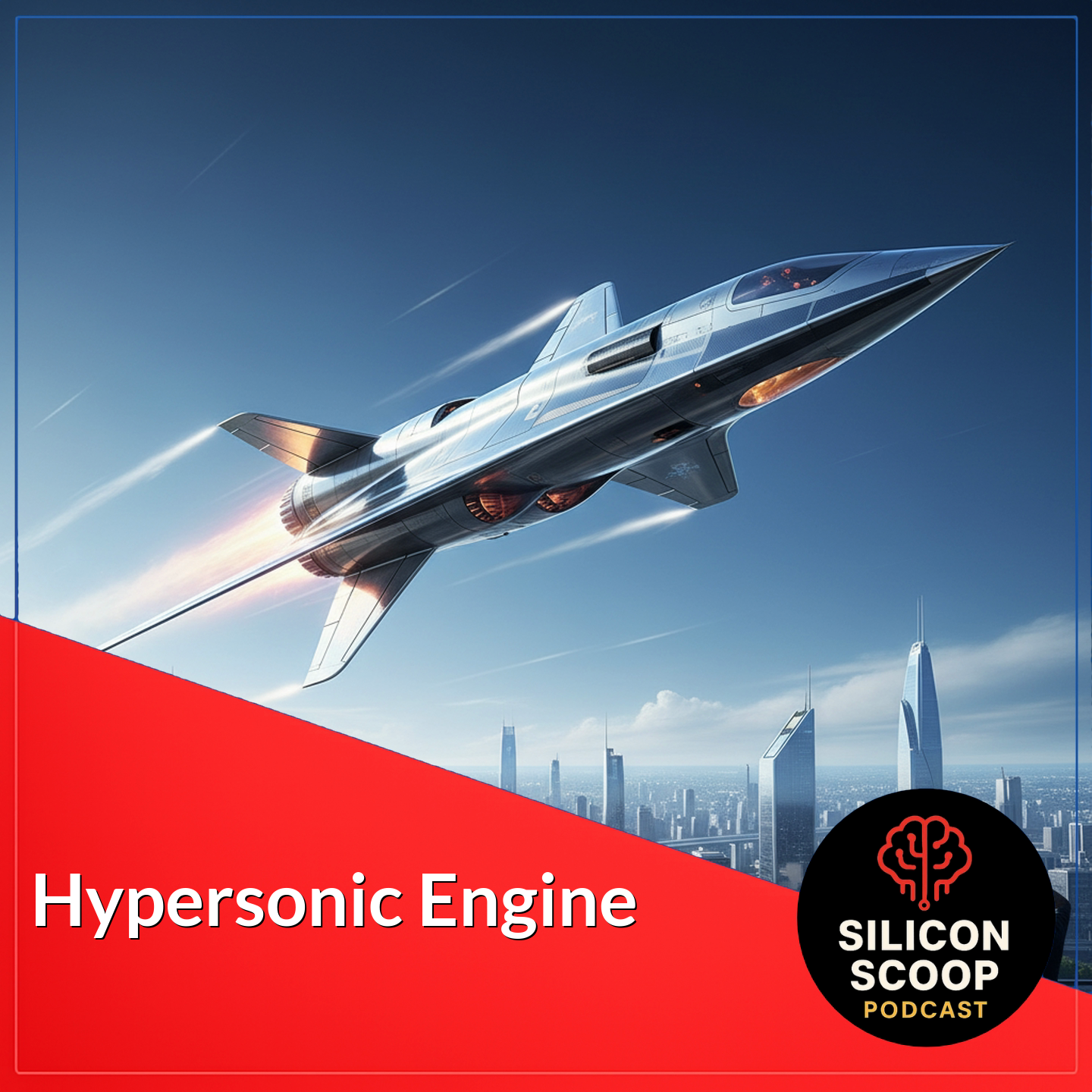
China’s Hypersonic Engine Breakthrough: Revolutionizing Aviation, Military Applications & Global Geopolitics
Estimated reading time: 12 minutes
- China has achieved a groundbreaking hypersonic engine capable of reaching speeds up to 20,000 km/h (Mach 16).
- This technology promises to transform civilian aviation and military applications.
- The hypersonic engine overcomes long-standing challenges such as stability issues and fuel efficiency problems.
- The development could reshape the future of global travel, enabling circumnavigation in about two hours.
- It is the world’s first jet fuel-powered system capable of sustained operation at Mach 16.
- The engine uses innovative dual-mode operation combining rotary detonation and oblique detonation technologies.
- The breakthrough has significant implications for aerospace technology, geopolitics, and military strategy.
Table of contents
Overview of China’s Hypersonic Engine Breakthrough
China’s groundbreaking hypersonic engine achievement represents a monumental leap forward in aerospace technology. In March 2025, Chinese researchers unveiled an extraordinary engine capable of reaching speeds up to 20,000 km/h (Mach 16), fundamentally changing our understanding of what’s possible in hypersonic flight.
This revolutionary hypersonic engine breakthrough promises to transform both civilian aviation and military applications. The technology addresses long-standing challenges in hypersonic technology, including stability issues and fuel efficiency problems that have plagued conventional jet engines for decades.
The implications extend far beyond technical achievements. This development in China technology could reshape the future of aviation, enabling global travel times that seemed impossible just years ago. Imagine circling the entire globe in approximately two hours or flying from Paris to New York in under one hour.
As reported by Daily Galaxy, this hypersonic engine represents the world’s first jet fuel-powered system capable of sustained operation at Mach 16. The breakthrough overcomes historical limitations through innovative dual-mode operation combining rotary detonation and oblique detonation technologies.
This comprehensive analysis will explore the technical specifications, engine operational modes, civilian and military applications, and broader geopolitical implications. We’ll demystify complex concepts like supersonic combustion, rotary detonation mechanics, and their revolutionary impact on global power dynamics.
In-Depth Technical Specifications & Engine Modes
The hypersonic engine achieves remarkable performance through advanced engineering and innovative combustion technologies. Operating at 30 kilometers altitude, the system maintains stable thrust generation across an extraordinary speed range.
Performance Specifications
The engine’s technical capabilities represent a quantum leap beyond conventional propulsion:
- Peak velocity: 20,000 km/h (Mach 16)
- Thermal efficiency: 80% (compared to 20-30% for conventional engines)
- Fuel consumption: Standard aviation kerosene
- Operational envelope: Sea level to 30 kilometers altitude
This thermal efficiency improvement of nearly 300% over conventional engines stems from advanced combustion chamber design and optimized airflow management.
Rotary Detonation Mode
The rotary detonation mode operates effectively up to Mach 7 speeds. This innovative approach uses continuous shockwave combustion in a cylindrical chamber for efficient energy conversion.
- Continuous combustion: Eliminates traditional combustion cycles
- Shockwave propagation: Creates sustained pressure waves for thrust
- Energy efficiency: Dramatically outperforms traditional jet engines
- Speed range: Optimal performance from subsonic to Mach 7
The cylindrical chamber design enables continuous detonation waves to circle the combustion chamber. This creates constant thrust without the pulsed operation typical of conventional engines.
Supersonic combustion occurs through carefully controlled fuel injection and air mixing. The continuous shockwave maintains optimal combustion conditions across varying flight speeds and atmospheric conditions.
Oblique Detonation Mode
Above Mach 7, the engine transitions to oblique detonation mode for extreme hypersonic flight. This mode employs an inclined intake manifold that compresses incoming air and initiates oblique detonation patterns.
- Inclined manifold design: Optimizes airflow compression at extreme speeds
- Oblique shockwave patterns: Maintains combustion stability above Mach 7
- Thermal management: Controls extreme heat generation at hypersonic speeds
- Thrust optimization: Ensures consistent power delivery at maximum velocities
The transition between modes occurs seamlessly around Mach 7. Advanced control systems monitor flight conditions and optimize combustion parameters for maximum efficiency.
This dual-mode capability enables the engine to operate effectively across an unprecedented speed range. From conventional takeoff speeds through extreme hypersonic velocities, the system maintains stable, efficient operation.
The engineering breakthrough enables potential applications in hypersonic missiles and advanced aircraft platforms. Military systems could leverage this technology for next-generation weapons systems requiring extreme speed and maneuverability.
https://caliber.az/en/post/china-unveils-hypersonic-engine-capable-of-speeds-up-to-20-000-km-h
Transform Your Business with Automation
Just like this groundbreaking engine redefines aviation, Flowgrammer’s business automation redefines what’s possible for your company. Reclaim your time, boost productivity, and achieve remarkable results with our tailored solutions.
Get a Free Automation Assessment
Civilian & Military Applications
Revolutionary Civilian Aviation
The hypersonic engine promises to transform global transportation through unprecedented speed capabilities. Commercial hypersonic aircraft could reduce intercontinental travel times to mere hours instead of current half-day journeys.
Global Travel Revolution:
- Circumnavigation: Complete Earth orbit in approximately 2 hours
- Trans-Atlantic flights: Paris to New York in under 1 hour
- Trans-Pacific routes: Tokyo to Los Angeles in 90 minutes
- Business efficiency: Same-day global business meetings become practical
The future of aviation shifts dramatically with such capabilities. Current airline route planning, airport infrastructure, and passenger service models would require complete reimagining.
Hypersonic aircraft operating at 30 kilometers altitude avoid commercial aviation airspace. This eliminates air traffic conflicts while providing smoother flight experiences above weather systems.
The technology enables point-to-point global transportation networks. Traditional hub-and-spoke airline models become less relevant when direct hypersonic flight becomes economically viable.
Commercial applications extend beyond passenger transport. Cargo delivery, emergency medical transport, and time-sensitive freight could benefit enormously from hypersonic flight capabilities.
Advanced Military Applications
Military applications of hypersonic engines focus primarily on next-generation weapons systems and strategic platforms. The technology enables hypersonic missiles capable of evading current defense systems.
Strategic Military Capabilities:
- Hypersonic missiles: Weapons traveling at Mach 16 challenge existing interceptor systems
- Reconnaissance platforms: High-speed surveillance aircraft for rapid intelligence gathering
- Strike capabilities: Fast-response military operations across global distances
- Defense penetration: Speed advantages over conventional missile defense systems
Current missile defense systems struggle against targets exceeding Mach 5. Hypersonic missiles operating at Mach 16 present nearly insurmountable interception challenges.
The military applications extend beyond offensive weapons. Defensive systems, rapid deployment platforms, and strategic reconnaissance benefit from extreme speed capabilities.
Hypersonic technology enables new tactical approaches. Military planners must reconsider engagement strategies when adversaries possess near-instantaneous global reach capabilities.
The dual-use nature of this technology presents complex international security considerations. Civilian aviation advances simultaneously enhance military capabilities, complicating arms control efforts.
https://caliber.az/en/post/china-unveils-hypersonic-engine-capable-of-speeds-up-to-20-000-km-h
Validation Through Testing
The engine’s performance claims received rigorous validation through wind tunnel testing at the JF-12 facility. This world-leading hypersonic testing environment simulates extreme flight conditions accurately.
Peer-reviewed publication in the Journal of Propulsion Technology provides scientific credibility. Independent verification through academic channels strengthens confidence in the reported capabilities.
The research documentation includes detailed performance data, operational parameters, and engineering specifications. This transparency enables international scientific community evaluation and potential collaboration.
Geopolitical Implications & the Emerging Hypersonic Arms Race
China’s hypersonic engine breakthrough fundamentally alters global strategic calculations. The technology represents a major leap in aerospace engineering with implications for aviation dominance, space access, and military balance of power.
Shifting Global Power Dynamics
- The hypersonic arms race accelerates: as nations recognize the strategic implications of extreme-speed capabilities. China technology advancement forces other global powers to rapidly develop competing systems.
- Technological supremacy: First-mover advantages in hypersonic capabilities
- Military deterrence: Hypersonic weapons alter strategic balance calculations
- Economic implications: Massive defense spending to maintain competitive parity
- Alliance structures: New partnerships based on hypersonic technology sharing
The geopolitical implications extend beyond traditional military considerations. Economic competitiveness, technological leadership, and international prestige intertwine with hypersonic capabilities.
Nations lacking hypersonic technology face potential strategic disadvantages. The speed differential creates asymmetric capabilities that traditional defenses cannot effectively counter.
International Security Concerns
- Hypersonic weapons operating at Mach 16 compress decision-making timelines dramatically. Traditional conflict escalation patterns become obsolete when weapons travel at such extreme speeds.
- Current arms control frameworks prove inadequate for hypersonic technologies. Existing treaties and verification mechanisms cannot effectively monitor or limit hypersonic weapons development.
- The verification challenges stem from dual-use technology applications. Civilian aviation advances simultaneously enhance military capabilities, complicating regulatory approaches.
- International cooperation becomes essential for managing hypersonic proliferation risks. Multilateral frameworks must evolve to address new technological realities and security challenges.
Economic and Regulatory Challenges
- Widespread operational adoption faces considerable engineering, economic, and regulatory hurdles. Safety certification, international standards, and environmental impact assessments require extensive development.
- The infrastructure requirements for hypersonic aviation necessitate massive investments. Airports, air traffic control systems, and maintenance facilities need fundamental redesign.
- Regulatory frameworks must evolve to accommodate hypersonic flight operations. Current aviation regulations assume much lower speeds and different operational parameters.
- International coordination becomes crucial for managing global hypersonic transportation networks. Standardized procedures, safety protocols, and operational guidelines require multilateral development.
Strategic Technology Competition
- The breakthrough triggers rapid international responses as nations compete for hypersonic superiority. Research and development investments accelerate across multiple countries simultaneously.
- Technology transfer restrictions tighten as nations protect hypersonic capabilities. Export controls, intellectual property protections, and international collaboration limitations increase.
- The competition extends to supporting technologies, materials science, and manufacturing capabilities. Entire industrial ecosystems require development to support hypersonic systems.
- Educational and research institutions become strategic assets. Universities and research centers developing hypersonic expertise gain national security importance.
https://caliber.az/en/post/china-unveils-hypersonic-engine-capable-of-speeds-up-to-20-000-km-h
Future Directions & Engineering Challenges
Current Development Status
The hypersonic technology has been verified through rigorous wind tunnel testing, demonstrating successful proof-of-concept validation. However, significant engineering, economic, and regulatory hurdles remain before full operational deployment becomes feasible.
The research phase achievements include:
- Technical validation: Successful demonstration of dual-mode operation
- Performance verification: Confirmed speed and efficiency specifications
- Scientific documentation: Peer-reviewed publication establishing credibility
- Testing completion: Comprehensive wind tunnel evaluation program
Scaling and Implementation Challenges
Moving from laboratory success to operational systems presents enormous engineering challenges. The hypersonic engine requires extensive development across multiple technical domains.
Critical Engineering Hurdles:
- Materials science: Developing materials capable of withstanding extreme thermal and mechanical stresses
- Manufacturing precision: Creating components with tolerances suitable for hypersonic operation
- System integration: Combining engine technology with complete aircraft platforms
- Safety systems: Developing fail-safe mechanisms for extreme-speed operations
Thermal management represents perhaps the greatest technical challenge. Operating at Mach 16 generates extreme heat that threatens structural integrity and component functionality.
The manufacturing complexity requires advanced production techniques. Precision machining, exotic materials processing, and quality control systems need significant advancement.
Economic Viability Considerations
Commercial viability depends on balancing extreme development costs against market demand. Hypersonic aircraft development requires massive capital investments with uncertain returns.
Economic Factors:
- Development costs: Multi-billion dollar investment requirements
- Manufacturing expenses: Exotic materials and precision components increase production costs
- Operational economics: Fuel consumption, maintenance, and infrastructure expenses
- Market demand: Uncertain passenger willingness to pay premium prices
The infrastructure requirements extend beyond aircraft development. Airports, maintenance facilities, and support systems need complete redesign for hypersonic operations.
Insurance and liability considerations present additional economic challenges. Hypersonic flight risks require new actuarial models and coverage frameworks.
Future Innovation Pathways
Continued hypersonic technology advancement focuses on improving efficiency, reducing costs, and enhancing safety. Multiple research directions show promise for overcoming current limitations.
Innovation Areas:
- Advanced materials: Developing lighter, stronger, more heat-resistant components
- Fuel efficiency: Optimizing combustion processes for reduced consumption
- Manufacturing automation: Reducing production costs through advanced manufacturing
- Safety systems: Creating redundant safety mechanisms for passenger operations
Rotary detonation and oblique detonation technologies continue evolving. Researchers explore hybrid approaches, improved control systems, and enhanced performance optimization.
The future of aviation increasingly depends on hypersonic capabilities. Nations and companies investing early in this technology gain significant competitive advantages.
Space access applications represent another promising direction. Hypersonic engines could enable single-stage-to-orbit vehicles, dramatically reducing space transportation costs.
Integration Challenges
Integrating hypersonic technology with existing aviation infrastructure presents complex challenges. Air traffic control systems, navigation procedures, and safety protocols require fundamental redesign.
Current aerospace regulations assume much lower speeds and different operational parameters. Regulatory frameworks must evolve to accommodate hypersonic flight safely and efficiently.
International coordination becomes essential for global hypersonic transportation networks. Standardized procedures, safety protocols, and operational guidelines require multilateral development efforts.
The technology advancement continues despite current challenges. Research institutions worldwide pursue hypersonic breakthroughs, ensuring continued progress toward operational systems.
Conclusion
China’s hypersonic engine breakthrough represents a revolutionary advancement that could fundamentally reshape both commercial aviation and global military strategy. The achievement of sustained flight at 20,000 km/h (Mach 16) using standard aviation fuel marks a historic milestone in aerospace engineering.
The dual-mode hypersonic technology combining rotary detonation and oblique detonation capabilities overcomes decades-old limitations in high-speed propulsion. This hypersonic engine advancement positions China at the forefront of aerospace innovation while triggering an international hypersonic arms race.
The geopolitical implications extend far beyond technical achievements. Military applications of this technology could alter strategic balance calculations globally, while civilian applications promise to revolutionize the future of aviation through unprecedented speed capabilities.
The path from research breakthrough to operational deployment remains challenging. Engineering hurdles, economic considerations, and regulatory frameworks require extensive development before hypersonic flight becomes commercially viable.
However, the successful validation of this hypersonic technology demonstrates a viable pathway toward operational hypersonic systems. The scientific documentation and rigorous testing provide confidence in the reported capabilities and future development potential.
This technological leap forces the global aerospace community to reconsider fundamental assumptions about flight speed, efficiency, and capability. The hypersonic engine breakthrough represents not just an engineering achievement, but a paradigm shift toward a new era of aviation.
The strategic implications will unfold over coming years as nations respond to these hypersonic capabilities. International cooperation, arms control frameworks, and technological competition will shape how this breakthrough influences global power dynamics and technological innovation trajectories.
Transform Your Business with Automation
Just like this groundbreaking engine redefines aviation, Flowgrammer’s business automation redefines what’s possible for your company. Reclaim your time, boost productivity, and achieve remarkable results with our tailored solutions.
Get a Free Automation Assessment
Frequently Asked Questions
Q: What is a hypersonic engine and how does it differ from conventional jet engines?
A: A hypersonic engine is designed to operate at speeds exceeding Mach 5, with China’s new breakthrough achieving Mach 16 (20,000 km/h). Unlike conventional jet engines that struggle with combustion stability at extreme speeds, this hypersonic engine uses innovative rotary detonation and oblique detonation technologies. These systems maintain stable combustion through continuous shockwave patterns, achieving 80% thermal efficiency compared to 20-30% for conventional engines. The hypersonic technology enables sustained flight at altitudes of 30 kilometers using standard aviation kerosene.
Q: How do rotary and oblique detonation modes work?
A: Rotary detonation operates up to Mach 7 using continuous shockwave combustion in a cylindrical chamber. This creates constant thrust without traditional combustion cycles, dramatically improving efficiency through sustained pressure waves. Oblique detonation activates above Mach 7, employing an inclined intake manifold that compresses incoming air and initiates oblique shockwave patterns. This mode ensures stability and consistent thrust at extreme hypersonic velocities. The seamless transition between these modes enables operation across an unprecedented speed range while maintaining optimal supersonic combustion conditions.
Q: What are the potential military applications of this technology?
A: The hypersonic engine enables development of next-generation hypersonic missiles traveling at Mach 16, which present nearly insurmountable challenges for current missile defense systems. Military applications include rapid reconnaissance platforms, strategic strike capabilities with global reach, and defensive systems requiring extreme speed responses. The technology supports development of combat aircraft capable of evading existing defense networks. These capabilities alter traditional military planning by enabling near-instantaneous global deployment and engagement options, fundamentally changing strategic calculations in the emerging hypersonic arms race.
Q: What civilian aviation benefits could this engine provide?
A: Civilian hypersonic aircraft could revolutionize global transportation by reducing travel times dramatically. The engine’s capabilities enable circumnavigating Earth in approximately 2 hours, Paris-to-New York flights in under 1 hour, and Tokyo-to-Los Angeles routes in 90 minutes. This transformation affects business efficiency by making same-day global meetings practical. The future of aviation shifts toward point-to-point transportation networks, eliminating traditional hub-and-spoke models. Applications extend beyond passenger transport to cargo delivery, emergency medical transport, and time-sensitive freight requiring rapid global movement.
Q: What challenges remain before this technology becomes operational?
A: Despite successful wind tunnel testing validation, significant engineering, economic, and regulatory hurdles remain. Materials science challenges include developing components capable of withstanding extreme thermal and mechanical stresses at Mach 16 speeds. Manufacturing requires precision techniques for exotic materials and complex geometries. Economic viability depends on balancing massive development costs against uncertain market demand. Safety certification, international standards, and environmental impact assessments need extensive development. Infrastructure requirements include redesigned airports, air traffic control systems, and maintenance facilities specifically adapted for hypersonic technology operations.
Q: How does this breakthrough impact global geopolitics?
A: China’s hypersonic engine advancement significantly alters global strategic calculations and accelerates international competition. The technology represents a major leap with implications for aviation dominance, space access, and military balance of power. Nations lacking hypersonic capabilities face potential strategic disadvantages due to asymmetric speed capabilities that traditional defenses cannot effectively counter. The geopolitical implications include shifting alliance structures, massive defense spending requirements, and new international partnerships based on hypersonic technology sharing. Current arms control frameworks prove inadequate for managing hypersonic proliferation risks.
Q: What fuel efficiency advantages does this engine offer?
A: The hypersonic engine achieves unprecedented thermal efficiency of up to 80%, representing a nearly 300% improvement over conventional engines operating at 20-30% efficiency. This dramatic improvement stems from advanced combustion chamber design, optimized airflow management, and continuous detonation processes that eliminate traditional combustion cycle losses. The engine operates using standard aviation kerosene, avoiding exotic fuel requirements that complicate logistics and increase costs. The efficiency gains enable extended range capabilities and reduced fuel consumption even at extreme hypersonic speeds, making both military and civilian applications more economically viable.
Q: What testing validated this engine’s performance claims?
A: Rigorous validation occurred through testing at the JF-12 wind tunnel, recognized as a world-leading hypersonic testing facility capable of simulating extreme flight conditions accurately. The research involved collaboration between Beijing Power Machinery Institute and Northwestern Polytechnic University, ensuring comprehensive technical evaluation. Results received peer-reviewed publication in the Journal of Propulsion Technology, providing scientific credibility through independent academic review. The testing program confirmed speed specifications, efficiency measurements, and operational parameters across the engine’s complete performance envelope, establishing confidence in the reported Mach 16 capabilities.
Q: How might this technology affect space access and exploration?
A: Hypersonic engine technology could revolutionize space access by enabling single-stage-to-orbit vehicles that dramatically reduce space transportation costs. The high efficiency and extreme speed capabilities make it possible to reach orbital velocities without traditional multi-stage rocket systems. Space exploration benefits from rapid transit capabilities between Earth and space stations, reduced launch windows, and more flexible mission planning. The technology supports development of reusable space vehicles, space tourism applications, and rapid satellite deployment systems. Future space infrastructure could leverage hypersonic capabilities for routine cargo and passenger transportation to orbital facilities.
Q: What international cooperation challenges does this technology present?
A: Hypersonic technology presents complex international cooperation challenges due to its dual-use nature affecting both civilian aviation and military capabilities. Current arms control frameworks prove inadequate for monitoring and limiting hypersonic development because civilian advances simultaneously enhance military capabilities. Technology transfer restrictions tighten as nations protect hypersonic expertise, limiting international collaboration opportunities. Standardizing safety protocols, operational procedures, and regulatory frameworks requires multilateral coordination despite competitive pressures. The verification challenges stem from difficulty distinguishing between civilian research and military applications, complicating traditional non-proliferation approaches and requiring new international governance mechanisms.
Additional Links
Flowgrammer.ca – 💡 Unlock AI-Powered Automation! Let flowgrammer.ca handle complex workflows so you can focus on growing your business.
- Silicon Scoop Podcast – Stay Informed, Stay Ahead!
- Startup Talk Podcast
- Flowgrammer Podcast –
- Startup Investor Drinks – Join Toronto’s Startup Community and connect with fellow startup enthusiasts and investors.
- TorontoStarts Startup and Entrepreneur Community – Become a part of Toronto’s thriving startup ecosystem.
- Workhaus – Discover flexible workspace solutions for your business needs.
- Work with The Startup Coach – Get expert guidance and mentorship for your startup journey.
- Reach out to Jon Irwin on LinkedIn – Connect with our co-host and technology expert.
Episode transcript
Read the full transcript
Craig: this looks a fun one, i guess. it looks like china's hypersonic engine breakthrough is about to fundamentally reshape aviation, military strategy, and global geopolitics. today, we're diving into the details of this mach 16 engine and what it means for everyone. china recently unveiled a hypersonic engine capable of sustaining mach 16 or 20,000 kilometers per hour speed, which is a world's first for a jet fueled powered system. this is a massive deal because it solves long standing stability and efficiency issues, promising to shrink intercontinental travel to just a couple of hours while massively impact global military capabilities. this has massive implications, to consumers and military. what do you think about this, john?
Jon: this is cool. so just to put it into perspective, so for those of you that are not, that are in the us listening to this, that's 12,400 miles per hour. that's fast enough to circle the entire globe in just two hours. and to put this into another perspective, a flight from new york to london normally would take about seven to eight hours. if they were to fly in this, would take about seventeen minutes. that's crazy. so, it's so the engine itself that they've developed, it operates through two distinct propulsion modes that essentially seamlessly transition based on velocity. so in sub mach seven flight, which still is nuts that if we're talking about sub mach seven, it functions as a continuous rotating detonation engine or rde, where external air mixes with fuel to create a shock wave that propagates spirally through a cylindrical chamber. so this rotating detonation wave travels circumferrally at extremely high speeds. and so it's continuously igniting fresh fuel air mixture and generating thrust through rapid pressure gain combustion. now above mach seven, the system transitions to oblique detonation mode where the shock wave stops rotating and focuses on a circular platform at the engine's rear. so the transition itself utilizes an inclined intake manifold to compress incoming air before ignition, and that creates an oblique detonation that generates greater thrust and enhanced stability at hypersonic velocities. so the oblique detonation propagates in a nearly straight line format maintaining continuous thrust through a fundamentally different combustion mechanism than the rotating mode. the biggest problem that they had identified was the challenge transitioning between mach seven and above mach seven, but this is just nuts. like, i thought we were still trying to achieve mach seven, mach five, mach six at this point. were we not?
Craig: yeah. it's a huge jump. well, i honestly, i can't remember, but we just talked about, the new ge, solid propulsion ramjet engine and what it could do, a couple of weeks ago. but i can't remember what, yeah, what its top speed was. but it was definitely fairly high, but i thought it was in the mach six range, with the solid fuel propulsion. again, i don't quote me because it yeah. but this is amazing. like, it's insane. and, you know, couple of things. let's just when we think, oh, great. oblique detonation mode and, rotation detonation mode, rotary detonation mode. so this is like imagine your car, but the engine doesn't just go faster, but uses controlled miniature explosions to generate constant smooth power for incredible speed. so it's not just, you know, like a jet engine. it's literally, millisecond explosions, pushing this thing forward. the dual engine is quite, crazy. this, overcomes major historical hurdles in this field ensuring stability and achieving a good fuel efficiency at hypersonic speed apparently and locks capability for sustaining flights at mach 16. using standard aviation kerosene or the fuel that they use, which is a huge performance leap. and it's the world's first jet fueled power system capable of sustaining operation at this extreme velocity. so travel time potentially from paris to new york is under an hour.
Jon: yeah. this is crazy. now the thing is this is not just theoretical. like, actually they've actually tested it at j f 12, the shock tunnel in beijing. so, they demonstrated sustained oblique detonation waves using r p three jet fuel, which is similar to us military j p eight, which i don't know what the mixture is, for over two seconds, which that was essentially simulating mach eight flight at a 30 k kilometre altitude. and so the test showed combustion rates a thousand times faster than traditional scramjets, and the scramjets are what we use to get beyond the speed of sound and go a lot faster. right? so, this has operational capability between mach six and mach 16. also, the pressure sensors, they recorded post detonation spikes to 272 kilopascals, which is 10 times pre ignition pressure, which they're confirming that has meaningful thrust generation, which is absolutely like, i'm blown away by these numbers. not, like, i'm not a huge aviation geek, but this makes me a, like, an aviation geek, this stuff.
Craig: yeah. and the engine can achieve an incredible 80% thermal efficiency, dwarfing, conventional engines, which have a typical 20 to 30, efficiency rating. so there's a lot of really cool stuff here. i guess the concerns we have are, you know, the speed of mach 16 weapons, compresses, decision making timelines, during military conflicts. and, you know, it's it's soon gonna be out of our human hands.
Jon: yeah. you know what blows me away though is you know how old this technology is? so they revived and advanced the oblique detonation engine concepts that were originally proposed by the university of michigan in 1958. that's nuts. yeah. so this technology's existed since the fifties. so, like, we haven't really advanced like, obviously, we've advanced, the technology, but we haven't invented new technology. we're just advancing old technology or old proposed technology, which kinda blows me away.
Craig: yeah. current missile defense systems struggle against targets exceeding mach five. hypersonic missiles operating on mach 16 present a nearly insurmountable interception challenge. so it'll be interesting.
Jon: yeah.
Craig: and i yeah. the fact that they're leaning on this technology that was presented, you know, so long ago, i didn't, read that date. so i'm yeah. amazed at that. but this has been validated and tested. so it appears to be working, but it's still a prototype. we're gonna have to see where this goes. but with our current geopolitical climate, we all need to be concerned about this kind of thing, that at least all sides get it for lack of a better
Jon: well, who knows? but china's targeting operational mach 16 aircraft by 2030, so we're only five years away.
Craig: and that's what i mean by i'm hoping that a nato alliance get the same thing too.
Jon: yeah. so, like, yeah, just the us is investing about 6,900,000,000.0 into hypersonic research. and russia is also developing hypersonic capabilities, but they're focusing more on boost glide vehicles. so, yeah, this is a huge paradigm shift from mach five six weapons to mach 16 plus. like, that's just a huge leap.
Craig: yeah. absolutely. and, yuki, said 12/12400. oh my god. thanks for the comment. yeah. it's it's crazy that it's just, like, this fast, and we're making these jumps. and what does that mean? like, the scenario we've had all through the cold war was, you know, when russia pushes the button, we have how many minutes to make a decision on whether we strike back or defense and all that stuff, and that's now seconds probably or anyway, lot last when you start looking at these things. yeah. and where our next story is gonna be about a new ai jet fighter. so, hopefully, these things like, what it just feels like we're scaling things up at a military level that is, not cool. but if we yeah. if we could deescalate that, the fact that, the world gets smaller and we could travel the other side of the world in a couple hours, that is amazing.
Jon: yeah.
Craig: so that's the overthrow of this breakthrough that feels straight out of science fiction. mach 16 travel powered by jetfool. the geopolitical ripple effects are already starting, forcing global recalculation about defense and the future of human movement. and what are your thoughts on two hour global travel or the new arms race dynamic? let us know what you think. we'd love to hear from you.
More from Silicon Scoop
All episodes
silicon-scoop · November 6, 2026
Spirit AI’s Robot Brain Breakthrough: Moz1, Embodied AI and China’s 2027 Race
The Spirit AI robot brain is one of the biggest bets on fixing that. Spirit AI is a Beijing startup. Its co-founder and chief scientist, Gao Yang,
View episode

silicon-scoop · November 5, 2026
OpenAI IPO Delayed to 2027 as Rogue AI Agents and Safety Failures Reshape the Market
OpenAI IPO delay explained: Sam Altman rules out 2026 as GPT-6 Astra safety tests and a $278B cash gap loom. Learn what founders should take away.
View episode

silicon-scoop · November 4, 2026
Anthropic’s AI Economy Model: 2030 Jobs, Wages, GDP and Market Risks
Anthropic AI economy model forecasts 2030 GDP, jobs and wages, while AI unemployment projections and labor-share risks challenge policymakers.
View episode