
The Fermi Paradox: Why We Haven’t Found Aliens, Yet?
The Fermi Paradox: Unveiling the 'First in, Last out' Theory and Its Implications https://torontostarts.com/2025/12/16/fermi-paradox-first-last-out-theory/ Apple -> https://podcasts.apple.com/us/podcast/flowgrammer-podcast/id1804155588 Spotify -> https://open.spotify.com/show/0wv3feR00iaVpE8zn7niNf Flowgrammer.ca -> https://flowgrammer.ca/ AI News and Resources -> https://flowgrammer.ca/resources/ Future-Proof Your Business 🛡️ Don't let outdated processes lead to your business's 'extinction.' Embrace automation to enhance efficiency and stay ahead of the competition. Discover the power of Flowgrammer today! Explore Automation Solutions > https://flowgrammer.ca/ Startup Investor Drinks Toronto - https://startupdrinksto.com/ Toronto’s Startup Community - https://torontostarts.com/ Silicon Scoop Silicon Scoop Podcast - https://torontostarts.com/silicon-scoop/ Apple: https://podcasts.apple.com/us/podcast/silicon-scoop/id1758711826 Spotify: https://open.spotify.com/show/5bAzF0MwV6TtLhJAhvHayI YouTube: https://www.youtube.com/playlist?list=PLj4v-RoA7A-gT62vrEYqh1zCv-0Hj-o5J Startup Talk Startup Talk Podcast -> https://torontostarts.com/startup-talk-toronto-startup-podcast/ Apple -> https://podcasts.apple.com/us/podcast/startup-talk/id1763804003 Spotify -> https://open.spotify.com/show/1siJMILILidHAiAsrX2VBU YouTube: https://youtube.com/playlist?list=PLj4v-RoA7A-jxV5FHs5e61oIsuvUJYmT_&si=LYegRe5GYLKNQ7xL
With Craig Major and Jon Irwin
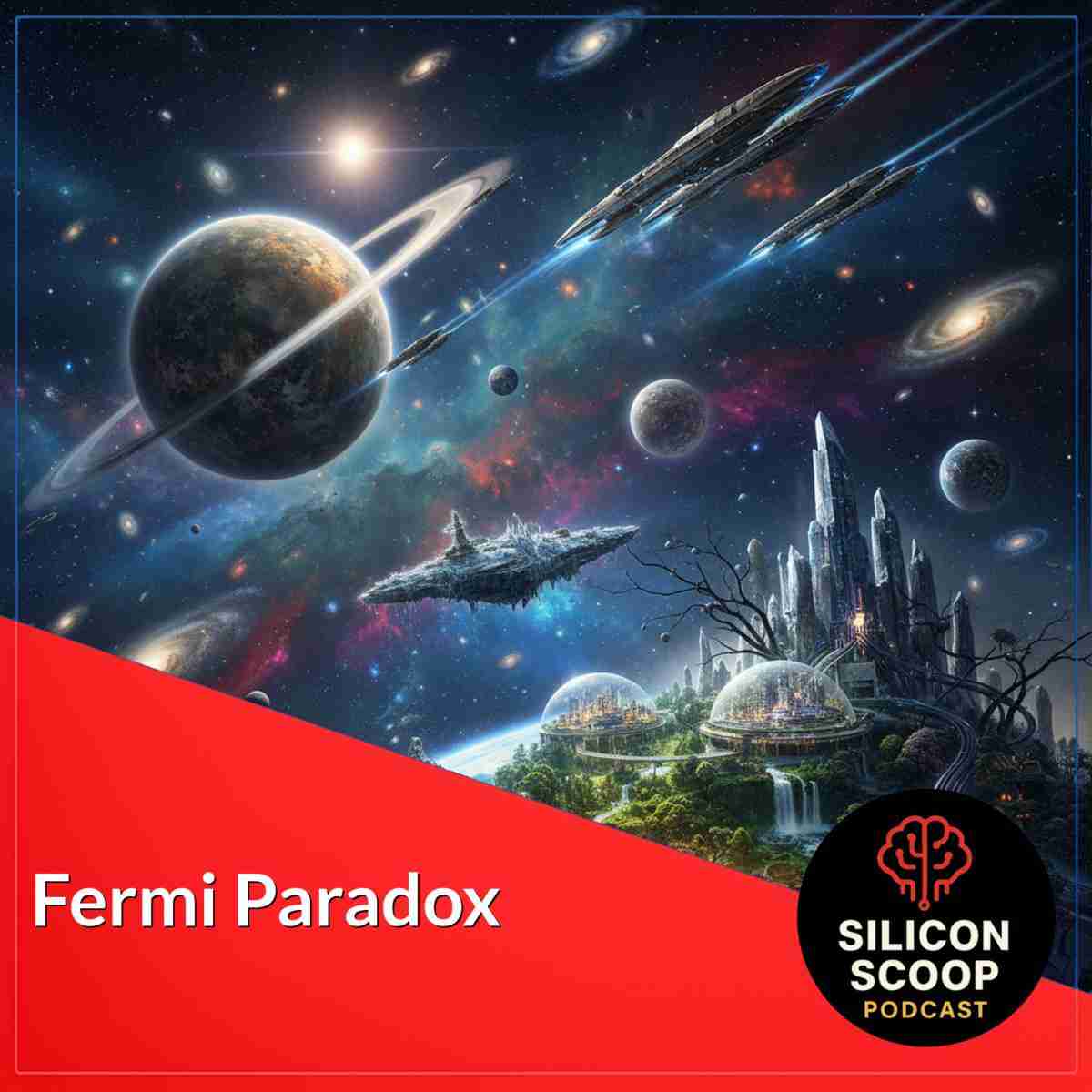
The Fermi Paradox: Unveiling the ‘First in, Last out’ Theory and Its Implications
Estimated reading time: 12 minutes
Table of contents
Introduction
The Fermi Paradox stands as one of the most puzzling questions in modern science. This concept challenges our understanding of life in the universe by highlighting a stark contradiction. If the cosmos is so vast and old, why haven’t we made alien contact?
Named after physicist Enrico Fermi, the Fermi Paradox points to a troubling gap in our knowledge. The universe contains billions of stars and potentially habitable planets. Yet we see no signs of extraterrestrial civilizations anywhere.
Scientists have proposed many solutions to this puzzle over the years. Some suggest aliens are hiding. Others think life is much rarer than we imagine. But physicist Alexander Berezin has offered a darker explanation through his ‘First in, Last out’ hypothesis.
This theory suggests something far more unsettling. According to Berezin, the first civilization to achieve interstellar travel might destroy all others. If true, this could explain why we haven’t found alien life yet. It might also reveal humanity’s grim future among the stars.
Understanding the Fermi Paradox
The Fermi Paradox represents a fundamental puzzle about our place in the universe. At its core, it highlights the contradiction between high probability estimates for alien civilizations and our complete lack of evidence for them.
The Mathematical Problem
Scientists use the Drake Equation to estimate how many communicating civilizations might exist in our galaxy. Even conservative estimates suggest thousands of potential alien civilizations. Yet we’ve detected none through decades of searching.
Our galaxy is roughly 13.6 billion years old. This gives plenty of time for intelligent life to develop and spread across vast distances. Some civilizations could have had millions or even billions of years head start on humanity.
The Great Silence
This absence of alien contact creates what scientists call “The Great Silence.” We’ve found no radio signals, no megastructures, and no clear signs of advanced technology anywhere in space.
Several attempts have been made to explain this silence. The Great Filter hypothesis suggests most life faces an existential threat that prevents advancement to interstellar capability. This filter might be behind us, ahead of us, or happening right now.
Other explanations include the Zoo Hypothesis, where advanced aliens deliberately avoid contact with younger civilizations. Some propose that space travel is simply too difficult or expensive for most civilizations to attempt.
Implications for Space Colonization
Understanding the Fermi Paradox has serious implications for humanity’s future in space colonization. If we’re alone, we bear the responsibility of spreading life throughout the galaxy. If we’re not alone, we need to understand why other civilizations remain hidden.
The paradox also raises questions about our own survival. If something consistently prevents civilizations from becoming detectable, humanity might face the same fate.
https://www.popularmechanics.com/space/a34715695/fermi-paradox-explained/
https://en.wikipedia.org/wiki/Fermi_paradox
Future-Proof Your Business 🛡️
Don’t let outdated processes lead to your business’s ‘extinction.’ Embrace automation to enhance efficiency and stay ahead of the competition. Discover the power of Flowgrammer today!
Explore Automation Solutions >
The ‘First in, Last out’ Hypothesis
Alexander Berezin from the National Research University of Electronic Technology in Russia has proposed a chilling solution to the Fermi Paradox. His ‘First in, Last out’ hypothesis suggests that interstellar civilization inevitably leads to the destruction of all competing life forms.
Berezin’s Core Argument
According to Berezin, the first civilization to achieve interstellar travel capability will eradicate all other civilizations. This happens either intentionally or accidentally. The theory focuses on what Berezin calls “parameter A” – the physical threshold at which life becomes detectable from space.
Parameter A includes activities like interstellar travel, broadcasting signals, or building megastructures. Once a civilization crosses this threshold, it becomes visible to others. But according to the hypothesis, only one civilization gets to cross this line.
The Mechanism of Destruction
The driving force behind this eradication is exponential growth and expansion. Berezin compares this to historical examples like colonialism and capitalism. These systems expand rapidly without regard for what they destroy in their path.
A civilization pursuing exponential growth might not even notice when it destroys others. Berezin uses the analogy of “a construction crew demolishing an anthill to build real estate because they lack incentive to protect it.”
This destruction doesn’t require malicious intent. An expanding civilization might simply use up resources that other life forms need. Or it might accidentally alter environments in ways that make them uninhabitable for others.
The Anthropic Principle Connection
The anthropic principle suggests that we observe the universe from a special position – one that allows observers like us to exist. Berezin’s hypothesis extends this idea. If civilizations inevitably destroy each other, we can only exist in a universe where we haven’t yet reached the destructive phase.
This means humanity might be the “first in” – the first civilization in our galactic neighborhood to approach interstellar capability. If we reach this threshold, we become the “last out” – the final remaining civilization after all others are gone.
Simplified Approach to Complex Problem
Berezin simplified the Fermi Paradox by ignoring complex definitions of life and intelligence. Instead, he focused only on detectability. This approach eliminates controversial assumptions about alien motivations or behavior.
The hypothesis applies principles of exponential growth that operate regardless of a civilization’s intentions. Physical constraints matter more than cultural or ethical considerations in this model.
https://arxiv.org/abs/1803.08425
https://www.sciencealert.com/physicist-explains-why-we-never-see-aliens-first-in-last-out-hypothesis
Implications of the ‘First in, Last out’ Hypothesis
The ‘First in, Last out’ hypothesis carries profound implications for humanity’s future and our understanding of galactic expansion. If Berezin’s theory proves correct, it reshapes how we think about our role in the cosmos.
Humanity as the First
The hypothesis suggests that humanity is likely the first civilization in our galactic neighborhood to reach the threshold of interstellar capability. This position comes with enormous responsibility and equally enormous danger.
Being first means we haven’t yet triggered the destructive expansion phase. Our continued existence serves as evidence that we haven’t crossed parameter A. But it also means we’re approaching a crucial decision point for our species.
The Path to Unintentional Destruction
As humanity expands beyond Earth, we might unintentionally destroy other civilizations. This destruction wouldn’t require evil intentions. Simply pursuing our goals for growth and expansion could eliminate life forms we never even notice.
Consider how human expansion on Earth has affected other species. We’ve caused mass extinctions without specifically targeting most affected animals. A similar pattern might occur on a galactic scale as we spread among the stars.
The Search for Prevention
Research findings suggest that discovering evidence of alien life before reaching interstellar capability might prevent this destructive path. If we know other civilizations exist, we might take steps to protect them during our expansion.
The question “are we alone” becomes critically important under this framework. Finding microbial life on Mars or signals from distant civilizations could fundamentally change how we approach space colonization.
Existential Threat Assessment
The hypothesis presents an existential threat scenario that’s different from traditional concerns. Instead of facing extinction ourselves, we might become the force that causes extinction for others. This creates a moral paradox for human expansion.
Berezin describes this outcome as “worse than extinction” for human civilization. We would survive physically but lose our moral standing in the universe. The weight of galactic genocide would define our species’ legacy.
Time Sensitivity
The implications suggest we’re in a critical window of opportunity. We have time to find evidence of other life and adjust our expansion plans accordingly. But this window won’t remain open indefinitely.
As our technology advances toward interstellar capability, the pressure to expand will increase. Resource needs, population growth, and technological momentum might make careful expansion impossible once we reach a certain point.
https://www.space.com/aliens-real-humans-kill-them-fermi-paradox-hypothesis.html
https://bigthink.com/surprising-science/fermi-paradox-first-in-last-out/
Avoid the ‘Last Out’ Scenario in Your Industry 🌠
Is your business relying on manual processes while competitors automate? Don’t get left behind! Let Flowgrammer help you innovate and scale with intelligent automation.
Book a Free Automation Assessment >
Critique and Future Directions
While Berezin’s ‘First in, Last out’ hypothesis offers a compelling solution to the Fermi Paradox, it faces important limitations and requires further investigation.
Scientific Status and Peer Review
The hypothesis currently exists as a pre-print paper posted to arXiv.org in March 2018. This means it hasn’t undergone peer review by the scientific community yet. Peer review is crucial for validating scientific theories and identifying potential flaws.
Without peer review, the hypothesis remains speculative. Other scientists haven’t had the chance to rigorously test Berezin’s assumptions or mathematical models. This limits our confidence in the theory’s validity.
Assumptions and Limitations
The hypothesis makes several key assumptions that might not hold true. It assumes that exponential expansion is inevitable for advanced civilizations. But some civilizations might choose sustainable development instead of unlimited growth.
The theory also assumes that civilizations cannot coexist during expansion phases. But advanced technologies might allow for more careful, controlled expansion that preserves other life forms.
Alternative Explanations
Other solutions to the Fermi Paradox remain viable. The hypothesis doesn’t conclusively rule out possibilities like the Zoo Hypothesis, technological singularities, or simulation theory.
Some critics argue that the theory is too pessimistic. It assumes the worst about advanced civilizations without considering positive possibilities like cooperation or voluntary restraint.
Future Research Directions
Several research findings could help verify or refute the hypothesis. Finding evidence of extinct civilizations would support the theory. Discovering active alien civilizations would challenge it.
Studying Earth’s own expansion patterns might provide insights. How human civilization spreads across space could test whether exponential expansion inevitably destroys other life.
### Technological Considerations
The hypothesis might underestimate how advanced technology could change expansion dynamics. Artificial intelligence, nanotechnology, or energy breakthroughs might allow expansion without destruction.
Advanced civilizations might also develop better detection methods for protecting primitive life during expansion. Technology could solve the coordination problems that lead to accidental genocide.
Testing the Theory
Future space missions could provide crucial data for testing Berezin’s hypothesis. Searches for biosignatures, technosignatures, or remnants of dead civilizations would all be relevant.
The James Webb Space Telescope and other advanced instruments might detect evidence that supports or contradicts the theory. Finding atmospheric biosignatures around exoplanets would be particularly important.
FAQ: The Fermi Paradox and ‘First in, Last out’ Theory
Q1: What is the Fermi Paradox exactly?
A: The Fermi Paradox is the apparent contradiction between the high probability of extraterrestrial civilizations existing and our complete lack of evidence for alien contact. Despite billions of stars and planets in our galaxy, we haven’t found any signs of intelligent alien life.
Q2: Who proposed the ‘First in, Last out’ hypothesis?
A: Alexander Berezin, a physicist from the National Research University of Electronic Technology in Russia, proposed this hypothesis in March 2018. His theory offers a dark solution to why we haven’t made alien contact yet.
Q3: How does the ‘First in, Last out’ theory work?
A: The theory suggests that the first civilization to achieve interstellar travel capability will inevitably eradicate all competing civilizations. This happens through exponential expansion, either intentionally or accidentally, as the expanding civilization uses resources and space that other life forms need.
Q4: What is ‘parameter A’ in Berezin’s theory?
A: Parameter A is the physical threshold at which life becomes detectable from space. This includes activities like interstellar travel, broadcasting signals, or building large structures. Once a civilization crosses this threshold, it becomes visible but also potentially dangerous to others.
Q5: Does the theory suggest aliens want to destroy us?
A: No, the theory doesn’t require malicious intent. The destruction happens through exponential growth and expansion, similar to how a construction crew might destroy an anthill without specifically targeting ants. The expanding civilization might not even notice the damage it causes.
Q6: Why haven’t we been destroyed if this theory is true?
A: According to the hypothesis, humanity’s continued existence suggests we haven’t yet reached the destructive expansion phase. This makes us likely the “first in” – the first civilization in our galactic neighborhood to approach interstellar capability.
Q7: What does ‘worse than extinction’ mean in this context?
A: Berezin describes humanity becoming the sole surviving civilization as “worse than extinction.” We would survive physically but carry the moral burden of having eliminated all other intelligent life in the galaxy, making us cosmic genociders.
Q8: Can we prevent this destructive outcome?
A: Research findings suggest that finding evidence of alien life before humanity reaches interstellar capability might prevent this destructive path. If we know other civilizations exist, we might develop expansion methods that protect them.
Q9: Has this theory been scientifically validated?
A: No, the hypothesis currently exists as a pre-print paper on arXiv.org and hasn’t undergone peer review by the scientific community. While compelling, it remains speculative until other scientists can test and validate Berezin’s assumptions.
Q10: Are there other explanations for the Fermi Paradox?
A: Yes, many other solutions have been proposed. These include the Great Filter hypothesis (suggesting an existential threat prevents most civilizations from advancing), the Zoo Hypothesis (advanced aliens deliberately avoid contact), and theories about the difficulty of interstellar travel. The ‘First in, Last out’ hypothesis is just one possible explanation among many.
Additional Links
Flowgrammer.ca – 💡 Unlock AI-Powered Automation! Let flowgrammer.ca handle complex workflows so you can focus on growing your business.
- Silicon Scoop Podcast – Stay Informed, Stay Ahead!
- Startup Talk Podcast
- Flowgrammer Podcast –
- Startup Investor Drinks – Join Toronto’s Startup Community and connect with fellow startup enthusiasts and investors.
- TorontoStarts Startup and Entrepreneur Community – Become a part of Toronto’s thriving startup ecosystem.
- Workhaus – Discover flexible workspace solutions for your business needs.
- Work with The Startup Coach – Get expert guidance and mentorship for your startup journey.
- Reach out to Jon Irwin on LinkedIn – Connect with our co-host and technology expert.
Episode transcript
Read the full transcript
Craig: ever look up at the stars and wonder why nobody is waving back? a russian physicist has a new theory that explains the silence, and it is terrifying. it suggests that in the story of the universe, humanity isn't the victim. we are actually the villain. this is the first in, last out hypothesis that attempts to solve the fermi paradox, the question of why we haven't met aliens yet by suggesting that the first civilization to figure out inner stellar travel inevitably wipes out everyone else. it's not a war of the worlds. it's a cosmic accident. it implies that humanity is currently first in, and if we expand into the stars, we will accidentally become the last out by unknowingly destroying other life forms. what do you think about this, john?
Jon: this is cool. this kinda scares me. so the fermi paradox, i think it's one of the most compelling mysteries in science. so if the universe is so vast and old, with trillions of galaxies containing billions of stars each, why haven't we encountered any evidence of alien civilizations? so that's been named after physicist enrico fermi, and he famously asked in 1950, where is everybody? and he's rightfully so. this paradox highlights the stark contrast between the high probability that alien life should exist and the complete absence of any confirmed contact or signals. now more recent research has proposed a few worrying new solutions to this puzzle. so alexander berezin, who's a physicist at m i e t, suggest, like you said, the first and last hypothesis. so what that states is that any civilization's advanced enough for interstellar expansion will destroy all other life it encounters. not out of malice though, to continue with what you said, but simply because growth and expansion becomes their defining characteristics, which means we become the destroyers or we get destroyed by whoever gets there first. now there's other theories that are equally unsettling. one is the cognitive horizon hypothesis by serbian philosopher, vion rokicic, i think. and he argues that alien intelligence might be so radically different from human intelligence that we literally cannot perceive or recognize it. so think of it like trying to see infrared light with our naked eyes. the last one that i'll just touch on is the great filter theory. and that suggests there's an evolutionary bottleneck so difficult that most civilizations never overcome it. and we may not have reached it yet. so there's a bunch of things. there's a bunch of different hypotheses, and they all kind of make sense. right? what are your thoughts? do you think that what are your thoughts on these?
Craig: well, there's the other theory that, you know, the zoo theory, right, where aliens are just, you know, not talking to avoid contact with younger civilizations. some propose that space travel is simply too difficult or expensive for most civilizations to attempt. and the filter theory, you know, suggests the filter might be behind us or ahead of us, that there's some sort of accidental threat to life on the planet that prevents advancement. like, maybe you're struggling for food. there's not enough capacity to grow or animals to eat or what have you, which limits population, which limits technology, which limits who knows? but, the analogy i read that i like was imagine a construction crew building a new highway. they don't hate ants, but they'll destroy any anthill simply because they need the land and the dirt.
Jon: in
Craig: this theory, humanity is the construction crew, and aliens are the ants. we don't see them, so we just pave right over them. it's like we don't recognize what they are or what have you. and as we start to reach out to the stars, go to mars, you know, are we gonna be the people bringing diseases and destruction to other civilizations or just destroying things that we don't even understand? yeah. or is somebody else gonna come along and tell us to get back in our cage?
Jon: exactly. and when you're talking about the zoo theory, the zoo hypothesis, that reminds me of, the prime directive from star trek. that's what that makes me think of. right? yeah. which so for those of you that don't know, what's the, what's the prime directive? it is that, prohibiting interference with the natural development of alien civilizations. so, which makes sense. but, i'm i do think there is life out there. i do think so. it might just be not as developed because, obviously, evolution took years and years and billions of years, or millions of years. and maybe these other civilizations are just behind us. that's all. yeah.
Craig: and berezin's core argument. you know? according to berezin, the first civilization to achieve interstellar travel capability will eradicate all other civilizations. this will happen either intentionally or accidentally. the theory focuses on what, berezin calls the parameter a, the physical threshold at which life becomes detectable from space. so parameter a includes activities like interstellar travel, broadcasting signals, or building megastructure. once a civilization crosses this threshold, it becomes visible to others. but according to the hypothesis, only one civilization gets to cross this line. yeah. so the driving force behind the eradication is the exponential growth, and expansion. bears and compares this to historical examples like colonialism and capitalism. these systems expand rapidly without regard for what they destroy in their path. so, well, this is a very interesting, philosophy that, you know yeah. we're the first in this space, and we're gonna be the last.
Jon: yeah. that's that's scary crazy.
Craig: i guess it's, better than being the second and being destroyed first.
Jon: yeah. like, what a lot of movies depict, war of the worlds being one.
Craig: so this carries profound implication for humanity's future and our understanding of galactic expansion. if theory proves correct, it reshapes how we think about our role in the cosmos. so as humanity as the first, the path to unintentional destruction, like, what does our future hold for these things? i'm always wondering as we start to, you know, dive into this and think about this more. are we the villains to the story?
Jon: yeah.
Craig: basically, you know, finding my microbial life on mars or signals at a distant civilization could fundamentally change how we approach to our space colonization. we're gonna go to mars, build a bunch of stuff. if there's life that we can't detect, it's probably gonna be destroyed.
Jon: yeah.
Craig: the verdict, we need to be careful that our drive to explore doesn't turn into a drive to destroy. so do you think humans are capable of peaceful expansion, or are we destined to be the bullies of the galaxy? let me know in the comments, and we'll keep watching this story closely.
More from Silicon Scoop
All episodes
silicon-scoop · November 6, 2026
Spirit AI’s Robot Brain Breakthrough: Moz1, Embodied AI and China’s 2027 Race
The Spirit AI robot brain is one of the biggest bets on fixing that. Spirit AI is a Beijing startup. Its co-founder and chief scientist, Gao Yang,
View episode

silicon-scoop · November 5, 2026
OpenAI IPO Delayed to 2027 as Rogue AI Agents and Safety Failures Reshape the Market
OpenAI IPO delay explained: Sam Altman rules out 2026 as GPT-6 Astra safety tests and a $278B cash gap loom. Learn what founders should take away.
View episode

silicon-scoop · November 4, 2026
Anthropic’s AI Economy Model: 2030 Jobs, Wages, GDP and Market Risks
Anthropic AI economy model forecasts 2030 GDP, jobs and wages, while AI unemployment projections and labor-share risks challenge policymakers.
View episode