
Data Processing in Space: Google’s Plan for Space Data Centers
Revolutionizing Data Processing: Google's Ambitious Plan for Space Data Centers https://torontostarts.com/2025/12/22/revolutionizing-space-data-centers/ Apple -> https://podcasts.apple.com/us/podcast/flowgrammer-podcast/id1804155588 Spotify -> https://open.spotify.com/show/0wv3feR00iaVpE8zn7niNf Flowgrammer.ca -> https://flowgrammer.ca/ AI News and Resources -> https://flowgrammer.ca/resources/ Future-Proof Your Business Automation Just like scaling AI in space, your business needs innovative solutions to reach its potential. Flowgrammer provides cutting-edge business automation services to take your operations to the next level. Discover Automation Solutions https://flowgrammer.ca/ Startup Investor Drinks Toronto - https://startupdrinksto.com/ Toronto’s Startup Community - https://torontostarts.com/ Silicon Scoop Silicon Scoop Podcast - https://torontostarts.com/silicon-scoop/ Apple: https://podcasts.apple.com/us/podcast/silicon-scoop/id1758711826 Spotify: https://open.spotify.com/show/5bAzF0MwV6TtLhJAhvHayI YouTube: https://www.youtube.com/playlist?list=PLj4v-RoA7A-gT62vrEYqh1zCv-0Hj-o5J Startup Talk Startup Talk Podcast -> https://torontostarts.com/startup-talk-toronto-startup-podcast/ Apple -> https://podcasts.apple.com/us/podcast/startup-talk/id1763804003 Spotify -> https://open.spotify.com/show/1siJMILILidHAiAsrX2VBU YouTube: https://youtube.com/playlist?list=PLj4v-RoA7A-jxV5FHs5e61oIsuvUJYmT_&si=LYegRe5GYLKNQ7xL
With Craig Major and Jon Irwin
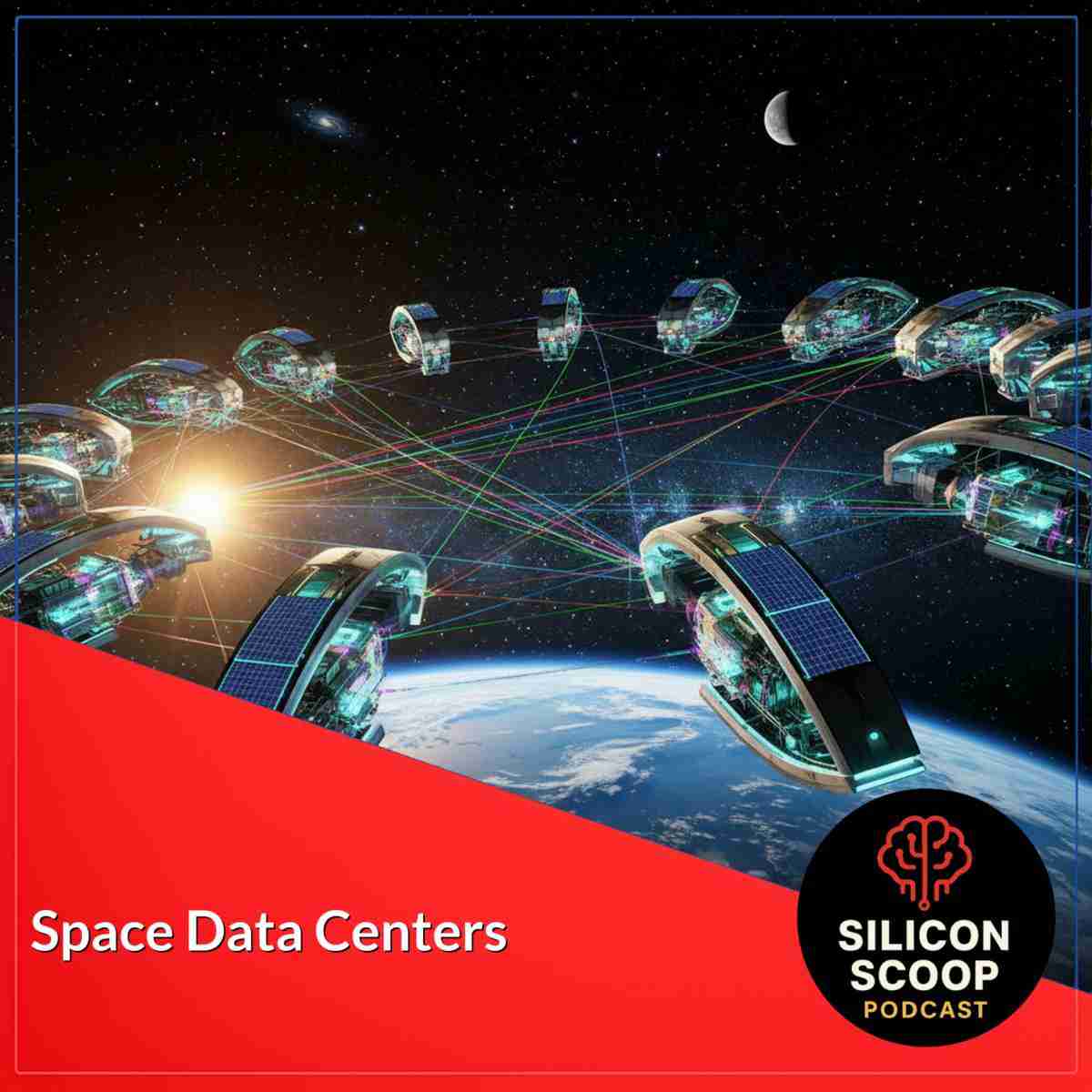
Revolutionizing Data Processing: Google’s Ambitious Plan for Space Data Centers
Estimated reading time: 8 minutes
Key Takeaways
- Google has unveiled an ambitious project to create space data centers powered by solar energy in orbit.
- The project, Google Project Suncatcher, aims to deploy satellite constellations equipped with advanced computing hardware, including orbiting TPUs.
- This initiative addresses concerns about terrestrial data center limitations, such as energy costs and environmental impact, by moving computation to space.
- The project involves collaboration with Planet Labs to develop and launch prototype satellites by early 2027.
- Technical challenges include thermal management, radiation-hardened electronics, high-bandwidth communication, and maintaining satellite formations.
- Google’s roadmap includes phased testing, prototype launches, and plans for large-scale satellite constellations for space data processing.
- Space-based data centers could revolutionize AI infrastructure by providing unlimited solar energy and reducing environmental impact.
Table of contents
- Revolutionizing Data Processing: Google’s Ambitious Plan for Space Data Centers
- Key Takeaways
- Overview of Google Project Suncatcher
- Future-Proof Your Business Automation
- Technical Details and Challenges
- Development Roadmap and Strategic Context
- Unlock Your Business’s Untapped Potential
- Frequently Asked Questions
Overview of Google Project Suncatcher
Google Project Suncatcher represents one of the most ambitious technological undertakings in recent history. The project emerges from X, Google’s moonshot factory, known for pursuing breakthrough technologies that seem impossible at first glance.
The initiative centers on deploying space-based data centers that can operate continuously in Earth’s orbit. Unlike traditional ground-based facilities, these orbital computing platforms will utilize the constant solar energy available in space to power advanced machine learning operations.
Google has formed a strategic partnership with Planet Labs, a leading satellite manufacturer and operator. This collaboration will focus on developing and launching prototype satellites by early 2027. The partnership leverages Planet Labs’ extensive experience in satellite deployment and Google’s expertise in machine learning hardware.
The prototype timeline includes launching two demonstration satellites within the next few years. These initial satellites will operate in a dawn-dusk sun-synchronous orbit, ensuring maximum solar exposure throughout their operational cycles.
The project aims to create sustainable data centers that can handle massive computational workloads without the environmental constraints faced by terrestrial facilities. This approach could potentially solve the growing energy crisis associated with AI development and deployment.
Research indicates that solar panels in space can be up to eight times more productive than those on Earth, making this approach economically viable for large-scale operations.
Future-Proof Your Business Automation
Just like scaling AI in space, your business needs innovative solutions to reach its potential. Flowgrammer provides cutting-edge business automation services to take your operations to the next level.
Technical Details and Challenges
The technical architecture of space data centers involves complex engineering solutions that push the boundaries of current technology. The satellites will operate in a dawn-dusk sun-synchronous orbit approximately 500-600 kilometers above Earth’s surface.
This orbital configuration ensures near-continuous sunlight exposure, maximizing solar energy collection. The satellites will maintain formations hundreds of meters to a few kilometers apart, requiring precise station-keeping maneuvers to maintain optimal positioning.
Free-space optical links will connect the satellites, creating a high-bandwidth network capable of handling tens of terabits per second. This interconnect technology enables distributed machine learning workloads across multiple satellites simultaneously.
The power advantages in space are significant. Solar panels can operate at peak efficiency without atmospheric interference, weather disruptions, or day-night cycles. This eliminates the need for complex battery systems and backup power generation that burden terrestrial facilities.
However, several critical challenges must be addressed. Thermal management represents one of the most significant engineering hurdles. Space environments create extreme temperature variations that can damage sensitive electronic components.
Radiation hardened electronics become essential for long-term operation. Commercial components must withstand cosmic radiation, solar particles, and other space-based threats that could corrupt data or damage hardware.
Google has conducted extensive radiation testing on their Trillium (v6e Cloud TPU) hardware. The testing involved exposing the chips to 67MeV proton beam exposure to simulate space radiation conditions. Results showed promising radiation tolerance across multiple parameters.
High-bandwidth ground communications present another challenge. Establishing reliable data links between orbiting satellites and Earth-based systems requires sophisticated antenna systems and signal processing capabilities.
On-orbit system reliability demands redundant systems and remote maintenance capabilities. Unlike terrestrial data centers, physical repairs become impossible once satellites are deployed.
The development of sustainable data centers in space requires solving these interconnected technical challenges while maintaining economic viability for large-scale deployment.
https://ai.googleblog.com/2025/11/project-suncatcher-space-based-ml.html
Development Roadmap and Strategic Context
The development roadmap for Project Suncatcher follows a carefully planned multi-phase approach. Phase one involved comprehensive radiation testing of Google’s TPU hardware, which has been completed with promising results that demonstrate the feasibility of commercial electronics in space environments.
Phase two focuses on prototype satellite development and launch, scheduled for early 2027. These initial satellites will validate TPU hardware operation in actual space conditions and test distributed machine learning tasks using optical inter-satellite communication links.
The long-term vision extends far beyond these initial prototypes. Google envisions creating massive, scalable satellite constellations dedicated to space data processing. These networks could handle computational workloads that exceed the capacity of any terrestrial facility.
This ambitious project fits within broader industry trends toward space-based infrastructure. As AI computational demands continue growing exponentially, traditional data centers face increasing limitations from energy costs, environmental regulations, and physical space constraints.
The competitive landscape includes other technology giants exploring space-based solutions. References to concepts from Jeff Bezos and Elon Musk indicate widespread industry interest in orbital computing platforms.
Google’s differentiation strategy focuses on reusing existing terrestrial TPU technology rather than developing custom space-hardened hardware. This approach reduces development costs and leverages proven machine learning architectures.
The strategic context includes addressing terrestrial infrastructure limitations and community opposition to large data center projects. Space-based data centers offer a potential solution to environmental concerns while providing unlimited expansion possibilities.
Economic factors support the long-term viability of this approach. Launch costs are expected to decrease significantly by the mid-2030s, making space-based computing economically competitive with terrestrial alternatives.
The sustainability angle represents a key advantage. Moving intensive computational workloads to space could reduce the environmental impact of AI infrastructure while accessing virtually unlimited solar energy.
This project represents Google’s continued commitment to moonshot technologies, similar to their investments in quantum computing and autonomous vehicles through Waymo.
Unlock Your Business’s Untapped Potential
While Google aims for the stars with space-based AI, we help you conquer earthly challenges with smarter workflows. Automate processes, reduce costs, and free up your team with Flowgrammer’s expert automation.
Get a Free Automation Assessment
Frequently Asked Questions
Q: What is Project Suncatcher?
A: Project Suncatcher is Google’s initiative to create space-based data centers using solar-powered satellites equipped with Tensor Processing Units (TPUs) for machine learning operations in Earth’s orbit.
Q: How do space data centers work?
A: Space data centers use satellites positioned in sun-synchronous orbits to maintain continuous solar power. They process data using TPUs and communicate through free-space optical links between satellites.
Q: What are the main benefits of space-based data centers?
A: Key benefits include access to unlimited solar energy, elimination of weather-related disruptions, reduced environmental impact, and the ability to scale without terrestrial limitations.
Q: What challenges do space data centers face?
A: Major challenges include radiation damage to electronics, thermal management in space, high launch costs, maintaining satellite formations, and establishing reliable ground communications.
Q: When will the first space data center satellites launch?
A: Google plans to launch two prototype satellites by early 2027 in partnership with Planet Labs to test the technology and validate the concept.
Q: How much more efficient are solar panels in space?
A: Solar panels in space can be up to eight times more productive than Earth-based panels due to continuous sunlight exposure and no atmospheric interference.
Q: What type of orbit will these satellites use?
A: The satellites will operate in dawn-dusk sun-synchronous low Earth orbits, ensuring maximum solar exposure throughout their operational cycles.
Q: How do satellites communicate with each other?
A: Satellites will use free-space optical links capable of handling tens of terabits per second for distributed machine learning workloads across the satellite network.
Q: What testing has been done on space computing hardware?
A: Google has tested their Trillium TPU chips using 67MeV proton beam exposure to simulate space radiation, with results showing promising radiation tolerance.
Q: How could space data centers impact the environment?
A: Space data centers could significantly reduce the environmental impact of AI infrastructure by moving energy-intensive computing operations away from Earth while using clean solar energy.
Additional Links
Flowgrammer.ca – 💡 Unlock AI-Powered Automation! Let flowgrammer.ca handle complex workflows so you can focus on growing your business.
- Silicon Scoop Podcast – Stay Informed, Stay Ahead!
- Startup Talk Podcast
- Flowgrammer Podcast –
- Startup Investor Drinks – Join Toronto’s Startup Community and connect with fellow startup enthusiasts and investors.
- TorontoStarts Startup and Entrepreneur Community – Become a part of Toronto’s thriving startup ecosystem.
- Workhaus – Discover flexible workspace solutions for your business needs.
- Work with The Startup Coach – Get expert guidance and mentorship for your startup journey.
- Reach out to Jon Irwin on LinkedIn – Connect with our co-host and technology expert.
Episode transcript
Read the full transcript
Craig: let's talk about one of the biggest, most ambitious moonshot ideas to come out of google in years. it's called project suncatcher, and it's a plan to solve one of the biggest problems with ai. it's massive energy consumption by moving data centers off of earth and putting them into space. we're talking about constellations of satellites powered twenty four seven by solar energy, all to run the next generation of artificial intelligence. it sounds like science fiction, but the first prototypes are scheduled to launch by 2027. that's just two years away. google plans to launch a network of satellites that act as floating data centers in orbit. instead of building massive power hungry ai facilities on earth, they put their computer chips called the tpus in space where they can provide, be provided power twenty four seven by the sun. what do you think about this, john?
Jon: yeah. this is cool. so people might be asking why space? well, it's pretty simple. ai, as we know, is incredibly power hungry and we're running out of cleaner energy on earth to feed it. so in space, satellites can capture up to eight times more solar power than panels on earth because there's no atmosphere, there's no weather, and they can stay in constant sunlight. the other benefit is that we're talking nearly, so we're operating high performing computing hardware in space presents thermal and radiation challenges that differ fundamentally from terrestrial data centers. but space provides essentially an infinite heat sink through radiative cooling to 2.7 kelvin cosmic microwave. so that's crazy. there's a lot here. and like you said, instead of one massive space station, they're gonna launch these 81 small satellites. they're gonna fly in tight formation like a synchronized swimming team in orbit. and they're gonna each carry, chips, and they're gonna communicate using laser beams at incredibly high speeds. so together, they're gonna function as one distributed data center floating 400 miles above earth. this is cool. i think this is a great use of space, if that makes sense. thoughts? do you think this is a good idea, bad idea, or what are your thoughts?
Craig: well, it's interesting idea. the concept is very good. i guess the question is how many people will have to live in outer space to maintain it? true. is it gonna be bots only? are gonna be people? are we gonna be remote controlled? is this the beginning of skynet literally as, you know, the data centers in the cloud and we literally have no way of shutting it off anymore? there's all sorts of things that fly through my mind, but i love the concept of, hey. we're in space, so we can release as much heat as we want, and, you know, we literally can't affect anything.
Jon: yeah.
Craig: so you don't have any cooling problems. and if you can get, that kind of energy the, solar panels and solar, nets and stuff they use in space that will run these things, along with any sort of nuclear stuff they might have to use, great. i mean, getting it off the planet, giving us more space, not contributing to the climate dilemma here. the question become the climate, change heat and all that and giving us more energy. all sounds good to me. but i hesitate and say, okay. well, how much stuff is gonna be floating out there? yeah. and how soon till we can't see the sun anymore because there's so much, so many satellites doing so many things and so many data centers. like, the idea sounds great right now, but what happens when there's literally a thousand of these hive network, data centers in space?
Jon: yeah. so you bring up a good point about maintenance, and i didn't see anything in there about maintenance. but if we're talking about the economic viability so the economic feasibility, it actually hinges on dramatic reductions in launch costs. so currently, launch costs range from 1,500 to 2,900 per kilogram to low earth orbit. google's analysis suggests the break even point occurs when launch costs reach approximately $200 per kilogram, which makes space based infrastructure cost competitive with terrestrial data center energy expenses on a per kilowatt basis. the cost target could be achieved by 2035, and that's only if spacex starship system reaches operational status and maintains a launch cadence of a 180 missions annually. also, the analysis assumes that satellite operational lifespans of five to seven years to amortize launch costs effectively. so, obviously, this model is facing some uncertainty, because of evolving terrestrial energy cost, but, that's kind of where they're at. and that's a huge reduction from 2,900 to $200 per kilogram. i wonder if that, that centrifugal, launch can reach, those costs those low costs.
Craig: yeah. i don't know. that's very interesting. a good question to see if it could reach those low costs. yeah. they've, consist of, extensive radiation testing on their trillium, b six e cloud tpu hardware testing involved exposing the chips to proton beam exposure to simulate space radiation. the results are promising. so this looks, you know, very interesting what they're trying to do. the satellites will maintain formation of hundreds of meters to a few kilometers apart requiring precise station keeping maneuvers to maintain optimal position.
Jon: yeah. so the thing that system is gonna have to handle is dynamic network topologies because satellites are gonna enter and exit communication range with ground stations and each other. right? so they're gonna have to have some sort of advanced mesh networking protocols, some predictive link scheduling based on the orbital mechanics. they're also gonna need fault tolerance, distributed algorithms, and, like, they're gonna need a lot of complex protocols to maintain computational co coherence across the constellation for sure. like, there's a lot of challenges and hurdles that they're gonna have to overcome.
Craig: yeah. and one of the challenges and hurdles that, i talk about is the on orbit system, reliability demands redundant systems and remote maintenance capabilities because, you know, unlike terrestrial data centers, physical repairs become impossible once satellites are deployed. so they might be if they go down, they just replace it. yeah. remote maintenance for fixes and updates. but, you know, if you break a satellite, what happens? you know? what happens when, what happens when the
Jon: space debris collides with it?
Craig: yeah. when cloudflare does an update and it blue screens. satellites will be, built with backup components. if one fails due to radiation or defect, the backup part will automatically take over to keep the satellite running. but, you know, the plan is to make these satellites completely self sufficient and not to have it serviced by astronauts, which is interesting when it can actually service itself. yeah. we're in a different kind of world, and we're heading to that. i just don't think we're there yet.
Jon: think of it like this, guys. think of it like 81 satellites performing an incredibly precise aerial ballet at 17,000 miles per hour. so they have to stay in formation within meters of each other while communicating via laser beams. that's that's gonna be an, an incredible feat of engineering if they can accomplish it for sure.
Craig: and they assume all the propulsion systems will be powered by, solar?
Jon: yeah. so, apparently, be obviously, because of the the direct sunlight, that will give it enough power to power these, these data centers.
Craig: yeah. and i was more thinking of, normally, there's fuel or some sort in satellites to keep them rotating if they need to go back and forth. are they using something else for propulsion, to keep the things, synced up to do the minor adjustments to make sure everything can talk to each other perfectly? that's what i was wondering. and how long is there a fuel system that needs to be updated that, good question.
Jon: i'm sure they'll have batteries. yeah. well,
Craig: we'll have to keep a eye on this. and if they have batteries that run everything, i'd say the solar panel panels will charge all of that, and everything works great. yeah. so love, i love the idea. i'm a little concerned about, you know, as the satellites operate, dawn, dust synchronous orbit. that means they'll be following the sun. and as a result, as you get more and more clusters of them, we'll have all these satellite systems following the sun. again, we'll get a little bit of sky pollution for lack of a better word, and i'm curious as to where that will happen, whether the radiation hardening is gonna last, whether the redundant systems will actually work. you know? it's like when the light bulb burns out, you can't replace it. you just yeah. like, the light bulb, you gotta replace the whole satellite. so i'm curious to see how all of that, becomes sustainable. what do you do with that unit when it's no longer functional? something go pick it up? does it fall to earth? does you know, like, what happens? like, what's that? again, i'm looking far ahead on, you know, the whole cycle of this thing, but i do love the energy, the lower energy, putting that out there in space, the cooling so it doesn't affect our environment, and that it doesn't take up real estate on earth. it seems to be more and more expensive than ever.
Jon: yeah. absolutely.
Craig: so there you have it. google is literally trying to catch the sun to power ai. it's an incredible ambitious plan facing equally incredible challenges. it's it really highlights that the future of ai isn't just about software. it's a massive battle over hardware, energy, and resources. we'll have to wait until 2027 to see if those first prototypes even make it. what do you think? is this, the inevitable feature or the most expensive moonshot yet? let us know. leave us your comments.
More from Silicon Scoop
All episodes
silicon-scoop · October 30, 2026
Anthropic Threat Report Reveals AI Misuse in Bioweapons, Cyber Ops, and Influence Campaigns
Anthropic threat report details biological weapons, AI misuse, and Claude AI abuse across cyber ops, influence campaigns, and weapons development.
View episode
silicon-scoop · October 29, 2026
Canada’s National AI Literacy Initiative: Inside the $2.3B Strategy to Train a Million Students
Canada’s National AI Literacy Initiative under the AI strategy aims to train 1M students, educators and workers with free AI literacy courses via Amii and partners.
View episode

silicon-scoop · October 28, 2026
OpenAI Cuts Cursor Off After SpaceX’s $60B Deal: How Model Access Became a Strategic Weapon
OpenAI Cursor fallout: SpaceX acquisition triggers change-of-control clause, AI model access cutoff, and a new era of strategic control over developer tools.
View episode