
Silicon Scoop · Technology
Tesla Roadster 2026 Reveal Shows Cold-Gas Thrusters
Craig Major·October 19, 2026
Tesla Roadster 2026 debuted in Texas. Tesla Roadster thrusters were demoed, production is a 2028 target. Learn what is proven and what is claimed.
Estimated reading time: 10 minutes
Key Takeaways
- The hook: Car and Driver reported that the Rocket prototype carried 250 kilograms of compressed air in two 600-liter pressure vessels and used 10 nozzles for its airborne maneuver.
- Three versions, not one: Tesla described Performance, Thrust and Rocket configurations. The single-seat, invite-only Rocket is reported as not approved for public roads.
- Money and timing: Tesla's stated target is production in 2028. No final list price was disclosed. The reservation page listed $50,000 for Performance and $250,000 for Thrust.
- Claims are still Tesla's own: The 0–60 mph in under one second, 230+ mph top speed and 2 g of downforce at 200 mph are company claims. No independent source retrieved here validated them.
- Analysts see a halo car: Morningstar's Seth Goldstein estimated roughly 2,000 Roadsters a year, and Gene Munster called the event an engineering demonstration with no commercial value beyond competitive signaling.
Table of contents
- What the Tesla Roadster 2026 Reveal Showed in McGregor
- Tesla Roadster Thrusters: Cold Gas, 10 Nozzles and 250 Kilograms of Air
- Tesla Flying Roadster: Only One Version Is Meant to Fly
- The Fan System and Speed Claims Nobody Has Verified
- Tesla Roadster Production 2028: A Target, Price Unknown, History Long
- What Analysts Say: A Halo Car, Not a Volume Driver
- What This Means for Startups and Small Businesses
- Frequently Asked Questions
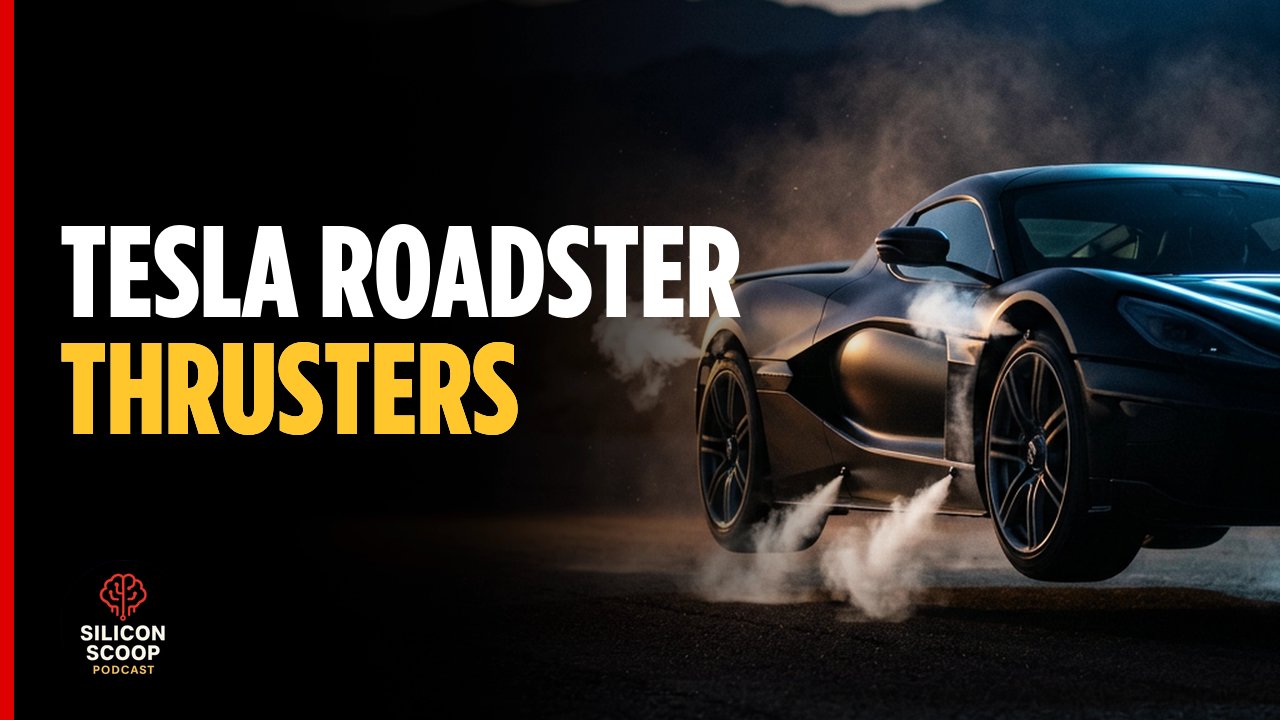
The Tesla Roadster 2026 reveal came with a surprising amount of hardware. Car and Driver reported that the Rocket prototype carried 250 kilograms of compressed air in two pressure vessels holding 600 liters combined. It released that air through 10 nozzles to perform its airborne maneuver. (Car and Driver thrusters and fan-system explainer, Oct. 17)
That is a lot of engineering for one stunt. It also raises a fair question: is this a car, a demo, or an advertisement?
For founders and operators, the answer matters. The Roadster shows how an attention-grabbing technical demonstration can strengthen a brand while the product itself stays commercially unproven. Certification, execution and delivery risk all remain. This post separates what was demonstrated, what Tesla claims and what is still only planned.
What the Tesla Roadster 2026 Reveal Showed in McGregor
Tesla unveiled the second-generation Roadster on Thursday, October 15, 2026. The event was held at a SpaceX rocket-test facility in McGregor, Texas, near Waco. (Transport Topics, carrying Bloomberg News reporting, Oct. 16)
Car and Driver reported that the prototype drove upside down using a fan system. SpaceX-supplied thrusters enabled an airborne maneuver. (Car and Driver Roadster reveal report, Oct. 16)
The stage show
According to The Wall Street Journal, the event had fog, red laser lights, content creators and a large, backward-curving ramp. The ramp looked like a skateboard halfpipe.
The angular Roadster climbed the ramp, launched into the air and landed in a controlled way. It later jumped over five other Tesla vehicles while rotating in midair.
Among the audience were people who, the WSJ reported, had paid $250,000 to reserve the car nine years earlier.
Musk's reaction
Elon Musk posted on October 16: "Turns out the future does have flying cars." That is his description of a demonstration, not a finding from an independent test.
Tesla's own labels
Tesla engineering vice president Lars Moravy called the Roadster "the world's first flying car" and "the last best driver's car," the WSJ reported. Those are company statements. They are not independent verdicts.
Source: The Wall Street Journal article by Christopher Otts, dated Oct. 16, also carried by To Vima; Car and Driver Roadster reveal report, Oct. 16; Transport Topics, carrying Bloomberg News reporting, Oct. 16
Tesla Roadster Thrusters: Cold Gas, 10 Nozzles and 250 Kilograms of Air
Car and Driver described the Rocket prototype's system as cold-gas propulsion. A cold-gas thruster pushes stored gas out through a nozzle, and the escaping gas creates the push. Nothing burns, and no rocket fuel is involved. In this case the gas was compressed air.
The numbers behind the stunt
Car and Driver reported these details for the Rocket prototype:
- Two carbon-overlay pressure vessels
- 600 liters of combined capacity
- 250 kilograms of air
- 10 nozzles to discharge it
These are company-reported technical details passed on by Car and Driver. They describe a prototype used in a demonstration. They do not describe a finished product.
What the WSJ said about the thrusters
The WSJ account says the car uses "a pair of compressed-air thrusters" to jump. It says Tesla claims the thrusters can take the car from a standstill to 60 mph in about one second. Fox Business reported the claim as acceleration to 60 mph in under one second.
The sources word the claim slightly differently. Treat it as a Tesla claim and a demonstration result, not a measured production spec.
Why cold gas matters for the story
Cold gas is simple and easy to control. It can give a short, strong burst, which suits a ramp jump. It also means the stunt tells us little about everyday driving.
Source: Car and Driver thrusters and fan-system explainer, Oct. 17; Fox Business, Oct. 15; The Wall Street Journal article dated Oct. 16
Spend Your Hours on the Big Ideas, Not the Busywork
A great demo takes a team's best hours, and routine tasks like data entry, follow-ups and reporting shouldn't compete for them. Flowgrammer builds business automation that handles repetitive work in the background, so a small team can scale without hiring for every manual task.
Tesla Flying Roadster: Only One Version Is Meant to Fly
The "Tesla flying Roadster" label sounds like one product. Tesla's own lineup is more split. Car and Driver reported three configurations:
- Performance: two seats, with the active aerodynamic and fan systems.
- Thrust: adds rear-mounted cold-gas thrusters.
- Rocket: a single-seat, invite-only version with perimeter thrusters intended for flight.
The Rocket is not road-approved
Car and Driver and Transport Topics (carrying Bloomberg News reporting) both reported that the flying Rocket package is not approved for public roads. Transport Topics said Tesla offers reservations for road-ready and Thrust versions.
Musk was asked how the car would be street legal. The WSJ quoted his reply: "Yeah, depends on your street, but it'll be a viable car." That is a loose answer, not a certification.
The stunt car was not the stage car
Car and Driver identified different wheel designs and described the stunt vehicle as a separate configuration from the on-stage car. That detail matters when reading the claims. The vehicle that flew and the vehicle on display were not the same build.
No approvals found
The research for this post found no regulatory filing or certification approval for the Roadster project. No completed financing announcement turned up either. That doesn't mean none exist. It means none were found in the retrieved sources.
Source: Car and Driver Roadster reveal report, Oct. 16; Car and Driver thrusters and fan-system explainer, Oct. 17; Transport Topics, carrying Bloomberg News reporting, Oct. 16; The Wall Street Journal article dated Oct. 16
The Fan System and Speed Claims Nobody Has Verified
The Roadster's grip trick is a fan system under the car. Moravy described it to the WSJ as "a fan suction system" that adds grip and downforce. Downforce is air pressure that pushes a car toward the road. The WSJ said the system lets the car drive up the curved ramp and continue upside down.
Two modes
Car and Driver reported that the fan system has low-speed and high-speed modes. Moravy told Hagerty, as relayed by Car and Driver, that low-speed suction is meant to give traction before conventional aerodynamic wings become effective.
Car and Driver also reported:
- A Tesla claim of up to 2 g of downforce at 200 mph. At 2 g, the downward force is twice the car's own weight.
- Rear fans rated at 20 kW.
Tesla's headline performance claims
The WSJ reported that Tesla executives claimed a top speed of more than 230 mph. Tesla also claims 0–60 mph in under one second.
These remain company-reported or demonstration claims. No independent expert source retrieved here validated the flight, downforce, speed or future-production claims as completed commercial results. A demo on a ramp is not a test of a production car.
What would count as proof
Proof would include independent track tests, road-legal approval and customer deliveries. None of those were reported in the sources used here.
Source: Car and Driver thrusters and fan-system explainer, Oct. 17; The Wall Street Journal article dated Oct. 16; Fox Business, Oct. 15
Tesla Roadster Production 2028: A Target, Price Unknown, History Long
Musk said consumer production would begin in 2028. The WSJ quoted him adding, "Actually, for real." Transport Topics (carrying Bloomberg News reporting) described 2028 as Tesla's production target. Today, that date is a plan, not a delivery.
The money side
Here is what is known about cost:
- No final list price was disclosed. The WSJ reported that audience members shouted for a price and Musk did not answer.
- Tesla's reservation page listed $50,000 for Performance and $250,000 for Thrust.
- Rocket was invite-only.
Reservation payments are deposits. They are not the price of the car, and they are not Tesla's revenue from finished sales.
A deposit history that needs care
The WSJ said Tesla first showed a prototype in November 2017. It took deposits of $50,000, or $250,000 for a limited Founders Series model. The 2026 reservation page also lists $50,000 and $250,000 tiers, but for Performance and Thrust. The sources don't say how the old deposits map onto the new versions, so don't assume they match.
The earlier timeline
The WSJ and Fox Business both reported that Tesla originally planned deliveries for 2020. The WSJ said that plan never materialized.
The new look also differs from 2017. The WSJ said the 2026 design has sharp angles similar to the Cybertruck, instead of the sleek, curving shape Tesla teased before.
The original Roadster
The new car follows Tesla's first vehicle, the 2008 Roadster. The WSJ described that car as a heavily modified Lotus sports car powered by batteries. It helped show that electric cars could be fun and desirable.
Source: The Wall Street Journal article dated Oct. 16; Transport Topics, carrying Bloomberg News reporting, Oct. 16; Fox Business, Oct. 15; Yahoo Finance, Oct. 16
What Analysts Say: A Halo Car, Not a Volume Driver
Independent commentary leans one way. The Roadster matters more as a showpiece than as a source of sales volume. A halo car is a high-profile model meant to lift the image of a whole brand.
The voices
- Gene Munster, Deepwater Asset Management, called the event an engineering demonstration. He said it has no commercial value beyond competitive signaling, including embarrassing traditional carmakers. (Transport Topics, carrying Bloomberg News reporting)
- Garrett Nelson, senior equity research analyst at CFRA, said Tesla's brand needed a new, attention-getting model after a long product-pipeline lull. (Same source.)
- Seth Goldstein, Morningstar, was cited by Yahoo Finance as expecting roughly 2,000 Roadsters a year and calling it a halo car. That is an independent estimate, not Tesla guidance. (Yahoo Finance, Oct. 16)
One more view on revenue
The WSJ cited a Thursday note from Battle Road Research, described as an independent research firm. It said the Roadster is not expected to add much to Tesla's vehicle volume. But it could add meaningfully to revenue because of its high-end positioning. The WSJ said the car is expected to compete with Porsche, Lamborghini and Ferrari.
This is not a unanimous view
The views overlap but don't match. The analysts differ on whether the main benefit is brand restoration, technical signaling or closer Tesla–SpaceX integration. Goldstein's roughly 2,000 units suggests limited volume. Battle Road's note points to a possible revenue effect.
None of these analysts validated Tesla's performance claims.
The strategy backdrop
Musk said the Roadster would eventually be the "only manually driven car that Tesla makes," as Tesla shifts toward autonomous vehicles and robotics, according to the WSJ. The WSJ framed the Roadster as a limited renewal of Tesla's traditional car business.
Source: Transport Topics, carrying Bloomberg News reporting, Oct. 16; Yahoo Finance, Oct. 16; The Wall Street Journal article dated Oct. 16
What This Means for Startups and Small Businesses
You may never build a car that jumps over five others. The playbook still applies at a smaller scale.
Use demos to earn attention, then back them with proof
A strong demo can bring in press, deposits and talent. But the reporting shows the gap between a stage result and a shipped product. Here, that gap includes a stunt car that differed from the stage car, claims without outside validation and no approvals found.
If you demo something, label it clearly. Say what is working today and what is planned.
Separate your versions and your promises
Tesla split its offer into Performance, Thrust and Rocket. Only some are meant for the road. Small firms can do the same: sell what is ready, and keep experimental features in an invite-only tier with clear limits.
Be careful with deposits and dates
Reservation money is a promise to customers. The Roadster's 2020 plan did not materialize, and 2028 is now the target. If you take pre-orders:
- Publish a realistic date range.
- Explain what a deposit buys.
- Update customers when plans change.
Don't mistake buzz for revenue
Analysts see a halo car, with one estimate near 2,000 units a year. For a small company, a viral moment is not the same as repeat sales. Track what the attention turns into: sign-ups, paid pilots and signed orders.
Keep a short list of claims you can prove
Tesla's speed, downforce and acceleration numbers are its own. Before you publish performance claims, ask who has tested them. If no one outside your team has, say so.
Plan for approvals early
The Rocket version is reported as not approved for public roads. If your product needs a license, safety review or compliance step, put that on the calendar from the start. The cost of that step falls on you, not on your marketing.
Source: Car and Driver Roadster reveal report, Oct. 16; Car and Driver thrusters and fan-system explainer, Oct. 17; Transport Topics, carrying Bloomberg News reporting, Oct. 16; Fox Business, Oct. 15; Yahoo Finance, Oct. 16
Frequently Asked Questions
Q: When did Tesla unveil the Tesla Roadster 2026?
A: Tesla unveiled the second-generation Roadster prototype on Thursday, October 15, 2026, at SpaceX's McGregor, Texas, facility. Coverage from Car and Driver, Transport Topics and Fox Business confirms the event.
Q: Can the Tesla flying Roadster really fly?
A: At the event, the prototype launched off a ramp, rotated in midair and landed under control. Tesla calls it a "flying car," but that is a company label. Independent sources described a thruster-assisted airborne maneuver.
Q: What are the Tesla Roadster thrusters?
A: They are cold-gas thrusters, which push out stored compressed air through nozzles without burning fuel. Car and Driver reported that the Rocket prototype held 250 kilograms of air in two 600-liter vessels and used 10 nozzles. The Thrust version adds rear-mounted cold-gas thrusters.
Q: When will Tesla Roadster production 2028 actually start?
A: Musk said consumer production would begin in 2028. That is a company target, not a confirmed start. The Roadster's earlier plan for 2020 deliveries never materialized, according to the WSJ.
Q: How much will the new Tesla Roadster cost?
A: Tesla did not disclose a final list price. Its reservation page listed $50,000 for Performance and $250,000 for Thrust. Those are reservation payments, not the car's price.
Q: What are the Performance, Thrust and Rocket versions?
A: Performance has two seats and the active aerodynamic and fan systems. Thrust adds rear-mounted cold-gas thrusters. Rocket is a single-seat, invite-only version with perimeter thrusters intended for flight.
Q: Is the Tesla Roadster street legal?
A: The Rocket configuration is reported as not approved for public roads. Musk answered a street-legality question by saying, "depends on your street, but it'll be a viable car." No certification approval was found in the sources used for this post.
Q: How fast is the new Roadster?
A: Tesla claims a top speed of more than 230 mph and 0–60 mph in under one second. Those are company claims and demonstration claims. No independent source retrieved here validated them as production results.
Q: How many Teslas Roadsters could be sold each year?
A: Morningstar analyst Seth Goldstein, cited by Yahoo Finance, estimated roughly 2,000 a year. That is an independent estimate, not Tesla guidance. Battle Road Research, cited by the WSJ, said the car is not expected to add much volume but could add meaningfully to revenue.
Q: Why did the Tesla Roadster take so long to arrive?
A: The sources used here don't give one clear reason. The WSJ reported that Tesla first showed a prototype in November 2017 and planned production for 2020. It also noted that the 2026 design looks substantially different from the 2017 version and that Tesla has focused on autonomous vehicles and robotics in recent years.
Additional Links
Flowgrammer.ca – 💡 Unlock AI-Powered Automation! Let flowgrammer.ca handle complex workflows so you can focus on growing your business.
Flowgrammers.ca – 💡 Join Toronto's Fastest Growing AI and Business Automation Community.
- SRED Funding Solutions – Maximize your R&D tax credits and secure funding for your innovation.
- Silicon Scoop Podcast – Stay Informed, Stay Ahead!
- Startup Talk Podcast
- Flowgrammer Youtube
- Startup Investor Drinks – Join Toronto’s Startup Community and connect with fellow startup enthusiasts and investors.
- TorontoStarts Startup and Entrepreneur Community – Become a part of Toronto’s thriving startup ecosystem.
- Workhaus – Discover flexible workspace solutions for your business needs.
- Work with The Startup Coach – Get expert guidance and mentorship for your startup journey.
- Reach out to Jon Irwin on LinkedIn – Connect with our co-host and technology expert.