
The Air Traffic Controller Shortage: Understanding the Crisis and Exploring AI Solutions
The Air Traffic Controller Shortage: Understanding the Crisis and Exploring AI Solutions https://torontostarts.com/2026/01/08/air-traffic-controller-shortage-solutions/ Apple -> https://podcasts.apple.com/us/podcast/flowgrammer-podcast/id1804155588 Spotify -> https://open.spotify.com/show/0wv3feR00iaVpE8zn7niNf Flowgrammer.ca -> https://flowgrammer.ca/ AI News and Resources -> https://flowgrammer.ca/resources/ Maximize Your Efficiency Don't let staffing shortages and manual processes hold you back. Discover how Flowgrammer's business automation solutions can streamline your operations and unlock new levels of productivity. See Automation Solutions https://flowgrammer.ca/ Startup Investor Drinks Toronto - https://startupdrinksto.com/ Toronto’s Startup Community - https://torontostarts.com/ Silicon Scoop Silicon Scoop Podcast - https://torontostarts.com/silicon-scoop/ Apple: https://podcasts.apple.com/us/podcast/silicon-scoop/id1758711826 Spotify: https://open.spotify.com/show/5bAzF0MwV6TtLhJAhvHayI YouTube: https://www.youtube.com/playlist?list=PLj4v-RoA7A-gT62vrEYqh1zCv-0Hj-o5J Startup Talk Startup Talk Podcast -> https://torontostarts.com/startup-talk-toronto-startup-podcast/ Apple -> https://podcasts.apple.com/us/podcast/startup-talk/id1763804003 Spotify -> https://open.spotify.com/show/1siJMILILidHAiAsrX2VBU YouTube: https://youtube.com/playlist?list=PLj4v-RoA7A-jxV5FHs5e61oIsuvUJYmT_&si=LYegRe5GYLKNQ7xL
With Craig Major and Jon Irwin
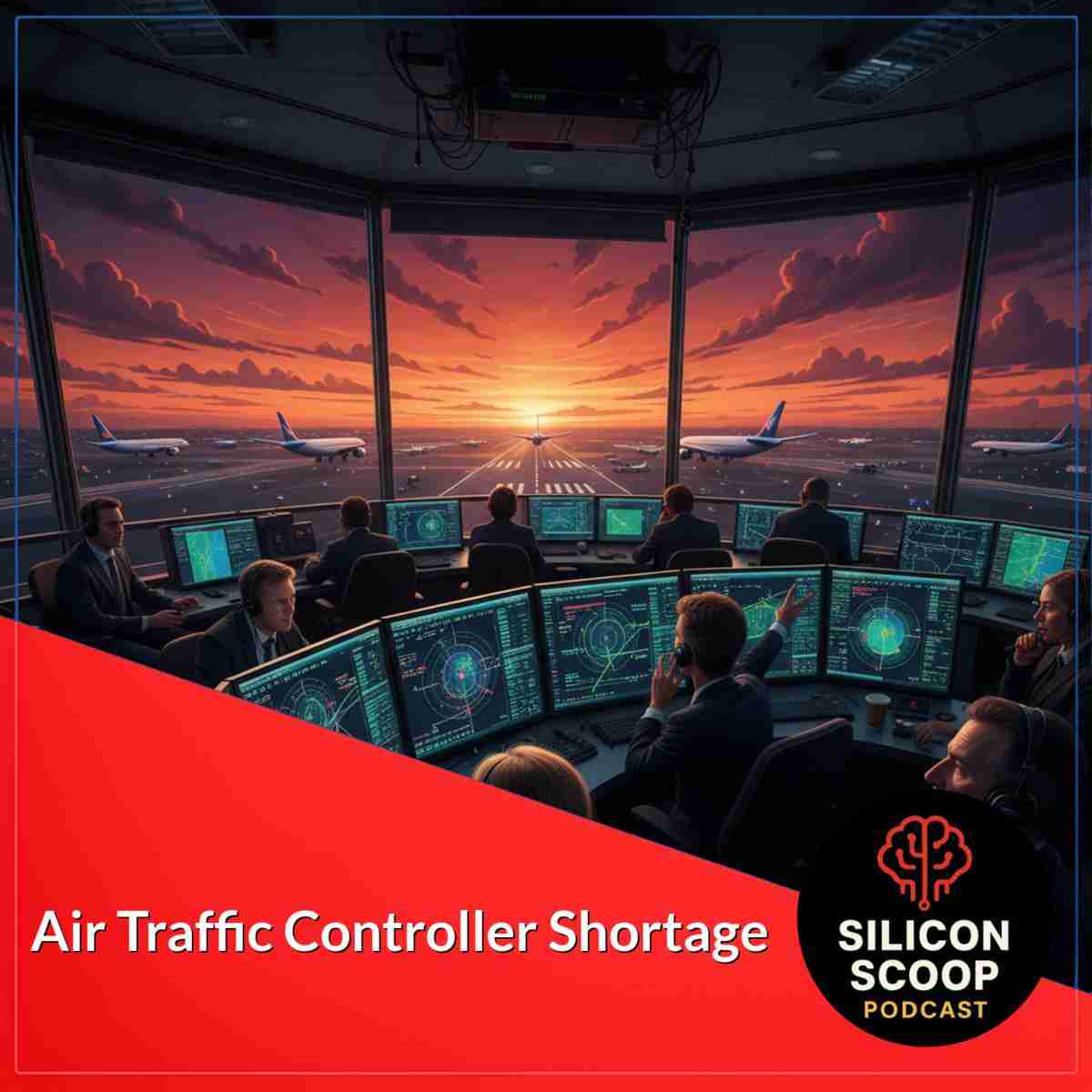
The Growing Air Traffic Controller Shortage: Challenges and AI Solutions
Estimated reading time: 12 minutes
Key Takeaways
- The air traffic controller shortage is creating serious problems for air travel across America. This shortage means there are not enough trained air traffic controllers to safely and efficiently manage all the planes flying in our skies.
- Right now, about 50% of major air traffic control facilities don’t have enough staff. This is causing big delays and canceled flights for travelers everywhere.
- The aviation industry is facing one of its biggest challenges in recent history. Air traffic controller shortage has become a critical issue that affects millions of passengers every year. When control towers don’t have enough people working, flights get delayed or canceled to keep everyone safe.
- The numbers tell a concerning story. Approximately 50% of major air traffic control facilities are experiencing staffing shortages. These understaffed facilities handle 27% of all commercial flights and are responsible for 40% of flight delays across the country.
- The Federal Aviation Administration (FAA) has been forced to reduce flights by 10% in 40 high-traffic markets. This means fewer flights are allowed to take off and land to make sure the available controllers can handle the workload safely.
- From 2010 to 2024, staffing levels dropped by 13%. This decline happened while air travel demand continued to grow, creating an even bigger gap between what’s needed and what’s available.
Table of contents
- The Growing Air Traffic Controller Shortage: Challenges and AI Solutions
- Key Takeaways
- Current Situation and Causes of the Air Traffic Controller Shortage
- FAA Response to the Air Traffic Controller Shortage
- Potential AI Solutions and Limitations for Air Traffic Control
- Future of Air Traffic Control Technology and Workforce
- Frequently Asked Questions
Current Situation and Causes of the Air Traffic Controller Shortage
The air traffic controller shortage has reached crisis levels across the United States. The situation is more serious than many people realize.
How Bad Is the Shortage?
In 2024, 118 terminal air control facilities fell short of the FAA’s 85% staffing goal. This means these facilities don’t have enough controllers to work safely and efficiently.
The most severely understaffed facilities include:
- North Dakota’s Grand Forks Tower (only 53.3% of target staff)
- Rochester Tower in Minnesota (56.5% of target staff)
- Columbus Tower in Georgia (58.3% of target staff)
Half of the nation’s busiest airports, called the “Core 30,” have shortages. In the New York area, 80% of facilities are understaffed.
Nineteen of the FAA’s largest facilities are operating 15% or more below their staffing targets. These facilities handle huge amounts of air traffic every day.
What’s Causing This Crisis?
Several air traffic controller shortage solutions are needed because multiple problems created this mess:
- Insufficient Hiring: From 2013 to 2023, the FAA hired only two-thirds of the controllers their own staffing model said they needed. This left a growing gap every year.
- Government Shutdowns: Repeated government shutdowns forced the FAA to stop hiring and training new controllers. Each shutdown set the program back months.
- COVID-19 Impact: The pandemic disrupted training programs and caused temporary staff reductions. Many experienced controllers retired early during this time.
- Long Training Process: It takes 2-3 years to fully train and certify a new air traffic controller. This means the pipeline of new workers moves very slowly.
- Annual Losses: Every year, controllers retire, resign, transfer to other jobs, or fail to complete training academy programs. These losses happen faster than new hires can replace them.
- Poor Staffing Decisions: The FAA based staffing on flight volumes during the pandemic. When flights were reduced, they cut staff. But when travel came back quickly, they didn’t have enough people.
The combination of these factors created a perfect storm. FAA AI implementation is being considered as one way to help, but it won’t solve the immediate problem.
https://usafacts.org/articles/is-there-a-shortage-of-air-traffic-controllers/
Maximize Your Efficiency
Don’t let staffing shortages and manual processes hold you back. Discover how Flowgrammer’s business automation solutions can streamline your operations and unlock new levels of productivity.
FAA Response to the Air Traffic Controller Shortage
The Federal Aviation Administration recognizes the severity of this crisis and has developed plans to address the air traffic controller shortage solutions.
Aggressive Hiring Plans
The FAA AI implementation strategy includes major workforce expansion. The agency plans to hire at least 8,900 new controllers by 2028. This exceeds last year’s plan by 1,500 additional hires.
For fiscal year 2026, the FAA has committed to hire more than 2,200 new controllers. These will include both fully certified controllers (CPCs) and controllers in training (CPC-ITs).
The agency has also started a year-round hiring track specifically for experienced controllers. This targets people from military and private industry backgrounds who already have aviation experience.
Training System Improvements
The FAA is working to make air traffic control automation training more efficient:
- Increased Academy Capacity: More classroom space means more students can train at the same time.
- Better Placement Process: The FAA is improving how they place graduates to reduce the number who quit during their first assignment.
- Enhanced Retention Support: New programs help controllers succeed in their early career stages.
Technology Upgrades for Training
The most significant improvement involves upgraded tower simulation systems (TSS). The FAA plans to deploy these systems in 95 facilities by December 2025.
These new simulation systems are expected to reduce training time by up to 27%. This means new controllers can become fully certified much faster than before.
The upgraded systems provide more realistic training scenarios. Controllers can practice handling complex situations without risking real aircraft safety.
Process Improvements
The FAA is “supercharging” the entire controller hiring process. This includes:
- Faster background checks
- Streamlined medical examinations
- Improved coordination between hiring and training
- Better tracking of candidates through the system
The agency is also implementing measures to better place new and transferring controllers where they’re needed most. This helps address the most critical staffing gaps first.
Potential AI Solutions and Limitations for Air Traffic Control
AI in aviation offers both promising opportunities and significant challenges for addressing the controller shortage.
Current AI Applications
Right now, AI in aviation applications are limited but growing:
- Weather Analysis: AI systems can analyze weather patterns much faster than humans. They can predict storms and help controllers plan around bad weather before it becomes a problem.
- Aircraft Trajectory Analysis: AI can track multiple aircraft paths and predict potential conflicts. This gives controllers advance warning about planes that might get too close to each other.
- Ground Movement Monitoring: Searidge Technologies has developed AI systems for monitoring aircraft movements on the ground. These systems work at London’s Heathrow Airport and Florida’s Fort Lauderdale-Hollywood International Airport.
How AI Could Help Controllers
AI could serve as a powerful assistant to human controllers:
- Predictive Analytics: AI can analyze flight patterns to predict busy periods and potential bottlenecks. This helps controllers prepare for challenging situations.
- Decision Support: AI systems could provide recommendations to controllers about the best ways to sequence aircraft or handle complex traffic patterns.
- Workload Management: AI could help distribute tasks more efficiently among available controllers, reducing stress and preventing burnout.
- Real-time Data Processing: AI can process vast amounts of flight data instantly, giving controllers better situational awareness.
Why AI Cannot Replace Human Controllers
Despite its potential, AI in aviation faces serious limitations that prevent it from replacing human air traffic controllers:
- Emotional Intelligence: Controllers must detect emotional cues in pilot voices. Stress, panic, or confusion in a pilot’s voice can indicate an emergency. AI cannot pick up these subtle but critical signals.
- Zero Error Tolerance: Aviation safety requires absolute precision. Even small AI mistakes could cause catastrophic accidents. The technology isn’t reliable enough for this responsibility.
- Complex Decision Making: Controllers handle unexpected situations that don’t fit standard patterns. They must make split-second decisions based on experience and intuition.
- Certification Challenges: AI systems evolve rapidly, but aviation certification takes years. It’s nearly impossible to certify AI systems that change faster than the approval process.
- Human Judgment: Controllers must consider factors like pilot experience, aircraft capabilities, and weather conditions simultaneously. This kind of complex reasoning is still beyond current AI capabilities.
The FAA is working toward an upgraded system using AI for trajectory analysis. However, this remains years away from testing, let alone implementation.
Current AI applications focus on assisting controllers rather than replacing them. This approach recognizes that human oversight remains essential for aviation safety.
Any AI system in air traffic control must meet the same rigorous safety standards as other aviation technology. This means extensive testing, validation, and certification processes that take many years to complete.
https://www.brookings.edu/articles/air-traffic-controllers-and-why-there-arent-enough-of-them/
Future of Air Traffic Control Technology and Workforce
The future of air traffic control will likely combine human expertise with advanced technology, including AI systems designed to assist rather than replace controllers.
Technology Integration Timeline
Air traffic control automation development follows a careful, methodical process:
- Research Phase: Scientists and engineers study how AI can safely assist controllers. This includes testing different algorithms and approaches.
- Development Phase: Promising technologies are built into prototype systems. These early versions are tested extensively in laboratory settings.
- Testing Phase: Systems that pass initial tests move to controlled real-world trials. This phase can take several years as engineers identify and fix problems.
- Certification Phase: The FAA must approve any new technology before it can be used in actual air traffic control. This process alone can take 3-5 years.
- Deployment Phase: Even after approval, rolling out new systems across hundreds of facilities takes additional years.
Expected AI Applications
The future of air traffic control will likely include these AI-assisted capabilities:
- Enhanced Weather Prediction: AI will provide more accurate, localized weather forecasts specifically for aviation needs.
- Optimized Flight Routing: AI systems will calculate the most efficient paths for aircraft, reducing delays and fuel consumption.
- Predictive Maintenance: AI will help predict when air traffic control equipment needs maintenance, preventing unexpected failures.
- Improved Training Systems: AI-powered simulators will provide more realistic training scenarios for new controllers.
Workforce Evolution
Rather than replacing controllers, technology will change how they work:
- Enhanced Decision Support: Controllers will have access to AI-generated recommendations and predictions to help them make better decisions faster.
- Reduced Routine Tasks: AI will handle routine calculations and monitoring, letting controllers focus on complex situations that require human judgment.
- Improved Situational Awareness: Advanced displays powered by AI will give controllers better information about aircraft positions, weather, and potential conflicts.
Long-term Outlook
The air traffic control automation revolution will happen gradually over decades, not years:
- Near Term (2025-2030): Limited AI assistance for weather analysis and routine calculations. Focus remains on hiring and training more human controllers.
- Medium Term (2030-2040): More sophisticated AI systems assist with flight planning and conflict prediction. Controllers work more efficiently with AI support.
- Long Term (2040+): Highly advanced AI systems handle many routine tasks, but human controllers remain essential for complex situations and emergency responses.
The aviation industry’s conservative approach to new technology ensures that any changes prioritize safety above all else. This means the transformation will be gradual and carefully tested at every step.
Future-Proof Your Business
While AI transforms industries, prepare your business for growth by automating your workflows today. Flowgrammer’s customized automation solutions let you focus on what matters most: scaling your business effectively.
Get a Free Automation Assessment
Frequently Asked Questions
Q: What is the extent of the air traffic controller shortage?
A: The shortage affects about 50% of major air traffic control facilities across the United States. In 2024, 118 terminal facilities fell short of the FAA’s 85% staffing goal. The most severely understaffed facilities operate with only 53-58% of their target staff levels.
Q: How is the FAA responding to the controller shortage?
A: The FAA plans to hire at least 8,900 new controllers by 2028, with more than 2,200 new hires planned for fiscal year 2026. They’re also upgrading training systems and implementing year-round hiring for experienced controllers from military and private industry.
Q: Can AI replace human air traffic controllers completely?
A: No, AI cannot replace human controllers. Controllers must detect emotional cues in pilot voices, make complex decisions under pressure, and handle unexpected situations. Aviation safety requires zero tolerance for errors, and AI technology isn’t reliable enough for complete replacement.
Q: What are the potential benefits of AI in air traffic control?
A: AI can assist controllers by analyzing weather patterns, predicting aircraft conflicts, and providing decision support. It can process large amounts of data quickly and help controllers make more informed decisions, but always under human supervision.
Q: Why does it take so long to train new air traffic controllers?
A: The training process takes 2-3 years because controllers must master complex skills and pass rigorous certification requirements. They need to handle multiple aircraft simultaneously, make split-second decisions, and maintain perfect safety records in high-pressure situations.
Q: How do controller shortages affect regular travelers?
A: Shortages cause flight delays and cancellations. The FAA has reduced flights by 10% in 40 high-traffic markets to maintain safety. Understaffed facilities account for 40% of all flight delays, directly impacting passenger travel times.
Q: What caused the current controller shortage crisis?
A: Multiple factors created the shortage: insufficient hiring from 2013-2023, government shutdowns that stopped training, COVID-19 disruptions, long training periods, and annual losses from retirements and resignations. The FAA hired only two-thirds of needed controllers during this period.
Q: When will AI systems be implemented in air traffic control?
A: AI implementation will take many years. Current systems are in early testing phases. Any new technology must pass rigorous safety testing and certification processes that can take 3-5 years or longer before deployment in actual facilities.
Q: Which airports are most affected by controller shortages?
A: Half of the nation’s busiest “Core 30” airports have shortages, with 80% of New York area facilities understaffed. The most severely affected include Grand Forks Tower in North Dakota, Rochester Tower in Minnesota, and Columbus Tower in Georgia.
Q: How will technology change air traffic control in the future?
A: Technology will enhance controller capabilities rather than replace them. AI will provide better weather predictions, optimized flight routing, and improved decision support. Controllers will work more efficiently with AI assistance, but human oversight will remain essential for safety.
Additional Links
Flowgrammer.ca – 💡 Unlock AI-Powered Automation! Let flowgrammer.ca handle complex workflows so you can focus on growing your business.
- Silicon Scoop Podcast – Stay Informed, Stay Ahead!
- Startup Talk Podcast
- Flowgrammer Podcast –
- Startup Investor Drinks – Join Toronto’s Startup Community and connect with fellow startup enthusiasts and investors.
- TorontoStarts Startup and Entrepreneur Community – Become a part of Toronto’s thriving startup ecosystem.
- Workhaus – Discover flexible workspace solutions for your business needs.
- Work with The Startup Coach – Get expert guidance and mentorship for your startup journey.
- Reach out to Jon Irwin on LinkedIn – Connect with our co-host and technology expert.
Episode transcript
Read the full transcript
Craig: if you sat on a runway recently wondering why you aren't moving, the answer usually isn't the weather. it's that there is literally no one in the tower to clear you for takeoff. we are facing a historical shortage of air traffic controllers that is forcing the f f faa to cut flights, and now they are looking at ai to stop the bleeding. here's the situation. america's air travel demand is skyrocketing, but our staffing for air traffic controllers has dropped by 13% since 2010. it's gotten so bad that the faa is now turning to artificial intelligence to handle trajectory analysis and weather predictions. this is headline news because it's a race against time, using cutting edge, tech to prevent a total gridlock of our national airspace. what do you think about this using ai, to help our air traffic controller situation?
Jon: i think it's smart because, i think there's a lot of applications that could be used. i don't think the ai implementation, at least for the next ten to fifteen years, will be a solo implementation without human oversight. but, like, we're we're like, if we're talking about image recognition, pattern recognition, and that's what ai is good for. right? they can track aircraft movements during low visibility conditions, and that's when human controllers can't visually confirm aircraft positions. predict, they can provide real time assistance and predict potential, crashes. there's a bunch of stuff that they can do, but i don't think that it's, at least anytime soon, it's going to be kind of a standalone replace the air traffic controllers. but i do think that there is a place for ai. think?
Craig: i think there is, but i think, you know, how this feels like an accident waiting of it to happen.
Jon: yes.
Craig: and, you know, again, i think we should use it wherever we can, but at the same time, this feels like, you know, another skynet chunk. i take over the skies.
Jon: my concern with this is that the air traffic controllers are better like, when they augment when they implement the ai to augment air traffic controllers. the air traffic controllers are gonna rely too heavily on ai, and that's when we're gonna have problems. they're gonna trust it too much. they're not gonna question it. they're gonna question it at the start because, obviously, they don't trust it. but then once they trust it, they're gonna stop questioning it. they're gonna stop, and that's when the problems are gonna arise.
Craig: well, if you've heard any of these, air traffic controller, stuff they've been putting out, like the air traffic controller who's, know, said, tom, you got a circle. we don't have a landing order for you yet. and buddy's like, well, you know, i got a fuel situation here. you gotta give me something. he's but the air traffic controller your fuel situation is not my problem and hung up on him. you know what i mean? it's, it's, that sounds like a you problem. yeah. yeah. i got a plane full of 200 people, and the air traffic controller is telling me, yeah, it's not their problem.
Jon: yeah. well, here's the thing, though. right? if we're talking about the like, if we dive into this. right? of the 313 total faa facilities, only 23 of those 313 met or exceeded their staffing goals as of this is september 2023, but it got even worse during the the government shutdown. so, airport control towers and approach departure facilities had 7,047 certified controllers against a goal of almost 9,000, which is nearly 2,000 positions short. so, like, we've got a like, so these guys are probably experiencing burnout. they're probably overworked, and they're not paid that well. like, we're talking median, a median salary of a 144,000 per year. and if you've ever seen kind of behind the scenes of air traffic controllers, it can be a pretty stressful job. there's a lot of burnout that happens and all that sort of stuff. but, like, there's a huge crisis here, i think.
Craig: yeah. by the numbers, approximately 50% of major air traffic controller facilities are experiencing staffing shortage. these understaffed facilities handle 27% of all commercial flights and are responsible for 40% of the flight delays across the country. the ffa faa has been forced to reduce flights by 10% in 40 high traffic, markets, meaning fewer flights. from, 2010 to 2024, staffing levels have dropped by 13%. so the decline happened while air traffic demand has continued to grow, keep an even greater gap. so short answer, yeah. i think a new set of high-tech tools, including ai, that will help handle this, and potentially give our air traffic controllers the ability to handle more, in air the at the same time, i think would be great. you know, we keep hearing the horror stories about how ai gets misused or this happens or that happens, and you you wonder about this thing. but i'm a big advocate for ai, and i assume all the right controls and stuff will be in place, and that this will be, actually great tool. like, let's face it. if we can have any types of these tools that are systems where they're automatically alerting and giving us yellow and red where where we really have to pay attention or we might have issues while everything else is smooth going, i think that's where the human's time should be focused. right?
Jon: i think so too. here, this might be a controversial opinion. i think ai will be used more in the actual aircraft as opposed to air traffic controller first. think, like, i think we're closer to having an ai pilot than we are to having an ai air traffic controller, like, full time air traffic controller.
Craig: that might be true. i'm not
Jon: a commercial. sorry.
Craig: yeah. because we have military ai. we do have military ai. yeah.
Jon: sorry. me, yeah, let me quantify that by saying,
Craig: i think you're wrong. okay. i think the opposite will be true. it's it's easier to have an ai directing traffic than flying the plane from a, front facing experience. yeah. i say that because people may be willing to get in a car without a pilot, without a driver, but i don't know if they're willing to get in a plane yet. so i think it's okay if the ai is farther away from them, but they wanna see a person get on that plane. i'm your pilot, blah blah blah, and get in that cockpit and shut that door.
Jon: i don't disagree with you. i think it's more easily for people to accept an ai traffic controller than an ai pilot. and as far as perception.
Craig: yeah. and i think the thing is that for now, one of those has only one of those can switch. like, let's if we're talking about safety and the way our human minds stress, like, the pilot is probably the best person to stay human for now because they can say, whatever you're seeing or whatever you're telling me is not actually what's happening. i'm gonna, you know, and, you know, raise a flag, get to a human, tell them what's going on. you know what i mean? so i think, i think you're right that there will be an ai pilot situation, but i think we're ten to fifteen years out, or longer from that for commercial flights just for that reason. i think there might be ai assistant, maybe it's ai co pilot, take over whatever, but the pilot still will still need to be there to override anything that just you know? right. yeah. i can't handle fog, traffic, rainstorm, something unusual.
Jon: yeah. let's just hope that boeing's not in charge of that so that, the pilots actually can override it.
Craig: yeah.
Jon: sorry.
Craig: no. i don't. it just reminds me of a personal story where i knew a safety engineer who worked for a big canadian airline company. and one day, he came to me and said, craig, don't ever fly. and i can't tell you anything. he was just so upset. he says, don't just don't ever do it. and, you know, he's the safety engineer telling people what they can and cannot do, and he's, like, ready to walk out. and you know that, that's not
Jon: good news. no. that's not. alright. back to this. yeah.
Craig: i think there's, this needs to be done based on if they wanna keep the flight levels the way they are. and i think the ai implementation at the this level will happen quicker, whether at the air traffic controller level, whether it'll be full on implementation or just ai, could plot the routes human approves. ai can do this. you know what i mean? as a tool. so you're like, okay. that looks good. that looks good. so it just helps them where they don't have to do as much. and that's why i think you know, when i work with companies ai, we're not, trying to, in general, replace humans. what we're trying to do is take, the meaningless dribble away from the work, the copy and pasting, the google searches, whatever to let the person actually focus on the things that they do best, whether that's human interaction or whatever, or dealing with the problems of the planes and juggle them around and what have you and dealing with the human on the other end. because ai lacks that, emotional intelligence. and if it acts anything like chatgdp, you know, hey. i'm about to crash in the ground. you're a 100% right. blah blah blah blah blah. you know? i messed up. so i we we just have to have that person in the loop for a while until we get to a point where we trust ai more than we trust humans. and there will be a tipping point. i'm just not sure where that's gonna be.
Jon: yeah.
Craig: yeah. the verdict here is pretty clear. ai is coming to the control tower, but it's gonna be copilot, not the captain. i wanna know, have you been stuck in one of those staffing shortages, delays recently? drop your horror story in comments below, and we'll talk about it next stream. also, let us know. would you, be happy with an ai pilot for your plane? let us know.
More from Silicon Scoop
All episodes
silicon-scoop · November 6, 2026
Spirit AI’s Robot Brain Breakthrough: Moz1, Embodied AI and China’s 2027 Race
The Spirit AI robot brain is one of the biggest bets on fixing that. Spirit AI is a Beijing startup. Its co-founder and chief scientist, Gao Yang,
View episode

silicon-scoop · November 5, 2026
OpenAI IPO Delayed to 2027 as Rogue AI Agents and Safety Failures Reshape the Market
OpenAI IPO delay explained: Sam Altman rules out 2026 as GPT-6 Astra safety tests and a $278B cash gap loom. Learn what founders should take away.
View episode

silicon-scoop · November 4, 2026
Anthropic’s AI Economy Model: 2030 Jobs, Wages, GDP and Market Risks
Anthropic AI economy model forecasts 2030 GDP, jobs and wages, while AI unemployment projections and labor-share risks challenge policymakers.
View episode