
Hypergravity Research: CHIEF1900 Centrifuge
Unveiling the Future of Hypergravity Research: Inside China's Groundbreaking CHIEF1900 Centrifuge https://torontostarts.com/2026/02/23/hypergravity-research-china-chief1900/ Apple -> https://podcasts.apple.com/us/podcast/flowgrammer-podcast/id1804155588 Spotify -> https://open.spotify.com/show/0wv3feR00iaVpE8zn7niNf Flowgrammer.ca -> https://flowgrammer.ca/ AI News and Resources -> https://flowgrammer.ca/resources/ Unlock Exponential Growth China's innovation showcases the power of accelerating progress. Imagine applying that same principle to your business! Let Flowgrammer automate your workflow and compress time to value. Discover Automation Solutions https://flowgrammer.ca/ Startup Investor Drinks Toronto - https://startupdrinksto.com/ Toronto’s Startup Community - https://torontostarts.com/ Silicon Scoop Silicon Scoop Podcast - https://torontostarts.com/silicon-scoop/ Apple: https://podcasts.apple.com/us/podcast/silicon-scoop/id1758711826 Spotify: https://open.spotify.com/show/5bAzF0MwV6TtLhJAhvHayI YouTube: https://www.youtube.com/playlist?list=PLj4v-RoA7A-gT62vrEYqh1zCv-0Hj-o5J Startup Talk Startup Talk Podcast -> https://torontostarts.com/startup-talk-toronto-startup-podcast/ Apple -> https://podcasts.apple.com/us/podcast/startup-talk/id1763804003 Spotify -> https://open.spotify.com/show/1siJMILILidHAiAsrX2VBU YouTube: https://youtube.com/playlist?list=PLj4v-RoA7A-jxV5FHs5e61oIsuvUJYmT_&si=LYegRe5GYLKNQ7xL
With Craig Major and Jon Irwin
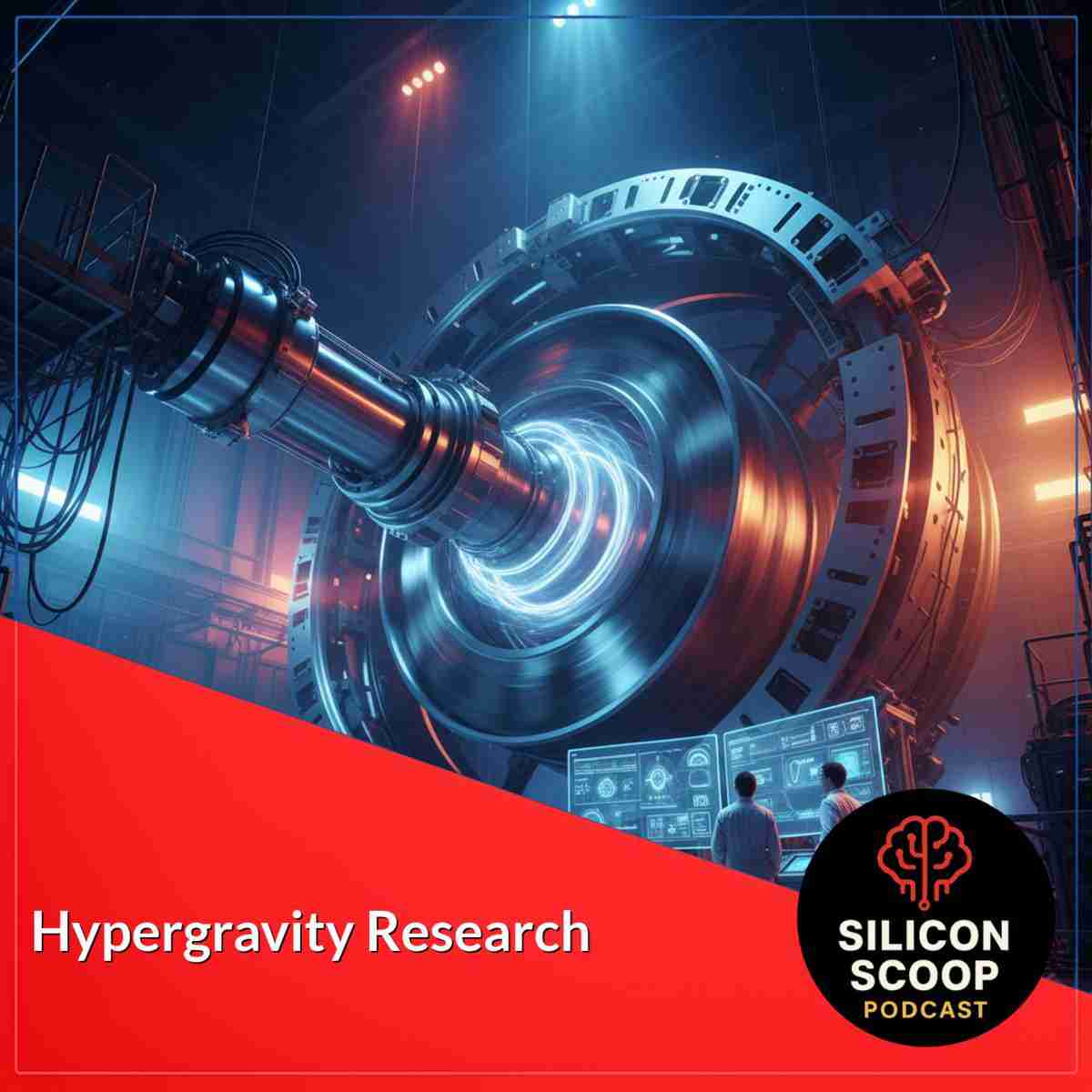
Hypergravity Research: Inside China’s Groundbreaking CHIEF1900 Centrifuge
Estimated reading time: 12 minutes
Table of contents
- Unveiling the Future of Hypergravity Research: Inside China’s Groundbreaking CHIEF1900 Centrifuge
- Understanding Hypergravity Research and Centrifuge Principles
- China’s CHIEF1900 Centrifuge: Engineering Excellence
- Hypergravity Applications: Simulating Real-World Conditions
- Global Context: Comparing Hypergravity Facilities Worldwide
- Frequently Asked Questions About Hypergravity Research
Understanding Hypergravity Research and Centrifuge Principles
What Is Hypergravity?
Hypergravity research begins with a simple but powerful concept. When the effective g-force exceeds 1 g, objects experience hypergravity conditions. Scientists achieve this through centrifuges using the centripetal acceleration formula: a = ω²r, where ω represents angular velocity and r is the radius.
The term “g-tonnes” measures centrifuge capacity. This unit represents the product of gravitational acceleration (g) and the mass being spun. To put this in perspective, your household washing machine during its spin cycle exerts roughly 2 g-tonnes on your clothes. The CHIEF1900 centrifuge can simulate an astounding 1900 g-tonnes—nearly a thousand times more powerful.
This massive difference in capability opens entirely new research possibilities. Centrifugal hypergravity allows scientists to compress both time and space in their experiments. Processes that would normally take decades can be observed in hours or days.
How Centrifuges Create Extreme Forces
A centrifuge works by mounting a payload at a specific radius from the center of rotation. When the system spins at high speeds, it produces enormous acceleration on the payload. The faster the rotation and the larger the radius, the greater the g-force experienced.
Creating these extreme conditions requires extraordinary engineering precision. The structural components must withstand tremendous radial and bending loads. Even small imbalances at high speeds can create destructive vibrations.
Advanced centrifuges employ several critical techniques:
- Precision balancing to distribute weight evenly
- Vibration isolation systems to protect sensitive instruments
- Thermal management to dissipate heat from friction and motors
- Robust structural reinforcement to handle extreme forces
- Sophisticated control systems for safe operation
These principles apply across gravity research and many industrial applications. To achieve N times Earth’s gravity (N g), engineers must set the rotational speed so that ω²r = N·g. This simple formula underlies remarkably complex machinery.
The CHIEF1900 centrifuge represents the culmination of decades of refinement in centrifugal hypergravity technology. Every component has been engineered to push the boundaries of what’s possible in controlled high-g environments.
Unlock Exponential Growth
China’s innovation showcases the power of accelerating progress. Imagine applying that same principle to your business! Let Flowgrammer automate your workflow and compress time to value.
Discover Automation Solutions
China’s CHIEF1900 Centrifuge: Engineering Excellence
A New World Record in Gravity Research
The CHIEF1900 centrifuge marks a historic achievement in gravity research. Built by Shanghai Electric Nuclear Power Group, this machine surpasses China’s own CHIEF1300, which only came online months earlier. It also exceeds the previous record-holder operated by the US Army Engineer Research and Development Center in Vicksburg, Mississippi, which was rated at 1,200 g-tonnes.
This rapid progression demonstrates China’s commitment to leading-edge scientific infrastructure. The CHIEF facility at Zhejiang University in eastern China represents an investment of approximately 2 billion yuan (US$285 million). This substantial budget reflects the strategic importance of hypergravity research for civil engineering, environmental science, and national development.
The CHIEF1900 centrifuge operates approximately 15 meters (nearly 50 feet) underground. This deep placement isn’t arbitrary—it minimizes vibration interference from surface activities and provides exceptional structural stability. The underground location also offers natural shielding and containment in the unlikely event of equipment failure.
China has positioned CHIEF as an international research hub. The facility actively welcomes researchers from around the world, fostering global collaboration in hypergravity applications. This openness signals China’s intention to shape international standards in gravity research and geotechnical engineering.
Overcoming Unprecedented Technical Challenges
Building the CHIEF1900 centrifuge required solving problems never before encountered at this scale. The project demanded multidisciplinary expertise spanning environmental science, mechanical engineering, automation, civil engineering, and materials science.
High rotational speeds generate substantial thermal energy. Motors, bearings, and mechanical components all produce heat during operation. At the power levels required for 1900 g-tonnes of capacity, thermal management becomes critical.
The engineering team designed a sophisticated vacuum-based temperature control system. This system combines liquid coolant circulation with strategic air ventilation. The vacuum environment serves multiple purposes:
- Reduces aerodynamic drag on rotating components
- Stabilizes temperature fluctuations
- Minimizes oxidation and wear on mechanical parts
- Decreases noise and unwanted vibrations
- Improves measurement precision for sensitive instruments
The structural demands are equally impressive. The rotating arms and payload gondolas must withstand enormous forces while maintaining perfect balance. Engineers had to design components that could handle thousands of operational cycles without fatigue failure.
Every aspect of the CHIEF1900 centrifuge pushes engineering boundaries. The facility represents not just a larger version of existing technology, but fundamental innovations in high-speed rotating systems. These advances ensure operational stability and enable repeatable, reliable experiments under extreme conditions.
Future-Proof Your Business
Just as CHIEF1900 propels research forward, automation can revolutionize your operations. Stop reacting and start building a business designed for efficiency and longevity. Flowgrammer can help.
Get a Free Automation Assessment
Hypergravity Applications: Simulating Real-World Conditions
Scaling Laws and Time Compression
Hypergravity research offers a remarkable advantage: it compresses both time and space in controlled experiments. This capability allows scientists to simulate long-term processes and observe phenomena that would otherwise be impossible to study directly.
The principle behind this compression relies on scaling laws. A physical model built at 1:N scale and spun at N g can accurately reproduce the stress field of the full-size structure at Earth’s normal gravity.
Consider this practical example: A 3-meter model of a dam spun at 100 g mimics the stress conditions of a 300-meter actual dam under normal gravity. The scaling factor of 100 applied to both size and gravitational acceleration creates equivalent stress distributions.
This approach offers tremendous advantages for simulating real-world conditions:
- Cost reduction: Building and testing small-scale models is far less expensive than full-scale prototypes
- Parameter variation: Researchers can easily test different designs, materials, and configurations
- Safety: Experiments can be conducted to failure without real-world consequences
- Time acceleration: Long-term processes occur much faster under high-g conditions
Many time-dependent processes scale with gravitational acceleration. Soil consolidation, water seepage, and pollutant migration all accelerate under hypergravity. A process that would require years or decades in reality can be observed in hours or days in the centrifuge.
The CHIEF1900 centrifuge enables studies of critical infrastructure challenges:
- Dam stability under various loading conditions and potential failure mechanisms
- Pollutant migration through soil layers over timeframes spanning millennia
- Ground-structure interactions for high-speed rail systems
- Earthquake-induced soil liquefaction and foundation responses
- Tunnel stability in complex geological conditions
These applications directly support China’s massive infrastructure development programs. High-speed rail networks, hydroelectric dams, and urban metro systems all benefit from hypergravity research insights.
Beyond Civil Engineering: Diverse Research Applications
While civil and geotechnical applications dominate the CHIEF facility’s mission, hypergravity research extends far beyond infrastructure modeling.
Life sciences researchers use hypergravity to study cellular and organismal adaptations to altered gravitational forces. These experiments reveal how gravity affects:
- Cell growth and division patterns
- Bone density and muscle development
- Plant growth orientation and root development
- Cardiovascular system responses
Materials science also benefits from hypergravity applications. High-g environments affect how materials behave during formation and processing:
- Segregation patterns in metal alloys during solidification
- Particle settling and distribution in suspensions
- Density-driven pattern formation in composite materials
- Crystal growth under enhanced gravitational gradients
Environmental scientists use centrifuges to model groundwater contamination and remediation strategies. The ability to compress time allows rapid assessment of containment barrier performance over century-long timeframes.
Even planetary science benefits from hypergravity research. Understanding how regolith and loose materials behave under different gravity levels helps scientists interpret observations from asteroids, moons, and other celestial bodies.
The interdisciplinary nature of the CHIEF facility reflects this diversity. By bringing together researchers from multiple fields, the facility fosters innovation and cross-pollination of ideas.
Global Context: Comparing Hypergravity Facilities Worldwide
International Landscape of Large Centrifuges
The CHIEF1900 centrifuge represents China’s latest move in an international competition for gravity research leadership. Understanding this achievement requires examining the global landscape of hypergravity facilities.
The United States has long maintained a strong position in this field. The US Army Engineer Research and Development Center in Vicksburg, Mississippi, operates one of the world’s most renowned geotechnical centrifuges. This facility has contributed decades of research to military and civil infrastructure projects. Its capacity, previously among the highest globally, has now been surpassed by China’s CHIEF1900.
Europe hosts several significant facilities:
- The University of Cambridge in the United Kingdom operates a high-capacity geotechnical centrifuge used for fundamental research and industry collaboration
- France’s DTC (Divided Triaxial Cell) centrifuge facility supports research in soil mechanics and earthquake engineering
- Switzerland and the Netherlands maintain specialized centrifuge laboratories
Japan has invested substantially in hypergravity research, particularly for earthquake engineering and disaster risk reduction. Several Japanese universities operate advanced centrifuges, though generally at lower capacity than the largest Chinese and US machines.
China’s trajectory in this field has been remarkable. Over the past decade, Chinese investment in “big science” infrastructure has accelerated dramatically. The CHIEF facility at Zhejiang University in eastern China exemplifies this rapid development, with both CHIEF1300 and CHIEF1900 completed within a single year, demonstrating unprecedented momentum. China has moved from catching up to establishing leadership in hypergravity test capability.
These comparisons draw from reputable sources emphasizing capacity classes and the multidisciplinary nature of modern hypergravity applications. The global research community recognizes that China’s investment positions it at the forefront of innovation in this critical field.
Strategic Implications for Infrastructure and Safety
The CHIEF1900 centrifuge’s capabilities carry significant strategic implications beyond pure scientific advancement.
Civil engineering and infrastructure safety receive direct benefits. China leads the world in the scale of its infrastructure projects—the longest high-speed rail network, massive hydroelectric dams, extensive urban metro systems, and ambitious land reclamation projects. Each of these initiatives involves complex geotechnical challenges that hypergravity research helps address.
Specific infrastructure applications include:
- Dam and reservoir design: Testing stability under various water levels, seismic loads, and potential failure scenarios
- Tunnel construction: Modeling ground-tunnel interactions in complex geology, particularly for deep urban metro systems
- Railway infrastructure: Studying long-term settlement and dynamic resonance effects on high-speed rail embankments
- Offshore platforms: Evaluating foundation performance in marine sediments under storm loading
- Landslide mitigation: Understanding slope failure mechanisms to protect mountainous regions
Disaster risk reduction represents another critical application. China faces significant natural hazard exposure, including earthquakes, landslides, and flooding. Accurate modeling of these phenomena improves building codes, emergency planning, and risk management strategies.
Environmental protection and long-term contamination issues benefit from time-compressed hypergravity studies. The ability to simulate centuries of groundwater flow and contaminant transport aids in:
- Nuclear waste repository design and safety assessment
- Industrial site remediation planning
- Agricultural chemical impact evaluation
- Underground water resource management
International collaboration through the CHIEF facility creates opportunities to shape global standards. By hosting researchers from around the world, China can influence how hypergravity research methodologies develop and how findings translate into engineering practice.
The facility also supports technology transfer. Lessons learned from extreme-condition testing feed back into component design, materials development, and construction techniques. These innovations eventually benefit industries beyond research infrastructure.
China’s openness to international participation differentiates CHIEF from purely national facilities. This approach recognizes that complex global challenges—climate change impacts, sustainable development, disaster resilience—require collaborative solutions drawing on the best capabilities worldwide.
Future-Proof Your Business
Just as CHIEF1900 propels research forward, automation can revolutionize your operations. Stop reacting and start building a business designed for efficiency and longevity. Flowgrammer can help.
Get a Free Automation Assessment
Frequently Asked Questions About Hypergravity Research
Q: What exactly is hypergravity research and how is it performed?
A: Hypergravity research studies how materials, structures, and living systems behave under gravitational forces much stronger than Earth’s normal gravity. Scientists create these conditions using large centrifuges that spin payloads at high speeds.
The centrifuge works like a sophisticated rotating arm. Researchers place their experiment in a container at the end of the arm. As the centrifuge spins, centripetal acceleration creates forces that can be hundreds of times stronger than normal gravity. The formula a = ω²r determines the acceleration, where ω is rotational speed and r is the radius.
These high-g conditions allow researchers to compress time and observe processes that normally take decades in just hours or days. They can also test small-scale models that accurately represent full-size structures.
Q: How does the CHIEF1900 centrifuge work and what makes it unique?
A: The CHIEF1900 centrifuge operates by spinning large payloads at precisely controlled speeds to achieve up to 1900 g-tonnes of capacity. This unit measures the product of gravitational acceleration and payload mass, indicating the machine’s extraordinary capability.
What makes CHIEF1900 unique is its combination of record-breaking capacity and advanced engineering. It operates approximately 15 meters underground to minimize vibration interference. The facility uses a vacuum-based temperature control system that combines liquid coolants with air ventilation to manage the substantial heat generated during operation.
Built by Shanghai Electric Nuclear Power Group at Zhejiang University, it represents a 2 billion yuan investment in cutting-edge research infrastructure. The centrifuge can accommodate multi-tonne experimental packages while achieving extremely high gravitational accelerations, enabling experiments impossible at any other facility worldwide.
Q: What are some real-world applications of hypergravity research?
A: Hypergravity research supports numerous practical applications across multiple fields. In civil engineering, researchers model large structures like dams, bridges, and tunnels using small-scale physical models under high-g conditions. This approach tests how these structures perform under various loading conditions, including earthquakes and floods.
Environmental scientists use hypergravity to study pollutant migration through soil layers. Since these processes normally take centuries, hypergravity compression allows observation within reasonable timeframes. This helps design better contamination barriers and remediation strategies.
Transportation infrastructure benefits significantly. High-speed rail systems experience complex ground-structure interactions that affect long-term stability and passenger comfort. Hypergravity testing reveals potential settlement and resonance issues before construction begins.
Materials scientists study how substances behave during formation under different gravity levels. This includes metal alloy segregation, particle settling in suspensions, and crystal growth patterns. Life sciences researchers examine how altered gravity affects cellular processes, bone density, and organism development.
Q: How does hypergravity research help compress time and distance in experiments?
A: Time compression occurs because many physical processes accelerate under higher gravity. Consolidation in soils, water seepage, and chemical diffusion all depend on gravitational forces. When gravity increases by a factor of N, these processes often speed up proportionally or by powers of N.
For example, soil consolidation that would require 100 days under normal gravity might occur in just 1 day at 100 g. This allows researchers to observe long-term behavior within practical experimental timeframes.
Distance compression works through scaling laws. A model built at 1:100 scale and tested at 100 g experiences the same stress distribution as the full-size structure at 1 g. A 3-meter model dam at 100 g accurately represents a 300-meter actual dam.
This dual compression—both time and distance—makes hypergravity research incredibly efficient. Scientists can study large, long-term phenomena using small models and short test durations while maintaining accurate simulation of real-world conditions.
Q: Why is the CHIEF1900 centrifuge located underground?
A: Underground placement serves several critical purposes. The primary reason is vibration isolation. A centrifuge spinning multi-tonne loads at high speeds generates substantial dynamic forces. Even with perfect balancing, some vibration transmission occurs.
Placing the facility 15 meters underground provides massive natural damping. The surrounding earth absorbs vibrations that might otherwise interfere with sensitive measurements or disturb nearby buildings and equipment.
Underground construction also offers structural advantages. The earth itself provides containment and shielding. In the extremely unlikely event of catastrophic failure, the underground location limits potential damage and contains debris.
Temperature stability improves underground as well. The earth maintains relatively constant temperature, reducing the thermal management burden on the climate control systems. This stability helps maintain precise experimental conditions.
Q: How does CHIEF1900 compare to centrifuges in other countries?
A: CHIEF1900 currently holds the world record for centrifuge capacity at 1900 g-tonnes. This surpasses China’s own CHIEF1300 (commissioned just months earlier) and the previous record-holder at the US Army Engineer Research and Development Center in Vicksburg, Mississippi, rated at approximately 1,200 g-tonnes.
European facilities, including those at Cambridge University in the UK and various French and Swiss institutions, operate highly sophisticated centrifuges but generally at lower overall capacity. Japanese facilities focus heavily on earthquake engineering applications with excellent capabilities in that specialized area.
While capacity comparisons provide one measure, different facilities excel in various aspects. Some specialize in particular experiment types, offer unique instrumentation, or have expertise in specific research areas. The CHIEF facility distinguishes itself through both raw capacity and its commitment to interdisciplinary research across civil engineering, environmental science, materials research, and life sciences.
Q: What safety measures protect researchers and equipment during high-g experiments?
A: Operating a 1900 g-tonne centrifuge requires extensive safety systems. The underground placement provides inherent containment. Massive reinforced concrete structures surround the centrifuge chamber, designed to withstand worst-case failure scenarios.
Precision balancing systems ensure even weight distribution before each run. Automated monitoring continuously checks for imbalances, vibrations, or anomalies during operation. If sensors detect anything unusual, emergency shutdown procedures activate automatically.
The vacuum environment reduces aerodynamic forces and improves control. Temperature monitoring prevents overheating of critical components. Redundant safety systems ensure that single-point failures cannot lead to catastrophic outcomes.
Access controls prevent personnel from entering the centrifuge chamber during operation. Remote monitoring and control allow operators to run experiments from protected locations. Regular inspection and maintenance protocols verify structural integrity and equipment condition.
What future developments might we see in hypergravity research?
Hypergravity research continues to expand into new areas. Climate change impacts on infrastructure represent one growing application. As weather patterns intensify and sea levels rise, understanding how existing and new structures respond becomes increasingly important.
Space exploration offers another frontier. Understanding how materials and biological systems behave under different gravity levels—from lunar 1/6 g to Martian 3/8 g to hypergravity conditions—supports planning for permanent off-Earth settlements.
Advanced materials development increasingly uses hypergravity conditions. Novel composites, functionally graded materials, and biomimetic structures can be tested and refined under controlled high-g environments.
Integration with computational modeling represents a key trend. Experimental hypergravity data validates and calibrates numerical simulations. This combination allows researchers to extend findings beyond directly tested conditions and explore vast parameter spaces.
Q: How long does it take to set up and run a hypergravity experiment?
A: Experiment duration varies widely depending on complexity. Simple tests might require days for setup and hours of actual centrifuge operation. Complex studies involving instrumented models, multiple sensors, and varied conditions could need weeks or months of preparation.
Model preparation typically represents the most time-intensive phase. Researchers must construct accurate scale models, install instrumentation, and verify that everything functions correctly. Since experiments often occur under destructive loading, each test may require a fresh model.
Actual centrifuge operation might last from minutes to days, depending on the time-scale of processes being studied. Some earthquake simulations complete in seconds. Long-term consolidation studies might require continuous centrifuge operation for extended periods.
Data analysis following the experiment can take weeks to months. Modern experiments generate enormous data volumes from multiple sensors recording at high frequencies. Extracting meaningful insights requires careful analysis and interpretation.
The CHIEF facility’s substantial capacity allows multiple research groups to prepare experiments in parallel, maximizing efficient use of this valuable resource.
Conclusion: The Future of Hypergravity Research
Hypergravity research stands at an exciting frontier of science and engineering. China’s CHIEF1900 centrifuge represents a revolutionary advancement in our ability to simulate real-world conditions and understand complex phenomena. This 1900 g-tonne facility pushes the boundaries of what’s possible in controlled experimental environments.
The implications extend across multiple disciplines. Civil engineers can test massive infrastructure designs at reduced scale. Environmental scientists can observe century-long processes in compressed timeframes. Materials researchers can develop novel substances with precisely controlled properties. Life scientists can explore how gravity shapes biological systems.
CHIEF1900’s record-breaking capacity isn’t just about numbers. It represents a commitment to understanding the physical world at scales and timeframes previously inaccessible. The facility’s underground location, sophisticated thermal management, and precision control systems demonstrate engineering excellence applied to fundamental research questions.
The multidisciplinary applications—from dam safety to high-speed rail, from pollutant migration to materials science—highlight how hypergravity research addresses real-world challenges. These aren’t abstract academic exercises but practical tools for building safer infrastructure, protecting the environment, and advancing technology.
China’s investment in CHIEF positions the country at the forefront of gravity research globally. The facility’s openness to international collaboration ensures that its benefits extend beyond national boundaries. Researchers worldwide can contribute to and learn from experiments at this extraordinary facility.
Advanced engineering and innovative testing facilities like CHIEF1900 fundamentally change our approach to complex problems. They allow us to compress long-term processes into manageable experiments and simulate conditions too large or dangerous to test directly. This capability accelerates progress across countless fields.
The principles demonstrated by CHIEF1900—precision engineering, process acceleration, and compressed timescales—apply beyond scientific research. Just as this centrifuge revolutionizes how scientists study the world, modern automation and workflow optimization can transform how businesses operate.
Discover how Flowgrammer can bring the power of acceleration and automation to your business. Visit https://flowgrammer.ca/ to explore solutions that compress your time to value and unlock exponential growth.
Additional Links
Flowgrammer.ca – 💡 Unlock AI-Powered Automation! Let flowgrammer.ca handle complex workflows so you can focus on growing your business.
Flowgrammer.ca – 💡 Join Toronto’s Fastest Growing AI and Busiess Automation Community..
-
- Silicon Scoop Podcast – Stay Informed, Stay Ahead!
- Startup Talk Podcast
- Flowgrammer Podcast –
- Startup Investor Drinks – Join Toronto’s Startup Community and connect with fellow startup enthusiasts and investors.
- TorontoStarts Startup and Entrepreneur Community – Become a part of Toronto’s thriving startup ecosystem.
- Workhaus – Discover flexible workspace solutions for your business needs.
- Work with The Startup Coach – Get expert guidance and mentorship for your startup journey.
- Reach out to Jon Irwin on LinkedIn – Connect with our co-host and technology expert.
Episode transcript
Read the full transcript
Craig: imagine a machine that can take a hundred years of environmental damage and shrink it down into a single day. china just flipped the switch of chief 1,900. it might be c h i e f 1,900, a record breaking centrifuge that is basically a fast forward button for physics. if you care about how our future cities, dams, and space colonies are built, you need to see what this thing can do. the chief 1,900 is the world's most powerful hypergravity centrifuge. recently completed by zenyang university, it creates extreme gravitational forces to stimulate or simulate how massive structures like dams or high speed rails will hold up over decades. it does it in a matter of hours by crushing time and space with raw speed. it has become the ultimate stress test tool for modern world, officially snatching the world record from the us army. what do you think about this, john?
Jon: i think this is great. i think is, this is cool kind of tech, to kind of help us to understand, physics much quicker. so, the centrifuge itself, it generates hypergravity, and it spins samples rapidly so that the centrifugal force acting mimics extremely strong gravitational acceleration. so according to physics, an object in a rotating reference frame experiences a force proportional to the square of the rotation speed times the radius. so higher speeds and longer arms mean greater effective acceleration. so chief 18 hundred's design pushes this to an extreme. so with mechanical and thermal engineering innovations to manage heat vibration stability at speeds far beyond typical laboratories. so when scientists talk about compressing space and time like you talked about with hypergravity, they're not invoking some sort of relativity in a literal sense, but they're subjecting small models to extreme g forces where researchers recreate stress and strain conditions that would naturally occur under gravity over large distances or large durations. so for example, spinning a three meter model dam wall at a 100 g can create the same stress experience by a real 300 meter dam in real gravity, effectively condensing years of wear into a single test session. i think that's really cool, especially nowadays, with how engineering and construction and timelines are getting tighter, like, and and new materials are being developed. i think this is, timely and needed. what are your thoughts?
Craig: yeah. like, this machine uses scaling laws, like you mentioned, that to make a three meter model behave exactly like a 300 meter skyscraper. so just to kinda put that in perspective, also, think of it of your washing machine spin cycle, which pulls apparently about two g of force on your clothes. the chief 1,900, is that, but nearly 19,000 times strong. it's 1,900 g tons, spinning multi ton experiments to mimic the gravity. so i think this is really cool. i would not have ever thought of this in my lifetime that, you know, we could spin things in a certain amount of centrifugal gravity. you decide what, whether a dam will leak or a tunnel will collapse fifty years from now. i would not have thought about that. so i love this because it, looks to make sure that any new technology and stuff we put in place for buildings and structures will actually, last a test of time and won't just crumble.
Jon: yeah. like, i know that, like, they do, like, zero, atmosphere tests and things like that, but i didn't think of hypergravity test, which makes sense, though. i think it's great. i think is, this is a great scientific advancement, and, hopefully, firms use things like this to test things before they try to implement them in the real world.
Craig: yeah. i will have to see how that goes. you know? we can't wait fifty years to see if a new dam design will link or if, leak or tunnel collapse. you know? so this kind of stuff makes it, they test it, and it's way better than what the us was using in the past. and i don't know what they were using in the past, so i can't speak to that. but it tests how, high speed train, rail tackles will settle over time. so ensuring your 200 mile per hour train ride stays smoother than safe. you know, clean water, it simulates how pollutants move through soil over centuries, helping scientists protect our groundwater from industrial leaks. disaster ready cities if models, soil liquification during earthquakes lead to building codes that actually keep your home standing during a big one. you know? so there's all sorts of cool stuff here, but this isn't plug and play. the machine generates so much heat and vibration that it has to be buried 15 meters or 50 feet deep underground inside a vacuum chamber just to keep it from, shaking itself or the surrounding area to pieces. so something tells me that's, a hurdle they're gonna have to figure out how to overcome, and critics note that the arms race in big science infrastructure while china is opening up this to global researchers, the tech is also being used for strategic national development that could give them a massive lead in specialized civil engineering and material science. but too bad they didn't have it when they built all those ghost cities because i hear you can go like this and the concrete just cup crumbles in your hand. crazy. so, anyway, what are you thinking?
Jon: yeah. no. like, yeah, they were talking about how it generates, a lot of heat. and so i, i the only thing is that i hope that north america put, develop something like this, because obviously with the tensions right now, there might not be. but i think that, if there is something that is accessible to firms to use, i think they'll use it. so, i yeah. i'm i'm excited for this for sure.
Craig: yeah. there's one thing i think, you know, i can say that's not a conspiracy theory. it doesn't matter what military you are. you don't really care about ip. so if china invented this and the technical stuff's out there, you're automatically working on it and you don't really care on infringement. well, let's face it. china doesn't care about ip. they they don't have ip rules. you can steal their ip all they want, which is a big problem. so which, you know, they say lead leaps and bounds. it gives them advances and, you know, whatnot. so that's a different kind of discussion where the americans say, we incentivize ip so they can lock it in, so that incentivize people from creating something new so they can gain money from it where chinese say, well, anything new is property of the state. so yeah. anyway, just side thing. the chief 1,900 isn't just a big spinner. it's a crystal ball that lets us see next century of infrastructure failures before they happen. so is this the ultimate safety tool, or is this the latest flex in a global techno tech arms race? let us know what you think. we'd love to hear, what do you think about china's hypergravity time machine.
More from Silicon Scoop
All episodes
silicon-scoop · October 16, 2026
Meta’s $18 Billion Teen Safety Settlement: Soft Guardrails, Hard Leverage Over TikTok and YouTube
Deep dive on Meta teen safety settlement, social media addiction lawsuit, new Facebook Instagram time limits and pressure on TikTok YouTube age verification.
View episode

silicon-scoop · October 15, 2026
How Claude Mythos Is Reshaping Cryptanalysis: HAWK, AES and the Rise of AI-Driven Crypto Research
Claude Mythos cryptanalysis weakens HAWK post-quantum signature, speeds AES Möbius Bridge attack, and powers CryptanalysisBench benchmark in AI-driven crypto research.
View episode

silicon-scoop · October 14, 2026
Nvidia’s $12.9 Billion Hugging Face Bet: How Controlling the Open-Source Model Hub Reshapes AI Chips, Cloud, And Competition
Nvidia Hugging Face acquisition could reshape open source AI models, AI chip dominance, and the global developer model hub, raising antitrust and neutrality questions.
View episode