
Brain Cells Master Doom: Cortical Labs’ Biological Computer Reaches Major AI Milestone
Brain Cells Master Doom: Cortical Labs' Biological Computer Reaches Major AI Milestone https://torontostarts.com/silicon-scoop/ Flowgrammer.ca -> https://flowgrammer.ca/ AI News and Resources -> https://flowgrammers.ca OpenClaw Toronto -> https://openclawto.com/ Cut Costs. Boost Output. Stay Ahead. If smarter systems can learn faster with less energy, imagine what your business can do with the right automation. Flowgrammer helps you eliminate repetitive work, reduce operational drag, and scale without hiring headaches. Book Your Free Automation Audit https://flowgrammer.ca/ Startup Investor Drinks Toronto - https://startupdrinksto.com/ Toronto’s Startup Community - https://torontostarts.com/ Silicon Scoop Silicon Scoop Podcast - https://torontostarts.com/silicon-scoop/ Apple: https://podcasts.apple.com/us/podcast/silicon-scoop/id1758711826 Spotify: https://open.spotify.com/show/5bAzF0MwV6TtLhJAhvHayI YouTube: https://www.youtube.com/playlist?list=PLj4v-RoA7A-gT62vrEYqh1zCv-0Hj-o5J Startup Talk Startup Talk Podcast -> https://torontostarts.com/startup-talk-toronto-startup-podcast/ Apple -> https://podcasts.apple.com/us/podcast/startup-talk/id1763804003 Spotify -> https://open.spotify.com/show/1siJMILILidHAiAsrX2VBU YouTube: https://youtube.com/playlist?list=PLj4v-RoA7A-jxV5FHs5e61oIsuvUJYmT_&si=LYegRe5GYLKNQ7xL
With Craig Major and Jon Irwin
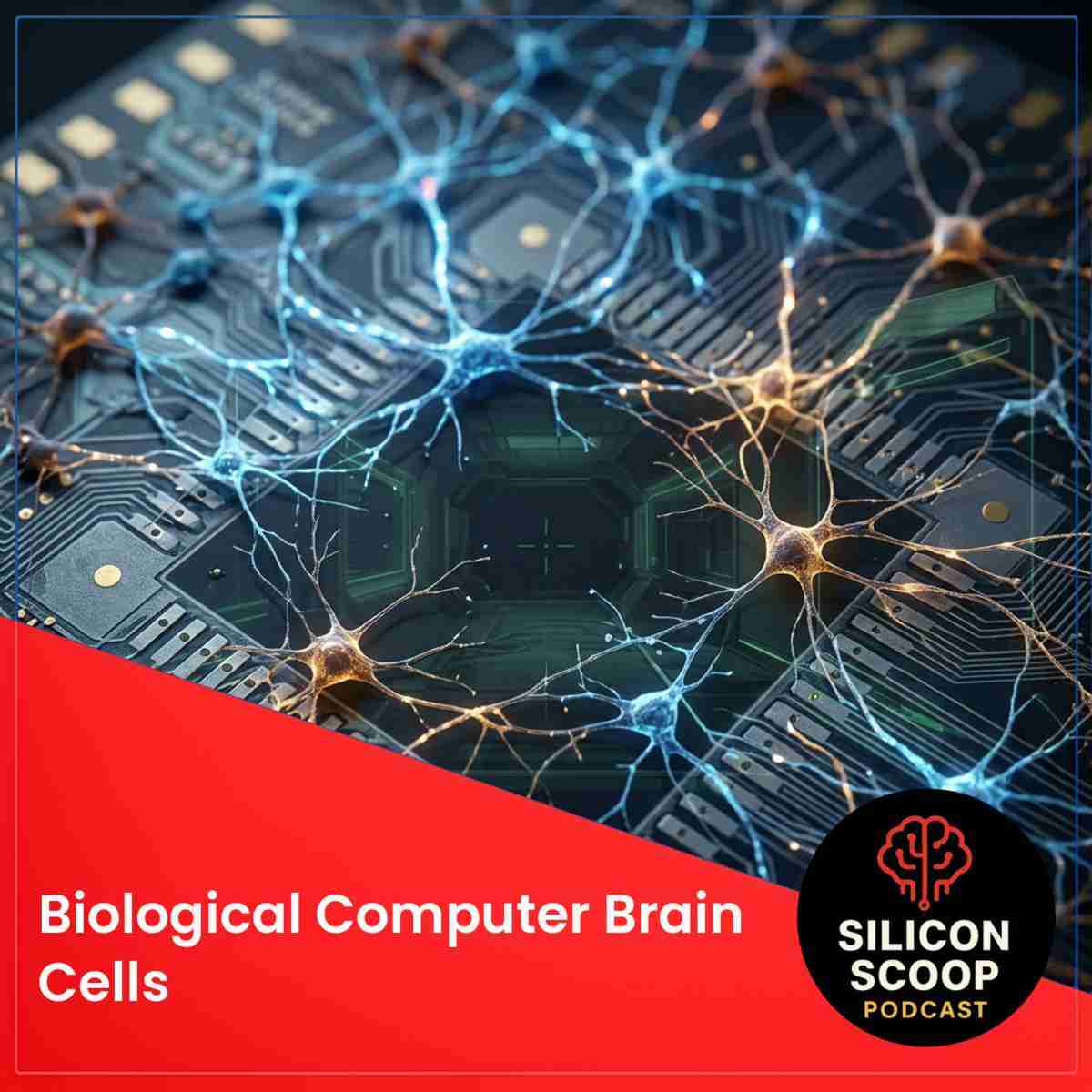
Biological Computer Brain Cells Just Learned to Play Doom in One Week — And It Changes Everything
Estimated reading time: 12 minutes
Key Takeaways
- Biological computer brain cells — roughly 200,000 human neurons — learned to play Doom in under a week.
- Cortical Labs’ CL1 uses living neurons on a microelectrode array with two-way electrical communication.
- The jump from Pong to Doom represents a roughly 3,000% improvement in learning efficiency.
- Biocomputing could help address the AI energy crisis with massive energy-efficiency advantages.
- Real-world applications include robotic limb control, diagnostics, drug discovery, edge computing, and brain-computer interfaces.
- Investment and infrastructure are scaling, alongside ongoing ethical considerations and scientific limitations.
Table of contents
- Biological Computer Brain Cells Just Learned to Play Doom in One Week — And It Changes Everything
- Introduction: When Living Neurons Meet a Classic Shooter
- Section 1: What Is a Biological Computer — And How Does It Work?
- Section 2: From Pong to Doom — A 3000% Leap in Learning Speed
- Cut Costs. Boost Output. Stay Ahead.
- Section 3: Why Biocomputing Could Solve the AI Energy Crisis
- Section 4: Real-World Applications Beyond Video Games
- Section 5: Investment, Infrastructure, and the Race to Scale Biocomputing
- Section 6: Ethical Considerations and Scientific Limitations
- FAQ: 10 Questions About Biological Computer Brain Cells and the Doom Breakthrough
- Conclusion: The Future of Computing May Be Alive
Introduction: When Living Neurons Meet a Classic Shooter
Biological computer brain cells just did something remarkable. A clump of human neurons — roughly 200,000 of them — learned to play Doom, one of the most complex classic video games ever made. And they did it in under a week.
This is not science fiction. This is happening right now, in 2026, at an Australian biotech company called Cortical Labs.
The achievement is being called a watershed moment in neuromorphic computing. It builds on earlier breakthroughs, signals a massive leap in biocomputing capability, and opens up real-world applications that were considered decades away — things like controlling robotic arms with living neural networks.
Here is everything you need to know about what happened, why it matters, and where this technology is headed.
Section 1: What Is a Biological Computer — And How Does It Work?
Neuromorphic Computing Meets Living Brain Cells
A biological computer is not a machine made of metal and circuits in the traditional sense. It is a system that uses living human neurons — real brain cells — to process information.
Cortical Labs pioneered this concept with a device they call CL1. Here is how it works:
- Human neurons are grown from stem cells in a lab setting.
- Those neurons are placed on top of a microelectrode array — a flat surface covered in tiny sensors.
- The array can both send electrical signals to the neurons and receive signals back from them.
- This two-way communication allows the neurons to receive information (like a game screen) and respond with actions (like moving a character).
Each CL1 unit contains approximately 200,000 human neurons. The device includes integrated life-support systems to keep those neurons alive and functional for up to six months. No external computing infrastructure is required.
The CL1 was officially launched in March 2025 as the world’s first commercially available, code-deployable biological computer. It comes with a cloud-based API and a touchscreen interface. Developers can program it using Python — the same language used to build most modern AI systems.
Each unit costs approximately $35,000.
This is organoid intelligence in practice — the idea, roadmapped by Johns Hopkins researchers in Frontiers in Science, that 3D brain organoid cultures connected to sensors and machine interfaces could form the basis of a new computing paradigm.
“It’s this accessibility and this flexibility that makes it truly exciting.” — Brett Kagan, Cortical Labs
Cortical Labs unveils biological data center prototype
Frontiers in Science: organoid intelligence roadmap
Section 2: From Pong to Doom — A 3000% Leap in Learning Speed
Organoid Intelligence Accelerates: The DishBrain to CL1 Journey
To understand how big the Doom achievement is, you need to know what came before it.
In 2021, Cortical Labs introduced DishBrain — a chip containing over 800,000 living neurons that learned to play Pong. That project took more than 18 months of painstaking scientific work. Researchers had to carefully design training methods, iterate constantly, and work directly with biological systems that most programmers had no experience handling.
Now compare that to Doom:
- The Doom demonstration used only about 200,000 neurons — roughly a quarter of the neurons used for Pong.
- An independent developer named Sean Cole, who had relatively little prior experience working with biology, taught the chip to play Doom using Python.
- He did it in approximately one week.
That is a learning efficiency improvement of roughly 3,000%.
What made this possible? Cortical Labs built a Python-based interface that makes it far easier for developers — not just biologists — to program these biocomputing chips. You no longer need a biology PhD to work with living neural networks.
The Doom gameplay required neurons to:
- Receive real-time visual information encoded as electrical stimuli.
- Send motor commands in response.
- Adapt their behavior based on feedback — a process fundamentally different from static “feed-forward” systems.
Dr. Andrew Adamatzky at the University of the West of England described the leap clearly:
“Doom is vastly more complex than earlier demonstrations, and successfully interacting with it highlights real advances in how living neural systems can be controlled and trained.”
The neurons played Doom better than a randomly firing system. They did not match elite human players — but that is not the point. The point is adaptive, real-time, goal-directed learning in a living neural network. That has never been demonstrated at this scale and speed before.
Professor Steve Furber at the University of Manchester acknowledged the significance while noting that important questions remain — like how neurons “understand” what is expected of them without eyes or prior experience of visual environments.
PopSci: human brain cell computer plays Doom
Cognitive Wonderland: did brain cells on a chip really
Science News: brain cells organoids video game Doom
Cut Costs. Boost Output. Stay Ahead.
If smarter systems can learn faster with less energy, imagine what your business can do with the right automation. Flowgrammer helps you eliminate repetitive work, reduce operational drag, and scale without hiring headaches.
👉 Book Your Free Automation Audit
Section 3: Why Biocomputing Could Solve the AI Energy Crisis
The Power Problem in Neuromorphic Computing
Artificial intelligence has an energy problem. A serious one.
- Training GPT-3 consumed enough energy to power 120 houses for an entire year.
- Training GPT-4 required approximately 50 times more energy than GPT-3.
- The International Energy Agency projects that data centers will consume 3% of all global electricity by 2030.
This is not sustainable. And it is one of the biggest reasons the biocomputing field is drawing serious attention from investors, governments, and enterprise technology buyers.
Here is where biological neural networks change the game:
- Human neurons process information at an estimated 10⁶-fold (one million times) greater energy efficiency than modern machines.
- Even silicon-based neuromorphic chips — like Intel’s Loihi 2 — deliver 100× energy savings compared to conventional processors.
- BrainChip’s Akida Pulsar delivers 500× lower energy consumption than standard AI processing cores.
Now imagine combining the efficiency of neuromorphic architecture with actual living neurons.
Johns Hopkins researcher Thomas Hartung, who coined the term organoid intelligence, framed this directly:
“Organoid intelligence launches a new era of fast, powerful, and efficient biocomputing.”
The neuromorphic computing market reflects this optimism. Analysts project it will reach $37.18 billion by 2034, growing at a CAGR of 19.9%.
The energy efficiency advantage alone makes biocomputing worth watching — even if every other performance metric remained equal to conventional AI. But they do not. Biological systems also show superior sample efficiency, meaning they learn from far less data than deep reinforcement learning algorithms require.
Polaris Market Research: neuromorphic computing market
Future Markets: neuromorphic computing sensing market
Section 4: Real-World Applications Beyond Video Games
From Doom to Robotic Arms — Biocomputing Goes Practical
Doom is the headline. But the actual implications stretch far beyond gaming.
Dr. Yoshikatsu Hayashi at the University of Reading put it plainly:
“[Playing Doom] is like a simpler version of controlling a whole arm.”
Hayashi and his team are working toward using biological computers to control robotic limbs — a task that requires exactly the kind of real-time, adaptive decision-making the CL1 demonstrated in the Doom experiment.
Other near-term application areas include:
- Medical diagnostics — biological neural networks that can identify patterns in patient data in ways silicon-based systems cannot.
- Drug discovery and testing — using organoid intelligence systems as more ethical alternatives to animal testing.
- Edge computing — low-power, adaptive systems that can process information locally without relying on energy-hungry cloud infrastructure.
- Brain-computer interfaces — bridging the gap between biological and digital systems in ways that could enhance human capability.
Concurrent research at UC Santa Cruz showed that mouse brain organoids performing a cartpole balancing task were capable of reinforcement learning when provided with electrical stimulation feedback. Researchers noted that long-term memory retention will require more complex neurochemical pathways — including dopamine reward circuits — that have not yet been replicated in vitro.
This is an important constraint. Biocomputing systems still face real scientific challenges. But each experiment narrows the gap.
Dr. Adamatzky summarized the broader potential:
“What’s exciting here is not just that a biological system can play Doom, but that it can cope with complexity, uncertainty, and real-time decision-making. That’s much closer to the kinds of challenges future biological or hybrid computers will need to handle.”
Intelligence in a dish: Hopkins researchers advance biocomputing
Frontiers in Science: 10.3389/fsci.2023.1017235
Section 5: Investment, Infrastructure, and the Race to Scale Biocomputing
Neuromorphic Computing Market Heats Up — Follow the Money
The Doom experiment was not just a scientific demonstration. It was a commercial signal.
Here is what has happened in the biocomputing investment and infrastructure space in parallel:
Cortical Labs’ Data Center Deployments:
- Partnered with DayOne data center operators to install 120 CL1 units in Melbourne, Australia.
- Planning a phased deployment of up to 1,000 units in Singapore.
- An initial validation phase of 20 CL1 units is underway at the National University of Singapore’s Yong Loo Lin School of Medicine.
Recent Funding Activity:
- In March 2026, Cortical Labs secured investment from Malaysia’s sovereign wealth fund Khazanah Nasional, channeled through Gobi Partners’ Dana Impak Ventures.
- Additional backing came from Horizon Ventures.
- Notable participant: Tom Oxley, founder of brain-computer interface company Synchron.
Competitive Landscape:
- The Biological Computing Co. (TBC) raised $25 million in seed funding in February 2026, led by Primary Ventures, to commercialize living-neuron computing systems.
This is not a fringe research area anymore. Sovereign wealth funds, established venture capital firms, and leading academic medical institutions are all placing bets on biological computing infrastructure.
The race is on to determine who builds the first scalable, commercially viable biocomputing data center — and who controls the software layer that sits on top of it.
Gobi Partners invests in Cortical Labs expands biological computing hub
Human brain cells set to power two new data centers thanks to Cortical Labs
Section 6: Ethical Considerations and Scientific Limitations
Biocomputing Ethics — What Happens When Neurons Are Involved?
Whenever human biology is involved in technology, ethical questions follow. Biocomputing is no different.
Key ethical and scientific considerations include:
Are these neurons conscious?
Brett Kagan addressed this directly: “Yes, it’s alive, and yes, it’s biological, but really what it is being used as is a material that can process information in very special ways that we can’t recreate in silicon.” The neurons are not a brain. They are a processing material.
Is it ethical to use human neurons in computing?
Cortical Labs argues that using lab-grown neurons derived from stem cells is ethically superior to animal testing, a common method in neuroscience research. No animals are harmed. The neurons are grown specifically for research and commercial purposes.
What are the current limitations?
- Long-term memory in these systems requires dopamine reward pathways that have not yet been replicated in vitro.
- We still do not fully understand how the neurons “know” what is expected of them or how they interpret visual data without sensory organs.
- Performance in complex tasks remains well below human capability.
- Regulatory frameworks governing the use of human biological material in commercial computing systems are still nascent and evolving.
What about the critics?
Some researchers initially suggested the neurons were simply acting as a static “feed-forward” system — that the real intelligence came from the encoder and policy learning software, not the neurons themselves. However, expert consensus confirms that the neurons themselves undergo adaptation through membrane potential changes and synaptic weight adjustments — genuine biological learning.
These are not simple relay switches. They are adapting.
Cognitive Wonderland: did brain cells on a chip really
FAQ: 10 Questions About Biological Computer Brain Cells and the Doom Breakthrough
1. What is a biological computer?
A biological computer uses living human neurons grown on a chip to process information. The neurons send and receive electrical signals, allowing them to learn and respond to tasks — much like a brain, but much simpler and purpose-built for computing.
2. How did brain cells learn to play Doom?
The neurons received visual information from the game encoded as electrical signals. They responded with motor commands. Over time, they adapted their responses based on feedback — a form of real-time learning — until they could navigate the game environment.
3. How long did it take?
Approximately one week. This compares to more than 18 months it took to train an earlier Cortical Labs system — called DishBrain — to play the much simpler game Pong.
4. How many neurons are in the CL1 chip?
Each CL1 unit contains approximately 200,000 human neurons derived from stem cells.
5. How much does the CL1 biological computer cost?
Each unit is priced at approximately $35,000. It includes integrated life-support systems and can sustain neural viability for up to six months.
6. Is this better than regular AI?
It is not a direct replacement for conventional AI. However, biological neural networks have shown superior energy efficiency (up to one million times better) and sample efficiency (they learn from less data). These are significant advantages for specific applications.
7. What could biological computers be used for in the real world?
Potential applications include controlling robotic limbs, medical diagnostics, drug discovery, edge computing, and brain-computer interfaces. Researchers are actively working on all of these.
8. Is it ethical to use human brain cells in computers?
Cortical Labs argues it is more ethical than animal testing because the neurons come from stem cells rather than living creatures. However, regulatory frameworks are still being developed, and ongoing ethical debate is healthy and necessary.
9. Can biological computers remember things long-term?
This remains a challenge. Current systems do not fully replicate the dopamine reward pathways needed for strong long-term memory. Researchers are working on solutions, but it is an area where more development is needed.
10. Who is investing in biological computing?
Notable investors include Malaysia’s sovereign wealth fund Khazanah Nasional (via Gobi Partners), Horizon Ventures, and Synchron founder Tom Oxley. Competing firm The Biological Computing Co. raised $25 million in seed funding in February 2026. Data center operators are also partnering with Cortical Labs for large-scale deployments in Melbourne and Singapore.
Conclusion: The Future of Computing May Be Alive
The story of biological computer brain cells learning to play Doom in a week is not just a clever headline. It is a signal.
Computing is changing at a fundamental level. Living neurons can process information in ways silicon cannot replicate. They are more energy efficient, faster at learning from limited data, and capable of real-time adaptive decision-making. The infrastructure is being built. The investment is flowing. The science is accelerating.
Biocomputing will not replace every form of artificial intelligence or conventional computing. But it will carve out a significant role — particularly where energy efficiency, adaptive learning, and real-time decision-making matter most.
The question is no longer whether biological computing is real. It is how fast it will scale — and who will be ready when it does.
Sources:
PopSci: human brain cell computer plays Doom
Tom’s Hardware: human brain cells set to power two new data centers
Data Center Dynamics: Cortical Labs unveils biological data center prototype
JHU Newsletter: intelligence in a dish
TechNode Global: Gobi Partners invests in Cortical Labs
Frontiers in Science: 10.3389/fsci.2023.1017235
Polaris Market Research: neuromorphic computing market
Future Markets: neuromorphic computing sensing market
Additional Links
Flowgrammer.ca – 💡 Unlock AI-Powered Automation! Let flowgrammer.ca handle complex workflows so you can focus on growing your business.
- Silicon Scoop Podcast – Stay Informed, Stay Ahead!
- Startup Talk Podcast
- Flowgrammer Youtube
- Startup Investor Drinks – Join Toronto’s Startup Community and connect with fellow startup enthusiasts and investors.
- TorontoStarts Startup and Entrepreneur Community – Become a part of Toronto’s thriving startup ecosystem.
- Workhaus – Discover flexible workspace solutions for your business needs.
- Work with The Startup Coach – Get expert guidance and mentorship for your startup journey.
- Reach out to Jon Irwin on LinkedIn – Connect with our co-host and technology expert.
Flowgrammers.ca – 💡 Join Toronto’s Fastest Growing AI and Busiess Automation Community..
Episode transcript
Read the full transcript
Craig: we've spent decades trying to make silicon think like a brain, but cortical labs just bypassed the middle man by teaching living human neurons to play doom. if you care about massive power grid crisis strangling the ai industry, the 3000% leap in biocomputing efficiency just changed the entire timeline. yeah. living brain cells are playing doom now. this is what they're doing. cortical labs successfully trained biological computer chip containing 200,000 living human neurons to play the complex video game doom in less than a week. by placing lab grown neurons on a microelectrode fractional of the fractional of the fraction of the energy of traditional ai, creating a legitimate pathway for sustainable computing and advanced robotics. what do you think about this, john?
Jon: yeah. i think this is really cool. that, i love that doom is used the, as kind of the benchmark for a lot of things. so, like, people have put doom on calculators. they put doom on pretty much any electronic that you can think of. that's not this, but i just like that doom is this. so, the thing is that the neurons themselves, they're not seeing doom, like, as we see it. they're receiving structured electrical signals, which represent the game environment, and then they're responding through firing patterns. so it's this is really fundamentally different from digital ai because digital ai processes symbolic or numerical data. so this system, it processes bioelectrical signals in real time. so, there's a learning mechanism to this and this is why this is huge. so the neurons are exhibiting adaptive learning behavior, meaning they improve performance over time, they respond to feedback loops, and they develop goal oriented behavior, which is similar to reinforcement learning. but instead of software based neural networks, this is actual biological plasticity. and so you have synapses that are strengthening or weakening based on activity. so there were early experiments. i don't know if we covered it, but it taught neurons to play palm. but doom is far more complex because there's three d navigation, there's real time enemies, and there's multi variable decision making. so the sexy the success here in what they've done, it shows that biological systems can handle higher order cognitive tasks and not just simple reflex loops. but this sounds cool. there are some performance and limitations. so the neurons play like a complete beginner. so think of your mom or dad playing doom, trying to play doom. the learning is slow and it's actually unstable. and the system is still extremely primitive compared to a human brain, obviously. but this milestone is not the performance. it's more of the proof of concept. and so i think this is cool. this is, this is a huge breakthrough. what are your thoughts on this, craig?
Craig: i think it's an amazing breakthrough. and not only, did they be able to disapprove upon what's going on with pong, but they are able to the doom demonstration used only 200,000 neurons, roughly a quarter of the neurons used previously in pong. so we're just able to do much more complex things at a quarter of the neuron use. and with a learning efficiency over 3000% over historical, uses of this biological type of system. though, this proves biological systems can handle real time adaptive decision making at a fraction of the energy cost of traditional ai, creating a legitimate pathway for sustainable computing and advanced robotics. i think of this, like trading a massive fuel guzzling freight train for a highly trained homing pigeon. traditional ai models require immense power and massive data centers just to brute force a route, but this biological chip uses native built in instinct to adapt and find the target on its own running on barely a fraction of a watt. so from a energy perspective, this sounds amazing, but i do have part of me that says, is this the first step towards the bork?
Jon: maybe.
Craig: you do wish to be assimilated.
Jon: yeah. yeah. is this like, where does this go? i know we've covered, brain chips too as well in the past, and this is similar to that. but, i think that the biggest break the hidden breakthrough here, like you talked about, is the energy efficiency. so these systems, they can outperform gpus by orders of magnitude and energy per computation. so, maybe this is elon's way of getting, of getting those data centers up in space, but, or whoever's getting them up there. but, i think that the cool thing about this is that they didn't program it. right? they didn't program it to play doom. they said learn it. so it learned organically, and it's it's unpredictable. just it's like a brain learning. right? so this is essentially challenging the entire software paradigm. so like you said, are we assimilating like the board? there are some ethical implications, and they're massive. so the question is, are these neurons aware at any level? can they feel pain or stress? and where do we draw the line between tool and organism, borg? so the researchers are emphasizing that the systems are not conscious, but the trajectory raises some serious concerns. and so some, yeah, i'm concerned about this, but i also think it's cool.
Craig: so researchers and developers can actually purchase the c l one it launched, a little while ago, and it cost 35,000 us, unit. and developers can interact with the living system using standard cloud based python api. so this is kinda interesting. the neuron count per unit is about 200,000 human neuron neurons per c l one unit. the energy efficiency is estimated a million times greater energy efficient than modern silicon based systems. so it almost feels inevitable. like, if this really is a million times greater efficiency, it's almost inevitable for us to start using biologics to, as chips.
Jon: yeah.
Craig: so this operates on the organoid intelligence. the c l one chip uses a microelectrode array for two way electrical communication. the network doesn't rely on static feed forward algorithms. instead, the living neurons undergo genuine biological adaptation through membrane potential changes and synaptic weight adjustments in response to stimuli. so this is the most radical shift in processing architecture since the transition from vacuum tubes to solid state transistors, moving us from artificial, neural networks back to literal biological ones. and like i said, we're heading into a power crisis because we want all these data centers that, you know, cost so much in energy. and if this is, literally a millionth of the energy cost, this has to be being looked at as a solution.
Jon: yeah. just sent you a link in the private chat to the picture of the c o one. i i was picturing i don't know what you were picturing, but i was picturing something completely different when it comes to what we were talking. i thought it was gonna be very rudimentary, but this seems pretty advanced, which is kinda cool. it's, like, ready for commercial use.
Craig: yeah. the website looks good and, the device looks interesting.
Jon: yeah. i know. right?
Craig: and you know, again, we're definitely interested in where this goes. while these in vitro neurons excel at rapid adaptation, they currently lack complex neurochemical dopamine reward pathways that human brains rely on for long term memory retention. so we're we'll have to see where that goes. the pursuit of neuromorphic computing is heavily funded by legacy tech giants like intel as its low high chip and ibm has true north, but both attempting to mimic brain architecture and silicon. the cortical labs is leapfrogging them by simply using raw biological material instead. the question becomes, though, we're talking about we saw that unit. it's not small. so we have to really take a look at size per computational power even if it is a lot cost efficient. do we need, you know, 10 times the space? we're not talking about nanometer, four nanometer technology like they have today. so we'll have to keep an eye on this. the original 1993 release of doom is the ultimate computing hardware benchmark. as you were mentioning, it's been notoriously ported to everything from atm machines to pregnancy tests. apparently, it can run doom on a pregnancy test. and now holds
Jon: that word. yeah.
Craig: complex virtual environment navigated by disembodied human neurons. so we'll have to see what happens because the system currently long lacks long term memory capabilities and keeping biological material alive, stable, and sterile at massive commercial scale is a monumental logistical hurdle right now that standard data centers are not equipped for. so keep an eye on what's going on in singapore. if one data centers can prove stable long term uptime across a thousand biological units, biological cloud computing becomes a viable, enterprise reality. so biocomputing just crossed the threshold from fascinating science experiment to scalable infrastructure offering a genuine genuine off ramp from ai energy crisis. would you trust a living neural network to run your smart home, or does a biological computer cross a creepy line? let us know in the chat. is this where the board starts? what do you think? we'd like to hear from you.
More from Silicon Scoop
All episodes
silicon-scoop · October 16, 2026
Meta’s $18 Billion Teen Safety Settlement: Soft Guardrails, Hard Leverage Over TikTok and YouTube
Deep dive on Meta teen safety settlement, social media addiction lawsuit, new Facebook Instagram time limits and pressure on TikTok YouTube age verification.
View episode

silicon-scoop · October 15, 2026
How Claude Mythos Is Reshaping Cryptanalysis: HAWK, AES and the Rise of AI-Driven Crypto Research
Claude Mythos cryptanalysis weakens HAWK post-quantum signature, speeds AES Möbius Bridge attack, and powers CryptanalysisBench benchmark in AI-driven crypto research.
View episode

silicon-scoop · October 14, 2026
Nvidia’s $12.9 Billion Hugging Face Bet: How Controlling the Open-Source Model Hub Reshapes AI Chips, Cloud, And Competition
Nvidia Hugging Face acquisition could reshape open source AI models, AI chip dominance, and the global developer model hub, raising antitrust and neutrality questions.
View episode