
Trisulfide Metathesis Revolutionizes Recycling and Drug Development
Trisulfide Metathesis Revolutionizes Recycling and Drug Development https://torontostarts.com/silicon-scoop/ Flowgrammer.ca -> https://flowgrammer.ca/ AI News and Resources -> https://flowgrammers.ca OpenClaw Toronto -> https://openclawto.com/ Turn “Busy Work” Into Business Growth If your team is stuck in repetitive tasks, you’re leaving time and money on the table. Flowgrammer helps you automate day-to-day operations so you can move faster, reduce errors, and scale without hiring chaos. Book Your Free Automation Consult https://flowgrammer.ca/ Startup Investor Drinks Toronto - https://startupdrinksto.com/ Toronto’s Startup Community - https://torontostarts.com/ Silicon Scoop Silicon Scoop Podcast - https://torontostarts.com/silicon-scoop/ Apple: https://podcasts.apple.com/us/podcast/silicon-scoop/id1758711826 Spotify: https://open.spotify.com/show/5bAzF0MwV6TtLhJAhvHayI YouTube: https://www.youtube.com/playlist?list=PLj4v-RoA7A-gT62vrEYqh1zCv-0Hj-o5J Startup Talk Startup Talk Podcast -> https://torontostarts.com/startup-talk-toronto-startup-podcast/ Apple -> https://podcasts.apple.com/us/podcast/startup-talk/id1763804003 Spotify -> https://open.spotify.com/show/1siJMILILidHAiAsrX2VBU YouTube: https://youtube.com/playlist?list=PLj4v-RoA7A-jxV5FHs5e61oIsuvUJYmT_&si=LYegRe5GYLKNQ7xL
With Craig Major and Jon Irwin
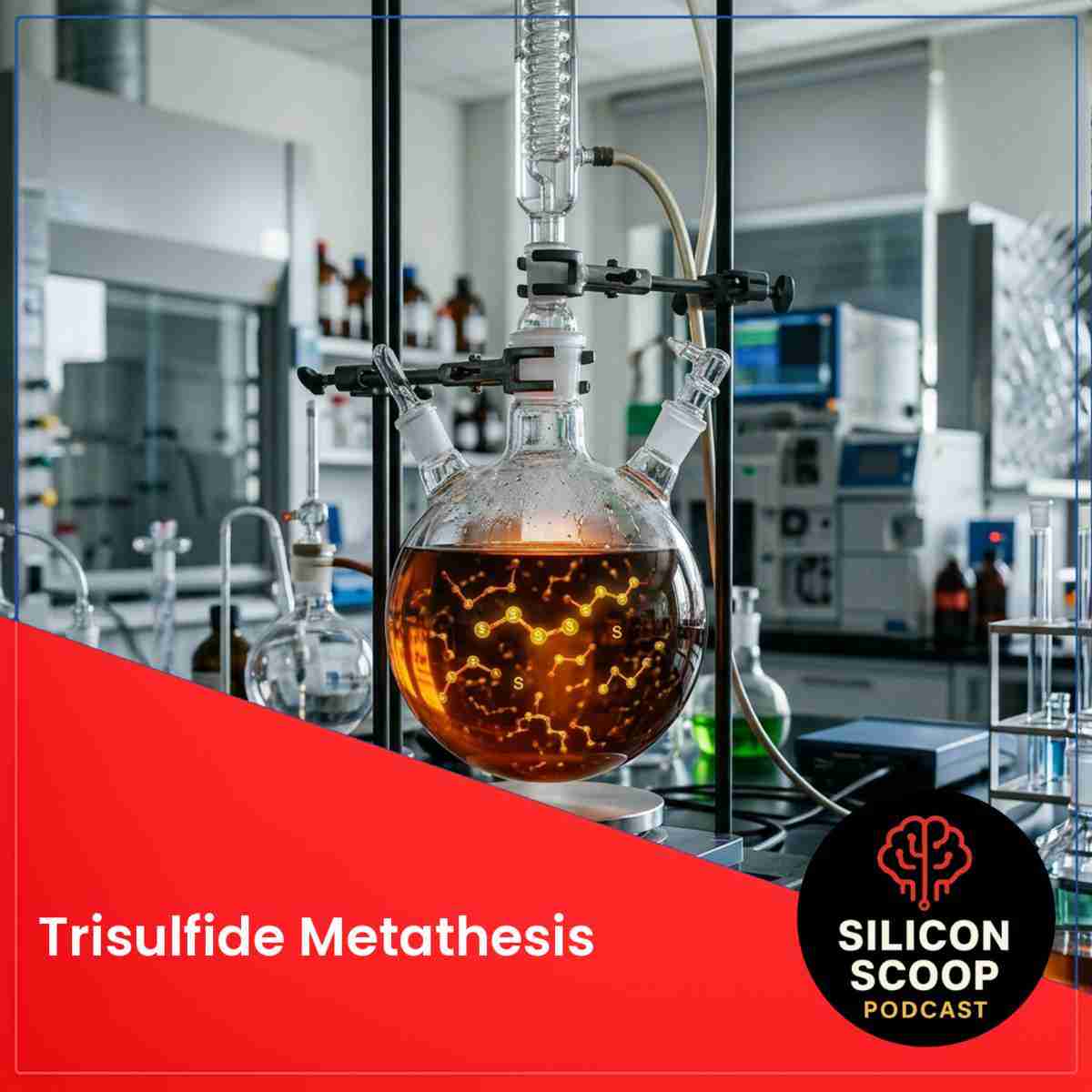
Trisulfide Metathesis: The Breakthrough Chemical Reaction Changing Recycling and Medicine Forever
Estimated reading time: 10 minutes
Key Takeaways
- Trisulfide metathesis is a brand new kind of chemical reaction — and it could change the way we recycle plastics and design life-saving drugs.
- Researchers have found a way to form and break ultra-strong sulfur-sulfur bonds in just seconds — at room temperature — without any extra chemicals needed to trigger the reaction.
- The reaction is fast, mild, reagent-free, and reversible, making it ideal for recycling and molecular design.
- It could enable closed-loop chemical recycling for sulfur-based plastics and accelerate anti-cancer drug modification and discovery workflows.
Table of contents
- Trisulfide Metathesis: The Breakthrough Chemical Reaction Changing Recycling and Medicine Forever
- Key Takeaways
- Introduction: A New Chapter in Chemistry
- What Are Sulfur-Sulfur Bonds and Why Do They Matter?
- What Is Trisulfide Metathesis? The Core Discovery Explained
- How Trisulfide Metathesis Could Transform Chemical Recycling
- Trisulfide Metathesis and Anti-Cancer Drug Development
- Turn “Busy Work” Into Business Growth
- Why This Discovery Is So Rare and So Important
- What Comes Next: The Future of Sulfur Chemistry
- Frequently Asked Questions (FAQ)
Introduction: A New Chapter in Chemistry
Trisulfide metathesis is a brand new kind of chemical reaction — and it could change the way we recycle plastics and design life-saving drugs.
Scientists have been discovering chemical reactions for centuries. Photosynthesis turns water and carbon dioxide into glucose and oxygen. The Haber-Bosch process, developed in 1909, created artificial fertilizers and helped feed billions of people. Now, a new discovery published in Nature Chemistry on March 12, 2026 is being added to that list.
Researchers at Flinders University in Australia, working with experts from the University of Liverpool, have found a way to form and break ultra-strong sulfur-sulfur bonds in just seconds — at room temperature — without any extra chemicals needed to trigger the reaction.
This is not a small upgrade to an old idea. This is an entirely new type of chemical reaction.
What Are Sulfur-Sulfur Bonds and Why Do They Matter?
Before we dive into the discovery, it helps to understand what sulfur-sulfur bonds are and why scientists care so much about them.
Sulfur is a chemical element found all over nature. It shows up in:
- Proteins and peptides in the human body
- Drug molecules used in medicine
- Plastics and polymers used in everyday products
- Vulcanized rubber (like in car tires)
The bonds that hold sulfur atoms together — called covalent bonds — are incredibly strong and stable. That strength is exactly what makes sulfur-based materials so useful. A plastic made with sulfur bonds holds its shape. A rubber tire made with sulfur bonds doesn’t fall apart in the rain.
But here’s the problem: that same strength makes these materials very hard to break down. When it’s time to recycle a sulfur-rich plastic, or modify a sulfur-containing drug molecule, scientists have traditionally needed high temperatures (between 176 and 302 degrees Fahrenheit) and special chemical reagents to get the job done — and even then, it could take hours or days.
The new trisulfide metathesis reaction changes all of that.
major discovery after years of research
What Is Trisulfide Metathesis? The Core Discovery Explained
The word “metathesis” means swapping or exchanging parts. You may have heard it used in language (when sounds swap places in a word) or in chemistry (when two molecules trade pieces with each other).
Trisulfide metathesis refers to the swapping of fragments along chains of three sulfur atoms called trisulfides. Each trisulfide chain has different molecule fragments attached to its ends. In this new reaction, those end-fragments spontaneously swap with each other — quickly, cleanly, and without needing any reagents to start the process.
Here is what makes this reaction so remarkable:
- Speed: The reaction completes in just seconds, not hours or days.
- Temperature: It works at room temperature (20–25°C / 68–77°F), not at high heat.
- No reagents needed: Normally, chemical reactions require a triggering substance. This one does not.
- Reversible: The bonds can be formed and broken apart again, making it ideal for recycling.
The key to triggering the reaction is using specific solvents — including dimethylformamide (DMF), dimethyl acetamide (DMA), and N-methyl pyrrolidone (NMP). These solvents allow the sulfur chains to begin swapping fragments almost instantly.
Scientists believe the reaction works through an unusual intermediate step involving a thiosulfoxide — a short-lived chemical structure that allows the swap to happen in a single, concerted motion.
“It is rare to discover an entirely new reaction, and even more rare for it to be useful in so many fields and applications,” said Justin Chalker, a chemist at Flinders University and co-author of the study.
How Trisulfide Metathesis Could Transform Chemical Recycling
One of the biggest promises of this discovery is what it could do for chemical recycling — especially for sulfur-based plastics.
Plastic pollution is one of the most serious environmental problems of our time. Millions of tons of plastic end up in landfills and oceans every year. Many types of plastic are hard or impossible to recycle using current methods.
Sulfur-based polymers are particularly stubborn. Their strong S-S bonds resist breakdown. Traditional recycling methods for these materials require high heat and harsh chemicals, making the process expensive, energy-intensive, and often impractical at scale.
Trisulfide metathesis opens a better path.
The research team demonstrated that they could create a polyethylene analog — a plastic similar to the kind used in packaging and containers — that uses trisulfide bonds in its structure. Because of the new reaction, this plastic can be:
- Made using standard processes
- Used just like normal plastic
- Un-made on demand, breaking back down into its original building blocks for reuse
This is called closed-loop chemical recycling, and it is a major step toward a true circular plastics economy — one where plastic is never truly “waste,” just a material waiting to be remade.
“Closed-loop chemical recycling is an important capability in supporting a circular plastics economy,” said Harshal Patel, a co-author of the study from Flinders University.
Justin Chalker has been researching environmentally friendly sulfur polymers for more than a decade. This new reaction is the breakthrough that could finally make recyclable sulfur-based materials a practical reality.
chemical discovery sparks a chain reaction
Trisulfide Metathesis and Anti-Cancer Drug Development
Beyond recycling, the new reaction has already shown powerful results in pharmaceutical chemistry — specifically in the modification of anti-cancer drugs.
The research team used trisulfide metathesis to selectively modify calicheamicin, a powerful anti-tumor compound used in cancer treatment. Calicheamicin contains sulfur-sulfur bonds as a key part of its structure. Being able to quickly and precisely adjust those bonds without damaging the rest of the molecule is a huge advantage in drug design.
Here is why this matters for medicine:
- Precision: The reaction targets sulfur bonds selectively, leaving other parts of a molecule untouched.
- Speed: Drug researchers can test many variations of a molecule in far less time.
- Dynamic combinatorial libraries: The reaction makes it possible to rapidly assemble large collections of molecule variations for drug discovery screening — a process that normally takes much longer.
This means scientists could use trisulfide metathesis to design better, more targeted medicines faster than ever before. It also opens the door to new types of protein engineering, where sulfur bonds in proteins are carefully modified to study or change how the proteins function.
Tom Hasell, co-author from the University of Liverpool, highlighted the reaction’s versatility for making reversible changes in both molecular and materials chemistry.
Turn “Busy Work” Into Business Growth
If your team is stuck in repetitive tasks, you’re leaving time and money on the table. Flowgrammer helps you automate day-to-day operations so you can move faster, reduce errors, and scale without hiring chaos.
Book Your Free Automation Consult
Why This Discovery Is So Rare and So Important
New chemical reactions are not discovered often. Chemistry is one of the oldest sciences, and the list of known reaction types is long. Adding a genuinely new category to that list is the kind of event that happens maybe a handful of times in a generation.
What makes trisulfide metathesis especially exciting is not just that it is new — it is that it is immediately useful in multiple fields at once.
Compare the new process to what came before:
| Feature | Old Methods | Trisulfide Metathesis |
|---|---|---|
| Temperature needed | 176–302°F (80–150°C) | Room temperature (68–77°F) |
| Time required | Hours to days | Seconds |
| Reagents needed | Yes | No |
| Reversible | Difficult | Yes |
| Applications | Limited | Plastics, pharma, proteins |
The combination of being fast, mild, reagent-free, and reversible is nearly unheard of for reactions involving bonds this strong. Most reactions that break strong bonds need extreme conditions. The fact that trisulfide metathesis works so gently and quickly makes it stand out sharply from anything else in the chemistry toolkit.
“I’m excited to see how this chemistry is adopted, expanded, and applied in ways not yet imagined,” said Harshal Patel.
major discovery after years of research
What Comes Next: The Future of Sulfur Chemistry
The study published in Nature Chemistry is the beginning, not the end. The research team has already demonstrated real-world applications, but the scientific community is just starting to explore what this reaction can do.
Here are some areas where trisulfide metathesis could have a major impact in the coming years:
- Sustainable materials manufacturing: Creating a new generation of sulfur-based polymers designed from the ground up to be recyclable.
- Targeted cancer therapies: Building on the calicheamicin work to design new drug-delivery systems that release medication precisely where it is needed.
- Protein engineering: Modifying the sulfur bonds in proteins to study diseases or develop new biological tools.
- Combinatorial drug discovery: Using dynamic molecular libraries to screen thousands of drug candidates rapidly.
- Vulcanized rubber recycling: Potentially applying the reaction to break down rubber products that are currently very difficult to recycle.
The international and interdisciplinary nature of the team behind this discovery — spanning chemistry, materials science, and biomolecular research — suggests that trisulfide metathesis will be picked up quickly by researchers across many fields.
chemical discovery sparks a chain reaction
Frequently Asked Questions (FAQ)
1. What is trisulfide metathesis?
Trisulfide metathesis is a newly discovered chemical reaction in which three-sulfur-atom chains (trisulfides) spontaneously swap the molecule fragments attached to their ends. It happens in seconds at room temperature without needing extra chemicals to trigger it.
2. Who discovered the trisulfide metathesis reaction?
The reaction was discovered by an international research team led by chemist Justin Chalker at Flinders University in Australia, with co-authors including Harshal Patel (Flinders University) and Tom Hasell (University of Liverpool). The study was published in Nature Chemistry on March 12, 2026.
3. Why are sulfur-sulfur bonds so hard to break?
Sulfur-sulfur covalent bonds are very strong and stable. This strength is what makes sulfur-based materials like plastics and vulcanized rubber so durable — but it also means they resist breakdown under normal conditions, making recycling and chemical modification very difficult.
4. What solvents are used to trigger the reaction?
The reaction is triggered using specific solvents including dimethylformamide (DMF), dimethyl acetamide (DMA), and N-methyl pyrrolidone (NMP). These solvents allow the sulfur chains to start swapping fragments almost instantly at room temperature.
5. How does this reaction help with plastic recycling?
The reaction allows sulfur-based plastics to be chemically “un-made” on demand, breaking them back down into their original building blocks. This enables closed-loop chemical recycling, where plastic material is continuously reused rather than discarded as waste.
6. What anti-cancer drug was modified using this reaction?
The research team used trisulfide metathesis to selectively modify calicheamicin, a powerful anti-tumor compound. The reaction allowed them to adjust the drug’s sulfur bonds without damaging the rest of the molecule, which could help in designing more targeted cancer treatments.
7. What is a dynamic combinatorial library?
A dynamic combinatorial library is a large collection of molecule variations that form and reform rapidly under controlled conditions. Trisulfide metathesis makes it possible to build these libraries quickly for drug discovery — allowing scientists to screen many potential drug candidates in a short time.
8. Is this reaction completely new, or is it a variation of something already known?
This is a genuinely new category of chemical reaction. While metathesis reactions are known in chemistry (for example, in Nobel Prize-winning olefin metathesis), trisulfide metathesis operates through a different mechanism — involving an unusual thiosulfoxide intermediate — and has no direct predecessor.
9. What other industries could benefit from trisulfide metathesis beyond plastics and medicine?
Potential industries include rubber recycling (breaking down vulcanized rubber), protein engineering (modifying biological molecules), materials science (creating new dynamic and reversible materials), and any field that works with sulfur-containing polymers or drug compounds.
10. Where can I read the original study?
The study was published in the journal Nature Chemistry. You can find related announcements and pre-publication details at:
Sources: EurekAlert, Flinders University News, ChemRxiv, Science Alert, Springer Nature Communities, Popular Mechanics
Additional Links
Flowgrammer.ca – 💡 Unlock AI-Powered Automation! Let flowgrammer.ca handle complex workflows so you can focus on growing your business.
- Silicon Scoop Podcast – Stay Informed, Stay Ahead!
- Startup Talk Podcast
- Flowgrammer Youtube
- Startup Investor Drinks – Join Toronto’s Startup Community and connect with fellow startup enthusiasts and investors.
- TorontoStarts Startup and Entrepreneur Community – Become a part of Toronto’s thriving startup ecosystem.
- Workhaus – Discover flexible workspace solutions for your business needs.
- Work with The Startup Coach – Get expert guidance and mentorship for your startup journey.
- Reach out to Jon Irwin on LinkedIn – Connect with our co-host and technology expert.
Flowgrammers.ca – 💡 Join Toronto’s Fastest Growing AI and Busiess Automation Community..
Episode transcript
Read the full transcript
Craig: we've been burning and burying plastics for decades because the chemical bonds holding them together are practically indestructible. our brand new room temperature chemical reaction just broke all the rules, giving us literal reset button on both permanent plastics and life saving cancer drugs. so this new reaction unlocks infinite recycling. scientists have discovered trysulfide metathis metathisis. john will pronounce it properly in a minute, i guess.
Jon: i thought metathisis. but
Craig: metathisis is probably correct. trisulfide metathesis, a process that instantly breaks and reforms ultra strong sulfur bonds at room temperature without triggering agent. it allows researchers to unmake and remake complex materials on demand in seconds. this effectively makes true closed loop recycling a reality for stubborn plastics and slashes the time it takes to engineer targeted medicines. what do you think about this, john?
Jon: so before i tell you, you were right. it's metathesis. so, i was yeah. i thought i was saying it. i thought i didn't even look it up because i'm like, oh, it's metathesis. but, no, it's metathesis. sorry. so i think this is cool, because this new reaction, it acts almost like a molecular swap system where parts of molecules can rearrange themselves cleanly and efficiently. so in simple terms, they found a way to make some of the toughest chemical bonds flexible and reusable, and that could transform drug development and plastic recycling. so why do sulfur bonds matter? well, sulfur bonds are critical in proteins, pharmaceuticals, and materials like rubbers, polymers, and plastics. so, historically, these bonds are strong and stable, and they're hard to selectively break and reform. so what the new reaction enables, a controlled, reversible manipulation of these bonds, which something that was previously extremely difficult. and so instead of breaking a bond forming a new one, this reaction allows a direct exchange between molecule molecules. so think of it like two molecules swapping parts without fully falling apart, which i i don't i don't i don't know if people can understand how much that blows my mind, which is super cool. because normally, things fall apart. things like, when they break up, they they the bonds and all the bonds are dimming up. so it's cool because this process is fast. it happens in seconds. it's reversible, and it's highly efficient. so the key innovation here is that reaction is triggered by specific solvent environments and not added chemicals. so that means the environment itself controls the reaction, and there's no extra reagents, and there's a cleaner chemistry. so, this is cool for green for those green people. but, yeah, what do you think about this? i'm super excited about this.
Craig: yeah. to humanize your example about swapping atoms
Jon: oh, sorry.
Craig: think of traditional sulfur based plastics like lego blocks glued together with industrial superglue. you have to literally melt the whole structure to separate them. with trisulfide metathesis, that turns super glue into high powered magnets. and with the right chemical environment, they just click apart in seconds, completely undamaged and ready to be snapped into something entirely new. so they just come apart, and you can reorder the items any way you want. the lab breakthrough was just published in, march a couple of weeks ago, and we're expecting some commercial and industry scaling, but that's years away. this currently operates at 20 to 25 degrees celsius, replacing legacy thermal requirements of 80 to a 150 degrees celsius, so this is, room temperature, and targets three sulfur atom chains, the trisulfides. the reaction relies on a short lived trisulfoxide intermediate in the presence of specific solvents, dmf, dma, and nmp. the fragments attach to the ends of the trisulfide chains and spontaneously swap in a single concerted motion bypassing the need for a traditional catalyst region. so this is arguably the biggest leap in polymer synthetic chemistry since the discovery of olefin metathus with metathasis, is, a nobel prize in chemistry back in 2005. yeah.
Jon: and this is this will help along with remember that bacteria that we cover that eats plastic that was developed that the earth developed? so this with that so the thing with this is that they've already shown that they can modify anticancer drug molecules, and they can create recyclable polymer systems. so that means that there's already applicability, and it's not just theoretical. so this could happen. this could come to commercialize very soon.
Craig: yeah. and specific anticancer compound modified here, the calichemycin is the antitumor antibiotic derived from the bacterium found in chalky soil. it is so notoriously toxic that it cannot be administered on its own. it must be tethered to targeted antibodies to avoid killing healthy cells. so, we can modify that with this process now instead of using this toxic treatment. mhmm. the atomic and chemical industries have spent billions over the last century trying to solve the exact sulfur bond problem for vulcanized rubber. over a billion tires are discarded annually because those sulfur cross links couldn't be officially reversed till now. and sulfur is universally famous for foul, rotten egg smell of hydrogen sulfide or brimstone. however, because trisulfide chemistry swaps the molecular fragments so rapidly and securely in solvent, the reaction doesn't release the volatile gas that causes that stench.
Jon: mhmm. yeah.
Craig: alright. so, let me try it one more time. trisulfide metathesis rewrites the textbook on sulfur bonds, turning previous indestructible materials and complex drugs into highly editable code. lets, if this lets us successfully recycle a 100% of our plastics, does that give massive corporations a free pass to keep producing single use packaging, or is this ultimate win for the planet? let us know what you think in the chat.
More from Silicon Scoop
All episodes
silicon-scoop · October 16, 2026
Meta’s $18 Billion Teen Safety Settlement: Soft Guardrails, Hard Leverage Over TikTok and YouTube
Deep dive on Meta teen safety settlement, social media addiction lawsuit, new Facebook Instagram time limits and pressure on TikTok YouTube age verification.
View episode

silicon-scoop · October 15, 2026
How Claude Mythos Is Reshaping Cryptanalysis: HAWK, AES and the Rise of AI-Driven Crypto Research
Claude Mythos cryptanalysis weakens HAWK post-quantum signature, speeds AES Möbius Bridge attack, and powers CryptanalysisBench benchmark in AI-driven crypto research.
View episode

silicon-scoop · October 14, 2026
Nvidia’s $12.9 Billion Hugging Face Bet: How Controlling the Open-Source Model Hub Reshapes AI Chips, Cloud, And Competition
Nvidia Hugging Face acquisition could reshape open source AI models, AI chip dominance, and the global developer model hub, raising antitrust and neutrality questions.
View episode