
99% Success Robots Are Finally Here with GEN-1 Robotics AI
Unbelievable: 99% Success Robots Are Finally Here https://torontostarts.com/silicon-scoop/ Flowgrammer.ca -> https://flowgrammer.ca/ AI News and Resources -> https://flowgrammers.ca OpenClaw Toronto -> https://openclawto.com/ Automate More. Stress Less. ⚡ If your team is buried in repetitive admin, follow-ups, and manual data entry, it’s time to streamline. Flowgrammer builds automation that cuts busywork, speeds up operations, and frees you to scale. Book a free consult https://flowgrammer.ca/ Startup Investor Drinks Toronto - https://startupdrinksto.com/ Toronto’s Startup Community - https://torontostarts.com/ Silicon Scoop Silicon Scoop Podcast - https://torontostarts.com/silicon-scoop/ Apple: https://podcasts.apple.com/us/podcast/silicon-scoop/id1758711826 Spotify: https://open.spotify.com/show/5bAzF0MwV6TtLhJAhvHayI YouTube: https://www.youtube.com/playlist?list=PLj4v-RoA7A-gT62vrEYqh1zCv-0Hj-o5J Startup Talk Startup Talk Podcast -> https://torontostarts.com/startup-talk-toronto-startup-podcast/ Apple -> https://podcasts.apple.com/us/podcast/startup-talk/id1763804003 Spotify -> https://open.spotify.com/show/1siJMILILidHAiAsrX2VBU YouTube: https://youtube.com/playlist?list=PLj4v-RoA7A-jxV5FHs5e61oIsuvUJYmT_&si=LYegRe5GYLKNQ7xL
With Craig Major and Jon Irwin
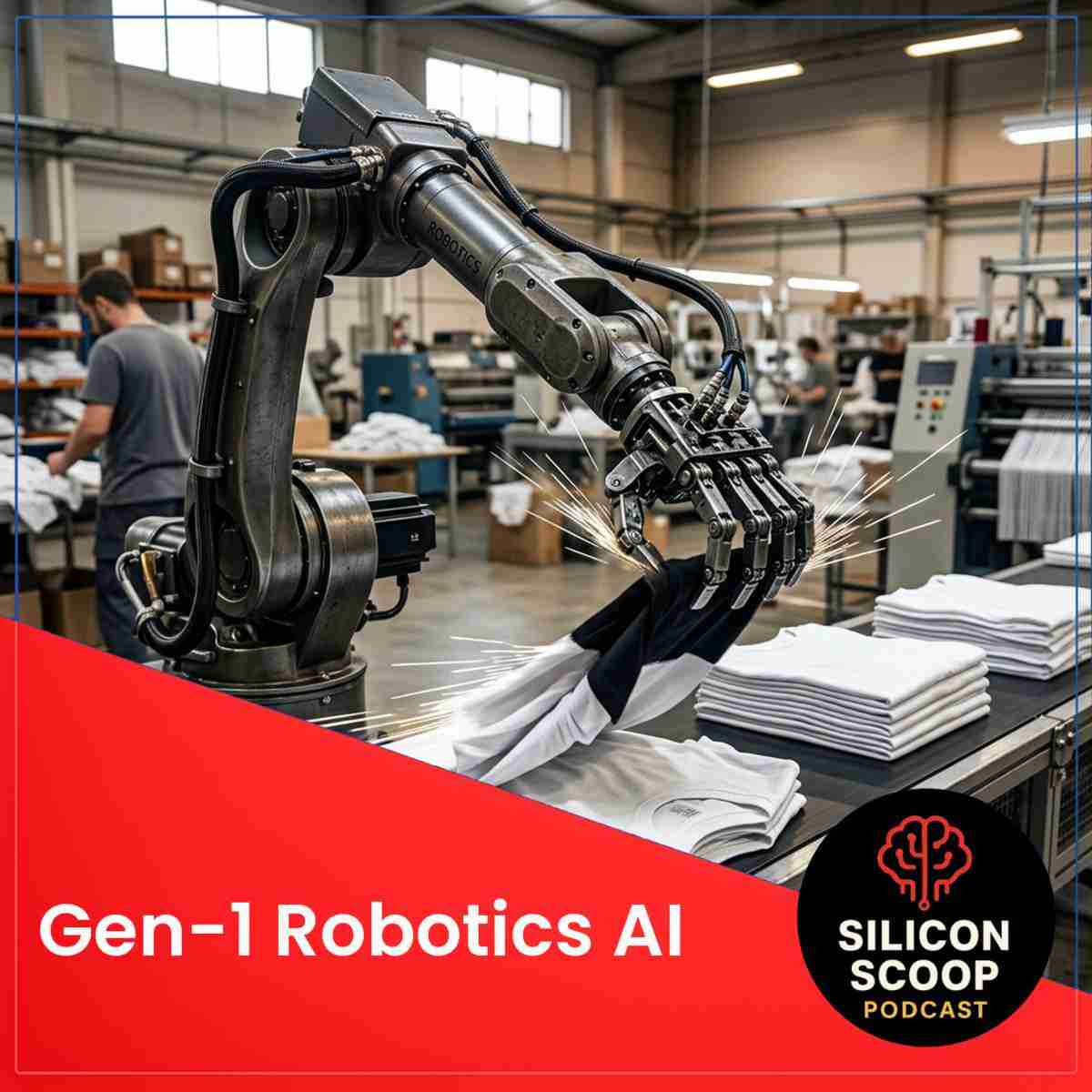
GEN-1 Robotics AI Achieves 99% Success Rate — Is This the Moment Robots Finally Get to Work?
Estimated reading time: 10 minutes
Key Takeaways
- ✅ 99% success rate on dexterous tasks (vs. 64% prior state of the art)
- ✅ 3x faster than the previous GEN-0 model
- ✅ Only 1 hour of robot-specific data needed per task
- ✅ Trained on 500,000+ hours of real human interaction via wearable data hands
- ✅ Handles unstructured environments and unexpected disruptions
- ✅ Bimanual regrasping, extrinsic dexterity, and improvisational recovery — all emergent
- ✅ Covers tasks from laundry folding to auto parts kitting to vacuum servicing
- ✅ Early commercial access available for partners
Table of contents
- GEN-1 Robotics AI Achieves 99% Success Rate — Is This the Moment Robots Finally Get to Work?
- Introduction: GEN-1 Robotics AI Changes the Game
- From GEN-0 to GEN-1: A Massive Leap in Physical AI Models
- How Generalist Trained GEN-1: The Data Hands Revolution
- What GEN-1 Can Actually Do: 99% Success Rate Tasks
- Recovering from Mistakes: The Improvisational Intelligence Breakthrough
- 🚀 Automate More. Stress Less. ⚡
- Where GEN-1 Fits in the Bigger Robotics Race
- What GEN-1 Means for Production Automation
- Key Takeaways: GEN-1 Robotics AI at a Glance
- FAQ: 10 Questions About GEN-1 Robotics AI
Introduction: GEN-1 Robotics AI Changes the Game
The GEN-1 robotics AI model from Generalist AI may be the most important robot release you haven’t heard about yet.
Released on April 2, 2026, GEN-1 is a physical AI model that achieves 99% success rates on dexterous, real-world tasks — things like folding boxes, packing phones, and servicing robot vacuums. These are jobs that, until now, required human hands and years of muscle memory.
This isn’t a lab demo or a staged prototype. Generalist says GEN-1 is crossing into production-level performance — the kind that can be deployed in real commercial environments.
Here’s everything you need to know about what GEN-1 does, how it got there, and why it matters for the future of automation.
From GEN-0 to GEN-1: A Massive Leap in Physical AI Models
The Starting Point: GEN-0
Generalist’s previous model, GEN-0, was introduced in November 2025 as a proof of concept. It showed that scaling laws — the idea that more training data and compute time lead to better results — could apply to robotics just as they do to large language models (LLMs) like ChatGPT.
But GEN-0 had limits. Its success rate sat at around 64%, which is impressive for a first attempt but nowhere near reliable enough for real production use.
The GEN-1 Upgrade
GEN-1 changes that picture dramatically:
- 99% average success rate — up from 64% in GEN-0
- 3x faster task completion — for example, folding a box in 12 seconds vs. 34 seconds before
- Only 1 hour of robot-specific data needed per new task
- Trained on over 500,000 hours of real human interaction data
That jump from 64% to 99% happened in just five months. Analysts note this compresses robotics timelines faster than many companies’ procurement cycles — meaning businesses that wait may find their pilot programs already outdated.
This is what researchers call the pretraining era for robotics — mirroring the same moment that transformed natural language AI when GPT-3 arrived.
How Generalist Trained GEN-1: The Data Hands Revolution
The Core Problem with Robot Training Data
Large language models had a huge advantage: the entire internet. Trillions of words, articles, books, and conversations were available to train on.
Robots don’t have that luxury. There is no giant library of “how to pick up a washer” or “how to fold a shirt when it slips.” Physical interaction data is hard to collect, expensive to create, and almost impossible to scale.
The “Data Hands” Solution
Generalist solved this with a clever approach: wearable data-capture devices called “data hands.”
These are low-cost pincers worn by human workers as they perform manual tasks. They record:
- Micro-movements of fingers and hands
- Visual information from the hands’ point of view
- Real-time feedback from physical interactions with objects
The result? Generalist has collected:
- Over 500,000 hours of real-world human task data
- Petabytes of physical interaction data
- A rich, diverse training set covering dozens of tasks across multiple environments
This approach avoids expensive teleoperation setups — where humans remotely control robots to generate training data — making the data collection process scalable and cost-effective.
Because the pretraining is done on human hand data, adapting GEN-1 to a specific robot body only takes about one hour of robot-specific data. That’s a dramatic reduction compared to what most robotic systems require.
boldstart.vc news
Generalist AI GEN-1 Blog
What GEN-1 Can Actually Do: 99% Success Rate Tasks
Real Tasks, Real Results
GEN-1 isn’t built for a single trick. It’s an embodied foundation model — meaning it can handle a wide range of physical tasks across different environments. Here are specific results from Generalist’s testing:
- Folding boxes — 200 repetitions, 99% success rate
- Packing phones — 100 repetitions, 99% success rate
- Servicing robot vacuums — 200+ repetitions, 99% success rate
- Kitting auto parts — sustained performance for over one hour
- Folding laundry — adaptable to shifting fabric positions
- Inserting money into a wallet — fine-grained dexterity at a new level
These aren’t easy tasks. They involve flexible materials, small parts, and unpredictable surfaces — exactly the kind of work that has stumped robots for decades.
Generalist AI GEN-1 Blog
There’s a Robot for That
Recovering from Mistakes: The Improvisational Intelligence Breakthrough
Why This Is Different from Old Robotics Systems
Traditional robots fail the moment something unexpected happens. They are programmed with fixed sequences of motion. Move one part out of place, and the whole operation breaks down.
GEN-1 works differently. It uses improvisational intelligence — the ability to respond to disruptions in real time, even in situations it was never explicitly trained for.
Real Examples of GEN-1 Adapting on the Fly
- The plastic bag trick: Engineers describe GEN-1 giving a bag a little shake to get a plush toy to slide inside correctly — a move no one programmed it to do.
- Shirt refolding: When a shirt is moved mid-fold, GEN-1 detects the change and refolds from scratch without missing a beat.
- Washer regrasping: When small washers get nudged out of position, GEN-1 uses both hands to regrasp and reposition them — a technique called bimanual regrasping — inserting them precisely into the correct slot.
- Springy objects: Flexible items that pop out of expected positions are handled naturally, with the robot adjusting its grip in real time.
Generalist engineer Felix Wang put it plainly:
> *”Nobody has programmed the robot to make mistakes, therefore nobody has programmed the robot to recover from mistakes. And that just happens for free.”*
This is the key insight. GEN-1 doesn’t need to be told what to do when things go wrong. Its deep pretraining on human physical interaction data gives it the context to figure it out.
This is what separates embodied foundation models from the robotic process automation systems of the past.
🚀 Automate More. Stress Less. ⚡
If your team is buried in repetitive admin, follow-ups, and manual data entry, it’s time to streamline.
Flowgrammer builds automation that cuts busywork, speeds up operations, and frees you to scale — no robots required.
👉 Book a free consult at Flowgrammer.ca
Where GEN-1 Fits in the Bigger Robotics Race
A Growing Field of Physical AI Competitors
Generalist isn’t alone in chasing production-ready physical AI. Here’s where the competition stands:
- Google Gemini Robotics — Demonstrated “visual learning action” capabilities in 2025, allowing robots to understand and respond to general human action prompts. Strong on language-guided tasks, still maturing on dexterity.
- Physical Intelligence (pi05) — Built robotic hands on a wheeled platform, trained in simulated household environments to perform tasks like cleaning spills and making beds. Real promise, but simulation-to-reality gaps remain.
- Tesla Optimus — First rolled out in late 2024 with demos that turned out to be operated by remote human pilots. As of January 2026, CEO Elon Musk admitted that Optimus robots are still not doing “useful work” at Tesla facilities.
Where GEN-1 Stands Out
What separates GEN-1 from these competitors comes down to three things:
- Production-level success rates (99%, verified over hundreds of repetitions)
- Broad task coverage across unrelated domains (vacuum repair, laundry, electronics packing)
- Fast adaptation — just one hour of task-specific data to deploy on a new robot body
This positions GEN-1 as the closest thing the industry has seen to a general-purpose physical AI model ready for real deployment.
What GEN-1 Means for Production Automation
The GPT-3 Moment for Robotics
Generalist describes GEN-1 as reaching a GPT-3-style inflection point — a threshold where performance becomes good enough for real economic value.
When GPT-3 arrived, it wasn’t perfect. But it was useful enough that businesses started building on it immediately. The same shift appears to be happening in physical robotics.
Generalist puts it directly: certain tasks are now crossing “the level of performance needed to be deployed in economically useful settings.”
What This Means for Businesses
If you run operations involving:
- Manual assembly or kitting
- Packaging and fulfillment
- Quality inspection and repair
- Repetitive physical processes that are hard to fully automate
…then GEN-1-level systems are entering your market faster than expected.
Analysts are flagging this clearly: the jump from 64% to 99% in five months means robotics timelines are compressing rapidly. Organizations that assumed physical automation was “five to ten years away” may need to reassess those projections.
Early access to GEN-1 is available for select commercial partners. Generalist is positioning this as a platform — not just a product — with each model generation expected to unlock new sets of increasingly complex physical tasks.
Robotics and Automation News
Generalist AI GEN-1 Blog
Key Takeaways: GEN-1 Robotics AI at a Glance
Here’s a quick summary of what makes GEN-1 significant:
- ✅ 99% success rate on dexterous tasks (vs. 64% prior state of the art)
- ✅ 3x faster than the previous GEN-0 model
- ✅ Only 1 hour of robot-specific data needed per task
- ✅ Trained on 500,000+ hours of real human interaction via wearable data hands
- ✅ Handles unstructured environments and unexpected disruptions
- ✅ Bimanual regrasping, extrinsic dexterity, and improvisational recovery — all emergent
- ✅ Covers tasks from laundry folding to auto parts kitting to vacuum servicing
- ✅ Early commercial access available for partners
FAQ: 10 Questions About GEN-1 Robotics AI
1. What is GEN-1 robotics AI?
GEN-1 is a physical AI model built by Generalist AI. It is designed to perform a wide range of real-world dexterous tasks — like folding boxes, packing phones, and servicing robot vacuums — with a 99% success rate.
2. What does 99% success rate mean in practice?
It means that in verified tests of 100 to 200+ repetitions per task, GEN-1 completed the task correctly 99 out of 100 times on average. That level of reliability is considered production-ready for commercial deployment.
3. How is GEN-1 different from older robots?
Older robots follow fixed, pre-programmed sequences. If something changes — a part moves, an object shifts — they fail. GEN-1 adapts in real time, recovering from mistakes and improvising new moves it was never explicitly trained to do.
4. What are “data hands” and why do they matter?
Data hands are wearable devices that capture micro-movements and visual data as humans perform physical tasks. Generalist used them to collect over 500,000 hours of training data without needing expensive teleoperation setups.
5. How quickly can GEN-1 learn a new task?
After its large pretraining, GEN-1 only needs about one hour of robot-specific data to adapt to a new task on a new robot body. This is a major step forward in making robotic AI scalable and deployable.
6. Is GEN-1 available for commercial use?
Yes. Early access is currently available for select commercial partners. Generalist is actively working with businesses to deploy GEN-1 in real production environments.
7. How does GEN-1 compare to Tesla’s Optimus robot?
As of early 2026, Elon Musk admitted Optimus robots are not doing useful work at Tesla. GEN-1, by contrast, has verified 99% success rates across multiple tasks in real-world conditions. The two are at very different stages of production readiness.
8. What kinds of businesses would benefit most from GEN-1?
Businesses in manufacturing, logistics, electronics assembly, auto parts kitting, and consumer goods packaging stand to benefit the most. Any operation with high-volume, repetitive physical tasks is a candidate.
9. What is an embodied foundation model?
An embodied foundation model is an AI system trained broadly on physical interaction data so it can perform many different tasks across different environments — similar to how LLMs are trained broadly on text. GEN-1 is one of the first true embodied foundation models with production-ready performance.
10. What comes after GEN-1?
Generalist has said that each new generation of its model is expected to master increasingly complex tasks. GEN-1 is described as a GPT-3-level moment — impressive and deployable, but likely just the beginning of a rapid progression toward more capable physical AI.
Sources: Generalist AI GEN-1 Blog | There’s a Robot for That | Robotics and Automation News
Additional Links
Flowgrammer.ca – 💡 Unlock AI-Powered Automation! Let flowgrammer.ca handle complex workflows so you can focus on growing your business.
Flowgrammers.ca – 💡 Join Toronto’s Fastest Growing AI and Business Automation Community.
- SRED Funding Solutions – Maximize your R&D tax credits and secure funding for your innovation.
- Silicon Scoop Podcast – Stay Informed, Stay Ahead!
- Startup Talk Podcast
- Flowgrammer Youtube
- Startup Investor Drinks – Join Toronto’s Startup Community and connect with fellow startup enthusiasts and investors.
- TorontoStarts Startup and Entrepreneur Community – Become a part of Toronto’s thriving startup ecosystem.
- Workhaus – Discover flexible workspace solutions for your business needs.
- Work with The Startup Coach – Get expert guidance and mentorship for your startup journey.
- Reach out to Jon Irwin on LinkedIn – Connect with our co-host and technology expert.
Episode transcript
Read the full transcript
Craig: robots have officially stopped being clumsy lab experiments and finally started getting to work. generals ai just dropped gen one, a model hitting a ninety nine percent success rate on tasks that used to break a robot's brain, and it's doing it three times faster than anything we've seen. so these robots finally get human hands. the gen one is an embodied foundation model that masters complex manual labor with near perfect reliability. it bypasses the rigid programming by learning from five hundred thousand hours of real human movement data. so is this the gpt three moment for physical labor where we've officially moved from robots that follow a script to robots that actually understand the physical world. what do you think about this, john?
Jon: you know what? it it it kind of is. so let's let's let's dive into what gen one actually is. so it's called the robotics foundation model. so it's a similar concept to llms like gpt, but it's designed for the physical world. so instead of generating text, it generates real time actions for robots interacting with objects. so it's trained on hundreds of thousands of hours of real world robotic data. try saying that five times real fast. allowing it to generalize across tasks instead of being programmed for one specific job. so the key breakthrough here is reliability, repeatability. so previous general purpose robotic systems struggle to exceed, i didn't know this, 64% success rates on real world tasks, where gen one jumps to 99%, which is a massive leap. so why this matters? well, robotics isn't limited by capability. it's limited by consistency. at 60 to 80%, systems are demos. at 99%, systems become deployable in production environments. and so i would say this is the same threshold shift, and feel free to to correct me, but that we saw in speech recognition, machine translation, and even self driving perception. what do you think about that? do you think that's kind of the breakthrough here or the threshold?
Craig: well, i i think we're getting there. i like to think of this as an update like a line cook in a busy kitchen. old robots were like a microwave. they could only do one thing, and if you put the wrong dish in, they'd fail. gen one is like a professional chef who could handle the chaos. if a plate slips or an ingredient now is out of place, it doesn't freeze. it just adjusts the grip and keeps cooking. we've got a little video of it putting, taking money in and out of a wallet on the screen for those who are watching. however, if you noticed, i have no bills, that are that flat and straight ever, in the wallet. so it's getting there, but i wouldn't consider this a real world task when you look at it putting the money in the wallet. that's a completely empty wallet with an easy access, with completely flattened bills. but it does a good job. it force make sure it's in there. it sees what's not in there, grabs the edges, puts them in. however, if you've got a foldable wallet and the money isn't completely flat like that, what's gonna happen? i think we're taking things to the next level. i think this is a huge leap forward. i am just not buying all the hype that says, oh, this is the next thing. i mean, it, i guess it's in the name. it's gen one. so at what version at what point does this, become really usable? i don't believe the 99% rate just because looking at this, i'm saying the 99% rate in an environment that is friendly to them versus a normal environment.
Jon: so would you say that this is the gpt one of llm, for robots?
Craig: yeah. i definitely think we're getting there. i don't know about gpt one because i have to say i didn't use gpt one, so i don't know how crappy it was.
Jon: but it's not it's not that i yeah. anyways yeah.
Craig: yeah. so, the 99% is verified across 200 repetitions, a massive jump from the 64% in gen zero. twelve second cycles of box, folding speed that, the test, i don't have here for you to show, improved from thirty four seconds to just twelve seconds when it was folding boxes. 500 k data hours. it was trained on petabytes of human to object interaction. so this is, like you're saying, more like a world model than, say, a text model where we're talking about interacting with three d objects in space and time, not just giving it text. so, i'm really interested in this. this is a very significant leap in physical ai. it's the biggest since the transition from hard coded robotics, rpa, to machine learning based vision. so it effectively renders twenty twenty five era scripted robots obsolete. so we can now have, robots that can respond and interact with their environment if it's not, a 100% way where it should be. if, you know, the thing is not in the fridge or it's not in the right spot in the cupboard or on the counter, you can react and figure it out. so i think we're definitely getting there. i i just i've heard this before. like, we're gonna have full self driving car five years ago, weren't we? but, you know, laws and registration, restrictions as well as capabilities aren't quite there.
Jon: well, we do have it. it's called, what's it called? the mode on, tesla it's not fsd. it's a special mode on the tesla.
Craig: yeah. and it's a self driving five. but it's
Jon: not dog mode, but, like,
Craig: it's a good one. with the waymo taxis and whatnot, i'm saying that when they encounter situations they don't understand, they break down. yeah. this kind of technology is going to change that. ideally, getting it to react in real time. like, we've heard the waymo and the other ones, where, if they're they go in a situation where there's police or fire or whatever, they just stop and start blowing their horn or shut down, and they don't know because they don't know what to do, and they're in the way of everything. so that's what i mean by, we're not a 100% there yet because it doesn't know what to do with the edge case scenarios. but, i mean, if you're still in the driver's seat with your hand on the wheel, then you're fine. however, it can handle 90% of it. but, like, you know, we do construction on the road. you drive to toronto, you know, where the lines, switch because of construction, you know, the car can't tell which is the right line and which isn't. no. so i
Jon: can't even tell which is the right line and which isn't. so jeez.
Craig: yeah. so i that's what i mean by real world scenarios. that's not, i think it can if the situation is clean and predictable and follows normal guidelines, great. yeah. however, as soon as it goes off the rails, that's when gen one starts to kick in to give us more functionality, but and it's so much more reliable than gen zero. the question is, how rapidly are we cycling? when will we see gen two? when will we see gen three? is this three months, six months, years as ai gets faster and faster, we get new models, two or three new models, flagship models from the main companies almost every year now versus it was one yeah. a couple years ago. so things are really accelerating. the data hands used for the screening are actually low cost wearable pincers, not high end haptic gloves. this allows the general ai to crowdsource data from actual warehouse workers rather than engineers in a lab. so meaning, you know, people can wear them and use them, and it gets real data, and that's how part of the training process. while tesla's optimists are still struggling to perform useful work this year, general ai compressed a five year development cycle into just five months by applying the scaling laws typically used for llms. and this is what i mean by it took five years to five months. when's the next generation coming down? is it gonna take that five months to one month? is it gonna take you know, how quickly does this keep going? and the robot's ability to shake a plastic bag to settle an item inside was an emergent behavior. no engineer programmed the shake, and the ai figured it out, was the most efficient way to use gravity just like a human would. so i don't have a video of that, but the idea of it finding a plastic bag and need to shake it to open it up a little better to put something in it that it figured out on its own is a remarkable breakthrough. yeah. so the last 1% problem in the high stakes of manufacturing, a one percent failure rate is still a disaster. so we need to see if gen one can maintain the position in high heat or extreme dust industrial comp, environments with dust and whatnot. general generalist ai didn't just build a better robot. they built a brain that makes every robot on the planet smarter. so now that we've solved this 99% success rate, what is the one chore you'd pay a thousand dollars to never do again? let us know in the chat. i'm see i'm guessing we're gonna see a lot of laundry and stuff. so i'm curious to see what, you would offload to a robot.
More from Silicon Scoop
All episodes
silicon-scoop · October 16, 2026
Meta’s $18 Billion Teen Safety Settlement: Soft Guardrails, Hard Leverage Over TikTok and YouTube
Deep dive on Meta teen safety settlement, social media addiction lawsuit, new Facebook Instagram time limits and pressure on TikTok YouTube age verification.
View episode

silicon-scoop · October 15, 2026
How Claude Mythos Is Reshaping Cryptanalysis: HAWK, AES and the Rise of AI-Driven Crypto Research
Claude Mythos cryptanalysis weakens HAWK post-quantum signature, speeds AES Möbius Bridge attack, and powers CryptanalysisBench benchmark in AI-driven crypto research.
View episode

silicon-scoop · October 14, 2026
Nvidia’s $12.9 Billion Hugging Face Bet: How Controlling the Open-Source Model Hub Reshapes AI Chips, Cloud, And Competition
Nvidia Hugging Face acquisition could reshape open source AI models, AI chip dominance, and the global developer model hub, raising antitrust and neutrality questions.
View episode