
Quantum Sensors Just Made Submarines Easier to Spot
Quantum Sensors Just Made Submarines Easier to Spot https://torontostarts.com/silicon-scoop/ Flowgrammer.ca -> https://flowgrammer.ca/ AI News and Resources -> https://flowgrammers.ca OpenClaw Toronto -> https://openclawto.com/ Stop Doing Busywork by Hand Automate your admin, follow-ups, and reporting so your team gets hours back every week—without hiring more people. Book a free automation consult https://flowgrammer.ca Startup Investor Drinks Toronto - https://startupdrinksto.com/ Toronto’s Startup Community - https://torontostarts.com/ Silicon Scoop Silicon Scoop Podcast - https://torontostarts.com/silicon-scoop/ Apple: https://podcasts.apple.com/us/podcast/silicon-scoop/id1758711826 Spotify: https://open.spotify.com/show/5bAzF0MwV6TtLhJAhvHayI YouTube: https://www.youtube.com/playlist?list=PLj4v-RoA7A-gT62vrEYqh1zCv-0Hj-o5J Startup Talk Startup Talk Podcast -> https://torontostarts.com/startup-talk-toronto-startup-podcast/ Apple -> https://podcasts.apple.com/us/podcast/startup-talk/id1763804003 Spotify -> https://open.spotify.com/show/1siJMILILidHAiAsrX2VBU YouTube: https://youtube.com/playlist?list=PLj4v-RoA7A-jxV5FHs5e61oIsuvUJYmT_&si=LYegRe5GYLKNQ7xL
With Craig Major and Jon Irwin
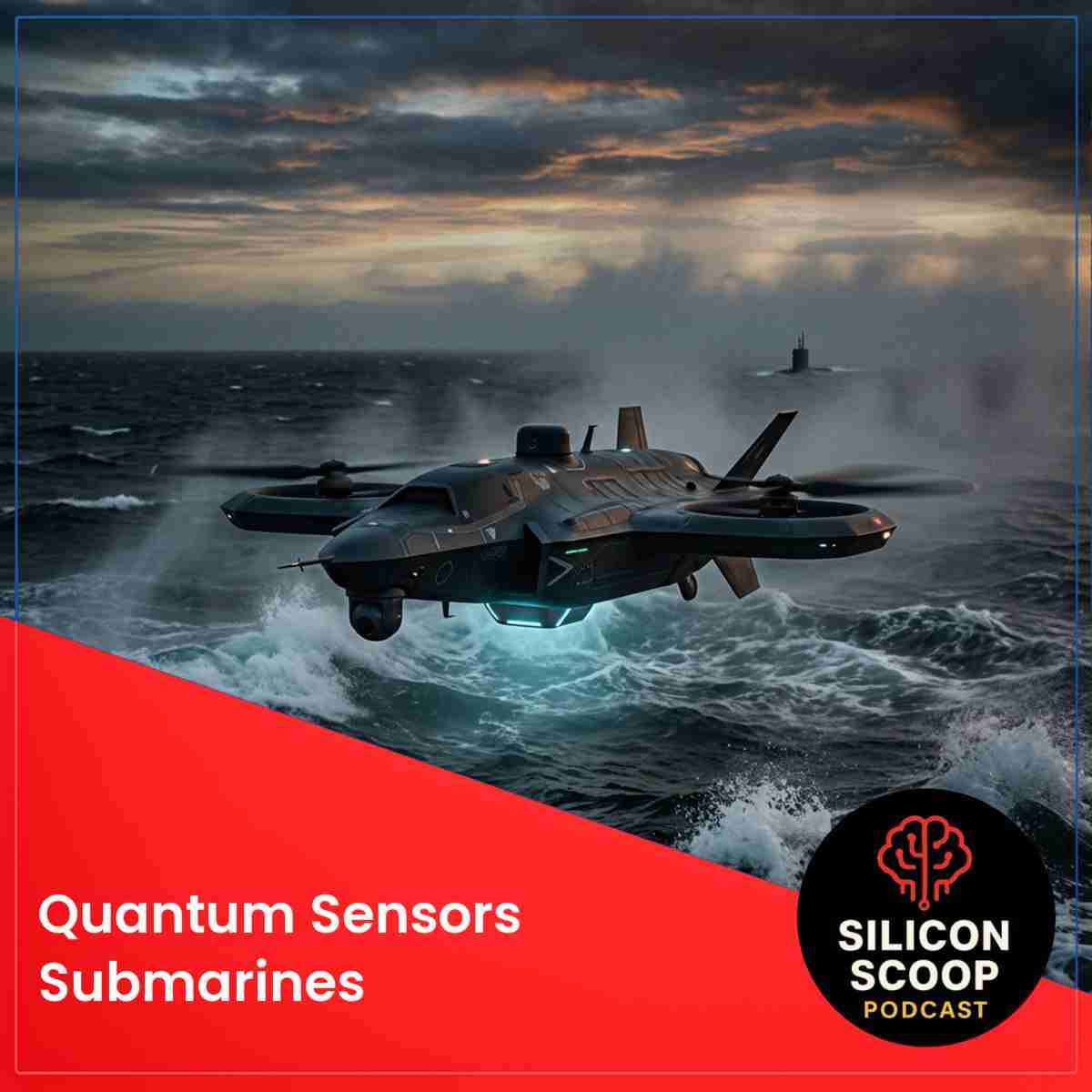
Quantum Sensors and Submarines: How China’s Drone Technology Could End Underwater Stealth Forever
Estimated reading time: 12 minutes
Key Takeaways
- New tools — including quantum magnetometers, gravimeters, and Superconducting Quantum Interference Devices (SQUIDs) — can now detect the faintest ripples in Earth’s magnetic and gravitational fields.
- China’s recent drone-mounted CPT atomic magnetometer trials near Weihai have sent shockwaves through the naval world.
- This system matches NATO’s gold-standard MAD-XR detection system — but costs far less and needs only a single unit to operate.
- Analysts describe as making the oceans “transparent” to detection by as early as 2050.
Table of contents
- Quantum Sensors and Submarines: How China’s Drone Technology Could End Underwater Stealth Forever
- Introduction: The End of Hiding Under the Ocean?
- Section 1: Why Traditional Submarine Detection Is Failing
- Section 2: The Quantum Revolution in Underwater Sensing
- ⚡ Stop Doing Busywork by Hand
- Section 3: China’s CPT Magnetometer — The Submarine Detection Breakthrough
- Section 4: The Global Detection Race and Naval Arms Competition
- Section 5: Technical Specs and What the Numbers Actually Mean
- FAQ: Quantum Sensors and Submarine Detection — 10 Key Questions Answered
- Conclusion: The Underwater Battlefield Is Changing
Introduction: The End of Hiding Under the Ocean?
For decades, quantum sensors submarines have been on a collision course. Now, that collision is happening.
Submarines have long been the ultimate hiding tool for the world’s navies. Sliding hundreds of feet beneath the ocean surface, they could move in near-total secrecy. Traditional detection tools like sonar, visual scanning, and sonobuoys have always had major gaps that skilled submarine crews could exploit.
But quantum sensing technology is changing the rules fast.
New tools — including quantum magnetometers, gravimeters, and Superconducting Quantum Interference Devices (SQUIDs) — can now detect the faintest ripples in Earth’s magnetic and gravitational fields. Even the quietest, most advanced nuclear submarine leaves a trace. And these new sensors are sensitive enough to find it.
China’s recent drone-mounted CPT atomic magnetometer trials near Weihai have sent shockwaves through the naval world. This system matches NATO’s gold-standard MAD-XR detection system — but costs far less and needs only a single unit to operate.
The underwater stealth era may be drawing to a close.
—
Section 1: Why Traditional Submarine Detection Is Failing
The Limits of Sonar and Visual Submarine Detection
For most of modern naval history, finding a hidden submarine came down to a few basic methods:
- Active sonar — sending out sound pulses and listening for echoes bouncing off a sub’s hull
- Passive sonar — listening for sounds the submarine itself makes (engines, crew movement, machinery)
- Sonobuoys — floating sensor devices dropped from aircraft to listen for underwater sounds
- Visual detection — spotting a submarine’s wake, silhouette, or the bioluminescence stirred up by its hull moving through the water
Each of these methods has serious weaknesses.
Submarines are designed from the keel up to defeat them. Modern submarine stealth features include:
- Anechoic tiles — rubber coatings that absorb sonar waves instead of bouncing them back
- Pump-jet propulsion — quieter than traditional propellers, making passive sonar far less useful
- Slow, quiet running — submarines can creep along at minimal speed to reduce acoustic signatures
- Deep diving — using ocean layers that bend and scatter sound waves to break sonar contact
Visual detection is almost useless in open-ocean conditions. And in areas like the South China Sea, where the Earth’s magnetic field runs nearly parallel to the surface, even traditional magnetic anomaly detection (MAD) becomes unreliable, creating blind spots that submarines can exploit.
These limitations are exactly why military research programs around the world have pivoted hard toward quantum physics as the next frontier in submarine detection.
quantum sensors make submarines harder to hide
—
Section 2: The Quantum Revolution in Underwater Sensing
How Quantum Magnetometers and SQUIDs Detect Hidden Submarines
Quantum sensing works on a completely different principle than sonar or visual detection. Instead of looking or listening for the submarine directly, it measures tiny disturbances the submarine causes in the invisible fields that surround the Earth.
Here is how the key technologies work:
Quantum Magnetometers
A quantum magnetometer uses specific quantum states of atoms to sense magnetic fields with extraordinary precision.
Every atom has a property called “spin” — think of it like a tiny compass needle. When a magnetic field is present, it causes these spins to wobble at measurable rates. Scientists use lasers to track these wobbles with incredible accuracy.
The result? A quantum magnetometer can detect magnetic fields billions of times weaker than the field produced by a small fridge magnet. A submarine’s steel hull distorts Earth’s magnetic field in a very small but measurable way. A quantum magnetometer can find that distortion even at significant distance.
SQUIDs — Superconducting Quantum Interference Devices
SQUIDs take a different approach to magnetic anomaly detection:
- They are made from tiny loops of supercooled metal wire
- The wire is cooled to near absolute zero, making it a superconductor
- The loops are connected by weak links called Josephson junctions
- When a magnetic field threads through the loop, it interferes with the electrical current in a measurable way
Because they operate at extreme cold, SQUIDs can detect even the faintest magnetic “whisper.” According to research, SQUIDs could detect submarines from up to 3.7 miles away — compared to only 0.5 miles for conventional magnetic detection systems. That is nearly a sevenfold increase in detection range, with a potential reach of up to 6 kilometers.
Quantum Gravimeters
Quantum gravimeters take yet another approach, measuring tiny changes in gravitational pull:
- A cloud of rubidium atoms is supercooled in a vacuum using lasers
- The atoms are pushed upward, causing their quantum wave to split into two paths
- When the atoms fall back and the paths recombine, they create interference patterns — like ripples overlapping on a pond
- Analyzing those ripples reveals gravity’s strength down to millionths of a gal (a measure of acceleration)
A submarine moving through the ocean displaces water. That displacement creates a tiny, local change in gravitational pull. A quantum gravimeter is sensitive enough to find it.
Together, these technologies — quantum magnetometers, SQUIDs, and quantum gravimeters — are building toward what analysts describe as making the oceans “transparent” to detection by as early as 2050.
china tests drone-mounted quantum sensor that could reshape submarine detection
quantum sensors make submarines harder to hide
—
⚡ Stop Doing Busywork by Hand
Your team is spending hours every week on admin tasks, follow-ups, and reporting that could be handled automatically.
Automate your admin, follow-ups, and reporting so your team gets hours back every week — without hiring more people.
Whether you run a small business or manage a growing team, automation can free up the time you need to focus on what actually matters.
👉 Book a free automation consult at Flowgrammer.ca
—
Section 3: China’s CPT Magnetometer — The Submarine Detection Breakthrough
China’s Drone-Mounted CPT Atomic Magnetometer Rivals NATO’s MAD-XR
The most significant recent development in the quantum sensors submarines race comes from China.
Chinese researchers have developed and successfully field-tested a Coherent Population Trapping (CPT) atomic magnetometer mounted on an unmanned aerial drone. The trials took place near Weihai, surveying a 400-meter by 300-meter grid over open water.
The results were remarkable:
- Magnetic anomaly accuracy: 0.849 nanoTesla (nT) after corrections
- Repeatability: 99.8% — meaning the system produces the same results almost every single time
- Sensitivity: picotesla level — detecting magnetic disturbances so small they are one trillionth of a Tesla
The CPT sensor works by scanning seven distinct microwave resonance signals from rubidium atoms. By reading multiple signals at once, the system can measure magnetic field strength and direction regardless of which way the sensor is pointed. This makes it orientation-independent — a key advantage for a drone-mounted system that is constantly moving and tilting.
The drone is tethered via a 20-meter cable to the CPT magnetometer, keeping it isolated from electromagnetic interference caused by the drone’s own motors and electronics. A fluxgate sensor provides additional correction data, and GPS ground stations are used to further reduce noise in the readings.
Why This Matters Strategically
The CPT system directly addresses a known weakness in traditional magnetic anomaly detection. In low-latitude bodies of water like the South China Sea, the Earth’s magnetic field runs nearly parallel to the ocean surface. This creates dead zones where conventional magnetic anomaly detection (MAD) systems struggle or fail entirely.
China’s CPT drone system is specifically engineered to overcome this blind spot — precisely in the waters most relevant to potential conflict over Taiwan and regional maritime disputes.
Even more striking is how this system compares to NATO’s best technology:
- China’s CPT system matches the sensitivity of NATO’s MAD-XR (Magnetic Anomaly Detection-Extended Role) system
- It does so at significantly lower cost
- It requires only a single unit — while NATO’s MAD-XR requires multiple probes working together
This is not a near-future possibility. The Weihai trials have already demonstrated it working in real ocean conditions.
china tests drone-mounted quantum sensor that could reshape submarine detection
china is now trying to use fancy quantum sensors to unstealth u.s. navy nuclear attack
china quantum sensing ecosystem
—
Section 4: The Global Detection Race and Naval Arms Competition
NATO, DARPA, and the International Submarine Detection Arms Race
China is not the only player in this race. Nations around the world are pouring resources into quantum sensing for military applications.
DARPA — the U.S. Defense Advanced Research Projects Agency — launched its Robust Quantum Sensors Phase One program in August 2025, specifically targeting maritime integration of quantum sensing technology. This signals that the U.S. military views quantum-based submarine detection as a near-term operational priority, not a long-term research project.
NATO’s MAD-XR system represents the current Western standard for airborne magnetic anomaly detection. It is sophisticated, proven, and effective. But it is more complex and costly to deploy than China’s CPT alternative — and it requires multiple probes to match what China’s single-unit system can achieve.
The publication of the Chinese CPT results in the Chinese Journal of Scientific Instrument (April 2026 study) was notable. Publishing these results openly is itself a strategic signal — a demonstration of capability intended to be seen and understood by rival navies.
What Happens to Submarines Next?
Military analysts do not believe submarines will become obsolete overnight. However, the pressure from advancing quantum detection is already changing how naval strategists think about undersea warfare.
Likely submarine adaptations include:
- Smaller, more compact submarines — reducing the magnetic and gravitational signature that quantum sensors hunt for
- Active jamming systems — broadcasting carefully tuned electromagnetic signals to confuse or baffle quantum magnetometers
- Drone swarms — deploying large numbers of small unmanned underwater vehicles around a submarine to mask its magnetic signature within a cloud of false targets
- New hull materials — non-magnetic composites that generate a smaller magnetic anomaly signature
- Deeper diving — using greater depth to place more water between the submarine and surface-based drone sensors
Analysts writing in the National Security Journal suggest that AI-enhanced networks of quantum sensors could render the oceans effectively transparent to detection by 2050. At that point, submarine-based nuclear deterrence — one of the foundational pillars of global strategic stability — would face an entirely new set of challenges.
china tests drone-mounted quantum sensor that could reshape submarine detection
china is now trying to use fancy quantum sensors to unstealth u.s. navy nuclear attack
china quantum sensing ecosystem
—
Section 5: Technical Specs and What the Numbers Actually Mean
Breaking Down the Key Metrics of Quantum Submarine Detection Systems
The technical numbers behind quantum sensing can be hard to put in context. Here is what the key figures actually mean for real-world submarine detection:
| Metric | Value | What It Means |
|---|---|---|
| CPT Magnetometer Accuracy | 0.849 nT | Detects magnetic changes 1,000 times smaller than Earth’s field |
| Repeatability | 99.8% | Nearly perfect consistency across repeated scans |
| Sensor Sensitivity | Picotesla range | Can detect fields trillionths of a Tesla in strength |
| SQUID Detection Range | Up to 3.7 miles (6 km) | Vs. 0.5 miles for conventional magnetic detection |
| Survey Area (Weihai Trials) | 400m x 300m grid | Real ocean conditions, not laboratory testing |
| Rubidium Resonance Signals | 7 microwave signals | Enables orientation-independent measurement |
| Tether Length | 20 meters | Isolates sensor from drone electromagnetic noise |
The jump from 0.5 miles to 3.7 miles detection range with SQUIDs is not incremental progress. It is a fundamental shift in what underwater stealth can realistically achieve.
A submarine commander who was once safe at 800 meters from the nearest sensor would need to completely rethink their operating assumptions. That kind of range increase, combined with picotesla sensitivity, means even the quietest, most modern nuclear attack submarine leaves a detectable footprint.
The 99.8% repeatability figure is equally important. Military systems need to be reliable under pressure. A sensor that works brilliantly 70% of the time is operationally limited. One that delivers consistent results 99.8% of the time is deployment-ready.
china tests drone-mounted quantum sensor that could reshape submarine detection
—
FAQ: Quantum Sensors and Submarine Detection — 10 Key Questions Answered
Q1: What are quantum sensors and why do they matter for submarine detection?
Quantum sensors use the strange properties of quantum physics to measure incredibly tiny changes in magnetic or gravitational fields. They matter for submarine detection because even a stealthy submarine disturbs these fields in ways that quantum sensors can find — unlike sonar or visual methods that submarines are built to defeat.
Q2: What is a CPT magnetometer?
A Coherent Population Trapping (CPT) magnetometer uses clouds of rubidium atoms to measure magnetic fields. It scans seven microwave resonance signals from the atoms, allowing it to detect the strength and direction of magnetic fields regardless of which way the sensor is pointing. China has successfully mounted one on a drone for submarine hunting.
Q3: How does a SQUID work in submarine detection?
A SQUID — Superconducting Quantum Interference Device — is a loop of supercooled metal wire connected by Josephson junctions. When a magnetic field passes through the loop, it creates measurable interference patterns in the electrical current. Because SQUIDs operate near absolute zero, they can detect extremely faint magnetic signals, potentially finding submarines from up to 3.7 miles away.
Q4: How accurate was China’s Weihai quantum sensor trial?
The trial achieved a magnetic anomaly detection accuracy of 0.849 nanoTesla after corrections, with 99.8% repeatability across scans of a 400-meter by 300-meter ocean grid. These results were published in the Chinese Journal of Scientific Instrument.
Q5: How does China’s CPT system compare to NATO’s MAD-XR?
China’s CPT drone-mounted system matches NATO’s MAD-XR in magnetic anomaly detection sensitivity. However, China’s system costs significantly less to build and operate and requires only a single sensor unit, whereas MAD-XR needs multiple probes to achieve comparable coverage.
Q6: Why is the South China Sea a problem area for traditional submarine detection?
In low-latitude waters like the South China Sea, Earth’s magnetic field runs nearly parallel to the ocean surface. This creates blind spots where conventional Magnetic Anomaly Detection (MAD) systems are less effective. China’s CPT system is specifically designed to work in these conditions.
Q7: What is DARPA doing about quantum submarine detection?
DARPA launched its Robust Quantum Sensors Phase One program in August 2025, focused on integrating quantum sensing technology into maritime operations. This signals that the U.S. military considers quantum-based submarine detection an urgent, near-term operational priority.
Q8: Will quantum sensors make submarines completely obsolete?
Not immediately. Analysts believe submarines will adapt by becoming smaller, adopting non-magnetic hull materials, using active jamming, or deploying drone swarms to mask their signatures. However, if AI-enhanced networks of quantum sensors mature by 2050 as predicted, submarine stealth faces fundamental challenges.
Q9: What is a quantum gravimeter and how does it detect submarines?
A quantum gravimeter supercools rubidium atoms near absolute zero and measures tiny changes in gravitational pull. A submarine moving underwater displaces water, creating a small local change in gravity. A quantum gravimeter is sensitive enough to detect this change, measuring gravity down to millionths of a gal.
Q10: When could quantum submarine detection become operational at scale?
Some systems — like China’s CPT drone magnetometer — have already completed open-ocean trials and appear close to operational deployment. Analysts project that AI-enhanced networks of quantum sensors could make the oceans effectively transparent to detection by 2050, though limited operational use could begin well before that timeline.
—
Conclusion: The Underwater Battlefield Is Changing
The race between quantum sensors and submarines is no longer a science fiction scenario. It is happening right now, in real ocean trials, with real military implications.
China’s CPT drone magnetometer — matching NATO’s MAD-XR at lower cost with a single unit — is the clearest sign yet that quantum sensing has crossed from the laboratory into operational reality. Combined with DARPA’s urgent investment in the Robust Quantum Sensors program, it is clear that every major naval power sees what is coming.
Submarine stealth is not finished yet. But the window in which a submarine can count on the ocean to keep it hidden is getting smaller. The physics that once made deep water a perfect hiding place is now being turned against the submarines themselves.
The navies that adapt fastest — whether through new hull designs, active countermeasures, or entirely new undersea strategies — will define the next era of covert maritime warfare.
The ocean floor used to be the safest place to hide. Quantum physics is taking that away.
china tests drone-mounted quantum sensor that could reshape submarine detection
quantum sensors make submarines harder to hide
china is now trying to use fancy quantum sensors to unstealth u.s. navy nuclear attack
Additional Links
Flowgrammer.ca – 💡 Unlock AI-Powered Automation! Let flowgrammer.ca handle complex workflows so you can focus on growing your business.
Flowgrammers.ca – 💡 Join Toronto’s Fastest Growing AI and Business Automation Community.
- SRED Funding Solutions – Maximize your R&D tax credits and secure funding for your innovation.
- Silicon Scoop Podcast – Stay Informed, Stay Ahead!
- Startup Talk Podcast
- Flowgrammer Youtube
- Startup Investor Drinks – Join Toronto’s Startup Community and connect with fellow startup enthusiasts and investors.
- TorontoStarts Startup and Entrepreneur Community – Become a part of Toronto’s thriving startup ecosystem.
- Workhaus – Discover flexible workspace solutions for your business needs.
- Work with The Startup Coach – Get expert guidance and mentorship for your startup journey.
- Reach out to Jon Irwin on LinkedIn – Connect with our co-host and technology expert.
Episode transcript
Read the full transcript
Craig: the ocean has been the ultimate hiding spot for a century, but quantum physics just turned on the lights. china's new drone mounted sensors can now see through the deep, and the air of invisible submarine is officially on life support. quantum sensors have just killed submarine stealth. the new quantum magnetometers and gravimeters can detect the microscopic magnetic and gravitational ripples caused by a submarine's hull. china has recently proved this works using a low cost drone that matches the best tech nato has to offer. this compromises the nuclear triad. if submarines can't hide, they can't access as secret deterrent fundamentally shifting global military balance. what do you think about this, john?
Jon: i love this. i love this new quantum tech, all these new sensors that are coming out. this is really cool stuff. and the question is is this just limited to underwater? is this going to eliminate radar completely even for planes and all that sort of stuff going forward? because so let's dive into this real quickly, though. so the reason why submarines have been historically undetectable is because they rely on acoustic stealth, which is ultra quiet propulsion, shape design to reduce their solar reflections, and operating in noisy ocean environments. and so traditional detection methods were solar, so sound waves, radar, which is kind of ineffective underwater, and magnetic anomaly detection, which has limited sensitivity. so modern submarines like nuclear ballistic submarines, they're designed to be so quiet they blend into background ocean noise, which makes them nearly invisible using classical techniques. the way that this quantum sensing breaks the stealth is from a completely different angle. so instead of detecting sound, they detect mass displacement in water, so gravitational changes. they, they detect magnetic signatures from metal hulls and disturbances in earth's natural fields. and i know we kind of covered some of this stuff in the past, but this just shows a practical application of some of those sensors that we covered. so even a perfectly silent submarine, there's three things that it has. well, more than that. but mass, it alters local gravity slightly, and it disturbs magnetic fields. so these effects are impossible to eliminate entirely, which is why this is potentially so disruptive. and so if we talk about the, the way that these sensors work, do you like, would you not think that they could adapt this to planes in the air? or what are your thoughts on this? is this more magic? you're on mute.
Craig: i don't know if they can adapt it to planes in the air for a couple of reasons because i think part of it is, they're detecting, like, the slight movements in the water on top of the magnetic, on top of like, this is according to research, squids could detect submarines from 3.7 miles away compared to, point five, miles conventional, and would they have the potential range of six kilometers? so we sit back and say they're looking towards a transparent ocean as early as 2050. but that means they've got to put all these magnetometers and squids and gravitometers gravimeters set up all over the place to have the transparent ocean. so how do you do that in the sky? well
Jon: okay. yeah. that makes sense.
Craig: so until we have enough satellites to be running these kinds of things in the sky at a six kilometer plus range, and that would, you know, blacken the sky probably or whatnot with all these things. so i think we're gonna have different types of detection via the satellite network that they're building for whatever is going on above ground.
Jon: yeah. and here's the thing, though. so despite the hype that what this could potentially do, there are some real limitations. so many of the quantum sensing systems, like, work only at short ranges, like you said, or controlled conditions. and ocean environments are extremely noisy. so thermal magnetic and geological noise. and scaling sensitivity to long range detection right now is a major hurdle. so even in related technologies like quantum radar, long range detection remains largely theoretical or speculative at this time. so, in nowhere in the near future are is this tech going to be usable tech, in the next, i'd say, five years. maybe ten.
Craig: yeah. so these drones are tethered via a 20 meter cable to a cpt magnetometer keeping it isolated from the electromagnetic interference. so these things have to be distributed. so that's why we wouldn't have them in the sky. but it's really like, to think of this update like trying to walk through a dark room filled with suspended glitter. you might be silent and invisible, but your body naturally pushes the glitter aside as you move. these quantum sensors don't look for the person. they look for the glitter. the tiny disturbances in the earth's magnetic field to tell them exactly where you are. yeah. so it's like, i don't know. every time the, in star trek, we have to collect the klingon, cloaking, we're detecting radiation signals or disturbances. we can't detect the ship itself.
Jon: yeah. so
Craig: its accuracy is point eight four nine nanoteslas. do you know what a nanotesla is? no. i'm trying to see if i have it here. the squid can hit 3.7 miles. we talked about that. it's a reliability of 99.8%, and the sensitivity is picotessla range, which is one trillionth of a tesla. so okay. anyway, these are extremely sensitive. the squid super con conducting quantum interface interference devices mentioned must be cooled near sub zero, absolute zero negative 273 degrees celsius requiring advanced cryogenics packaging in the mobile unit. while china is making headlines, the us launched darpa's robust quantum sensors phase one in august 2020 sorry, 2025, essentially confirming that the pentagon is in a black project arms race to catch or surpass these findings. so they've got their own thing going on that there we don't really, know about. the earth's magnetic field in the south china sea is nearly parallel to the surface, which usually creates a blind spot for magnetic sensors. china's cpt system was specifically designed to exploit this unscannable zone.
Jon: crazy.
Craig: so the silent service is about to get very loud as quantum physics makes the haystack smaller and the needle glow in the dark. if the ocean becomes transparent, does the submarine become a $3,000,000,000 coffin, or can tech, like magnetic jamming, save it? drop your theories in the chat. we'd love to hear what you think.
More from Silicon Scoop
All episodes
silicon-scoop · October 16, 2026
Meta’s $18 Billion Teen Safety Settlement: Soft Guardrails, Hard Leverage Over TikTok and YouTube
Deep dive on Meta teen safety settlement, social media addiction lawsuit, new Facebook Instagram time limits and pressure on TikTok YouTube age verification.
View episode

silicon-scoop · October 15, 2026
How Claude Mythos Is Reshaping Cryptanalysis: HAWK, AES and the Rise of AI-Driven Crypto Research
Claude Mythos cryptanalysis weakens HAWK post-quantum signature, speeds AES Möbius Bridge attack, and powers CryptanalysisBench benchmark in AI-driven crypto research.
View episode

silicon-scoop · October 14, 2026
Nvidia’s $12.9 Billion Hugging Face Bet: How Controlling the Open-Source Model Hub Reshapes AI Chips, Cloud, And Competition
Nvidia Hugging Face acquisition could reshape open source AI models, AI chip dominance, and the global developer model hub, raising antitrust and neutrality questions.
View episode