
LUCA Rewrites How Fast Complex Life Began
LUCA Rewrites How Fast Complex Life Began https://torontostarts.com/silicon-scoop/ Flowgrammer.ca -> https://flowgrammer.ca/ AI News and Resources -> https://flowgrammers.ca OpenClaw Toronto -> https://openclawto.com/ Stop Doing Busywork by Hand Automate the repetitive tasks that eat your week—follow-ups, invoices, data entry, reporting—so you can focus on sales and delivery. Book an automation consult https://flowgrammer.ca Startup Investor Drinks Toronto - https://startupdrinksto.com/ Toronto’s Startup Community - https://torontostarts.com/ Silicon Scoop Silicon Scoop Podcast - https://torontostarts.com/silicon-scoop/ Apple: https://podcasts.apple.com/us/podcast/silicon-scoop/id1758711826 Spotify: https://open.spotify.com/show/5bAzF0MwV6TtLhJAhvHayI YouTube: https://www.youtube.com/playlist?list=PLj4v-RoA7A-gT62vrEYqh1zCv-0Hj-o5J Startup Talk Startup Talk Podcast -> https://torontostarts.com/startup-talk-toronto-startup-podcast/ Apple -> https://podcasts.apple.com/us/podcast/startup-talk/id1763804003 Spotify -> https://open.spotify.com/show/1siJMILILidHAiAsrX2VBU YouTube: https://youtube.com/playlist?list=PLj4v-RoA7A-jxV5FHs5e61oIsuvUJYmT_&si=LYegRe5GYLKNQ7xL
With Craig Major and Jon Irwin
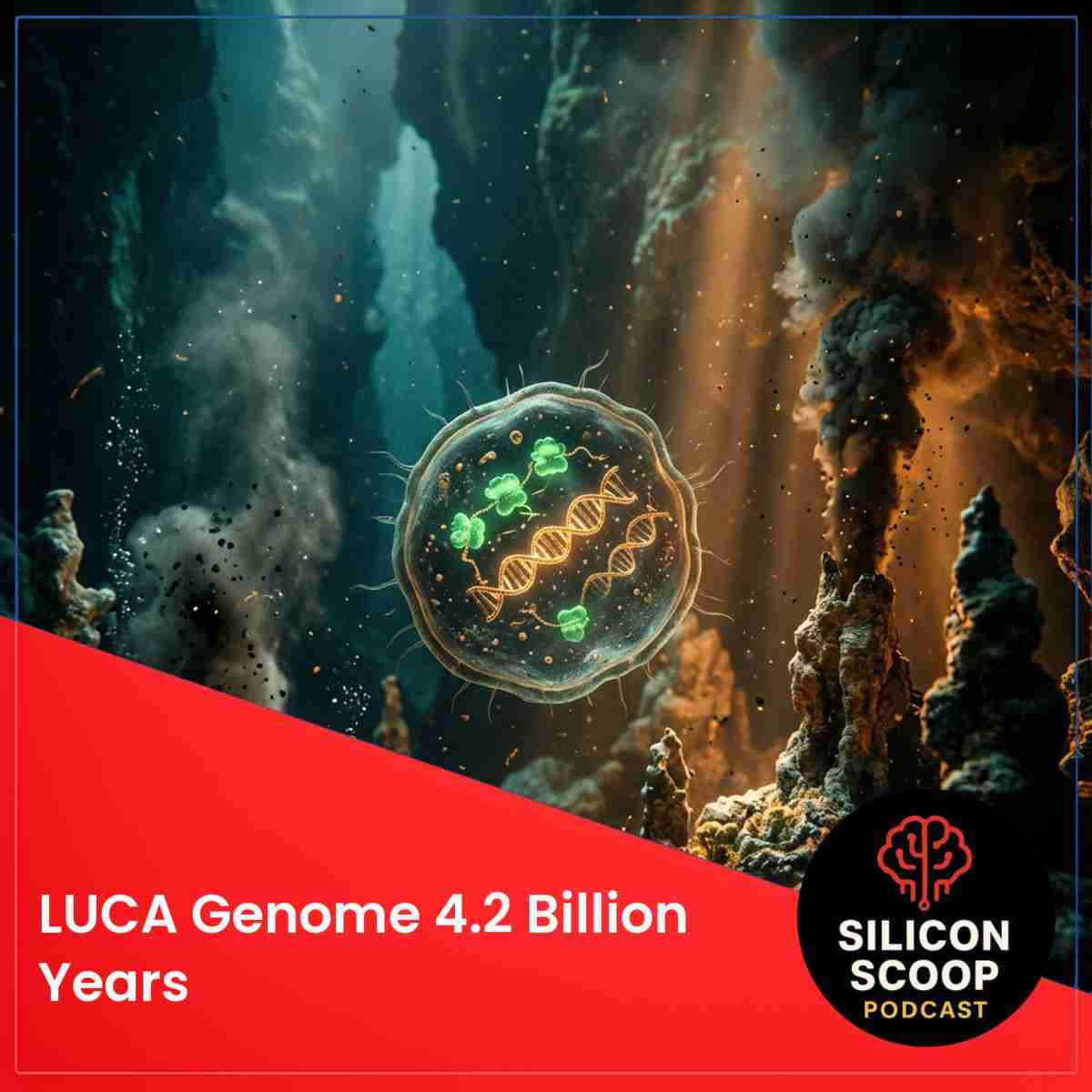
LUCA Genome 4.2 Billion Years Old: Earth’s Ancient Ancestor Had a Surprising Immune System
Estimated reading time: 8 minutes
Key Takeaways
- The LUCA genome 4.2 billion years old contains over 2,600 genes, an early immune system, and complex metabolism.
- Scientists used a molecular clock and paralogy-based molecular clocking to estimate LUCA’s age with a confidence interval of 4.09 to 4.33 billion years ago.
- The reconstructed LUCA genome included 19 CRISPR-Cas9 genes, suggesting viral warfare and DNA-based immunity existed extremely early in Earth’s history.
- Genomic evidence points to LUCA living near deep-sea hydrothermal vents and being part of an established microbial community.
- The findings reshape the timeline of early life and strengthen the case for life emerging quickly on other worlds with suitable conditions.
Table of contents
- LUCA Genome 4.2 Billion Years Old: Earth’s Ancient Ancestor Had a Surprising Immune System
- The Oldest Family Tree Just Got Longer
- What Is LUCA? Understanding the Last Universal Common Ancestor
- How Scientists Dated the Ancient Prokaryote and Mapped Its Genome
- LUCA’s Immune System: Ancient CRISPR-Cas9 Genes Found
- ⚡ Stop Doing Busywork by Hand
- Where Did LUCA Live? Hydrothermal Vents and the Hadean Eon
- What Experts Are Saying: A Paradigm Shift in Early Life Evolution
- What We Still Don’t Know About LUCA and Early Life
- FAQ: 10 Questions About LUCA and Early Life on Earth
- Summary: What the LUCA Discovery Changes
The Oldest Family Tree Just Got Longer
What if the story of life on Earth started much earlier than anyone thought? Scientists have now pushed back the origin of LUCA — the Last Universal Common Ancestor — by hundreds of millions of years. And the new details about this ancient microbe are nothing short of stunning.
The LUCA genome 4.2 billion years old contains over 2,600 genes, an early immune system, and complex metabolism. This was no simple blob of chemistry. This was a living, fighting, energy-producing organism that existed when Earth was still a violent, molten nightmare.
Every living thing on Earth — every bacterium, every blue whale, every human being — traces its family tree back to this one tiny creature.
—
What Is LUCA? Understanding the Last Universal Common Ancestor
LUCA stands for Last Universal Common Ancestor. Think of it like the trunk of the entire tree of life. Every branch — bacteria, archaea, and all complex life including plants, animals, and fungi — grew out from this one common starting point.
LUCA was a prokaryote, meaning it had no nucleus. It was microscopic and simple in structure — but as new research reveals, far more advanced on the inside than scientists ever expected.
Why LUCA Matters
- LUCA is the single ancestor of all life on Earth
- Understanding LUCA tells us how quickly life can evolve on a planet
- It gives clues about where to look for life on other planets
- It rewrites the timeline of early Earth’s history
For years, scientists estimated LUCA lived around 4 billion years ago — about 600 million years after Earth formed. A new international study has pushed that date back to 4.2 billion years ago, placing LUCA in the middle of the Hadean Eon — a period when Earth was being constantly bombarded by asteroids and volcanoes were everywhere.
The results were published in the journal Nature Ecology & Evolution in 2024.
—
How Scientists Dated the Ancient Prokaryote and Mapped Its Genome
Figuring out when a creature lived 4.2 billion years ago — before any fossils existed — sounds impossible. But the research team found a clever way to do it.
The Molecular Clock Method
Scientists used what’s called a molecular clock. Here’s how it works in simple terms:
- DNA changes slowly over time through mutations
- By counting how different two species’ genes are today, you can estimate when they shared a common ancestor
- The further back the split, the more mutations have piled up
The team analyzed 700 microbial genomes — 350 bacterial and 350 archaeal species — and tracked 57 conserved marker genes. These are genes so important to life that they barely change across billions of years.
They also used a smarter approach than past studies: paralogy-based molecular clocking. Instead of tracking a single gene, they tracked pairs of genes that duplicated before the split of archaea and bacteria. This gave them a much tighter estimate, landing on a confidence interval of 4.09 to 4.33 billion years ago.
What They Found in the LUCA Genome
The reconstructed primordial Earth microbe had:
- A genome of 2.75 megabases
- 2,657 genes — well within the range of modern prokaryotes
- This is not a primitive progenote. This is a fully functional, complex organism
“The common ancestry of all extant cellular life is evidenced by the universal genetic code, machinery for protein synthesis, shared chirality of the almost-universal set of 20 amino acids and use of ATP as a common energy currency,” the study authors write.
Lead author Edmund Moody of the University of Bristol explained: “The evolutionary history of genes is complicated by their exchange between lineages. We have to use complex evolutionary models to reconcile the evolutionary history of genes with the genealogy of species.”
—
LUCA’s Immune System: Ancient CRISPR-Cas9 Genes Found
Here is where things get truly remarkable.
The research team discovered 19 CRISPR-Cas9 genes in the reconstructed LUCA genome. CRISPR-Cas9 is the same system that modern scientists use to edit DNA in labs today. But in LUCA, it was being used as a natural immune defense against viruses.
What This Means
- Viruses existed before LUCA split into archaea and bacteria
- The ancient prokaryote CRISPR-Cas9 genes are evidence that viral warfare was already happening 4.2 billion years ago
- LUCA wasn’t living in a peaceful, sterile world — it was already in an arms race with viral parasites
This is a bombshell discovery. It means that DNA-based viral immunity evolved by 4.2 billion years ago — almost as soon as Earth could support life at all.
LUCA Wasn’t Alone
Co-author Tim Lenton of the University of Exeter put it clearly: “It’s clear that LUCA was exploiting and changing its environment, but it is unlikely to have lived alone. Its waste would have been food for other microbes, like methanogens, that would have helped to create a recycling ecosystem.”
This tells us that early life’s evolution didn’t happen in isolation. LUCA was already part of an established microbial community — a recycling ecosystem powered by hydrogen. Methanogens (microbes that produce methane) were likely feeding off LUCA’s waste products.
The old idea of a “sterile early Earth” slowly warming up to life has been shattered.
—
—
⚡ Stop Doing Busywork by Hand
Automate the repetitive tasks that eat your week — follow-ups, invoices, data entry, reporting — so you can focus on sales and delivery.
Book an automation consult → flowgrammer.ca
—
—
Where Did LUCA Live? Hydrothermal Vents and the Hadean Eon
The Hadean Eon (4.5 to 4 billion years ago) is named after Hades — the underworld. Earth’s surface was brutal: constant asteroid impacts, no stable crust in many places, and an atmosphere very different from today’s.
So where did LUCA survive?
Deep-Sea Hydrothermal Vents
The genomic evidence points strongly to deep-sea hydrothermal vents — underwater cracks in the ocean floor where superheated, mineral-rich water pours out.
Here’s why:
- LUCA showed thermophilic (heat-loving) traits in its genome, suggesting it thrived in hot environments
- It used the Wood-Ljungdahl pathway — a method of fixing carbon from CO₂ without sunlight, perfect for deep-sea environments
- This acetogenic metabolism (producing acetate from CO₂ and hydrogen) is common in modern vent-dwelling microbes
- LUCA also had some UV-protection genes, possibly hinting at occasional exposure to surface water
The primordial Earth microbe likely lived near these mineral-rich hot springs, feeding off the chemical energy pouring out of the planet itself.
A Thriving Ecosystem, Not a Lonely Cell
What’s remarkable is that LUCA wasn’t just surviving. It was part of a functioning ecosystem:
- LUCA produced waste gases that methanogens recycled
- Methanogens converted hydrogen and CO₂ into methane
- This created a closed-loop microbial economy billions of years before complex life existed
This completely contradicts the old model of early life as a lonely, slowly evolving chemical experiment. Life hit the ground running.
—
What Experts Are Saying: A Paradigm Shift in Early Life Evolution
The scientific community has recognized this study as genuinely groundbreaking.
Expert Reactions
- Betül Kaçar (University of Wisconsin-Madison) and Rika Anderson (Carleton College) called the research a “robust” advancement in comparative genomics
- William Martin, whose 2016 LUCA model was a landmark study, confirmed the new study’s methodological validity and noted it achieved his predicted results with enhanced precision
- The broader consensus: this is paradigm-shifting evidence that complex microbial life with viral immunity evolved within just 100–200 million years of planetary habitability
That’s an astonishing compression of the abiogenesis-to-complexity timeline. Life didn’t slowly crawl into existence over billions of years. It appeared, organized, fought off viruses, and built ecosystems — fast.
What This Means for the Search for Life Beyond Earth
If life on Earth went from nothing to complex, immune-equipped communities in under 200 million years, it raises a powerful question: could the same thing happen on other planets?
Astrobiologists are already exploring this. Environments like the subsurface oceans of Europa and Enceladus, or the hydrothermal systems potentially active on Mars billions of years ago, look a lot more promising when you understand how quickly life can get started.
—
What We Still Don’t Know About LUCA and Early Life
As impressive as this research is, major questions remain unanswered.
The Gap Before LUCA
LUCA is the oldest known common ancestor — but it is not the first life. Something had to come before it. Scientists still don’t fully understand:
- How abiogenesis (life emerging from chemistry) actually happened
- What the organisms between raw chemistry and LUCA looked like
- Whether LUCA had predecessors that left any traceable record
Methodological Limits
- Molecular clocks rely on assumptions about mutation rates, which can vary
- Horizontal gene transfer — where organisms swap genes sideways rather than passing them down — complicates the evolutionary tree
- The further back in time, the more uncertainty compounds
Edmund Moody’s team used sophisticated models (ILN relaxed-clock and GBM relaxed-clock) to reduce this uncertainty — but it cannot be eliminated entirely.
The Next Frontier
Further studies will need to:
- Dive deeper into the chemistry of pre-LUCA life
- Build better models of Hadean Earth environments
- Explore how RNA-based life may have preceded DNA-based life like LUCA
- Use increasingly powerful genomic tools to narrow the confidence intervals further
—
FAQ: 10 Questions About LUCA and Early Life on Earth
1. What does LUCA stand for?
LUCA stands for Last Universal Common Ancestor. It is the single organism from which all life on Earth — bacteria, plants, animals, fungi, and everything else — descended.
—
2. How old is LUCA exactly?
According to the 2024 study published in Nature Ecology & Evolution, LUCA lived approximately 4.2 billion years ago, with a 95% confidence interval of 4.09 to 4.33 billion years ago.
—
3. What kind of organism was LUCA?
LUCA was a prokaryote — a single-celled organism with no nucleus. Despite being microscopic, it had 2,657 genes, a metabolism, and an immune system. It was far more complex than scientists previously thought.
—
4. Did LUCA have an immune system?
Yes. The research found 19 CRISPR-Cas9 genes in LUCA’s genome, indicating it had an early DNA-based immune system that could defend against viral attacks.
—
5. Where did LUCA live?
Evidence suggests LUCA lived near deep-sea hydrothermal vents — underwater volcanic openings that produce heat and minerals. LUCA’s thermophilic (heat-loving) traits and carbon-fixing metabolism support this habitat.
—
6. How do scientists figure out when LUCA lived if there are no fossils?
Scientists use a molecular clock — a method that counts genetic mutations between species and works backward to estimate when they shared a common ancestor. The 2024 study analyzed 700 microbial genomes and 57 conserved marker genes.
—
7. Was LUCA the first life on Earth?
No. LUCA is the last common ancestor of all life alive today, but life existed before LUCA. Scientists still don’t fully understand the earlier stages of life’s development, called abiogenesis.
—
8. What did LUCA eat?
LUCA used the Wood-Ljungdahl pathway — a type of metabolism that fixes carbon from CO₂ using hydrogen, without needing sunlight. This is called acetogenic metabolism. It’s the same kind of chemistry found in microbes living in deep-sea vents today.
—
9. Was LUCA alone?
No. Evidence suggests LUCA was part of a microbial ecosystem. Its metabolic waste (like hydrogen byproducts) fed other microbes called methanogens, which recycled those waste products. Life was already communal 4.2 billion years ago.
—
10. Why does LUCA matter to the search for life on other planets?
If complex life with immune defenses appeared on Earth within 100–200 million years of the planet becoming habitable, it suggests life can emerge quickly given the right conditions. This makes environments like the oceans of Jupiter’s moon Europa or Saturn’s moon Enceladus far more interesting to astrobiologists.
—
Summary: What the LUCA Discovery Changes
The mapping of the LUCA genome 4.2 billion years ago has fundamentally reshaped how scientists understand the origin and early evolution of life. Here’s what we now know:
- LUCA lived 400 million years after Earth formed — far earlier than previously believed
- Its genome contained 2,657 genes — not a primitive progenote but a fully complex organism
- It possessed CRISPR-Cas9 immune genes — fighting viruses billions of years before humans discovered CRISPR
- It thrived in hydrothermal vent environments using hydrogen and CO₂ for energy
- It was part of a recycling microbial ecosystem — never truly alone
- Life went from bare chemistry to viral immunity and community ecology in under 200 million years
This isn’t just a story about a 4.2-billion-year-old microbe. It’s a story about how fast life moves once it gets started — and what that means for every corner of the universe where the conditions might one day be right.
Additional Links
Flowgrammer.ca – 💡 Unlock AI-Powered Automation! Let flowgrammer.ca handle complex workflows so you can focus on growing your business.
Flowgrammers.ca – 💡 Join Toronto’s Fastest Growing AI and Business Automation Community.
- SRED Funding Solutions – Maximize your R&D tax credits and secure funding for your innovation.
- Silicon Scoop Podcast – Stay Informed, Stay Ahead!
- Startup Talk Podcast
- Flowgrammer Youtube
- Startup Investor Drinks – Join Toronto’s Startup Community and connect with fellow startup enthusiasts and investors.
- TorontoStarts Startup and Entrepreneur Community – Become a part of Toronto’s thriving startup ecosystem.
- Workhaus – Discover flexible workspace solutions for your business needs.
- Work with The Startup Coach – Get expert guidance and mentorship for your startup journey.
- Reach out to Jon Irwin on LinkedIn – Connect with our co-host and technology expert.
Episode transcript
Read the full transcript
Craig: forget everything you knew about the slow crawl of evolution. new genomic data just pushed the origin of our oldest ancestor back to a time when earth was still a molten hellscape. we discovered that the four point two billion years ago, life wasn't just surviving. it was already running a complex immune system to fight off viruses. the luca's life sophisticated four point two billion year origin. scientists use a molecular clock to date the last universe common ancestor, the last universal common ancestor, luca, to 4,200,000,000 ago, and they found it wasn't a primitive chemical blob, but an complex organ organism with over 2,600 genes and a functional crispr immune system. this proved that life hits the ground running. if complexity develops this fast under two hundred million years, the odds of finding life on mars or europa just skyrocketed. what do you think about this, john?
Jon: i think this is really cool. so let's let's let's get into some of the details about this, though. so like you said, new research suggested that luca lived around 4,200,000,000 years ago, and that's much earlier than what scientists previously thought. so that essentially means that life may have emerged on earth pretty quickly after the planet formed during a time when earth was still considered a violent volcanic, hellish environment bombarded by asteroids. so the thing about this is what makes this discovery so fascinating is that luca was, like you said, is probably not a simple blob of chemistry, barely hanging on. so they actually now think that they have a surprisingly sophisticated biology including a primitive immune systems offense, and a metabolism capable of using hydrogen and carbon dioxide for energy. now, one thing to note, luca is not kind of first life on earth. okay? that's one of the most important distinctions to understand. what they're saying is luca represents the last organism from which all current living organisms descent. okay? sorry for you you, non, darwinism people. but scientists infer its existence because every known life form shares universal biological systems. so we share dna, rna, genetic coding, atp as the energy currency, ribosomes for protein synthesis, nearly identical genetic code structures, and shared amino acids and cellular chemistry. so these shared features, they strongly suggest that all modern life inherited them from a common ancestor, this is this is a really cool, discovery. what are your thoughts on this? does it blow?
Craig: it blows my mind, you know. think of this update like finding a fully functional high speed fiber router inside a victorian era house. we expected the first life to be a carrier pigeon, slow and simple, but it turns out luca was already running a digital defense network against hackers, viruses, before the earth's crust even cooled down. they had a complex immune system that did all sorts of things that, changes the way we look at how quickly these organisms develop.
Jon: yeah. this alright. go ahead. nope. so, like, just to kinda put it in so, like, earth, essentially, they said the they're they're guesstimating it formed around 4,540,000,000 years ago. so we're talking about luca existing around 4,200,000,000 years with an estimated range between four point zero nine and four point three three billion years ago. so they kind of rewound evolution backward through time to kind of figure this out, which is really cool. but the reason why this is a cool discovery is that for decades, many scientists assume that life couldn't stabilize during what's what was called the hadean eon, which is when earth formed with all of the volcanic activity. but, essentially, this new discovery estimates that luca, life emerged while the planet was still super chaotic, which has huge implications. right? so the study itself also compresses the timeline between earth becoming habitable, the origin of life, and the evolution of relatively sophisticated biology. so some researchers now think the transition from non life chemistry to cellular life may have happened within only and i yeah. i know. these are big numbers, though. a hundred to two hundred million years after stable oceans appeared. so this is from a geologist. geologically speaking, this isn't me. this is almost instantaneous, which kinda blows my mind.
Craig: so the spreeters team also discovered 19 crispr c x cas nine genes in the reconstructed luca genome. a crispr cas nine is the same system that modern scientists use to edit dna in labs today, but in luca, it was being used as a natural immune defense system. it's amazing that the things we're learning and that the origins of life are not what we thought they were. the team utilized a pairology based molecular clocking by tracking gene pairs that duplicate before the bacteria archaea split. they bypass the usual noise of horizontal gene transfer providing a higher resolution of the hadan timeline. yeah. this is the most significant recalibration of the tree of life since the nineteen seventies discovery of the archaea by, carl woese. it effectively compresses the timeline of abo genesis to complexity by hundreds of millions of years.
Jon: yeah. so the other thing too, and this is one of the least discussed, but i think most intellectually interesting aspects is that viruses may be almost as ancient as life itself. so just think about this. if luca had antiviral defenses, then viruses or virus like genetic parasites may have existed near the very origin of life itself. like, we're talking yin and yang, good and bad type stuff. right? the balance of life. that means that evolutionary competition probably emerged extremely early, and life may have become an arms race almost immediately. and it completely changes the simplistic picture that many people have of early life as isolated primitive cells peacefully evolving. right? which i think that that's another aspect that kinda blows my mind. oh, you're on mute.
Craig: sorry about that. luca was likely a methane maker's roommate. it lived in a communal ecosystem where its waste products, acetate and hydrogen, were the primary currency for the other microbes, meaning a social biology that is as old as life itself. molecular clocks are models, not physical fossils. critics argue that the horizontal gene transfer, microbe swapping genes like trading cards can blur lines, potentially making luca look more complex than it actually was. so there are some skeptics around this, but it, we'll have to see, as we progress and we start getting more analysis of other planets, if we're gonna see the similar type things.
Jon: yeah.
Craig: thought life didn't wait for the perfect moment to start. it grabbed the hate on earth by the throat and started innovating immediately. if life can go from zero to crispr in two hundred million years on a volcanic earth, do you think we're gonna find luca two point o under, ice of europa? let us know
Jon: in
Craig: the chat.
More from Silicon Scoop
All episodes
silicon-scoop · October 16, 2026
Meta’s $18 Billion Teen Safety Settlement: Soft Guardrails, Hard Leverage Over TikTok and YouTube
Deep dive on Meta teen safety settlement, social media addiction lawsuit, new Facebook Instagram time limits and pressure on TikTok YouTube age verification.
View episode

silicon-scoop · October 15, 2026
How Claude Mythos Is Reshaping Cryptanalysis: HAWK, AES and the Rise of AI-Driven Crypto Research
Claude Mythos cryptanalysis weakens HAWK post-quantum signature, speeds AES Möbius Bridge attack, and powers CryptanalysisBench benchmark in AI-driven crypto research.
View episode

silicon-scoop · October 14, 2026
Nvidia’s $12.9 Billion Hugging Face Bet: How Controlling the Open-Source Model Hub Reshapes AI Chips, Cloud, And Competition
Nvidia Hugging Face acquisition could reshape open source AI models, AI chip dominance, and the global developer model hub, raising antitrust and neutrality questions.
View episode