
Taara Beam Makes 25gbps Links Faster to Deploy
Taara Beam Makes 25gbps Links Faster to Deploy https://torontostarts.com/2026/08/01/taara-beam-internet/ Flowgrammer.ca -> https://flowgrammer.ca/ AI News and Resources -> https://flowgrammers.ca OpenClaw Toronto -> https://openclawto.com/ Stop Losing Hours to Repeat Work If your team lives in spreadsheets, inboxes, and copy-paste, you don’t need more hustle—you need automation. We map your workflow, remove manual steps, and free up time to sell, ship, and scale. Book a free automation consult https://flowgrammer.ca/ Startup Investor Drinks Toronto - https://startupdrinksto.com/ Toronto’s Startup Community - https://torontostarts.com/ Silicon Scoop Silicon Scoop Podcast - https://torontostarts.com/silicon-scoop/ Apple: https://podcasts.apple.com/us/podcast/silicon-scoop/id1758711826 Spotify: https://open.spotify.com/show/5bAzF0MwV6TtLhJAhvHayI YouTube: https://www.youtube.com/playlist?list=PLj4v-RoA7A-gT62vrEYqh1zCv-0Hj-o5J Startup Talk Startup Talk Podcast -> https://torontostarts.com/startup-talk-toronto-startup-podcast/ Apple -> https://podcasts.apple.com/us/podcast/startup-talk/id1763804003 Spotify -> https://open.spotify.com/show/1siJMILILidHAiAsrX2VBU YouTube: https://youtube.com/playlist?list=PLj4v-RoA7A-jxV5FHs5e61oIsuvUJYmT_&si=LYegRe5GYLKNQ7xL
With Craig Major and Jon Irwin
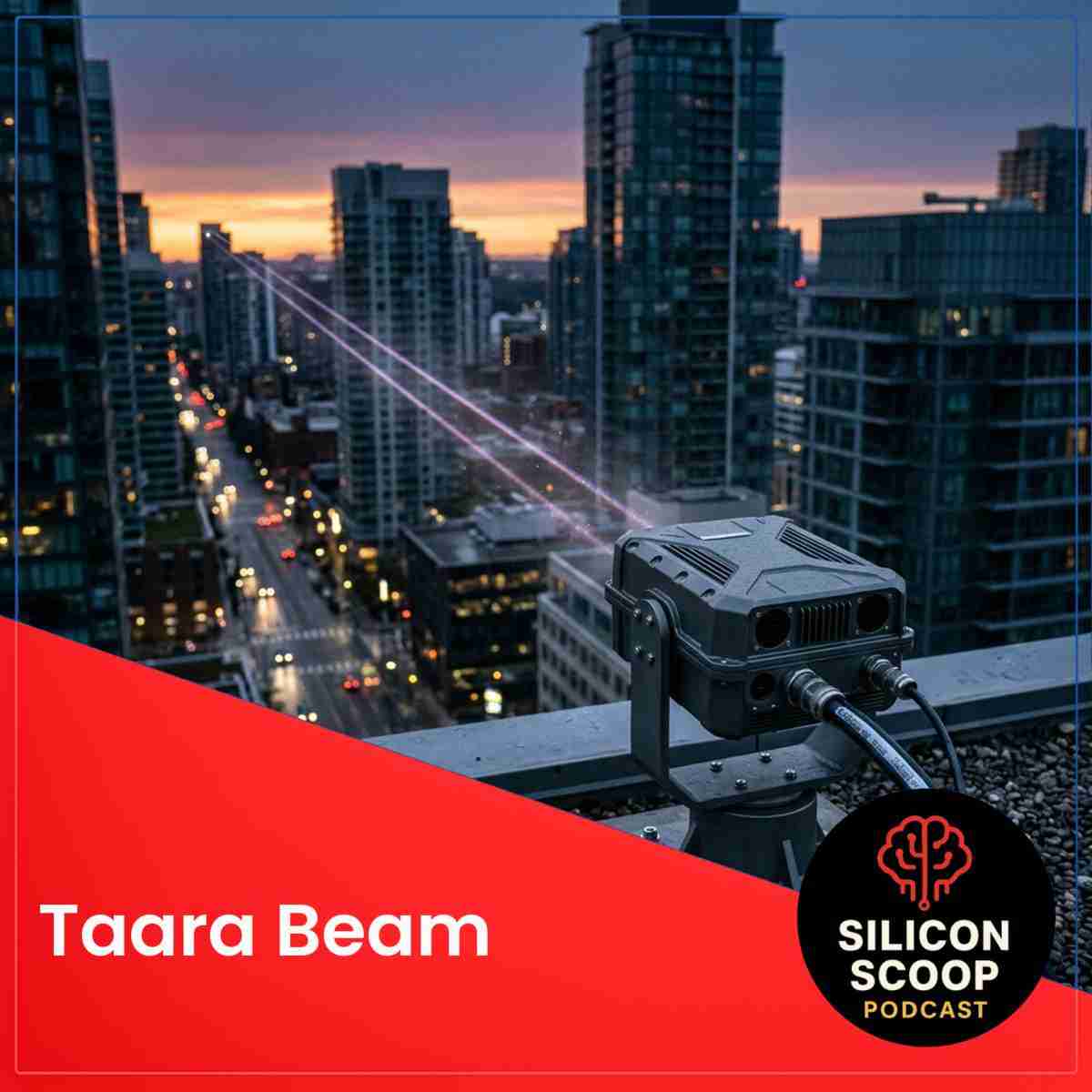
Taara Beam: The 25Gbps Light-Based Internet Device Changing Middle-Mile Broadband in 2026
Estimated reading time: 10 minutes
Key Takeaways
- The Taara Beam uses beams of near-infrared light to deliver up to 25Gbps of internet speed over distances of up to 10 kilometers.
- It can be deployed without digging trenches, buying spectrum licenses, or waiting months for permits.
- The device is built on the Taara Photonics Platform using an optical phased array with more than 1,000 miniature light emitters on a silicon chip.
- Taara sells primarily to ISPs and carriers for middle-mile broadband and enterprise backhaul use cases.
- Weather sensitivity (fog, heavy rain, particulate matter) remains the biggest challenge for free-space optical systems.
Table of contents
- Taara Beam: The 25Gbps Light-Based Internet Device Changing Middle-Mile Broadband in 2026
- Introduction
- What Is the Taara Beam? A New Era of 25Gbps Internet
- How Taara Beam Deployment Works — No Trenching, No Spectrum Licensing
- ⚡ Stop Losing Hours to Repeat Work
- The Silicon Photonics Platform Behind the Taara Beam
- Taara Beam vs. Starlink: Different Products, Different Problems
- Weather Sensitivity and the Uptime Challenge
- Global Deployment and Key Partners
- Why Middle-Mile Broadband Matters More Than Ever in 2026
- FAQ: 10 Questions About the Taara Beam Answered
- Final Thoughts
Introduction
The Taara Beam is making waves in the world of high-speed connectivity. This compact device uses beams of near-infrared light to deliver up to 25Gbps of internet speed over distances of up to 10 kilometers — without digging trenches, buying spectrum licenses, or waiting months for permits.
Taara, a startup that grew out of Alphabet’s moonshot lab X, has been quietly building toward this moment. Their new Beam device is faster, smaller, and smarter than anything they have released before. And it could change how internet service providers, carriers, and enterprises think about middle-mile broadband infrastructure.
This post breaks down exactly what the Taara Beam is, how it works, what it costs to deploy, and why it matters for the future of internet connectivity in 2026 and beyond.
What Is the Taara Beam? A New Era of 25Gbps Internet
The Taara Beam is the company’s first commercial product built on the Taara Photonics Platform. This platform uses an optical phased array with more than 1,000 miniature light emitters packed onto a single silicon chip. That is the heart of what makes this device so different from traditional wireless or fiber solutions.
Key Specs at a Glance
- Speed: Up to 25Gbps bidirectional throughput
- Range: Up to 10 kilometers (6.2 miles)
- Weight: 17 pounds (approximately 8 kg)
- Form Factor: Roughly shoebox-sized
- Latency: Approximately 50 to under 100 microseconds
- Light Type: Near-infrared (invisible to the human eye)
The device can be mounted on:
- Rooftops
- Cell towers
- Poles
- Opposite sides of buildings
- Existing infrastructure of almost any kind
How It Compares to the Previous Model
Taara’s earlier device, the Lightbridge, delivered up to 20Gbps over a range of up to 20 kilometers and weighed nearly 29 pounds. The new Taara Beam is lighter, more compact, and built on a more advanced silicon photonics foundation.
The trade-off is range — 10 km versus 20 km — but for urban and enterprise use cases, 10 km is more than enough. The gains in size, weight, and deployability make the Beam a far more practical solution for dense city environments.
The core innovation here is silicon photonics, the technology that miniaturizes optical functions onto a chip the same way traditional processors miniaturize computing. This is what allows Taara to shrink a complex optical wireless system into a device you can carry in two hands.
Sources:
- new device from Starlink rival Taara promises 25Gbps internet using light
- introducing the light generation
- Taara Beam provides 25Gbps connectivity over invisible beams of light
How Taara Beam Deployment Works — No Trenching, No Spectrum Licensing
One of the biggest selling points of the Taara Beam is how fast and cheap it is to deploy compared to traditional fiber or licensed wireless links.
What You Do NOT Need
- ❌ Trenching fiber cables underground
- ❌ Licensed radio spectrum
- ❌ Right-of-way permits
- ❌ Months of regulatory waiting
What You DO Get
- ✅ Installation in hours, not weeks or months
- ✅ Deployment on existing poles, towers, or rooftops
- ✅ High-speed optical wireless backhaul
- ✅ Line-of-sight connectivity at fiber-like speeds
This is a massive advantage in cities where underground infrastructure is expensive and slow to build. It is also a game changer in developing regions where laying physical cables across long distances is simply not feasible.
Target Use Cases for Optical Wireless Backhaul
- Urban rooftops needing fast point-to-point links
- Enterprise campuses requiring secure, high-bandwidth connections between buildings
- Data center clusters that need dense, low-latency interconnects
- Event venues needing temporary but powerful connectivity
- Carrier middle-mile links to extend fiber networks without digging
Taara sells primarily to ISPs and carriers, not directly to consumers. Think of it as the invisible fiber running between major network nodes — the backbone that feeds the last mile to homes and businesses.
The policy backdrop matters here too. The Infrastructure Investment and Jobs Act includes $1 billion in competitive grants for middle-mile broadband projects. Technology-neutral language in that program means optical wireless systems like the Taara Beam could qualify alongside traditional fiber builds — especially when trenching is too slow or expensive.
Sources:
- introducing the light generation
- Taara launches photonics communications platform
- new device from Starlink rival Taara promises 25Gbps internet using light
⚡ Stop Losing Hours to Repeat Work
If your team lives in spreadsheets, inboxes, and copy-paste, you don’t need more hustle — you need automation. We map your workflow, remove manual steps, and free up time to sell, ship, and scale.
Book a free automation consult
The Silicon Photonics Platform Behind the Taara Beam
To understand why the Taara Beam matters, you need to understand the Taara Photonics Platform it is built on.
What Is an Optical Phased Array?
An optical phased array is a grid of tiny light emitters on a chip that can steer a beam of light electronically — no moving parts. The Taara Beam uses more than 1,000 of these miniature emitters on a single silicon chip to aim, focus, and maintain a near-infrared light beam at a distant receiver.
This is fundamentally different from how older free-space optical (FSO) systems worked. Traditional FSO devices used mechanical mirrors or gimbals to point the beam. That added weight, complexity, and failure points.
With a silicon photonics approach:
- The beam is steered electronically at the chip level
- The device is smaller and more reliable
- Manufacturing can scale like semiconductor production
- Costs can drop significantly over time as volume increases
Why Silicon Photonics Changes the Economics
Silicon photonics is the same manufacturing process used for computer chips. That means:
- Lower unit costs as production scales
- Tighter integration of optical and electronic functions
- Faster iteration on performance improvements
- Broader availability through existing chip supply chains
This is not just a faster version of old tech. It is a platform shift — one that puts Taara in a very different competitive position than legacy FSO vendors.
Sources:
Taara Beam vs. Starlink: Different Products, Different Problems
Headlines often frame Taara as a “Starlink rival.” That comparison is technically accurate but strategically misleading. These two products solve very different problems.
Starlink
- Delivers internet directly to end consumers via satellites in low Earth orbit
- Covers areas where no ground infrastructure exists
- Speeds typically range from 50 Mbps to 300 Mbps for residential users
- Higher latency than fiber (20–40 ms for Starlink Gen 2)
- Requires a dish at the customer’s location
Taara Beam
- Delivers middle-mile backhaul between network nodes
- Works in urban and semi-urban environments with line-of-sight
- Delivers up to 25Gbps — roughly 100x faster than typical Starlink
- Latency as low as 50 microseconds — far lower than satellite
- Targets ISPs, carriers, and enterprises
The real competition for the Taara Beam is licensed microwave backhaul, dark fiber leases, and traditional FSO systems — not consumer satellite dishes.
Where Starlink fills coverage gaps for end users in rural areas, the Taara Beam fills speed and cost gaps for network operators trying to extend high-capacity infrastructure in cities and dense corridors.
Industry analysts broadly agree that Taara is a serious middle-mile and enterprise connectivity play, with real advantages in line-of-sight speed, ultra-low latency, and fast deployment timelines.
Sources:
- new device from Starlink rival Taara promises 25Gbps internet using light
- Taara Beam provides 25Gbps connectivity over invisible beams of light
Weather Sensitivity and the Uptime Challenge
No technology is perfect. The biggest challenge for the Taara Beam — and for free-space optical systems generally — is weather sensitivity.
Near-infrared light travels through air beautifully in clear conditions. But fog, heavy rain, and particulate matter can scatter or absorb the light beam, degrading performance or breaking the link entirely.
How Taara Addresses This
Taara’s Lightbridge Pro system promises “99.999%” uptime — the so-called “five nines” standard used by carriers and enterprise networks. This is achieved through a combination of:
- Adaptive beam control that compensates for atmospheric distortion
- Diversity routing that can switch paths when one link degrades
- Link monitoring that detects degradation before it causes outages
The 99.999% uptime claim means less than 5.26 minutes of downtime per year. That is a carrier-grade reliability target — and if Taara can consistently hit it in real deployments across diverse climates, weather sensitivity becomes a manageable risk rather than a deal-breaker.
It is also worth noting that for many urban environments — where buildings are within 1–3 km of each other — shorter link distances make atmospheric interference much less of a factor.
Sources:
- new device from Starlink rival Taara promises 25Gbps internet using light
- introducing the light generation
Global Deployment and Key Partners
Taara is not starting from zero. Their earlier Lightbridge technology has already been deployed in more than 20 countries, giving the company real-world operational data and established carrier relationships.
Current Partner Network
Key partners already working with Taara include:
- T-Mobile — Major US carrier with dense urban infrastructure needs
- SoftBank — Japanese telecom giant expanding capacity in Asia
- Airtel — One of Africa and South Asia’s largest telecoms
- Digicel — Caribbean and Pacific Island carrier serving remote markets
This roster is significant. These are not small pilots. These are global carriers actively using optical wireless backhaul in live networks.
The combination of a new, more powerful device (Taara Beam) and an established global footprint puts Taara in a strong position to expand network density and flexibility well beyond its current deployment base.
Pricing Structure
Taara offers both:
- Hardware purchase models
- Connectivity-as-a-service models
Pricing varies by geography and use case. The service model is particularly attractive for smaller ISPs and operators who want to avoid large upfront capital costs and instead pay for capacity as they use it.
Taara also plans to showcase new technology at MWC in Barcelona, targeting enterprise customers and expanding its carrier pipeline.
Sources:
- new device from Starlink rival Taara promises 25Gbps internet using light
- introducing the light generation
- Taara Beam provides 25Gbps connectivity over invisible beams of light
Why Middle-Mile Broadband Matters More Than Ever in 2026
The internet’s weakest link is often not the last mile to homes — it is the middle mile connecting local distribution networks to the core internet backbone.
Middle-mile infrastructure is expensive, slow to build with fiber, and often controlled by a small number of large carriers. This creates bottlenecks and raises costs for smaller ISPs trying to serve communities.
Where Taara Beam Fits in the Middle-Mile Picture
The Taara Beam is purpose-built for middle-mile broadband use cases:
- Extending fiber reach without laying new cable
- Connecting underserved communities that are close to fiber nodes but expensive to trench to
- Bridging data centers across a city campus at fiber speeds
- Creating redundant paths for critical network infrastructure
The Infrastructure Investment and Jobs Act created $1 billion in competitive middle-mile grants. Because the program is technology-neutral, optical wireless links qualify alongside traditional fiber builds. For network operators evaluating how to spend those grant dollars, a device that deploys in hours at carrier-grade speeds is extremely attractive.
For communities and regions where trenching fiber takes years and costs millions, the Taara Beam represents a way to get gigabit-class connectivity infrastructure in place today rather than waiting.
Sources:
FAQ: 10 Questions About the Taara Beam Answered
1. What is the Taara Beam?
The Taara Beam is a compact optical wireless device that uses near-infrared light to transmit internet data at speeds up to 25Gbps over distances of up to 10 kilometers. It is built on the Taara Photonics Platform and uses a silicon chip with more than 1,000 light emitters.
2. How fast is the Taara Beam?
The Taara Beam delivers up to 25Gbps of bidirectional throughput. Latency is between 50 and 100 microseconds depending on conditions, which is faster than most fiber connections and far faster than satellite internet.
3. How far can the Taara Beam reach?
The Taara Beam has a range of up to 10 kilometers (about 6.2 miles). Its predecessor, the Lightbridge, reached up to 20 kilometers but was heavier and larger.
4. How hard is the Taara Beam to install?
Installation takes hours, not days or weeks. It mounts on existing infrastructure like rooftops, poles, or cell towers. No trenching, no spectrum licensing, and no right-of-way permits are needed.
5. Does weather affect the Taara Beam?
Yes. Fog, heavy rain, and other atmospheric conditions can disrupt light-based signals. Taara’s Lightbridge Pro system addresses this with carrier-grade engineering and claims “99.999%” uptime even in bad weather.
6. Who can buy the Taara Beam?
The Taara Beam is sold to ISPs, carriers, and enterprise customers — not directly to consumers. If you are an internet service provider or business with high-capacity connectivity needs, this is the product for you.
7. Is the Taara Beam a competitor to Starlink?
Only loosely. Starlink connects end consumers via satellites. The Taara Beam delivers high-capacity middle-mile backhaul between network nodes. They serve different parts of the internet delivery chain.
8. What is silicon photonics and why does it matter here?
Silicon photonics uses standard chip manufacturing to build optical functions on a silicon chip. This allows Taara to shrink complex optical wireless hardware into a small, lightweight, and affordable device that can improve over time as chip technology advances.
9. Where is Taara’s technology already deployed?
Taara’s earlier Lightbridge product is deployed in more than 20 countries. Partners include T-Mobile, SoftBank, Airtel, and Digicel — all major carriers with active networks.
10. How does Taara price its products?
Taara offers both hardware purchase and connectivity-as-a-service models. Pricing varies by region and use case. The service model allows smaller operators to access high-speed capacity without large upfront hardware costs.
Final Thoughts
The Taara Beam is not just a gadget. It is a signal that optical wireless technology has matured enough to compete seriously with fiber and licensed spectrum for middle-mile and enterprise connectivity.
Its combination of 25Gbps speeds, near-zero deployment friction, a proven global partner network, and a silicon photonics foundation makes it one of the most technically interesting connectivity products of 2026.
For ISPs, carriers, and enterprises trying to expand high-capacity infrastructure quickly and affordably — especially in dense urban areas or regions where trenching fiber is impractical — the Taara Beam deserves serious attention.
The broader shift toward technology-neutral middle-mile broadband policy and the growing demand for data-center interconnect capacity only strengthen Taara’s position as the market evolves.
Sources:
Additional Links
Flowgrammer.ca – 💡 Unlock AI-Powered Automation! Let flowgrammer.ca handle complex workflows so you can focus on growing your business.
Flowgrammers.ca – 💡 Join Toronto’s Fastest Growing AI and Business Automation Community.
- SRED Funding Solutions – Maximize your R&D tax credits and secure funding for your innovation.
- Silicon Scoop Podcast – Stay Informed, Stay Ahead!
- Startup Talk Podcast
- Flowgrammer Youtube
- Startup Investor Drinks – Join Toronto’s Startup Community and connect with fellow startup enthusiasts and investors.
- TorontoStarts Startup and Entrepreneur Community – Become a part of Toronto’s thriving startup ecosystem.
- Workhaus – Discover flexible workspace solutions for your business needs.
- Work with The Startup Coach – Get expert guidance and mentorship for your startup journey.
- Reach out to Jon Irwin on LinkedIn – Connect with our co-host and technology expert.
Episode transcript
Read the full transcript
Craig: we've been told for decades that the only way to get gigabit internet is to dig up our streets, but a stealthy alphabet spin out just changed the math entirely. if you think fiber optic cables are the final frontier bandwidth, wait until you see what happens when they untethered them and shoot 25 gigabits straight through thin air. so invisible light replaces digging fiber. so alphabet's x spin out, terra, has launched a terrabeam, a shoebox sized device that uses near infrared light to blast 25 gigabit bidirectional internet up to 10 kilometers. it completely bypasses the need for underground trenching or expensive wireless spectrum licensing. this effectively democratized internet backhaul, turning any rooftop or cell tower into a high capacity data hub in hours instead of months. what do you think about this, john?
Jon: i think this is awesome. and i know it's it's often compared to sterling, but the two technologies, they solve different networking problems. and they actually may complement each other rather than directly compete. so at its core, tara uses technology known as fso or free space optical communication. so in traditional fiber networks, data travels through glass fibers as pulses of light. tara removes the fiber and transmits those same optical signals directly through the atmosphere. and so the breakthrough actually comes from tara's new silicon photonic platform. so earlier versions of the technology such as the light bridge system relied on mirrors, sensors, and mechanical systems to physically aim laser beams, freaking laser beams, at receiving stations. the new tara beam replaces much of that mechanical complexity with a photonic chip that electronically steers the beam using software. so this transition from mechanically rotating radar dishes to phased array radar systems is the game changer here. so the photonic chip contains more than a thousand miniature optical emitters that can dynamically shape and direct the beam without moving parts. and so this reduces maintenance requirements and improves reliability and dramatically shrinks the size of the device. so the original lightbridge i don't know if you have a picture of it, but it was roughly the size of a traffic signal. those are huge. and so this new system, it's been miniaturized as something closer to a fingernail sized chip. so why 2.5 gigahertz or gigabits per second? so typical home broadband is between a 100 megabits to one gigabit, sometimes faster. starlink, between 50 to 300 megabits. enterprise fiber, one to 10 gigabits. and so tarabeam's has tarabeam has a 25 gigabit bidirectional throughput. and it also boasts latency measured around a hundred microseconds, which is orders of magnitude lower than satellite internet. so it's not a starlink killer. it's more of a, it's more of a last, it's more of like a last mile connectivity kind of thing, if that makes sense.
Craig: or even more. yeah. like, i work for some big corporations, and we had to lay dark fiber between buildings downtown. and dark fiber is fiber you own, and no one else taps into it. it's not shared internet or whatever. we connected to buildings in the downtown core, and using something like this would be so much easier. so think of this update like trading in your city's underground plumbing system for a high powered water cannon on the rooftops. instead of spending millions of dollars in six months tearing up pavement, just lay a single pipe from point a to point b and just place a digital water cannon on one roof, point it direct, perfect. we add a funnel on the other roof miles away and it blast data through the air instantly. so this is available now and, being able to do what i call, like, city wide networks kind of thing where you can start connecting and what they're doing is last back hauling and whatnot. so
Jon: yeah.
Craig: this could be used by enterprises, by businesses, and any sort of internet providers trying to do back calling. this speed is great, and we're still limited by, sight. so, like, i don't think it's can be obstructed, with these point to point connections. so, in order to get this kind of speed and whatnot, the near infrared light frequency used here is entirely visible to the human eye, meaning these device are quietly blanketing urban skies with massive data pipelines without contributing to visual or electromagnetic pollution. you'll start to see these smaller boxes appearing on those towers you see on top of, high rises and whatnot, and think about a cable comp
Jon: my question is how secure is this?
Craig: well, it's point to point. so when you say how secure it is, something's gonna have to get right in the middle to capture the beam. and, usually, if it's capturing the beam, the beam will be disrupted at the other end. so i but think about this? instead of a cable company when a new building is formed or they switch contractors to supply cable to, a building, internet, whatnot, they're usually one contractor. they just have to put something on the roof now and beam it to it instead of digging up all this stuff and fiber that and then, you know, down. it becomes much easier to deploy these kinds of things. so you'll probably get better competition in these towers and whatnot now since it's easier to deploy and people don't have to have exclusive contracts to, build all the hardware in order to get the return on investment. yeah. tara didn't just spawn out of nowhere. it's a, graduate of alphabet x, formerly known as google x, the exact same moonshot factory that incubated waymo self driving cars and verily life sciences. despite being cutting edge, its massive global rollout includes major deployments by telecoms like airtel, digicel across developing regions like africa, south asia, and remote pacific islands, proving the moonshot tech is scaling faster, in emerging markets than in some western capital. so, you know, we'll have to see. the tara beam is proof that the future of infrastructure isn't buried in the dirt. it's flying right over our heads. chat, if your neighborhood isp could instantly 10 x your speed, but the connection dipped for five minutes a year during heavy fog, would you take that deal or stick to your steady copper? drop your thoughts in the chat below and let us know.
More from Silicon Scoop
All episodes
silicon-scoop · October 16, 2026
Meta’s $18 Billion Teen Safety Settlement: Soft Guardrails, Hard Leverage Over TikTok and YouTube
Deep dive on Meta teen safety settlement, social media addiction lawsuit, new Facebook Instagram time limits and pressure on TikTok YouTube age verification.
View episode

silicon-scoop · October 15, 2026
How Claude Mythos Is Reshaping Cryptanalysis: HAWK, AES and the Rise of AI-Driven Crypto Research
Claude Mythos cryptanalysis weakens HAWK post-quantum signature, speeds AES Möbius Bridge attack, and powers CryptanalysisBench benchmark in AI-driven crypto research.
View episode

silicon-scoop · October 14, 2026
Nvidia’s $12.9 Billion Hugging Face Bet: How Controlling the Open-Source Model Hub Reshapes AI Chips, Cloud, And Competition
Nvidia Hugging Face acquisition could reshape open source AI models, AI chip dominance, and the global developer model hub, raising antitrust and neutrality questions.
View episode