
Self-healing Composites Just Made FRP Last Longer
Self-healing Composites Just Made FRP Last Longer https://torontostarts.com/2026/08/07/self-healing-composite-frp/ Flowgrammer.ca -> https://flowgrammer.ca/ AI News and Resources -> https://flowgrammers.ca OpenClaw Toronto -> https://openclawto.com/ Stop Losing Hours to Manual Busywork Automate quoting, follow-ups, reporting, and handoffs so your team ships more without hiring more. Book a free automation consult https://flowgrammer.ca Startup Investor Drinks Toronto - https://startupdrinksto.com/ Toronto’s Startup Community - https://torontostarts.com/ Silicon Scoop Silicon Scoop Podcast - https://torontostarts.com/silicon-scoop/ Apple: https://podcasts.apple.com/us/podcast/silicon-scoop/id1758711826 Spotify: https://open.spotify.com/show/5bAzF0MwV6TtLhJAhvHayI YouTube: https://www.youtube.com/playlist?list=PLj4v-RoA7A-gT62vrEYqh1zCv-0Hj-o5J Startup Talk Startup Talk Podcast -> https://torontostarts.com/startup-talk-toronto-startup-podcast/ Apple -> https://podcasts.apple.com/us/podcast/startup-talk/id1763804003 Spotify -> https://open.spotify.com/show/1siJMILILidHAiAsrX2VBU YouTube: https://youtube.com/playlist?list=PLj4v-RoA7A-jxV5FHs5e61oIsuvUJYmT_&si=LYegRe5GYLKNQ7xL
With Craig Major and Jon Irwin
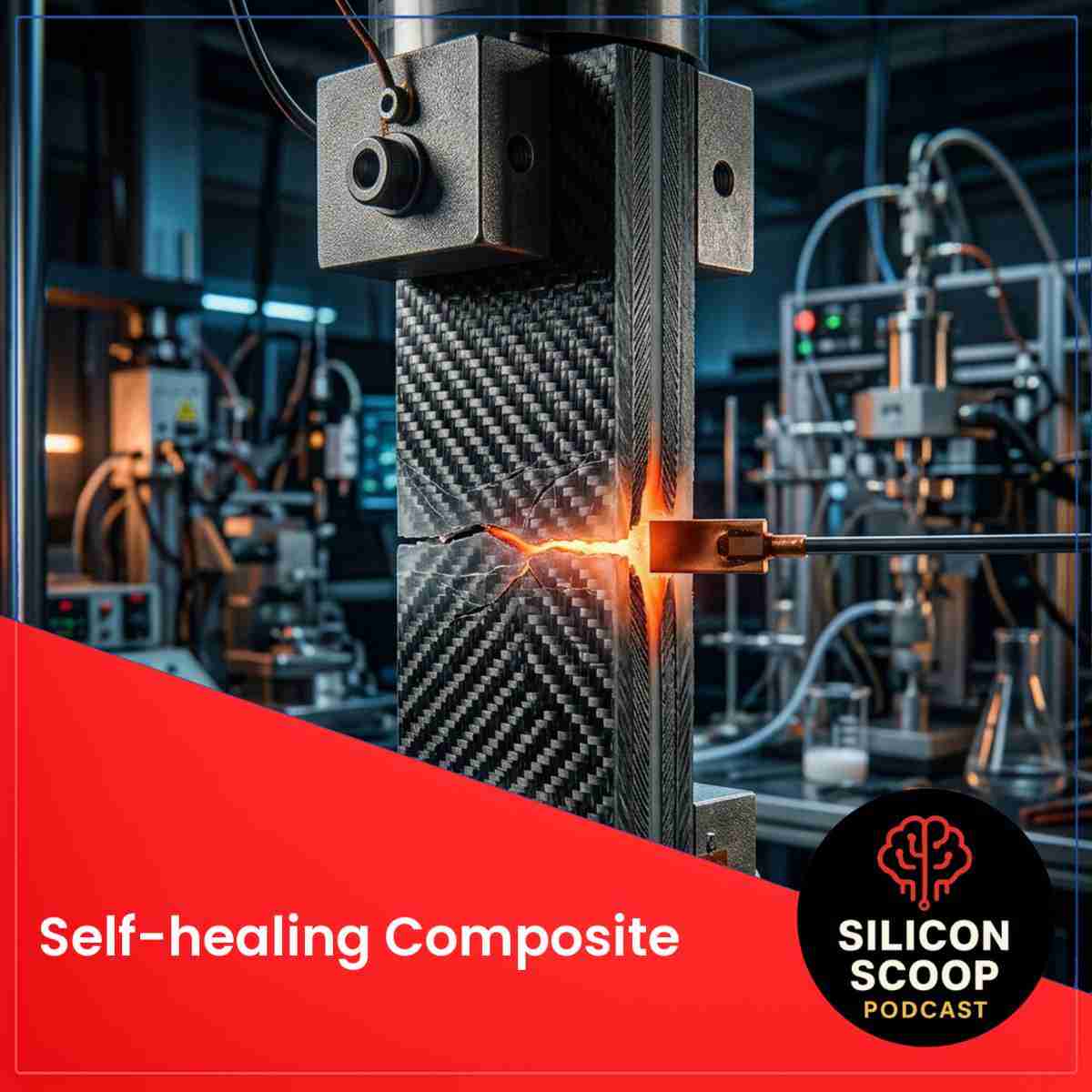
Self-Healing Composite Could Let Machines Last for Centuries
Estimated reading time: 8 minutes
Key Takeaways
- Researchers at North Carolina State University have built a self-healing composite that can repair itself more than 1,000 times.
- The material is a fiber-reinforced polymer (FRP) composite designed to address delamination.
- The system uses a thermoplastic healing substance called poly(ethylene-co-methacrylic acid), or EMAA, and carbon-based layers that heat up when electricity passes through them.
- Testing and modelling suggest a projected lifespan of 125 years with quarterly healing and 500 years with annual healing.
- The technology is protected under US Patent 11,613,088 B2 and is moving toward commercialisation through Structeryx Inc.
Table of contents
- Self-Healing Composite Could Let Machines Last for Centuries
- Key Takeaways
- NC State’s Fiber-Reinforced Polymer Breakthrough Changes Everything We Know About Durability
- What Is the Self-Healing Composite and How Does It Work?
- The Numbers Behind the Composite Lifespan and 1,000-Cycle Repairability
- Why This Matters: Industry Impact and Lifecycle Cost Savings
- Stop Losing Hours to Manual Busywork
- Structeryx and the Path to Commercial Self-Healing Composites
- What Comes Next for Self-Healing FRP Technology
- Frequently Asked Questions: Self-Healing Composite and FRP Technology
NC State’s Fiber-Reinforced Polymer Breakthrough Changes Everything We Know About Durability
What if a machine could fix itself — over and over again — for 500 years?
That is no longer just a science fiction idea. Researchers at North Carolina State University have built a self-healing composite that can repair itself more than 1,000 times. It is tougher than standard materials. It can last centuries. And it could change how we build everything from wind turbines to spacecraft.
Here is what you need to know.
What Is the Self-Healing Composite and How Does It Work?
The material is called a fiber-reinforced polymer (FRP) composite. FRP composites are already used everywhere — in airplanes, wind turbine blades, cars, and bridges. They are light, strong, and tough.
But they have one big problem: delamination.
Delamination is when the inner layers of the composite start to split apart. Over time, tiny cracks form between the fiber layers and the surrounding matrix material. These cracks grow. The material weakens. Eventually, you need to replace the whole component.
That replacement is expensive. It takes time. And in some places — like a satellite in orbit or a probe on another planet — replacement is simply impossible.
The NC State team, led by PhD candidates Jack Turicek and Zach Phillips alongside Dr. Kalyana Nakshatrala, solved this problem. Their research was published in the Proceedings of the National Academy of Sciences under the title “Self-healing for the Long Haul: In situ Automation Delivers Century-scale Fracture Recovery in Structural Composites.”
The Healing Mechanism — How Delamination Repair Actually Happens
The self-healing system works in a very clever way:
- A thermoplastic healing substance — specifically a polymer called poly(ethylene-co-methacrylic acid), or EMAA — is 3D-printed as a thin interlayer directly onto the fiber reinforcement during manufacturing.
- Carbon-based layers are woven into the composite structure. When electricity passes through these layers, they heat up.
- That heat causes the EMAA thermoplastic to melt and flow into any cracks or delaminated gaps.
- The melted material seeps into the fissures and re-bonds the separated layers, essentially gluing the composite back together from the inside.
- No human hands are needed. No disassembly. No replacement parts. The structure heals in situ — while still in place and in service.
This in-situ repair capability is what makes the technology so valuable. The component does not need to be removed from service to be fixed. That changes the entire maintenance equation for industries that rely on hard-to-reach or impossible-to-reach structures.
The research was funded in part by SERDP grant W912HQ21C0044 and NSF grant 2137100, showing strong institutional backing for the development.
Sources:
– news.ncsu.edu
– pnas.org
The Numbers Behind the Composite Lifespan and 1,000-Cycle Repairability
The test results are extraordinary. Let’s look at the hard data.
Strength Improvements
The Structeryx FRP composite — the commercialized name for this material, tied to Structeryx Inc., a company founded to bring this technology to market — delivers:
- 2x to 4x greater resistance to delamination compared to conventional fiber-reinforced polymer composites
- Healing performance that starts at 175% of plain composite fracture resistance and stabilises above 60% of baseline even after extreme repeated cycling
- A Weibull statistical model confirming an asymptotic healing limit above 40%, meaning the material never fully degrades to zero — it retains functional toughness indefinitely
Cycle Testing Results
The automated testing pushed the material hard:
- Over 1,000 fracture-and-heal cycles completed in just 40 days
- A standardised 50 mm delamination crack was introduced and healed repeatedly during testing
- Performance exceeded all previous records for self-repairing structural composites
- The composite resisted cracking better than conventional alternatives for at least 500 cycles — shattering what was previously thought possible
Projected Composite Lifespan
Here is where the numbers get truly remarkable:
| Healing Frequency | Projected Lifespan |
|---|---|
| Once per season (quarterly) | 125 years |
| Once per year (annually) | 500 years |
To put that in perspective: a wind turbine blade healed four times a year could outlast the great-great-great-grandchildren of the engineer who built it.
The technology is protected under US Patent 11,613,088 B2, and corresponding author Jason Patrick, associate professor at NC State, has already patented and licensed the technology — signalling a clear and active commercialisation pathway.
Sources:
– compositesworld.com
– eurekalert.org
– pnas.org
Why This Matters: Industry Impact and Lifecycle Cost Savings
Professor Jason Patrick, the corresponding author on the PNAS paper, put the business case plainly:
“This innovation will significantly drive down costs and labor associated with replacing damaged composite components, and reduce the amount of energy consumed and waste produced by many industrial sectors.”
That is not just a scientific achievement. It is a maintenance economics revolution.
Industries That Benefit From Self-Repairing FRP
Wind Energy
Wind turbine blades are among the largest FRP composite structures in the world. They are exposed to constant stress, UV radiation, and weather extremes. Blade repair and replacement is one of the biggest costs in wind energy operations. A blade that heals itself quarterly for 125 years makes wind energy dramatically cheaper to operate.
Aerospace
Aircraft fuselages, wings, and structural panels use FRP composites heavily. Composite damage inspection and repair grounds aircraft, costs money, and creates downtime. In-situ self-repair without removing the component changes everything about how airlines and defence contractors manage fleet maintenance.
Space and Interplanetary Missions
This is perhaps the most exciting application. Space probes, satellites, and future crewed spacecraft operate in environments where no repair crew can reach them. A structure that autonomously heals delamination and fractures over hundreds of cycles — without any human intervention — could be the difference between a mission lasting decades and one that fails prematurely. For interplanetary landers or deep-space probes, self-repairing composites are not just convenient. They are mission-critical.
Automotive and Infrastructure
Cars, bridges, marine vessels, and industrial machinery built with FRP composites could see dramatically extended service lives, lower maintenance overhead, and reduced material waste.
Environmental and Ecological Benefits
Longer-lasting materials mean:
- Less raw material consumption over time
- Less manufacturing energy spent producing replacement parts
- Less waste going to landfills when composite components fail
- Lower carbon footprint per unit of infrastructure over a century-long lifecycle
The ecological argument for self-healing composites is just as strong as the economic one.
Sources:
– news.ncsu.edu
– compositesworld.com
Stop Losing Hours to Manual Busywork
Your team is spending time on tasks that should already be automated.
Quoting, follow-ups, reporting, handoffs — these are not high-value activities. They are friction. And that friction is costing you hours every single week.
Flowgrammer helps teams automate the repetitive work so your people can focus on what actually moves the needle. No new hires needed. Just smarter systems.
👉 Book a free automation consult at flowgrammer.ca
Structeryx and the Path to Commercial Self-Healing Composites
The technology is not sitting in a university lab waiting for something to happen. It is already moving toward real-world deployment.
Structeryx Inc. is the commercial vehicle for this technology. The company is built around the patented Structeryx FRP composite system, giving it a direct pathway to licensing and manufacturing deals with aerospace suppliers, wind energy manufacturers, and defence contractors.
Key commercialisation signals include:
- US Patent 11,613,088 B2 — already granted, not just pending
- Jason Patrick has already licensed the technology, not just filed for protection
- PNAS publication gives the research maximum scientific credibility
- Federal grant funding from SERDP (a defence-focused environmental research program) suggests military and defence interest in the material
The SERDP connection is particularly telling. Defence applications — aircraft, naval vessels, military infrastructure — demand extreme reliability in environments where maintenance access is limited. A self-healing composite that can repair itself in the field, without disassembly, directly addresses one of the biggest pain points in defence logistics.
Sources:
– news.ncsu.edu
– pnas.org
What Comes Next for Self-Healing FRP Technology
The current research establishes the foundation. Here is what the next phase of development likely looks like:
Scaling manufacturing: 3D-printing EMAA interlayers onto large-scale composite structures — like full-size turbine blades or aircraft panels — will require manufacturing process refinement.
Integrating smart sensors: Pairing the self-healing mechanism with embedded damage-detection sensors would allow the material to detect a crack and trigger healing autonomously, without any manual inspection.
Expanding the chemistry: EMAA is the healing agent used in this research. Future work may identify alternative thermoplastic agents with different melting points, viscosities, or chemical compatibility for specific use environments — including the extreme cold of deep space or the heat of re-entry vehicles.
Regulatory approval pathways: Aerospace and defence applications require extensive certification. Getting self-healing FRP composites into flight-certified structures will take time, but the PNAS publication and patent protection are the right first steps.
The trajectory is clear. This material will find its way into critical infrastructure. The question is not whether self-healing composites will become standard — it is how quickly.
Sources:
– eurekalert.org
– compositesworld.com
Frequently Asked Questions: Self-Healing Composite and FRP Technology
1. What is a self-healing composite?
A self-healing composite is a material that can automatically repair internal damage — like cracks or delamination — without needing to be removed from service or manually fixed. The NC State version uses heat-activated thermoplastic that melts into cracks and re-bonds separated layers.
2. What does delamination mean in fiber-reinforced polymers?
Delamination is when the internal layers of a composite material begin to separate. It weakens the structure over time. In standard FRP composites, delamination usually means the component needs to be repaired or replaced. In the Structeryx composite, it triggers an automatic healing response.
3. How many times can the NC State composite heal itself?
The composite completed over 1,000 fracture-and-heal cycles during automated testing — all within 40 days. That is significantly more than any previous self-repairing structural composite on record.
4. How long can this self-healing composite last?
Testing and modelling suggest that with quarterly healing, the material can last 125 years. With annual healing, the projected lifespan reaches 500 years.
5. What is EMAA and why is it used as the healing agent?
EMAA stands for poly(ethylene-co-methacrylic acid). It is a thermoplastic polymer that melts at relatively low temperatures. When the carbon-based layers in the composite heat up, EMAA melts and flows into cracks, re-bonding the structure. It was chosen for its healing efficiency and compatibility with the composite architecture.
6. Is this technology already patented and for sale?
Yes. The technology is protected under US Patent 11,613,088 B2. It has been licensed through Structeryx Inc., the company built to commercialise this innovation. It is not yet in mass production but is actively moving through the commercialisation pipeline.
7. What industries will benefit most from self-healing FRP composites?
The primary industries include wind energy (turbine blades), aerospace (aircraft structures), space exploration (probes, satellites, spacecraft), automotive, marine, and defence. Any application where FRP composites are used and maintenance is expensive, difficult, or impossible is a strong candidate.
8. Why is in-situ repair such a big deal?
In-situ repair means the component heals while still installed and in service. You do not have to shut down the machine, remove the component, send it to a workshop, and reinstall it. That eliminates enormous amounts of downtime, labour cost, and logistical complexity — especially for wind turbines, aircraft, and spacecraft.
9. Who funded the NC State self-healing composite research?
The research received funding from SERDP grant W912HQ21C0044 — a Department of Defense environmental research program — and NSF grant 2137100 from the National Science Foundation. Both are prestigious and competitive funding sources.
10. Where can I read the original research paper?
The full study is published in the Proceedings of the National Academy of Sciences and is available at: https://doi.org/10.1073/pnas.2523447123. The NC State press release is available at: https://news.ncsu.edu/2026/01/healing-composite-lasts-centuries/
Published June 2026 | Sources: NC State University, PNAS, Composites World, EurekAlert
Additional Links
Flowgrammer.ca – 💡 Unlock AI-Powered Automation! Let flowgrammer.ca handle complex workflows so you can focus on growing your business.
Flowgrammers.ca – 💡 Join Toronto’s Fastest Growing AI and Business Automation Community.
- SRED Funding Solutions – Maximize your R&D tax credits and secure funding for your innovation.
- Silicon Scoop Podcast – Stay Informed, Stay Ahead!
- Startup Talk Podcast
- Flowgrammer Youtube
- Startup Investor Drinks – Join Toronto’s Startup Community and connect with fellow startup enthusiasts and investors.
- TorontoStarts Startup and Entrepreneur Community – Become a part of Toronto’s thriving startup ecosystem.
- Workhaus – Discover flexible workspace solutions for your business needs.
- Work with The Startup Coach – Get expert guidance and mentorship for your startup journey.
- Reach out to Jon Irwin on LinkedIn – Connect with our co-host and technology expert.
Episode transcript
Read the full transcript
Craig: imagine a wind turbine or a deep space okay. i'll start again. imagine a wind turbine or a deep space probe that fixes its own structural cracks without a single human lifting a finger. north carolina state university research just built a self healing material that repairs itself over a thousand times, pushing mechanical lifespans to an unbelievable five hundred years. so self healing materials, last five hundred years now. the scientists have engineered a fiber reinforced polymer, an frp, that uses an embedded carbon layer to electrically heat and melt an internal plastic layer, sealing internal structural splits in real time. this effectively eliminates delamination, the hidden internal cracking that dooms aircraft infrastructure and green tech. this completely rewrites the economics of heavy industry by turning high maintenance, fragile hardware into essentially immoral structures. what do you think about this, john?
Jon: yeah. i like how you have, terminator tech because this is kind of interesting and scary. so most people, and so do i, i think or thought machines fail because of major accidents, but most of the time, they fail because of structural failures, because of fatigue. and so fatigue happens when materials experience millions or billions of tiny stress cycles. so, airplane wings flex during every flight. right? wind turbines bend continuously. bridges vibrate under traffic. cars experience constant road vibrations. each of those cycles creates microscopic cracks. and so, initially, these cracks are invisible. but over time, they grow larger until catastrophic failure occurs. and engineers, they spend enormous amounts of time and money inspecting structures, specifically because fatigue damage is unavoidable in conventional materials. so fiber reinforced polymer polymers, what they do is they combine high strength fibers like carbon fiber, glass fiber, aramid, and polymer matrix materials like epoxies and resins. and so the fibers provide strength. the polymer matrix transfers load between fibers. and so this combination produces materials with exceptional strength to weight ratios, corrosion resistance, and design flexibility. and so, actually, modern aircraft such as, like, the boeing seven eighty seven dreamliner and airbus a three fifty, they already rely heavily on composite structures. so the weakness is that once matrix cracking begins, damage accumulates permanently. and so this new material, what it does is it incorporates reversible chemical bonds within the polymer matrix. so unlike conventional polymers that permanently fracture when molecular bonds break, these specialized polymers can reform bonds after damage occurs. so it's like molecular velcro, i guess. so under stress, bonds separate, energy absorb, crack formation begins. but once the stress is removed, the bonds reconnect, the material properties recover, and crack propagation slows or stops, which is crazy. and this differs from older self healing materials that relied on more one time use micro capsules filled with repair agents because those systems only worked once. so this new approach, it's repeatable. it allows multiple healing cycles throughout the material's lifetime. this is cool. i think this is great. this is i'm excited to see, this being implemented into our everyday use items. right? what are your thoughts?
Craig: yeah. i like to think of this update like building a microscopic hot glue gun directly into a piece of heavy duty cardboard. normally, if you bend the cardboard, the internal layer split apart, and it's ruined forever. but with this new tech, the moment a microscopic rip happens, a tiny built in wire goes off quickly, gives off a quick zap of heat, melting a layer of internal plastic glue right in the wound to seal it perfectly before the structure can snap. this technology is officially patented, and the commercialization is going through their spin off company structure yx structure yx inc. they operate as a b to b industrial licensing model, so you can take a look at that. and right now, this highly adaptable framework is designed for wind turbine blades, commercial aviation win wings, military hardware, and deep space exploration probes. so we probably won't be seeing it in the consumer market, anytime soon.
Jon: no. and the thing is is, like, this headline that we're seeing, it might sound sensational, but there's some real engineering logic behind it. so, like, i don't, like, we cover a lot that could potentially never make it to market, but i think that this is one of those that, could definitely, we could definitely see very, very soon.
Craig: yeah. it's coming to market now. yeah. and, this company is distributing it. so you take a look at that. the number of auto automated fracture and heal cycles completed sexually successfully during the intensive four day laboratory testing was, over a thousand. and two times the four time increased baseline resistance to delamination compared to conventional, fiber reinforcement polymers, and a 175% is the initial post heal performance rating relative to standard composite fracture resistance, which stabilize well above 60% even after extreme, cycle fatigue. so this is really interesting. this is the most, significant leap forward in autonomous materials since the advent of self healing concrete. we talked about that in a previous, episode way way back. it marks a paradigm shift from passive, sacrificial material engineering to active dynamic structural recovery, fundamentally challenging the traditional limitations of an x 80 x x equivalent passive materials in aerospace design. so this is not a passive miracle material. it requires an active electrical subsystem to trigger the heating, mechanism. if the internal carbon wiring is severed during a catastrophic impact or if power routing fails, a composite material behaves exactly like standard vulnerable plastics. scaling three d printing plastic interlayers uniformly across a 100 meter commercial wind turbine blade remains a massive manufacturing bottleneck. so we are officially leaving the area of wear and tear and entering a world of immortal machines. if you could build one everyday item out of this self healing composite so it would never break again, what would it be? let us know in the chat. we'd love to hear from you.
More from Silicon Scoop
All episodes
silicon-scoop · October 30, 2026
Anthropic Threat Report Reveals AI Misuse in Bioweapons, Cyber Ops, and Influence Campaigns
Anthropic threat report details biological weapons, AI misuse, and Claude AI abuse across cyber ops, influence campaigns, and weapons development.
View episode

silicon-scoop · October 29, 2026
Canada’s National AI Literacy Initiative: Inside the $2.3B Strategy to Train a Million Students
Canada’s National AI Literacy Initiative under the AI strategy aims to train 1M students, educators and workers with free AI literacy courses via Amii and partners.
View episode

silicon-scoop · October 28, 2026
OpenAI Cuts Cursor Off After SpaceX’s $60B Deal: How Model Access Became a Strategic Weapon
OpenAI Cursor fallout: SpaceX acquisition triggers change-of-control clause, AI model access cutoff, and a new era of strategic control over developer tools.
View episode