
This PFAS Filter Cuts Cleanup Time from Days to Hours
This PFAS Filter Cuts Cleanup Time from Days to Hours https://torontostarts.com/2026/08/10/rice-university-pfas-filter/ Flowgrammer.ca -> https://flowgrammer.ca/ AI News and Resources -> https://flowgrammers.ca OpenClaw Toronto -> https://openclawto.com/ Cut the Busywork, Keep the Growth If your team is stuck copying data, chasing approvals, or patching spreadsheets, automation is the fastest way to scale without adding headcount. Book an automation consult https://flowgrammer.ca Startup Investor Drinks Toronto - https://startupdrinksto.com/ Toronto’s Startup Community - https://torontostarts.com/ Silicon Scoop Silicon Scoop Podcast - https://torontostarts.com/silicon-scoop/ Apple: https://podcasts.apple.com/us/podcast/silicon-scoop/id1758711826 Spotify: https://open.spotify.com/show/5bAzF0MwV6TtLhJAhvHayI YouTube: https://www.youtube.com/playlist?list=PLj4v-RoA7A-gT62vrEYqh1zCv-0Hj-o5J Startup Talk Startup Talk Podcast -> https://torontostarts.com/startup-talk-toronto-startup-podcast/ Apple -> https://podcasts.apple.com/us/podcast/startup-talk/id1763804003 Spotify -> https://open.spotify.com/show/1siJMILILidHAiAsrX2VBU YouTube: https://youtube.com/playlist?list=PLj4v-RoA7A-jxV5FHs5e61oIsuvUJYmT_&si=LYegRe5GYLKNQ7xL
With Craig Major and Jon Irwin
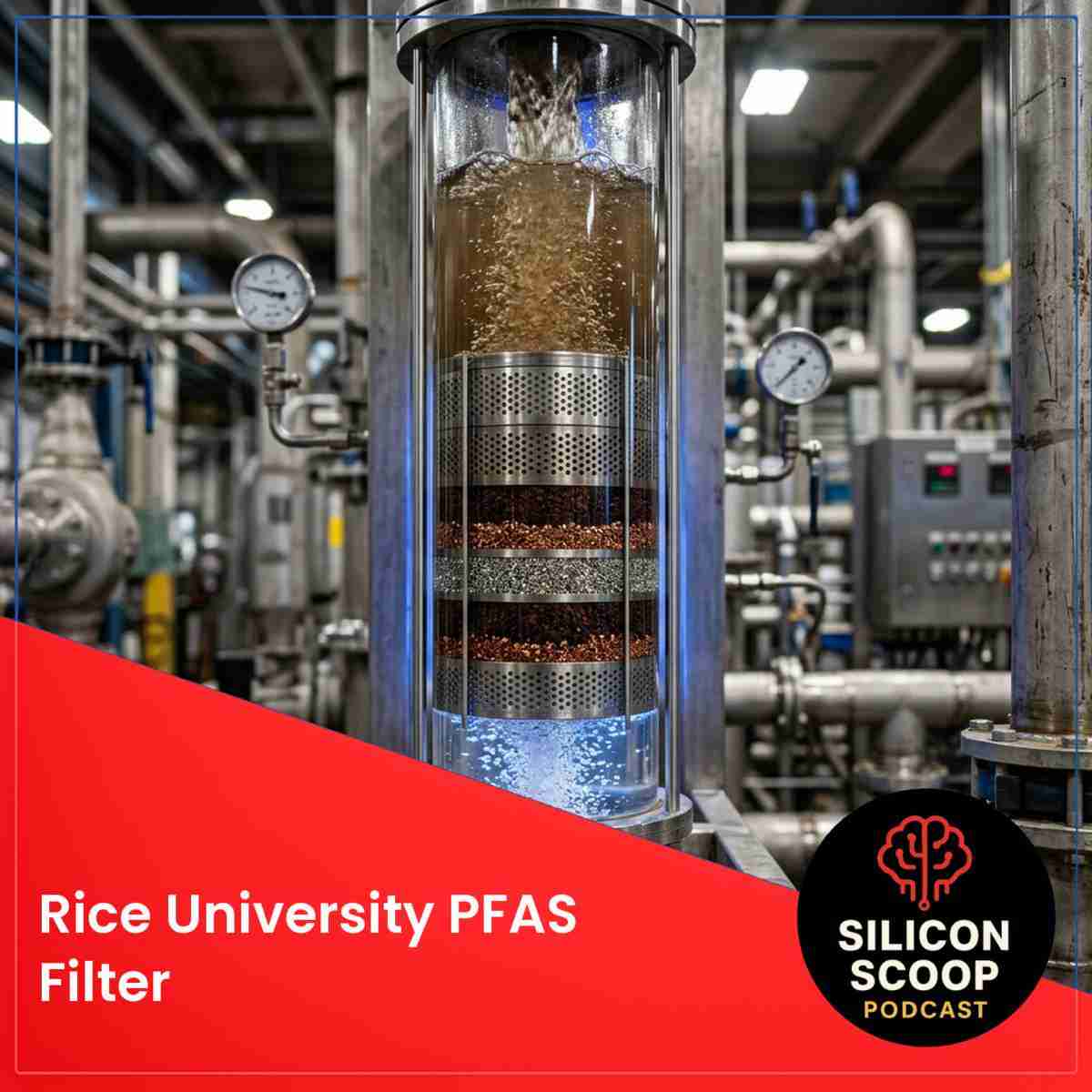
Rice University PFAS Filter: The Forever Chemical Breakthrough That Could Change Drinking Water Forever
Estimated reading time: 12 minutes
Key Takeaways
- Rice University’s PFAS filter uses a copper-aluminum layered double hydroxide (LDH) material that captures PFAS more than 1,000 times better than conventional adsorbents and works roughly 100 times faster than commercial activated carbon filters.
- The LDH system shifts PFAS remediation from “capture and concentrate” to “capture and destroy” by mineralizing more than 50% of trapped PFAS per cycle when heated with calcium carbonate at approximately 400–500°C.
- The filter performed at a highly effective level across tap water, river water, and industrial wastewater, including in continuous-flow configurations.
- Rice University’s broader PFAS ecosystem includes Rice-PAR and additional technologies like a COF-on-hBN photocatalyst that uses light to break down PFAS and other pollutants.
- Commercialization still faces challenges including selectivity across PFAS types, scale-up costs, regulatory approval, infrastructure integration, and thermal destruction at scale.
Table of contents
- Rice University PFAS Filter: The Forever Chemical Breakthrough That Could Change Drinking Water Forever
- Introduction: A Water Crisis That Won’t Wait
- Section 1: What Are PFAS “Forever Chemicals” and Why Are They So Dangerous?
- Section 2: The Rice University PFAS Filter — How It Works and Why It’s Different
- ✅ Cut the Busywork, Keep the Growth
- Section 3: Rice University’s Broader PFAS Research Ecosystem
- Section 4: What This Means for Water Utilities and EPA PFAS Compliance
- Section 5: Challenges on the Road to Commercialization
- Section 6: What You Can Do About PFAS Right Now
- FAQ: 10 Questions and Answers About PFAS and the Rice University Filter
- Final Thoughts
Introduction: A Water Crisis That Won’t Wait
Rice University’s PFAS filter may be the most important water treatment breakthrough in decades — and the problem it targets has been quietly poisoning water supplies for over 70 years.
Per- and polyfluoroalkyl substances (PFAS), better known as “forever chemicals,” have been found in tap water, rivers, rainwater, and even human blood across the globe. These man-made chemicals were introduced into consumer products in the 1950s and haven’t stopped spreading since.
Now, researchers at Rice University’s Water Institute believe they’ve found a way to remove PFAS from water faster and more effectively than anything currently available — and the numbers behind their findings are hard to ignore.
Section 1: What Are PFAS “Forever Chemicals” and Why Are They So Dangerous?
Understanding Forever Chemicals and Their Health Risks
PFAS stands for per- and polyfluoroalkyl substances. They are a large group of man-made chemicals used in thousands of everyday products.
The reason they’re called “forever chemicals” is simple: they don’t break down. Once they enter the environment — or your body — they stay there for a very long time.
Where are PFAS found?
- Nonstick cookware coatings
- Water-resistant clothing and fabrics
- Food packaging (like microwave popcorn bags)
- Firefighting foams (known as AFFF)
- Stain-resistant carpets and upholstery
- Tap water and surface water near industrial sites
According to the Interstate Technology & Regulatory Council (ITRC), PFAS chemicals are used widely because they provide:
- Oil, water, stain, and soil repellency
- Thermal stability
- Friction reduction
In short, anything nonstick or moisture-wicking likely contains them.
Why are they dangerous?
Health researchers have linked PFAS exposure to a growing list of serious conditions:
- Altered cholesterol levels
- Immune system impairment
- Thyroid disruption
- Increased cancer risk
- Developmental issues in children
The science is still evolving, but study after study published by institutions including the CDC continues to show concerning links between PFAS exposure and human health problems. The consistency of these findings across independent research groups is what has pushed regulators to act.
In 2024, the U.S. Environmental Protection Agency (EPA) finalized a strict PFAS drinking water rule, setting enforceable maximum contaminant levels (MCLs) for several PFAS compounds. Water utilities across the country are now scrambling to meet these new standards — and their existing tools are falling short.
Section 2: The Rice University PFAS Filter — How It Works and Why It’s Different
PFAS Removal Technology Built on Layered Double Hydroxide (LDH) Material
In late 2025, a team of researchers at Rice University published a landmark study in the peer-reviewed journal Advanced Materials. Their findings introduced a new class of PFAS removal technology that outperforms anything currently on the market.
The filter is built around a copper-aluminum layered double hydroxide (LDH) material — a compound first discovered at KAIST in 2021. Rice’s lead researcher, postdoctoral fellow Young-Gun (Youngkun) Chung, optimized a nitrate-intercalated version of this material that set new records for PFAS adsorption performance.
The results were stunning:
- The LDH material captures PFAS more than 1,000 times better than conventional adsorbents
- It removes PFAS roughly 100 times faster than standard activated carbon filters
- It achieves rapid removal within minutes — not hours
“To my astonishment, this LDH compound captured PFAS more than 1,000 times better than other materials,” Chung said. “It also worked incredibly fast, removing large amounts of PFAS within minutes, about 100 times faster than commercial carbon filters.”
Why Does the LDH Filter Work So Well?
The secret is in the filter’s internal structure.
The layered design creates slight charge imbalances between the material’s layers. These imbalances cause PFAS molecules to bind tightly to the material — and they do it fast.
Think of it like a molecular magnet. The PFAS chemicals are drawn in and held with both speed and strength.
Real-World Testing Across Multiple Water Sources
The team didn’t just test this in a laboratory with pure water. They put it through rigorous trials using:
- Tap water — the kind that flows from your faucet
- River water — with natural organic matter and competing contaminants
- Industrial wastewater — a much harder challenge for any filter
In every case, the LDH filter performed at a highly effective level. It worked in both batch (static) and continuous-flow configurations, meaning it could potentially fit into existing water treatment infrastructure.
The Closed-Loop Advantage: Capture AND Destroy
Here’s where the Rice University PFAS filter becomes truly groundbreaking.
Most current PFAS filters — including activated carbon and ion-exchange resin systems — follow a “capture and concentrate” model. They trap PFAS, but the spent filter media becomes hazardous waste that must be disposed of, often through incineration or landfilling. That just moves the problem.
Rice’s LDH system works differently. When the PFAS-loaded filter material is heated with calcium carbonate at approximately 400–500°C:
- More than 50% of trapped PFAS is mineralized (permanently destroyed) per cycle
- The process produces no detectable toxic by-products
- The sorbent material can be regenerated and reused for at least six cycles while maintaining high performance
This makes it one of the first demonstrated closed-loop, eco-friendly PFAS remediation platforms ever developed.
Michael S. Wong, professor and department chair of Chemical and Biomolecular Engineering at Rice University, explained the significance: “We are excited by the potential of this one-of-a-kind LDH-based technology to transform how PFAS-contaminated water sources are treated in the near future.”
Wong, who also directs Rice’s WaTER Institute, has noted that the LDH platform fundamentally shifts PFAS remediation from “capture and concentrate” to “capture and destroy” — a change that could reduce long-term disposal costs and secondary waste liabilities at scale.
✅ Cut the Busywork, Keep the Growth
If your team is stuck copying data, chasing approvals, or patching spreadsheets, automation is the fastest way to scale without adding headcount.
Section 3: Rice University’s Broader PFAS Research Ecosystem
Rice-PAR and the EPA PFAS Drinking Water Rule — Building an Institutional PFAS Powerhouse
Rice University’s LDH filter didn’t come out of nowhere. It’s the product of a deliberate, well-funded institutional strategy to tackle the PFAS crisis from multiple angles.
Rice-PAR (formerly R-PARC) is Rice’s dedicated PFAS center of excellence, housed within the WaTER Institute. It was built through a multi-year, multi-million-dollar collaboration with the U.S. Army Engineer Research and Development Center (ERDC).
The center’s mission covers:
- PFAS-contaminated water treatment
- Remediation of PFAS-contaminated soils
- Destruction of legacy AFFF (aqueous film-forming foam) stockpiles — a major military source of PFAS pollution
- Treatment of spent carbon media from existing filtration systems
This institutional backing gives Rice a clear pathway to scale the LDH filter and related technologies from laboratory to real-world application.
And there’s more in the pipeline.
A separate Rice research team has developed a covalent organic framework (COF)-on-hexagonal boron nitride (hBN) photocatalyst — a material that uses light to break down PFAS and other pollutants on a reusable surface. Think of it as a self-cleaning “supercleansing” platform powered by light.
This photocatalytic technology was published in Materials Today and represents a broader Rice toolkit that could one day be combined with LDH-based filtration in integrated multi-barrier PFAS treatment systems — essentially a layered defense strategy that captures and destroys forever chemicals using multiple methods working together.
Section 4: What This Means for Water Utilities and EPA PFAS Compliance
Forever Chemicals Water Treatment Under the New EPA PFAS Drinking Water Rule
The timing of Rice’s breakthrough is not coincidental. Water utilities across the United States are facing enormous pressure right now.
The 2024 EPA PFAS drinking water rule is described by industry analysts as “strict and far-reaching.” It sets enforceable standards for multiple PFAS compounds and gives utilities a compliance deadline they cannot ignore.
The dominant current treatment technologies — granular activated carbon (GAC) and ion-exchange resins — have serious limitations:
- They are slow to adsorb PFAS
- They require frequent regeneration or replacement
- Spent media must be disposed of as hazardous waste
- They struggle with short-chain PFAS compounds
- Lifecycle costs are high
Water industry technical experts are now urging utilities to evaluate higher-performance, regenerable media as alternatives. Rice’s LDH material fits that profile closely:
- Higher adsorption capacity (1,000x better than conventional adsorbents)
- Faster treatment cycles (100x faster than activated carbon)
- Regenerable for at least six cycles with maintained performance
- Closed-loop destruction that eliminates hazardous waste disposal costs
If proven cost-competitive at scale, this technology could fundamentally reshape the economics of PFAS compliance for utilities — and pressure incumbent carbon and ion-exchange vendors to respond.
Industry analysts have noted that the EPA’s new rule will drive multi-billion-dollar capital expenditures for treatment retrofits at water utilities, creating strong demand for exactly this kind of advanced, high-performance media. The utility that locks in superior PFAS removal technology early gains a significant compliance advantage.
Key implications for utilities and remediation contractors:
- Potential to reduce total lifecycle costs by reusing sorbent media instead of discarding it
- Ability to treat multiple water matrices (tap, surface, industrial) without reformulation
- Compatibility with continuous-flow systems that map onto existing infrastructure
- Applicability to AFFF-contaminated sites and military remediation projects under federal funding programs
Section 5: Challenges on the Road to Commercialization
Scaling PFAS Removal Technology — What Still Needs to Happen
Despite the remarkable results, experts are clear-eyed about the hurdles ahead.
Michael Wong himself has acknowledged that both the filtration and destruction technologies face “significant challenges in being deployed at industrial scale.”
Key commercialization challenges include:
- Selectivity for long-chain vs. short-chain PFAS: The LDH material has shown strongest results for certain PFAS types. Performance across the full range of PFAS compounds — particularly newer short-chain replacements — needs further validation.
- Scale-up costs: What works in a laboratory column is not automatically cheap to manufacture at water-utility scale. Production costs for copper-aluminum LDH media need to come down significantly.
- Regulatory approval pathways: New treatment media must be evaluated and approved for use in drinking water systems, a process that takes time even for clearly superior materials.
- Infrastructure integration: Retrofitting existing treatment plants to accommodate new media types requires engineering, capital investment, and operational retraining.
- Thermal destruction at scale: The calcium carbonate heating process works in the lab. Designing a continuous-scale thermal destruction unit that fits within a utility’s footprint and budget is a separate engineering challenge.
The good news is that Rice-PAR’s partnership with the U.S. Army ERDC provides a clear pathway for demonstration projects at a scale between lab and full commercial deployment. Federal infrastructure funding programs and PFAS-specific remediation grants also create financial incentives for early adopters.
The consensus among water industry experts is that LDH-based PFAS capture technology is not a matter of if but when — and the timeline depends heavily on continued research investment and regulatory alignment.
Section 6: What You Can Do About PFAS Right Now
Reducing Forever Chemical Exposure — Practical Steps for Today
The LDH filter isn’t in your home yet. Commercial deployment is still years away.
But that doesn’t mean you’re helpless. There are concrete steps you can take right now to reduce your PFAS exposure meaningfully.
1. Use a quality home water filter.
Not all home filters are equal. Look for filters that are NSF/ANSI 58 certified for reverse osmosis or NSF/ANSI 53 certified for activated carbon. These certifications confirm that the filter is tested to reduce specific PFAS compounds.
Good options include:
- Reverse osmosis under-sink systems
- Pitcher filters with certified PFAS reduction media
- Whole-house carbon block systems
The best home water filters currently on the market also filter out microplastics, giving you two layers of protection in one investment.
2. Replace nonstick cookware.
Nonstick coatings — especially older PTFE-based ones — are a direct source of PFAS exposure in the home, particularly when pans are scratched or overheated. PFAS-free cookware options are widely available in 2026 at all price points.
Look for cookware labeled:
- Ceramic-coated
- Cast iron
- Stainless steel
- PFAS-free (verified by the manufacturer with documentation)
3. Reduce PFAS in food packaging.
- Avoid microwave popcorn bags
- Choose fresh or frozen foods over heavily packaged fast food
- Ask your favorite brands whether they’ve transitioned away from PFAS-coated packaging
4. Filter at the tap, not just in the pitcher.
Pitcher filters are convenient but have limited contact time with water, which reduces their effectiveness. Point-of-use tap filters or under-sink reverse osmosis systems are more reliable for PFAS reduction.
5. Stay informed about your local water supply.
The EPA’s PFAS drinking water rule now requires utilities to test and report PFAS levels. Check your municipality’s annual water quality report. If you’re on a private well, consider getting your water tested independently.
FAQ: 10 Questions and Answers About PFAS and the Rice University Filter
Frequently Asked Questions About PFAS Removal Technology and Forever Chemicals
Q1: What are PFAS chemicals and why are they called “forever chemicals”?
PFAS (per- and polyfluoroalkyl substances) are man-made chemicals used in thousands of products since the 1950s. They are called “forever chemicals” because the strong carbon-fluorine bonds in their structure don’t break down naturally in the environment or in the human body. They build up over time in water, soil, wildlife, and people.
Q2: What did Rice University discover about PFAS water filtration?
Researchers at Rice University developed a copper-aluminum layered double hydroxide (LDH) material that captures PFAS more than 1,000 times better than conventional adsorbents and works roughly 100 times faster than commercial activated carbon filters. The findings were published in the journal Advanced Materials in late 2025.
Q3: How does the Rice University LDH filter actually remove PFAS?
The layered structure of the LDH material creates slight electrical charge imbalances between its layers. These imbalances act like a magnet for PFAS molecules, drawing them in and binding them tightly — and doing it very fast, often within minutes.
Q4: Can the Rice filter destroy PFAS permanently, or does it just capture them?
It can do both. When the PFAS-loaded LDH material is heated with calcium carbonate at around 400–500°C, more than half of the trapped PFAS is permanently destroyed (mineralized) without producing toxic by-products. The filter material can then be regenerated and reused for at least six cycles.
Q5: Is the Rice University PFAS filter available to buy right now?
No. The technology is still in the research and early development phase. It has not yet been commercialized. Water utilities and consumers should watch for updates from Rice University’s WaTER Institute and Rice-PAR for future developments.
Q6: What is the EPA PFAS drinking water rule and why does it matter?
In 2024, the U.S. Environmental Protection Agency finalized a strict rule setting maximum contaminant levels (MCLs) for several PFAS compounds in public drinking water. This means water utilities are now legally required to test for PFAS and bring levels down to meet these standards — creating massive demand for better filtration technologies.
Q7: How does the LDH filter compare to the activated carbon filters used today?
Current granular activated carbon (GAC) filters are the most common PFAS treatment technology at water utilities. Rice’s LDH material captures PFAS 1,000 times more effectively and works 100 times faster. It also enables on-site PFAS destruction, whereas carbon filters generate hazardous spent media that must be shipped off for disposal.
Q8: What types of water was the LDH filter tested on?
The research team tested the filter on tap water, river water, and industrial wastewater. It performed at a highly effective level across all three, including in continuous-flow system configurations that resemble real water treatment infrastructure.
Q9: What home water filters can reduce PFAS exposure right now?
Look for home water filters certified to NSF/ANSI 58 (reverse osmosis) or NSF/ANSI 53 (activated carbon). Reverse osmosis systems — either under-sink or countertop — are among the most effective options currently available for reducing PFAS in drinking water. Certified pitcher filters are a lower-cost option.
Q10: What other PFAS research is Rice University working on?
Rice has developed a second technology — a covalent organic framework (COF) on hexagonal boron nitride (hBN) photocatalyst — that uses light to break down PFAS and other pollutants on a reusable surface. This “supercleansing” material could one day be combined with LDH filtration in multi-barrier PFAS treatment systems. Rice-PAR, the university’s dedicated PFAS center, is also working with the U.S. Army on destroying PFAS in contaminated soils and AFFF foam stockpiles.
Final Thoughts
The Rice University PFAS filter represents a genuine leap forward in forever chemical water treatment. It’s faster, more powerful, and more environmentally responsible than anything currently deployed at scale.
The gap between lab success and your tap is still real. Commercialization takes time, money, and regulatory alignment. But the direction is clear — and the EPA’s new PFAS drinking water rule means the pressure to get there is only going to grow.
Until then: filter your water, ditch the nonstick pan, and pay attention to what’s in your local water supply.
The science is moving fast. And for once, it’s moving in the right direction.
Sources:
Additional Links
Flowgrammer.ca – 💡 Unlock AI-Powered Automation! Let flowgrammer.ca handle complex workflows so you can focus on growing your business.
Flowgrammers.ca – 💡 Join Toronto’s Fastest Growing AI and Business Automation Community.
- SRED Funding Solutions – Maximize your R&D tax credits and secure funding for your innovation.
- Silicon Scoop Podcast – Stay Informed, Stay Ahead!
- Startup Talk Podcast
- Flowgrammer Youtube
- Startup Investor Drinks – Join Toronto’s Startup Community and connect with fellow startup enthusiasts and investors.
- TorontoStarts Startup and Entrepreneur Community – Become a part of Toronto’s thriving startup ecosystem.
- Workhaus – Discover flexible workspace solutions for your business needs.
- Work with The Startup Coach – Get expert guidance and mentorship for your startup journey.
- Reach out to Jon Irwin on LinkedIn – Connect with our co-host and technology expert.
Episode transcript
Read the full transcript
Craig: for seventy years, toxic forever chemicals have been quietly invading our drinking water with zero practical ways to destroy them. but rice university just engineered a molecular trap that captured these chemicals a thousand times better than standard filters and then completely vaporize them. so we have now the forever chemical filter breakthrough. rice university scientists created a copper aluminum layered double hydroxy filter, that strips out of toxic pfas from water in minutes rather than hours. unlike modern filters that merely trap the toxins, the system uses a targeted thermal process to permanently shatter and destroy the hazardous chemical bonds. this shifts environmental remediation from a costly capture and concentrate liability, model to a permanent closed loop capture and destroy cycle, completely altering the global economics of clean water compliance. what do you think about this, john?
Jon: i love this, especially when we're talking about pfas because pfas are found in thousands of products. we're talking nonstick cookware, waterproof clothing, food packaging, firefighting foam, cosmetics, industrial manufacturing, and they're called forever chemicals because they don't naturally break down in the environment and can remain in water, soil, or even the human body for years. so, the layered double hydroxide material at rice university think of it like a positively charged nanoscale sheet or a stack of them. right? so molecule molecules typically carry negative charges. and so the rice team engineered an ldh, which is the layered double hydroxide layer, structured, composed primarily of copper and aluminum, which creates strong electrostatic attraction to pfas molecules. and so the result, extremely rapid absorption. so according to the researchers, the material removed large amounts of pfas within, within minutes and operated roughly a 100 times faster than commercial carbon filtration systems. what was even more impressive was that researchers reported the material captured pfas over a thousand times more effectively than many alternative absorption material tested during their development. so, a 100 times faster isn't just laboratory, curiosity. this is perfect for, municipal water treatment. so faster filtration means smaller treatment plants. it means smaller treatment plants with lower capital costs. lower capital cost means broader adoption. faster cleanup means shorter remediation timelines for contaminated sites. there are so many amazing applications that could help if they can commercialize this. what do you thought? what do you think about this?
Craig: i like to think of this update like upgrading a city security from an old sticky flypaper trap to an ultra fast automated magnetic tractor beam. instead of waiting hours for a few stray toxins to randomly float into a standard carbon filter and get stuck, this new material uses electrical charge imbalances to violently pull the pfas molecules out of the streaming water in seconds, locking them down instantly so they can be hauled away and destroyed. so, currently moving from advanced laboratory testing and continuous flow pilot configurations, commercial integration into municipal utilities will take several years, but, i'd like to see this happening. we might or may not see some aspects of this depending on cost in some of these personal filters, but i think they would have to be plugged in and tied to. i think, you know, some clever companies might be able to implement this, but a thousand times superior absorption capacity, compared to conventional commercial absorbents. this filter utilizes a nitrate intercalated copper aluminum layered double hydroxide compound. its highly ordered crystalline nano scale layers exhibit systematic structural charge imbalances that electrostatically force perfluorocatonic acid, a pfoa and other perfluorinated suffocants to bind with maximum density. rice is also pairing this platform with a covalent organic framework on hexagonal boron nitride photocatalyst for light driven multivariate degradation. so the secret to destroying these practically indestructible carbon fluoride bonds without releasing toxic gas relies on a process called defluorination. when the heat with calcium carbonated, carbonate, the fluorines are stripped off the carbon backbone and safely bound to calcium fluoride, which is the extract same inert material naturally found in the human bones and teeth. so loving what this is doing. it looks like we might finally have a solution for pfas that might work.
Jon: yeah. yeah. this is really interesting. yeah. i'm excited for this.
Craig: rice university has turned the tide against forever chemicals, proving that we can finally destroy what we once thought was indestructible. are you willing to see a temporary bump in your local utility taxes if it means completely purging your city's waters of forever chemicals? are you just buying a reverse osmosis filter and calling it a day? so let us know in the chat below.
More from Silicon Scoop
All episodes
silicon-scoop · October 16, 2026
Meta’s $18 Billion Teen Safety Settlement: Soft Guardrails, Hard Leverage Over TikTok and YouTube
Deep dive on Meta teen safety settlement, social media addiction lawsuit, new Facebook Instagram time limits and pressure on TikTok YouTube age verification.
View episode

silicon-scoop · October 15, 2026
How Claude Mythos Is Reshaping Cryptanalysis: HAWK, AES and the Rise of AI-Driven Crypto Research
Claude Mythos cryptanalysis weakens HAWK post-quantum signature, speeds AES Möbius Bridge attack, and powers CryptanalysisBench benchmark in AI-driven crypto research.
View episode

silicon-scoop · October 14, 2026
Nvidia’s $12.9 Billion Hugging Face Bet: How Controlling the Open-Source Model Hub Reshapes AI Chips, Cloud, And Competition
Nvidia Hugging Face acquisition could reshape open source AI models, AI chip dominance, and the global developer model hub, raising antitrust and neutrality questions.
View episode