
SpaceX’s Q2 2026 Earnings: Inside the AI Spending Spree Behind a 92% Revenue Surge
Deep dive into SpaceX Q2 2026 earnings, massive AI capex, Starlink revenue growth, and the strategic Cursor acquisition shaping its trillion-dollar ambitions.
With Craig Major and Jon Irwin
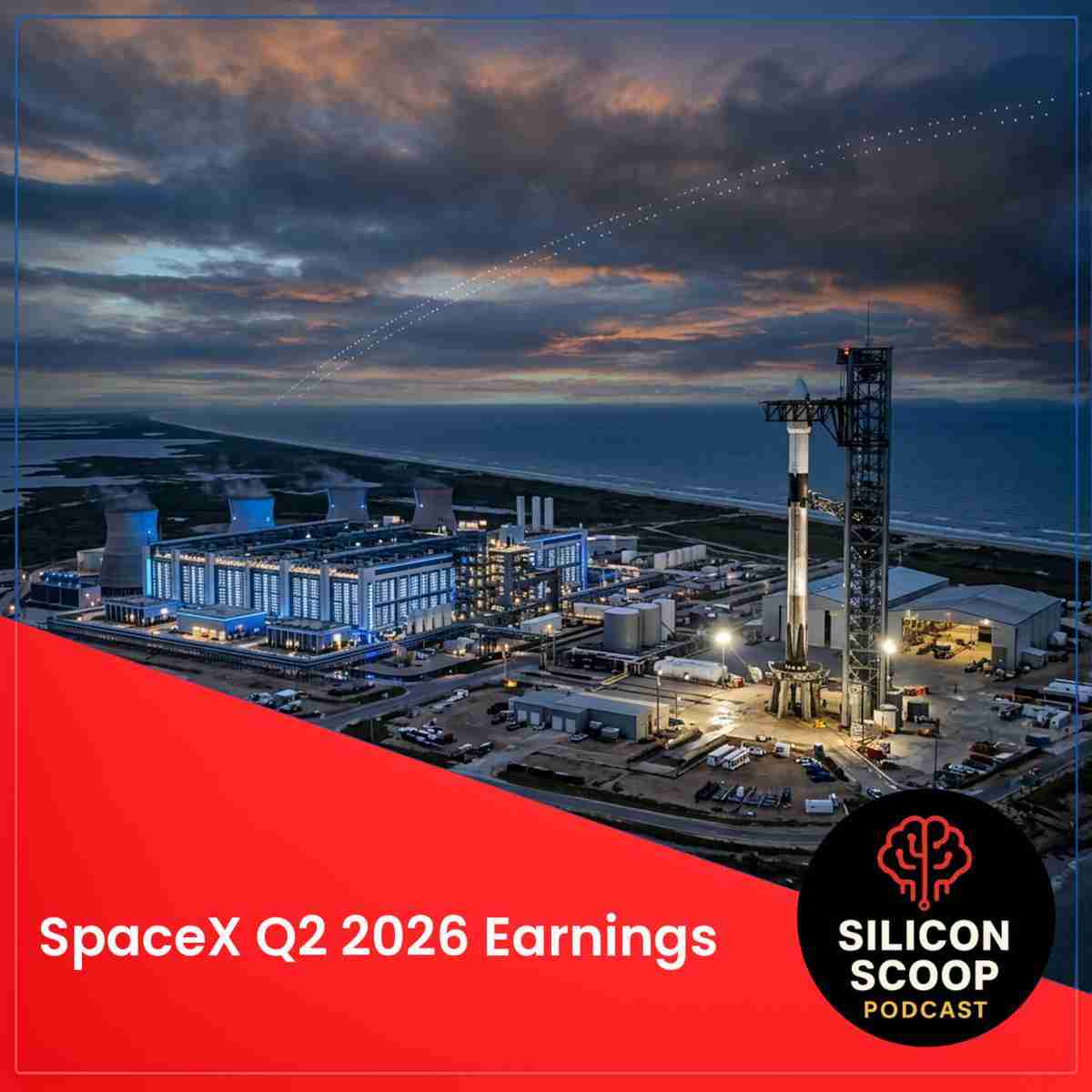

SpaceX Q2 2026 Earnings Hid a $18.4B AI Spending Bomb
Estimated reading time: 8 minutes
Key Takeaways
- SpaceX Q2 2026 earnings showed a 92% revenue surge alongside an $18.4B quarterly capex bill, including $15.8B for AI infrastructure.
- Starlink (Connectivity) remained the profitable cash engine, funding losses and aggressive investment across other segments.
- The market reaction centered on AI spending coming in more than double expectations, pushing out free cash flow timelines.
- SpaceX confirmed a $60B Cursor acquisition and tied it to a $100B ARR target by year-end 2026.
- Plans to launch an orbital AI satellite next year could create a major moat—or extend the capex burden if delayed.
Table of contents
- SpaceX Q2 2026 Earnings Hid a $18.4B AI Spending Bomb
- SpaceX Q2 2026 Earnings at a Glance
- How SpaceX’s Three Business Segments Actually Performed
- SpaceX AI Capex — The Bet That’s Dividing Wall Street
- The Cursor Acquisition and the $100 Billion ARR Target
- Starlink Revenue 2026 — Why the Satellite Business Is Still the Foundation
- What the Stock Drop Actually Tells Us
- 10-Question FAQ: SpaceX Q2 2026 Earnings Explained
SpaceX Q2 2026 earnings told two very different stories at the same time.
On the surface, the numbers looked spectacular. Revenue nearly doubled. Profitability metrics beat every analyst on Wall Street. The company’s first earnings report since its June Nasdaq IPO landed with real force.
But underneath that 92% revenue surge sat something that sent shares tumbling more than 7% in after-hours trading: an $18.4 billion capital spending bill in a single quarter, with $15.8 billion of that going straight into AI infrastructure.
This is not a story about a rocket company having a good quarter. This is a story about one of the most aggressive corporate bets in modern technology history — and whether it pays off.
Let’s break down exactly what happened, what the numbers actually mean, and why the market reacted the way it did.
—
SpaceX Q2 2026 Earnings at a Glance
SpaceX posted $7.814 billion in total revenue for the second quarter of 2026, a 92% increase year-over-year. That number crushed Wall Street’s consensus estimate of roughly $6.9 billion — a beat of nearly $900 million.
Here are the core financial figures:
- Total Revenue: $7.814 billion (vs. $6.9 billion expected)
- Net Loss: $541 million, or $0.09 per share (vs. $0.26 per share expected)
- Adjusted EBITDA: $3.538 billion (nearly tripled year-over-year)
- Total Capital Expenditure: $18.369 billion
- AI Capital Expenditure: $15.828 billion
The net loss itself improved dramatically — from roughly $1 billion a year ago down to $541 million. The loss per share of $0.09 beat analyst expectations of $0.26 by a wide margin.
On paper, this is a strong quarter. Revenue beat. Profitability beat. Loss shrank.
So why did the stock drop?
Because that capex number — $18.4 billion in one quarter — was more than double what analysts had modeled. Investors are not scared of losses. They are scared of losses and a spending pace that has no clear ceiling yet.
Sources: SEC Form 8-K, August 4 2026 | TechCrunch
—
How SpaceX’s Three Business Segments Actually Performed
SpaceX now reports three distinct revenue segments. Understanding each one separately is the only way to see the full picture clearly.
Connectivity (Starlink) — The Cash Engine
The Connectivity segment, which houses Starlink, remains the financial backbone of the entire company.
- Revenue: $4.291 billion (up 66% year-over-year)
- Operating Income: $1.656 billion
- Operating Margin: 38.6%
Starlink is not just growing — it is growing profitably. A 38.6% operating margin at this scale is a genuinely impressive number. This is the segment that funds everything else SpaceX is building.
The 66% year-over-year growth rate also tells you that Starlink is still in an expansion phase. It has not plateaued. Subscriber counts are climbing, enterprise contracts are growing, and the pending rollout of Starlink Mobile will open an entirely new revenue channel.
Beyond consumer Starlink, SpaceX disclosed that it has been awarded over $6 billion in multi-year U.S. government contracts for Starshield — its secure, defense-grade satellite service for military and intelligence customers. This is a separate, recurring revenue stream that insulates the company from consumer market swings. Specific contract identifiers remain classified, but the dollar figure is confirmed in public filings.
Space Segment — Heavy Investment, Modest Return (For Now)
- Revenue: $962 million
- Operating Loss: $542 million
The Space segment covers launch services, Falcon rockets, and Starship development. It is currently running at a loss because Starship development costs are still being absorbed here. As Starship reaches operational cadence and launch frequency increases, this segment is expected to become profitable.
The upcoming V3 satellite is tied closely to this segment’s future performance. Management has flagged V3 as a meaningful revenue multiplier, both for Starlink capacity expansion and for the AI orbital ambitions outlined later in this report.
AI Segment — The Wildcard
This is where the story gets complicated.
- Revenue: $2.561 billion (up 247% year-over-year)
- Operating Loss: $1.257 billion
- Adjusted EBITDA: +$1.146 billion
The AI segment grew 247% year-over-year. That growth rate is extraordinary by any standard. SpaceX signed $14.1 billion in new cloud services agreements in the quarter — reportedly with customers including Anthropic and Google — and expanded its nameplate compute capacity to 1.4 gigawatts, up sharply from prior periods.
The Adjusted EBITDA figure of positive $1.146 billion tells you the underlying business generates cash. The operating loss of $1.257 billion tells you the company is reinvesting every dollar it earns — and then some — back into building more infrastructure.
For the first half of 2026 alone, AI capital expenditure hit $23.551 billion, compared with just $3.316 billion for all of 2025. SpaceX’s AI capex has grown more than sevenfold in roughly 12 months.
Sources: SEC Form 8-K | Yahoo Finance | TechCrunch
—
Stop Drowning in Manual Work While SpaceX Automates Everything
If the world’s most ambitious tech company is betting billions on automation and AI infrastructure, the question for your business is simple: what are you still doing by hand?
At Flowgrammer, we help businesses remove the repetitive, manual tasks that eat up hours every week — from data entry and reporting to client follow-ups and workflow handoffs. You don’t need a billion-dollar capex budget to start automating. You just need the right systems.
👉 See How Business Automation Can Free Up Your Team Today (https://flowgrammer.ca)
—
SpaceX AI Capex — The Bet That’s Dividing Wall Street
The single most debated number from this earnings report is the $15.828 billion in AI capital expenditure in Q2 alone.
To put that in context:
- SpaceX spent more on AI infrastructure in one quarter than it spent on all capital expenditures for the entirety of 2025.
- The H1 2026 AI capex total of $23.551 billion already dwarfs most hyperscalers’ full-year infrastructure budgets.
- SpaceX is building its entire AI compute stack exclusively with Nvidia hardware, making it one of the largest single customers in Nvidia’s enterprise pipeline.
Bank of America analyst Ronald Epstein described the quarter as a beat “across topline and profitability metrics” and called management’s communication constructive. But he flagged the elevated capex and uncertainty around monetizing the AI segment as the primary reasons for post-earnings stock pressure.
Visible Alpha analyst Melissa Otto, speaking to Fortune, framed the market reaction directly: the share price drop was driven by AI capex coming in “more than double what was expected.” Her view is that management’s aggressive pull-forward of the $1 trillion revenue target is only credible if SpaceX can convert its $14.1 billion in cloud deals, Starshield contracts, and the Cursor acquisition into durable, high-margin cash flows over time.
The broader market narrative from Forbes and CNN coverage centers on a simple idea: investors are accepting near-term losses and capex spikes as long as they believe SpaceX’s 1.4 GW compute build, V3 satellite rollout, and orbital AI plans will produce defensible market leadership against OpenAI, Anthropic, Google, and other hyperscalers.
That is a significant conditional. The spending is real today. The returns are a projection.
SpaceX also confirmed plans to launch an orbital AI satellite next year — a move that would place compute infrastructure directly in low Earth orbit. There is no comparable product from any competitor at this stage. If it works, the competitive moat becomes much harder to cross. If it faces technical delays, the capex bill continues to grow without the corresponding revenue offset.
Sources: CNBC | Fortune | StockTitan
—
The Cursor Acquisition and the $100 Billion ARR Target
On August 4, 2026, alongside its earnings release, SpaceX filed a Form 8-K with the SEC confirming an agreement to acquire AI coding startup Cursor for $60 billion. Closing is expected in Q3 2026.
This is not a small, quiet bolt-on deal. At $60 billion, this is one of the largest software acquisitions in history.
Management connected the Cursor deal directly to a specific financial milestone: reaching a $100 billion annualized revenue run rate (ARR) by year-end 2026. The logic is straightforward — Cursor’s AI-powered developer tools bring both enterprise software revenue and a massive user base that integrates directly into SpaceX’s growing cloud infrastructure layer.
Here is how the path to $100 billion ARR is being constructed:
1. Starlink and Starshield providing a stable, growing connectivity revenue base
2. Cloud services agreements ($14.1 billion signed in Q2 alone) providing forward revenue visibility
3. Cursor integration adding enterprise software ARR at scale
4. V3 satellite deployment expanding capacity and pricing power for Starlink
The $1 trillion revenue target has also moved. Internal projections that previously pointed to 2031 have been pulled forward to 2030, with management acknowledging a “non-zero chance” of hitting that mark as early as 2029.
These are extraordinary projections. But it is worth noting they are backed by signed contracts, not just speculative forecasts. The $14.1 billion in cloud agreements is contracted revenue. The $6 billion in Starshield contracts is contracted revenue. The Cursor deal, once closed, brings recurring software subscription revenue.
Whether the unit economics hold as costs scale is the real open question.
Sources: SEC Form 8-K | StockTitan 8-K filing | Fortune
—
Starlink Revenue 2026 — Why the Satellite Business Is Still the Foundation
Despite all the noise around AI infrastructure, Starlink revenue in 2026 remains the single most important number in SpaceX’s financial model for one simple reason: it is the only large segment currently operating at a meaningful profit.
At $4.291 billion in quarterly revenue with a 38.6% operating margin, Starlink generated $1.656 billion in operating income. That cash is what funds the AI segment’s losses, the Space segment’s losses, and the aggressive capital expenditure program.
Think of it this way: without Starlink’s operating income, SpaceX’s quarterly operating loss would be dramatically larger, and the pace of the AI buildout would face tighter financial constraints.
Key factors driving Starlink’s continued growth:
- Geographic expansion: Starlink continues to add countries and regions, particularly in underserved rural markets across Africa, Southeast Asia, and Latin America.
- Starlink Mobile: A pending service tier targeting mobile carriers and maritime applications represents a significant untapped revenue pool.
- Starshield contracts: The $6 billion-plus in U.S. government contracts for the secure, defense-grade version of Starlink provides non-cyclical, recurring government revenue.
- V3 satellite capacity: The next-generation V3 satellite will dramatically increase per-satellite throughput, enabling SpaceX to serve more users at higher speeds without proportional increases in launch costs.
Starlink’s competitive position in the satellite internet market also remains strong. Competitors like Amazon’s Project Kuiper are scaling, but SpaceX has a multi-year head start in constellation size, ground infrastructure, and user terminal production.
The 66% year-over-year growth rate suggests Starlink has not yet reached a natural saturation ceiling. Management’s own projections embed continued strong Starlink growth as a foundational assumption behind the $100 billion ARR target.
Sources: TechCrunch | Yahoo Finance
—
What the Stock Drop Actually Tells Us
SpaceX shares fell more than 7% in after-hours trading following the results. That reaction deserves an honest read — it is not panic, and it is not irrational.
When a company reports revenue that beats by $900 million, cuts its loss per share from $0.26 expected to $0.09 actual, and nearly triples its Adjusted EBITDA, the stock does not normally drop 7%.
The drop is a message from the market about one thing: the pace and scale of AI capital spending is ahead of what investors were pricing in.
When capex comes in at more than double expectations, investors recalibrate their free cash flow models. The timeline for positive free cash flow gets pushed out. The uncertainty around AI return-on-investment grows. That creates selling pressure even against a genuinely strong revenue quarter.
This is a pattern seen across the hyperscaler world. When Microsoft, Amazon, and Alphabet all significantly raised their AI capex guidance in 2024 and 2025, their stocks initially dipped before recovering as revenue from those investments became visible. SpaceX is following a structurally similar path, but at a faster pace and from a less established public market standing.
The investors selling today are saying: “We believe you can build this. We’re not yet certain you can monetize it at the pace you’re projecting.”
The investors holding are saying: “The cloud contracts, the Starshield awards, and the Cursor deal give this enough concrete revenue foundation to justify the risk.”
Both positions are rational given what the data shows today.
—
10-Question FAQ: SpaceX Q2 2026 Earnings Explained
1. What were SpaceX’s total revenues in Q2 2026?
SpaceX reported total revenue of $7.814 billion in the second quarter of 2026. This was a 92% increase compared to the same quarter in 2025 and beat Wall Street’s consensus estimate of approximately $6.9 billion by roughly $900 million.
2. Why did SpaceX’s stock drop after such strong earnings?
The stock fell more than 7% in after-hours trading because SpaceX’s total capital expenditure of $18.4 billion — with $15.8 billion specifically for AI infrastructure — came in at more than double what analysts had modeled. Strong revenue beats can still trigger stock selling when spending projections change materially, because it pushes out the timeline for free cash flow generation.
3. How much did Starlink generate in Q2 2026?
The Connectivity segment, which includes Starlink, generated $4.291 billion in revenue, up 66% year-over-year. It produced $1.656 billion in operating income at a 38.6% operating margin, making it the most profitable segment in the company’s portfolio.
4. What is Starshield, and how much has SpaceX earned from it?
Starshield is SpaceX’s secure satellite communications service designed specifically for U.S. government defense and intelligence customers. SpaceX confirmed it has been awarded over $6 billion in multi-year U.S. government contracts for Starshield. The specific contract details remain classified, but the total value is confirmed in public SEC filings.
5. What is the Cursor acquisition, and why does it matter?
SpaceX announced an agreement to acquire Cursor, an AI-powered developer tools startup, for $60 billion, with closing expected in Q3 2026. Management has directly tied this acquisition to reaching a $100 billion annualized revenue run rate by year-end 2026. Cursor adds enterprise software revenue and a large developer user base that connects directly with SpaceX’s cloud infrastructure business.
6. How fast is SpaceX’s AI segment growing?
SpaceX’s AI segment grew 247% year-over-year in Q2 2026, reaching $2.561 billion in revenue. The company signed $14.1 billion in new cloud services agreements during the quarter and expanded its compute capacity to 1.4 gigawatts. Despite the strong growth, the segment posted an operating loss of $1.257 billion due to heavy infrastructure investment, though it generated a positive Adjusted EBITDA of $1.146 billion.
7. What is SpaceX’s revenue target, and when does it expect to hit $1 trillion?
SpaceX’s internal projections have moved the $1 trillion revenue target forward from 2031 to 2030. Management also noted a “non-zero chance” of reaching $1 trillion by 2029. A nearer-term milestone is a $100 billion annualized revenue run rate by the end of 2026, which management considers achievable following the Cursor acquisition and continued cloud contract bookings.
8. What chip hardware is SpaceX using for its AI compute build?
SpaceX is exclusively using Nvidia hardware for its AI compute infrastructure buildout. This makes SpaceX one of Nvidia’s largest single enterprise customers. The company expanded its nameplate AI compute capacity to 1.4 gigawatts in Q2 2026, up significantly from prior periods.
9. What is the V3 satellite, and when will it launch?
SpaceX’s next-generation V3 satellite is expected to significantly increase the revenue capacity of the Starlink network by delivering dramatically higher per-satellite throughput. This means SpaceX can serve more users at faster speeds without needing proportional increases in launch volume. A specific launch date has not been publicly confirmed, but management has signaled V3 is a key driver of revenue growth in the near-to-medium term.
10. What does SpaceX’s orbital AI satellite plan involve?
SpaceX has confirmed plans to launch an orbital AI satellite — essentially a compute node placed directly in low Earth orbit — in the coming year. This would put AI processing capability in space, enabling lower-latency AI services for ground customers and potentially opening entirely new commercial and defense use cases. No competitor has a directly comparable product at this stage, which represents a potentially significant moat if the technical execution succeeds.
—
Sources referenced in this article:
- SEC Form 8-K filing (August 4, 2026): SEC Form 8-K filing (August 4, 2026)
- StockTitan 8-K summary: StockTitan 8-K summary
- Yahoo Finance earnings coverage: Yahoo Finance earnings coverage
- TechCrunch analysis: TechCrunch analysis
- Fortune / Elon Musk trillion-dollar target: Fortune / Elon Musk trillion-dollar target
- CNBC Wall Street analyst reactions: CNBC Wall Street analyst reactions
Additional Links
Flowgrammer.ca – 💡 Unlock AI-Powered Automation! Let flowgrammer.ca handle complex workflows so you can focus on growing your business.
Flowgrammers.ca – 💡 Join Toronto’s Fastest Growing AI and Business Automation Community.
- SRED Funding Solutions – Maximize your R&D tax credits and secure funding for your innovation.
- Silicon Scoop Podcast – Stay Informed, Stay Ahead!
- Startup Talk Podcast
- Flowgrammer Youtube
- Startup Investor Drinks – Join Toronto’s Startup Community and connect with fellow startup enthusiasts and investors.
- TorontoStarts Startup and Entrepreneur Community – Become a part of Toronto’s thriving startup ecosystem.
- Workhaus – Discover flexible workspace solutions for your business needs.
- Work with The Startup Coach – Get expert guidance and mentorship for your startup journey.
- Reach out to Jon Irwin on LinkedIn – Connect with our co-host and technology expert.
Episode transcript
Read the full transcript
Craig: spacex nearly doubled its revenue in a year, and wall street rewarded it by sending the stock down. why? because underneath a 7,800,000,000 in quarterly revenue was an absolute staggering 15,800,000,000 ai infrastructure bill. spacex isn't merely trying to dominate rockets anymore. elon is attempting to turn the company into one of the world's largest ai infrastructure businesses. spacex earned 7,800,000,000 last quarter and spent roughly twice that amount just building ai infrastructure. the rockets may get the photographs, but the biggest bet inside spacex right now might actually be gpus. apparently, rockets weren't expensive enough. spacex nearly doubled revenue. starlink is throwing off serious operating profit, and elon musk found somewhere to put it a truly absurd number of nvidia chips. spacex first quarterly report as a public company showed 7,814,000,000 revenue, up 92 with losses narrowing to 541,000,000. so they're only losing $541,000,000 a quarter. that's actually pretty good. but the headline behind the headline was spending 18,369,000,000 in capex, including 15.84 ai. starlink's connectivity business remains highly profitable while spacex's ai division is growing dramatically, but still losing money on gaap general approved accounting practices operating basis. management believes those investments can support a 100,000,000,000 annualized revenue runway by the end of twenty twenty six. investors are essentially being asked whether they believe the returns can arrive as quickly as the spending. what do you think about this, john?
Jon: yeah. this is crazy. a total of 18,370,000,000 on capital expenditures during the quarter. and you said 15.83 was to ai. right? yep. so this is why investors sold the stock despite the enormous revenue beat because the market is trying to determine whether spacex is becoming one of the most powerful technology platforms or one of the most capital intensive companies. so, and now i don't know if we're covering it today. so, nvidia has partnered with, like, blackrock and jpmorgan and all these other, banks. are we covering it today? where their companies can now borrow from these banks to buy nvidia ai chips.
Craig: so no. i don't think we're covering it. no.
Jon: okay. we're not covering it today. we should. we'll cover it next time. but, there it's again, it's just adding to the ai bubble. and, hopefully, we can get through it. but if we don't, there's gonna be a lot of, repercussions here. so the good thing about spacex is that the revenue growth is becoming increasing increasingly diversified. so they now report three major operating segments. so space, which is 962,000,000. we'll call the next one connectivity, which is 4,291,000,000, and ai, which is 2,561,000,000. and, essentially, if you look at that connectivity is the highest one. so that's essentially starlink, and that's the financial engine. and starlink is currently the strongest business inside spacex. the connectivity revenue increased from 2,588,000,000 in q two of twenty twenty five to 4,290,000,000 in q two of twenty twenty six, which is 66%. and they just signed another deal with, i think, vietnam, somewhere in south asia, to bring starlink there. so, there's yeah. i think they finished off with about 12,000,000 subscribers. so starlink is what's holding this whole thing together right now with all the spending that's happening and all that sort of stuff. right? but, i don't know. do you think this is sustainable, or is wall street right by pulling back?
Craig: well, this is traditional for wall street. they pull back on good news and buy back on bad news, because they like to buy the dip for one for some reason, and they all kinda move with the mindset. so are they right to pull back? i have to put that aside a little bit because market's all about timing. right? because you can think completely different than the market, and you have proof. but if the market moves one way and you move another way because of your proof, then you still lose. it doesn't really matter. so it's not so much predicting what the company does. it's predicting how the market's gonna react to what the company does. so taking a step back, they're they have a huge amount of revenue now coming in from google and from anthropic for their data centers. do you know that their, build time for a new data center is now down to sixty six days? it's crazy how quickly they can, put these things up. and what? and
Jon: the problem isn't anymore how fast can they put them up. the problem is getting approval to build them now.
Craig: yeah. that's a secondary issue, and i and i think it's a little crazy what, everyone's doing around that. i'd love to talk about this if we get through this, because what they're doing is crazy to me. the whole point, i guess, is the demand right now is data center chip gpu, and they're getting a crap ton of revenue from month by month revenue from anthropic and google. and if they have more data centers, they get more revenue. it's a long term play that the other companies aren't willing to make because, dario from anthropic said, if they bought the hardware at their expected growth rate at 10 x, they'd go broke if they only went eight x. you know? so they can't afford to buy it, but they're more than willing to pay huge amount of, surplus money to rent it because they can afford it while the run rate's high, the run rate goes down, they can jump out of it ideally. so i think this is really interesting in a world where gpus and data centers are gonna be the powerhouses. they don't have anyone else who's competing with them. the big other like, google's even going after them, and the other people who do data centers is amazon and facebook. and so i don't think anybody's so to me, this is an amazing move. i love where they're going. we talked about starlink, and their cash cow right now. i honestly believe it's gonna jump to a bigger cash cow because if they can get over the legislative hurdles, they're planning on deploying a thousand v three satellites within the year. so v three satellites will give us, they something like a thousand times the bandwidth that we have now. and, and he's planning his phone network. so yes. i'm at yeah. so imagine that in a couple of years, we've got these fully deployed systems, and you can now buy a satellite phone that you don't have to worry about micro sims. you don't have to worry about switching providers. you don't have to worry about it's satellite connected direct up. there's no
Jon: well, actually, no. it's not just satellite connected direct up. he's building cell phone towers too because so what? and verizon won't lease him time on their towers, so he's building his own infrastructure.
Craig: yeah. so i haven't seen that. so i'd love to delve into that because i if he has to build his own infrastructure, and i guess it depends what that means, because he needs to build his backhaul infrastructure no matter what. because you've gotta backhaul it from somewhere and, you know, preferably closer to the source. but i'm not sure with the low orbit satellites, are they talking to local microwave towers and then going up to the, satellite? or are they using, like, what is in the starlink technology, and they're just shrinking it down to give you direct satellite access? if he has to build his own infrastructure, then he's gotta play the regulation game. he's gotta buy signal from someone if no one's gonna give, yeah, license that, which is a whole problem. so we'll
Jon: have to see read. read, it, from what i read, he he's going to have to build his own cell phone, type, infrastructure towers. i'll have to find the article again. but,
Craig: yeah, we'll do a whole thing on his big bet on this yeah. so we can drill down. i'd rather not, you know, speculate now on
Jon: no. no. no. yeah.
Craig: because we don't have it right. but, these all also said that, teslas will be a hot spot automatically. so somehow, if there's a tesla nearby and you have a, like, a proper spacex account, you'll be able to use it. so this is interesting. so they're trying to make these plays into, a market that other people don't have access to the ways they're playing. like, no one else has access into, hey. let's just put, in our robotaxis, all our teslas, all our other vehicles out there. we'll put wi fi hotspots for anybody who subscribes, and they'll have free access to all these places. so interesting to see. i like the hardware play. i like they are by far the leader in satellite stuff.
Jon: yeah.
Craig: their government contracts, i didn't really get a long hard look at it because they're usually left out of some of this stuff, or not broken out separately, because we have starshield and a few other things related to their military contracts and whatever is going on with, using some of this stuff inside, the pentagon and whatnot. yeah. i'm impressed where they're going. the revenues go ahead.
Jon: yeah. let's talk about kind of the vertical integration and how it's sort of like a flywheel so that people can understand. so this is probably one of the best ways to explain the company. so falcon nine lowers launch costs. lower launch costs allows spacex to deploy more starlink satellites. more satellites improve starlink coverage and capacity. better starlink service attracts more customers. more customers generate more cash. that cash finances starship and ai infrastructure. starship could eventually lower launch costs even further, and cheaper starship launch could enable enormous next generation starlink satellites and potentially orbital data centers. that's kind of the system that musk is attempting to build besides the the consumer side of things. this is kind of the back end infrastructure on this on the flywheel of how these businesses kind of reinforce one another.
Craig: and the intelligence to run it
Jon: all with
Craig: the ai. you know?
Jon: is it really intelligence still with grok? sorry.
Craig: well, you can say that all you want, but they're building and building. you know? and how long ago were we talking about grok 4.5 just coming out? because grok 4.6 just came out, and i'm using it. and so far, it's great. again, i'm using it to code, so i haven't actually used it to, you know, talk to or come up with plans and crap. yeah.
Jon: you gotta check out hermes agent, by the way. we'll we'll talk about that another time. but
Craig: okay. that's a whole and i know all about that. you know, i run openclottio. i know all about the different harnesses, hermes paperclip. people just jump to the next one, jump to the next one. if you follow my buddy, ruve, he's had his ruve meta harness for a long time. so go check all that out. but let us know what you think about the spacex, revenue. do you think the investors are way off, because some are jumping in and some are jumping out? you know, because spacex delivered a genuinely extraordinary growth quarter, but the bigger story is that the company is placing an even larger bet on becoming a global ai infrastructure powerhouse. spacex spent twenty years lowering the cost of getting things into orbit. now musk is betting that things worth launching won't just be people or satellites. it'll eventually be computation. if you had that 15,800,000,000 to invest in spacex today, would you put it into starship, starlink, or ai compute? let us know your thoughts in the chat below.
More from Silicon Scoop
All episodes
silicon-scoop · October 16, 2026
Meta’s $18 Billion Teen Safety Settlement: Soft Guardrails, Hard Leverage Over TikTok and YouTube
Deep dive on Meta teen safety settlement, social media addiction lawsuit, new Facebook Instagram time limits and pressure on TikTok YouTube age verification.
View episode

silicon-scoop · October 15, 2026
How Claude Mythos Is Reshaping Cryptanalysis: HAWK, AES and the Rise of AI-Driven Crypto Research
Claude Mythos cryptanalysis weakens HAWK post-quantum signature, speeds AES Möbius Bridge attack, and powers CryptanalysisBench benchmark in AI-driven crypto research.
View episode

silicon-scoop · October 14, 2026
Nvidia’s $12.9 Billion Hugging Face Bet: How Controlling the Open-Source Model Hub Reshapes AI Chips, Cloud, And Competition
Nvidia Hugging Face acquisition could reshape open source AI models, AI chip dominance, and the global developer model hub, raising antitrust and neutrality questions.
View episode