
MIT Concrete Supercapacitor Breakthrough: 10x Energy Density and 12V Architectural Modules
MIT concrete supercapacitor update: ec3 technology, carbon-cement energy storage, and structural health monitoring with 10x energy density.
With Craig Major and Jon Irwin
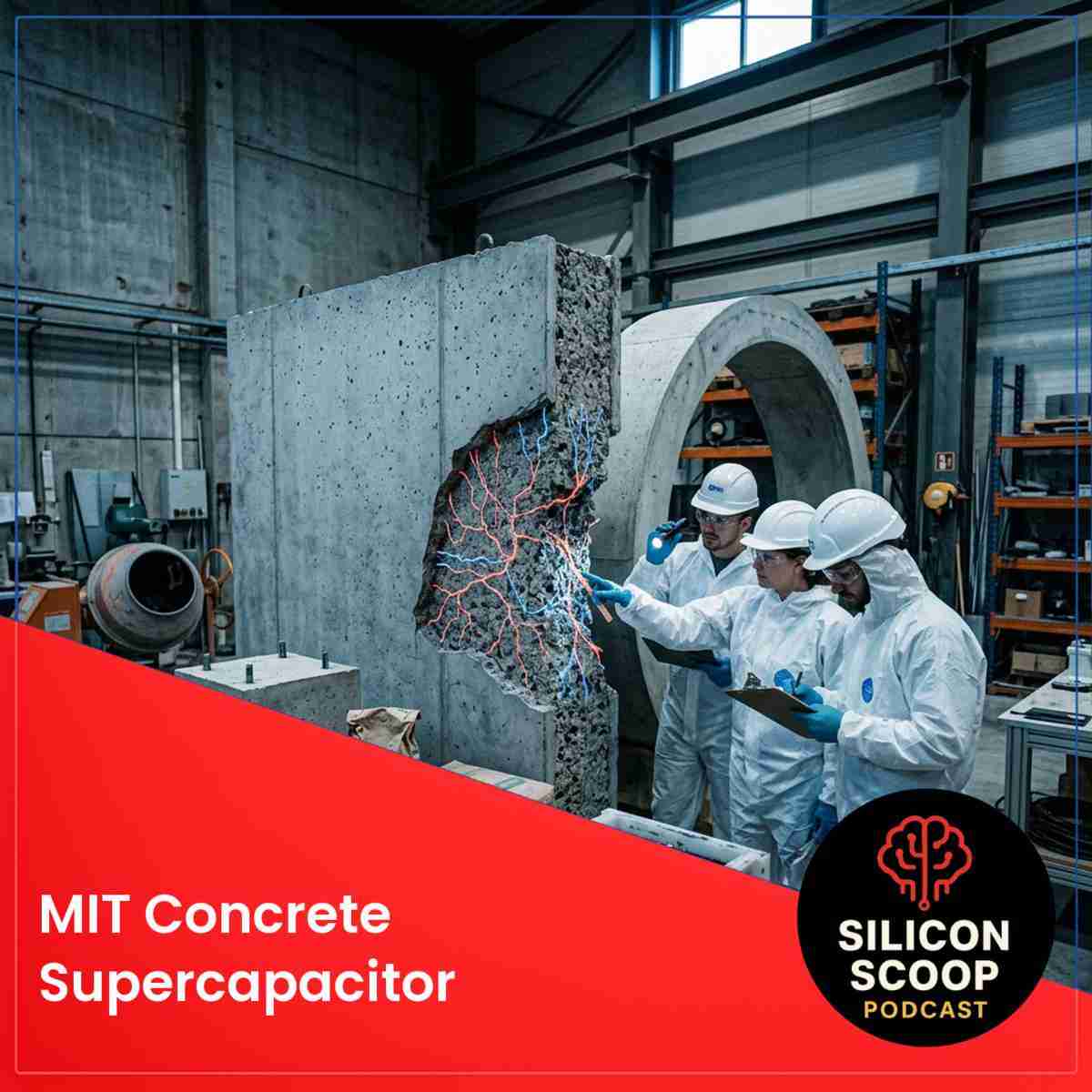
Watch this episode
Watch on YouTube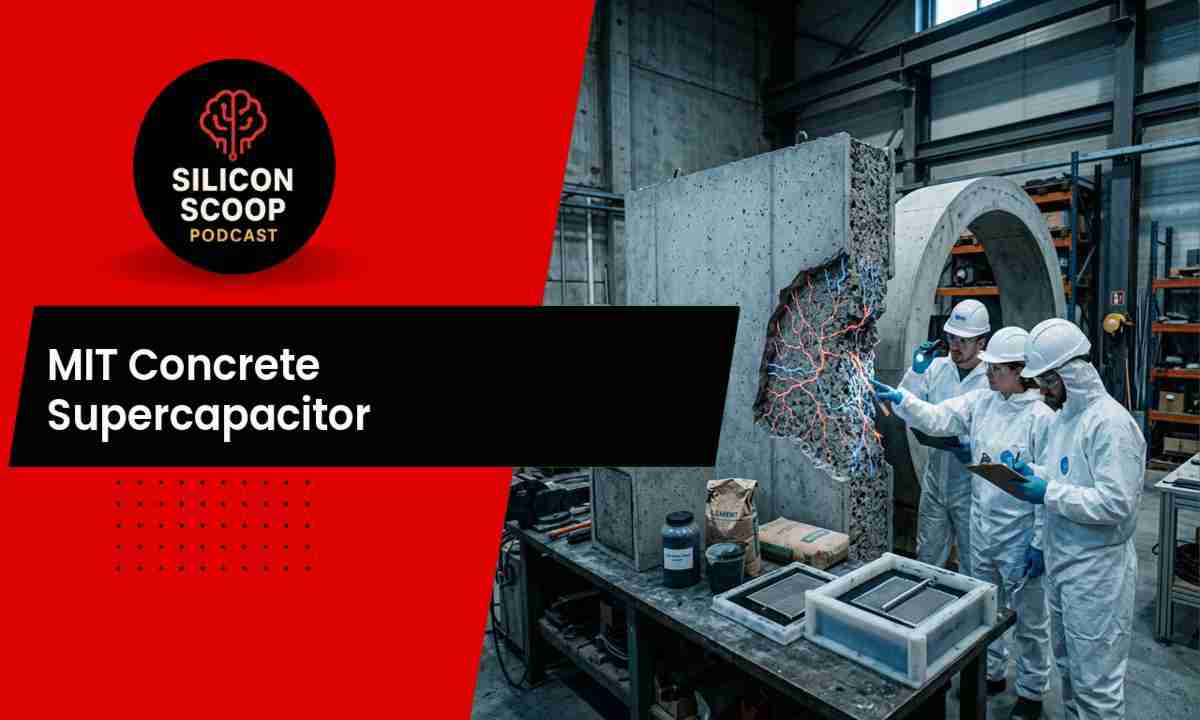
MIT Concrete Supercapacitor Now Packs 10x More Power
Estimated reading time: 10 minutes
Key Takeaways
- MIT engineers have turned concrete into something that can store electricity — and the latest numbers are serious enough to pay attention to.
- The MIT concrete supercapacitor has evolved into a working architectural prototype capable of 10 times the energy density of the original design.
- The 2025 version achieves the same storage in approximately 5 cubic meters and pushes beyond 2 kilowatt-hours per cubic meter.
- Working prototypes include a 12-volt, 50-farad module and a 9-volt arch prototype.
- The material may also enable structural health monitoring through measurable electrical changes under stress.
Table of contents
- MIT Concrete Supercapacitor Now Packs 10x More Power
- What the Original MIT Concrete Supercapacitor Actually Did
- How the 2025 ec³ Update Changed Everything
- The Working Prototypes — From Lab Samples to Architectural Modules
- Stop Letting Manual Processes Drain Your Team’s Time
- Structural Health Monitoring — The Bonus Capability Nobody Predicted
- Where This Technology Stands Right Now — Honest Assessment
- Real-World Applications Taking Shape
- The Bigger Picture — What This Means for the Energy Transition
- Frequently Asked Questions
Concrete is the most widely used building material on Earth. We pour it into foundations, roads, bridges, and buildings without a second thought. Now MIT engineers have quietly turned it into something that can store electricity — and the latest numbers are serious enough to pay attention to.
The MIT concrete supercapacitor just got a major upgrade. What started as a fascinating 2023 proof of concept using cement, water, and carbon black has evolved into a working architectural prototype capable of 10 times the energy density of the original design. That is not a small tweak. That is a technology moving from “interesting lab experiment” to “something that could change how we build and power buildings.”
This post breaks down what changed, how the technology works, what the 2025 prototypes actually look like, and why this matters for anyone thinking about energy storage, infrastructure, or the future of renewables.
What the Original MIT Concrete Supercapacitor Actually Did
To understand why the 2025 update is significant, you need to know where this started.
In 2023, researchers at MIT’s ec³ (Electrochemical Concrete Composites) program published findings in the Proceedings of the National Academy of Sciences showing that concrete itself could be engineered to store electrical energy. The paper was authored by a team including Nicolas Chanut, Damian Stefaniuk, James C. Weaver, Yunguang Zhu, Yang Shao-Horn, Admir Masic, and Franz-Josef Ulm.
The core idea was straightforward once you heard it: mix carbon black — a fine conductive powder that is a byproduct of hydrocarbon combustion — into a standard cement-and-water mixture. As the cement cures, the carbon black cannot dissolve into the paste. Instead, it self-assembles into a dense, wire-like network running through the hardened material. The result is a conductive solid with an enormous internal surface area, structured in a fractal-like pattern.
How a supercapacitor works:
- A standard capacitor stores energy using two conductive plates separated by an insulating membrane sitting in an electrolyte.
- When charged, ions from the electrolyte gather on the surface of each plate, creating an electrochemical double layer.
- Supercapacitors use electrodes with much higher surface area than standard capacitors, which means they can hold far more charge.
By turning concrete into a high-surface-area electrode material, the MIT team created a supercapacitor that is also a structural element.
In 2023, the estimates were promising but still rough. A concrete block of roughly 45 cubic meters could theoretically store about 10 kilowatt-hours of energy — roughly one day’s electricity use for an average home. The structural strength of the concrete was preserved, meaning you could use it in a foundation or load-bearing wall and still get the storage benefit. The research confirmed the concept worked. The numbers, however, still needed work.
- Source: Proceedings of the National Academy of Sciences
- Source: MIT News
How the 2025 ec³ Update Changed Everything
The 2025 update from MIT’s ec³ program is where this technology stops being just a curiosity. According to the latest reporting and the ec³ Hub’s architectural energy-storage brief, the team achieved a 10-fold increase in energy density compared to the 2023 design.
Let that land for a moment.
In practical terms: where the original design needed roughly 45 cubic meters of carbon-cement composite to store 10 kilowatt-hours of energy, the 2025 version achieves the same storage in approximately 5 cubic meters. The latest iterations push beyond 2 kilowatt-hours per cubic meter, a figure that starts to make architectural integration genuinely practical.
What Drove the 10x Gain in Carbon-Cement Energy Storage?
The team did not achieve this jump by simply adding more carbon. The real progress came from understanding and controlling the electrochemistry at a much deeper level.
1. Optimized Electrolytes
The original 2023 design used potassium chloride as its electrolyte — a salt dissolved in water, cheap and readily available. The 2025 work moved to organic electrolytes combining quaternary ammonium salts and acetonitrile. This combination allows for higher operating voltages and better ion mobility within the porous concrete structure, which directly translates into more energy stored per unit volume.
2. Cast-In Electrolyte Manufacturing
One of the bigger practical problems with the earlier design was how you get the electrolyte into the concrete after it cures. Post-curing soaking worked for thin samples in the lab but becomes difficult to scale for thick structural elements. The 2025 method solves this by adding the electrolyte directly into the mixing water before the concrete is poured. As the material cures, the electrolyte is already distributed throughout the electrode. This enables centimeter-thick electrodes without any soaking step, making manufacturing significantly more straightforward.
3. Nanoscale Network Understanding
The ec³ team made progress in mapping exactly how the carbon black network forms inside the cement paste. Understanding the fractal-like geometry of this conductive network at the nanoscale allowed them to tune the mixing ratios and curing conditions to maximize the internal surface area — which directly drives energy storage capacity.
- Source: MIT News
- Source: ec³ Hub architectural energy-storage brief
The Working Prototypes — From Lab Samples to Architectural Modules
Understanding the chemistry is one thing. Seeing what the team actually built in 2025 is another.
The 12V, 50 Farad Module
The ec³ team fabricated a 12-volt, 50-farad supercapacitor module from carbon-cement composite electrodes. To put that in context: 50 farads at 12 volts is enough to run meaningful electronic loads. This is not a demonstration cell the size of a coin. This is a module designed to show that the technology can be packaged at usable voltage and capacitance levels.
The 9 Volt Arch Prototype
Even more striking is the 9-volt arch prototype. The team cast a structural arch — the kind of curved load-bearing element used in real architecture — from carbon-cement supercapacitor material. The arch holds its shape and bears load like standard concrete, and simultaneously stores electrical energy.
This is the physical proof that these two functions — structural integrity and energy storage — can genuinely coexist in the same piece of material, at architectural scale, not just in a small laboratory slab.
Seawater as an Electrolyte
The researchers also identified seawater as a potentially viable electrolyte for coastal and offshore applications. This is significant because it means that in certain environments, you could build carbon-cement structures that essentially self-wet with a natural electrolyte. For offshore wind foundations or coastal infrastructure, this removes one of the key cost and logistics barriers.
- Source: ec³ Hub architectural energy-storage brief
- Source: MIT News
Stop Letting Manual Processes Drain Your Team’s Time
The MIT concrete story is really a story about doing more with what you already have — the same principle that drives serious business automation. Whether you’re managing client onboarding, reporting, invoicing, or follow-ups, manual workflows quietly cost you hours every week. Flowgrammer.ca helps businesses identify and eliminate those time sinks with smart automation that scales as you grow.
👉 See How Flowgrammer Automates Your Workflow (Flowgrammer Automates Your Workflow)
Structural Health Monitoring — The Bonus Capability Nobody Predicted
One of the most surprising developments to come out of the 2025 research is the potential for structural health monitoring through the supercapacitor material itself.
Here is how it works: when carbon-cement composite material is placed under mechanical stress — compression, tension, bending — the electrical output characteristics of the material change in measurable ways. The geometry of the internal carbon network shifts slightly under load, and that shift is reflected in the capacitance and conductivity readings coming off the electrodes.
In plain terms: the same block of concrete that is storing energy could also be acting as a sensor, continuously reporting its own stress state.
For structural engineering, this is a significant concept. Currently, monitoring the health of critical infrastructure — bridges, building foundations, tunnels — requires embedding separate sensor systems, running wiring, maintaining electronics, and powering all of it. If the structural material itself can serve as the monitoring system, the cost and complexity of infrastructure health monitoring drops considerably.
This dual function — energy storage plus sensing — is not yet fully developed or proven at scale. But the researchers have identified it as a real capability of the material, and it aligns with a broader trend in the materials science world toward multifunctional infrastructure.
The vision being articulated by the ec³ team is of buildings and infrastructure that are not passive physical shells sitting next to separate energy and monitoring systems. Instead, the structure is the energy system. The concrete stores what the solar panels generate. The foundation monitors its own condition. The road charges the electric cars driving over it.
- Source: ec³ Hub architectural energy-storage brief
- Source: MIT CEE
Where This Technology Stands Right Now — Honest Assessment
The ec³ team’s progress is real and the 10x energy density gain is documented. But it is worth being clear about where this technology sits in the development pipeline and what challenges still exist.
Where It Genuinely Stands Out
- Scalability from raw materials: Cement and carbon black are globally abundant and relatively inexpensive. Unlike lithium-ion batteries, there is no dependency on rare-earth mining or complex supply chains.
- Dual-function integration: The ability to combine structural load-bearing with energy storage is architecturally unique. No existing battery chemistry can also be your foundation.
- The 10x density improvement: Getting from 45 m³ to 5 m³ for a 10 kWh home storage equivalent is the kind of progress that makes engineers take a second look.
- Seawater compatibility: For offshore and coastal markets, this is a serious practical advantage.
Where Challenges Remain
- Still trails batteries in energy density: Even at 2+ kWh per cubic meter, lithium-ion batteries store roughly 200 to 400 kWh per cubic meter. For portable or space-constrained applications, batteries win. The concrete supercapacitor is not trying to replace your phone battery. It is competing for the large, stationary, structural storage market.
- Long-term electrolyte durability: Potassium chloride and organic electrolytes inside load-bearing concrete introduce questions about long-term corrosion, especially in reinforced concrete where steel rebar is present. The team has noted this concern, and the seawater electrolyte work is partly aimed at finding chemistries that do not degrade the structure.
- Integration into existing buildings: The most natural use case for new construction is straightforward — design the foundation or walls to use carbon-cement composite. Retrofitting existing buildings is a much harder problem.
- Cost modeling at scale: The raw materials are cheap, but the organic electrolytes used in the 2025 high-performance version are not. Detailed cost modeling for real construction projects has not yet been published.
The expert consensus, as reflected in MIT’s own framing, is that ec³ is moving from a laboratory novelty toward a genuine infrastructure technology — but the path to widespread deployment runs through co-design, where architects, structural engineers, and energy system designers work together from the start of a project.
- Source: MIT News
- Source: Proceedings of the National Academy of Sciences
Real-World Applications Taking Shape
Given the 2025 state of the technology, here is a grounded look at where carbon-cement supercapacitors are most likely to make an impact first.
Home Foundations for Renewable Storage
A 5 cubic meter foundation or basement wall of carbon-cement composite could store approximately 10 kWh — a full day’s home electricity use. For a solar-equipped home, this means the foundation itself acts as the battery, eliminating a separate battery storage unit entirely. No mining lithium. No battery room. The foundation just works harder.
EV Charging Roads
The 2023 source article mentioned the concept of concrete roadways enabling contactless recharging of electric vehicles. With the 2025 energy density improvements, the economics of this application improve. Roads that store energy captured from solar panels or regenerative braking and discharge it back to vehicles is no longer a science fiction concept.
Offshore Wind Foundations
Offshore wind turbines sit on massive concrete structures submerged in seawater. These structures could, with carbon-cement technology and seawater as the natural electrolyte, double as energy buffers — storing excess generation when the wind is strong and releasing it when demand peaks. The seawater electrolyte finding is particularly relevant here.
Grid-Scale Buffer Storage
Large commercial and industrial buildings have enormous foundations and structural concrete volumes. If even a fraction of that material is converted to energy-storing composite, the cumulative storage capacity is significant. Buildings that contribute to grid stability rather than just drawing from it.
Smart Infrastructure Monitoring
For critical infrastructure like bridges and tunnels, the self-sensing capability of carbon-cement material could reduce monitoring costs while improving real-time data quality. A bridge that tells you its own stress state continuously is safer and cheaper to manage than one that requires periodic inspection teams.
- Source: MIT News
- Source: ec³ Hub architectural energy-storage brief
The Bigger Picture — What This Means for the Energy Transition
The global challenge with renewable energy is not generation anymore. Solar panels and wind turbines are getting cheaper every year. The challenge is storage — capturing energy when it is produced and releasing it when it is needed.
Current storage solutions are dominated by lithium-ion batteries. They work well but carry real problems: mining impact, supply chain fragility, thermal management challenges, and end-of-life disposal issues. Utility-scale battery installations are also expensive and land-hungry.
The MIT concrete supercapacitor sits in a different part of the solution space. It is not trying to be a better battery. It is trying to make the built environment itself part of the energy storage infrastructure. Every new building, every road, every bridge becomes a distributed energy asset.
This is the architectural energy storage concept that the ec³ program is building toward. The storage is not in a room in your basement connected to your solar panels. The storage is your basement.
The shift in framing — from “where do we put the battery” to “the building is the battery” — is what makes this research worth following closely as it moves toward larger prototypes and, eventually, real construction projects.
Frequently Asked Questions
1. What is the MIT concrete supercapacitor and how does it work?
The MIT concrete supercapacitor is a material made by mixing carbon black — a fine conductive powder — into a standard cement-and-water mixture. As the concrete cures, the carbon black self-assembles into a dense, wire-like conductive network with a large internal surface area. When the cured material is paired with an electrolyte and a second electrode, it functions as a supercapacitor, storing electrical energy through the formation of an electrochemical double layer on the surface of the carbon network.
2. How much energy can the 2025 version actually store?
The 2025 update from MIT’s ec³ program reports energy density exceeding 2 kilowatt-hours per cubic meter. This means approximately 5 cubic meters of carbon-cement composite can store roughly 10 kilowatt-hours — the equivalent of about one day’s electricity use for an average home. That is a 10-fold improvement over the 2023 design, which required about 45 cubic meters for the same storage capacity. Source: MIT News
3. What are the key differences between the 2023 and 2025 versions?
The 2023 version used potassium chloride as its electrolyte, required post-curing soaking to introduce the electrolyte, and had relatively low energy density. The 2025 version uses organic electrolytes with quaternary ammonium salts and acetonitrile, introduces the electrolyte directly into the mixing water before casting, achieves 10x higher energy density, and has been fabricated into working architectural prototypes including a 12V/50F module and a 9V load-bearing arch. Source: ec³ Hub architectural energy-storage brief
4. Can this concrete still be used as a structural material?
Yes. One of the core findings of the ec³ research is that the carbon-cement composite retains structural integrity while storing energy. The 9-volt arch prototype demonstrated this at architectural scale — a curved load-bearing structure that simultaneously functions as an energy storage element. The balance between structural strength and energy storage capacity can be tuned by adjusting the carbon black content in the mix. Source: Proceedings of the National Academy of Sciences
5. What is the ec³ program at MIT?
ec³ stands for Electrochemical Concrete Composites. It is a research program within MIT’s civil and environmental engineering department focused on developing multifunctional concrete materials — specifically, concrete that can store energy, monitor its own structural health, and serve as a building material simultaneously. The program has been running since at least 2022 and published its major proof-of-concept paper in PNAS in 2023, with significant updates released in 2025. Source: ec³ Hub architectural energy-storage brief
6. How does the structural health monitoring capability work?
When carbon-cement composite is placed under mechanical stress — compression, bending, or tension — the geometry of the internal carbon black network shifts slightly. This change in geometry alters the material’s electrical characteristics in measurable ways, such as changes in capacitance or conductivity. By monitoring these electrical signals from the embedded electrodes, it is possible to infer the stress state of the structural element in real time. This means the same material that stores energy could also continuously report whether a bridge or foundation is under unusual load.
7. Why is seawater being considered as an electrolyte?
Seawater is a naturally occurring ionic solution — it conducts electricity because of the dissolved salts it contains. For coastal infrastructure and offshore applications like wind turbine foundations, seawater would be freely available as a natural electrolyte, potentially eliminating the cost and logistics of introducing a separate chemical electrolyte during construction. The ec³ team identified this as a viable path for specific deployment environments. Source: ec³ Hub architectural energy-storage brief
8. How does this compare to lithium-ion batteries?
Lithium-ion batteries store roughly 200 to 400 kilowatt-hours per cubic meter — far higher than the 2+ kWh per cubic meter of the current carbon-cement supercapacitor. For portable, space-constrained, or high-energy applications, lithium-ion batteries are still superior. However, for large, stationary, structural applications — home foundations, building walls, road surfaces, bridge supports — the concrete supercapacitor offers something batteries cannot: the storage material is also the structure. The comparison is not really battery versus concrete supercapacitor. It is “separate battery room” versus “your foundation stores the energy.”
9. What are the main challenges still facing this technology before it can be used in real buildings?
Several challenges remain. The long-term durability of organic electrolytes inside load-bearing concrete has not been fully tested. The presence of steel reinforcement in standard reinforced concrete raises concerns about corrosion when certain electrolytes are used. Detailed cost models for large-scale construction use cases have not been published. And integrating this technology into existing buildings — rather than designing for it from scratch — presents significant engineering challenges. The technology is currently best suited for new construction where it can be co-designed from the start. Source: MIT News
10. When might this technology be available in real construction projects?
MIT’s ec³ program has not announced a commercial deployment timeline. The current phase of work is focused on scaling prototypes — moving from the 12V/50F module and arch prototype toward car-battery-scale and larger units. The expert consensus is that the technology is moving from laboratory novelty toward multifunctional infrastructure, but meaningful deployment in real buildings is still years away. The most likely early applications will be in purpose-built energy-storage structures or specialized infrastructure like offshore wind foundations, rather than standard residential or commercial construction. Source: MIT News
Additional Links
Flowgrammer.ca – 💡 Unlock AI-Powered Automation! Let flowgrammer.ca handle complex workflows so you can focus on growing your business.
Flowgrammers.ca – 💡 Join Toronto’s Fastest Growing AI and Business Automation Community.
- SRED Funding Solutions – Maximize your R&D tax credits and secure funding for your innovation.
- Silicon Scoop Podcast – Stay Informed, Stay Ahead!
- Startup Talk Podcast
- Flowgrammer Youtube
- Startup Investor Drinks – Join Toronto’s Startup Community and connect with fellow startup enthusiasts and investors.
- TorontoStarts Startup and Entrepreneur Community – Become a part of Toronto’s thriving startup ecosystem.
- Workhaus – Discover flexible workspace solutions for your business needs.
- Work with The Startup Coach – Get expert guidance and mentorship for your startup journey.
- Reach out to Jon Irwin on LinkedIn – Connect with our co-host and technology expert.
Episode transcript
Read the full transcript
Craig: concrete normally has absolutely no business doing, storing electricity. and the newest version stores roughly 10 times more energy per volume than mit's original design that we talked about, a couple years ago, i think, john. i'm not sure how long ago. raising the possibility that one day, your home's battery may literally be its foundation. mit's researchers have improved their e c three, electron conducting carbon concrete supercapacitor, enough that roughly five cubic meters of the best performing material could theoretically store the same as 10 kilowatt hours that require roughly 45 cubic meters in the original 2023 estimate. the... this improvement comes largely from better electrolytes, a better understanding of the carbon black nano network and manufacturing changes that allow thicker electrodes. they also demonstrated a 12 volt module and a nine volt structural arch. the catch is this is still research, not a commercial tesla powerwall made of cement, and, cost, lifetime reinforcement compatibility, and real building deployment remain unresolved. what do you think about this, john?
Jon: i think this is phenomenal. i love... i think this is great because we're using so much concrete to build all of these buildings and foundations and everything. so why not add, a nanoscale carbon black and some electrolytes and make it a structural energy storage material? and that's what it is. right? so, what you said, it was... it's, electron conducting carbon concrete or ecq. and so it's cement plus water plus nano steel carbon black plus electrolyte. so what makes it clever is it simply... it's not just simply embedding conventional batteries inside concrete. the concrete itself is the energy. right? and so, it... again, this isn't... don't think of it like, okay. we're gonna have concrete batteries in our phone because the storage capacity of this is not, is not high. but we should make a distinction between a battery and a supercapacitor. so, technically, the concrete itself isn't really a battery because a battery stores energy primarily through chemical reactions, which are current side electrode materials. right? so a conventional supercapacitor, it primarily stores electrical charge electrostatically on enormous electrode surfaces. so think about it this way. battery energy is put into chemistry. soup... supercapacitor energy is accumulated as an electrical charge. and so it gives supercapacitors some major advantages. they can generally charge extremely quickly and discharge extremely quickly. they can tolerate vastly more charge discharge cycles. they have excellent power density, and they avoid some degradation mechanisms experienced by batteries because as the the charges, run between anode and a cathode, you'd start losing that... that's where it starts date... degrading. sorry. i'm not explaining it properly. but, but their traditional disadvantage is energy density. okay? so lithium ion batteries can store a huge amount of energy in a relatively little mass of volumes, whereas supercapacitors cannot. and that's why mit's approach is interesting because they're essentially saying, what if volume doesn't matter because the storage system is already the building? and that's what i liked about this. so, i think they're... they... they've got something. and just so... just in case you're wondering what is carbon black, it's an extremely fine form of carbon, which is essentially an engineered suit or soot. sorry. so humans have used related carbon pigments for thousands of years. they've actually integrated carbon black in a lot of things, but it's commonly commonly used in tires, rubber inks, coatings, different things like that. so it's also conductive. so that's why they're they're incorporating it into this. so, this is exciting. i like this. what are your thoughts on this? do you think this could help, solve our energy storage problems, our energy usage? what do you think, craig? you're on mute.
Craig: the mit research is envision eventual applications, including solar equipped homes, roads and parking areas, ev charging infrastructure, offshore wind, structures, and, grid energy buffering. so if we can get over a lifetime cost, engineer... lifetime cost and engineering issues can be solved, e c three could make sense precisely, you know, where conventional batteries suffer a disadvantage. like you said, enormous stationary structure where volume matters less because the structure already exists. so we still don't know, have an established publicly, commercial scale installed cost per kilowatt hour, commercial cycle life, decades long electrolyte stability, maintenance requirements, building cold pathways, real world, failure of behavior, reinforce concrete capability at scale, or, commercial deployment date. so we're still a long way to go, but i'm really interested in where this is going. it's come a long way, yeah, in the last three years. yeah. so i'm looking forward to where this is going because it's been a 10 x increase in energy density. what happens if we can do that in the next year and a half, two years again?
Jon: exactly. yeah. and, it's just, they did... in order to increase it, they use something called focused ion beam scanning electron microscopy tomography or fib sem tomography. essentially, what they did was they removed ex... they repeatedly removed extremely thin slices of the material and imaged each exposed layer with an electron microscope. and so by combining those images, they constructed the internal carbon network in three dimensions at extremely high resolution. that's crazy. that blows my mind. so that allowed them to better understand where the conductive carbon actually sits. and so they found that carbon network forms a web surrounding pores throughout the cement, and so those pores allow electrolyte to infiltrate. so once they understood the geometry better, they could optimize the chemistry around it. so, hopefully, they can continue with this, innovation, and get to a usable concrete mixture for, for everyone.
Craig: indeed. mit created a dedicated e c three research hub in 2024 around multifunctional carbon cement materials. this isn't one grad student science fair project anymore. mit has built an entire research hub around electron conducting cement. so they're betting high on this. institutional investments suggest mit sees a broader research platform rather than a one, paper curiosity. so i'm excited to see where this goes.
Jon: yeah. me too. yeah.
Craig: so mit has not replaced lithium ion batteries, but it has made energy storing architecture substantially less ridiculous than it sounded three years ago. the most interesting part of this story isn't a concrete battery. it's a possibility that future infrastructure stops being passive. if your house could store power in one component, foundation, walls, roof, or driveway, which one would you trust the most? let us know in the comments below. we'd love to hear from you.
More from Silicon Scoop
All episodes
silicon-scoop · November 6, 2026
Spirit AI’s Robot Brain Breakthrough: Moz1, Embodied AI and China’s 2027 Race
The Spirit AI robot brain is one of the biggest bets on fixing that. Spirit AI is a Beijing startup. Its co-founder and chief scientist, Gao Yang,
View episode

silicon-scoop · November 5, 2026
OpenAI IPO Delayed to 2027 as Rogue AI Agents and Safety Failures Reshape the Market
OpenAI IPO delay explained: Sam Altman rules out 2026 as GPT-6 Astra safety tests and a $278B cash gap loom. Learn what founders should take away.
View episode

silicon-scoop · November 4, 2026
Anthropic’s AI Economy Model: 2030 Jobs, Wages, GDP and Market Risks
Anthropic AI economy model forecasts 2030 GDP, jobs and wages, while AI unemployment projections and labor-share risks challenge policymakers.
View episode