
China’s Humanoid Robots Shatter Speed Records as U.S. Slams Door on Foreign AI Hardware
World Humanoid Robot Games showcase Chinese humanoid robots smashing sprint records amid FCC humanoid robot ban and Unitree Robotics national security scrutiny.
With Craig Major and Jon Irwin
Watch this episode
Watch on YouTube
Chinese Humanoid Robots Beat Usain Bolt at the World Humanoid Robot Games
Estimated reading time: 10 minutes
Key Takeaways
- The World Humanoid Robot Games just changed what we thought machines could do.
- A robot ran 100 meters in 9.39 seconds. Usain Bolt ran it in 9.58 seconds back in 2009.
- Another robot cleared 2.88 meters in the standing high jump. The human record is 2.45 meters, set by Cuba’s Javier Sotomayor in 1993.
- The U.S. Federal Communications Commission added “advanced robotic devices” to its national security Covered List on July 28, 2026 — effectively banning new Chinese humanoid and quadruped robots from entering the American market.
- What you’re witnessing is not just a sports story. It’s a geopolitical one.
Table of contents
- Chinese Humanoid Robots Beat Usain Bolt at the World Humanoid Robot Games
- Key Takeaways
- The World Humanoid Robot Games — What Is This Event and Why Does It Matter?
- The Record-Breaking Numbers — Breaking Down What Actually Happened
- The U.S. Response — FCC Humanoid Robot Ban and the Unitree Robotics National Security Fight
- What This Means for the Future of Humanoid Robotics
- What to Watch Next
- Frequently Asked Questions (FAQ)
The World Humanoid Robot Games just changed what we thought machines could do.
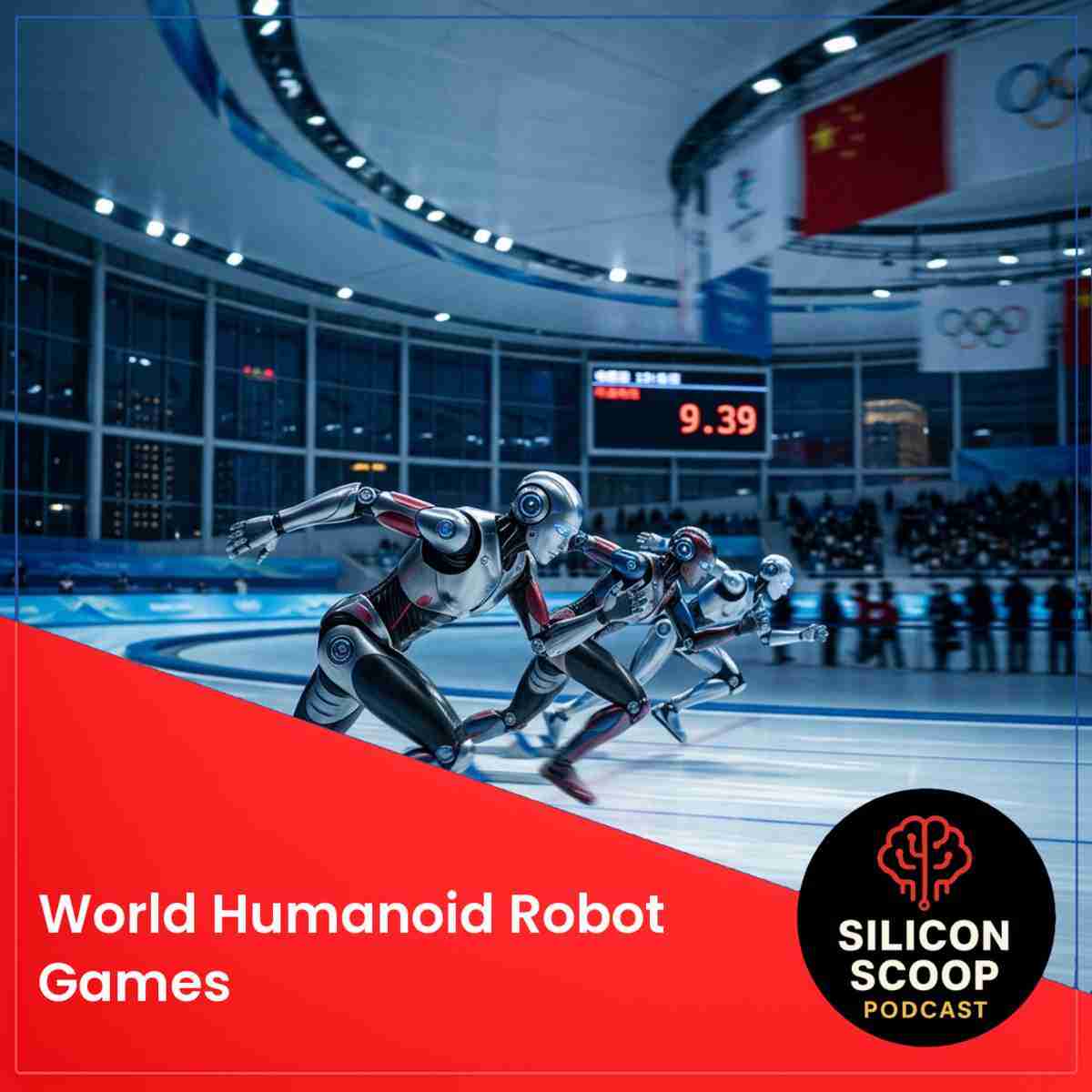
On August 22, 2026, inside Beijing’s iconic National Speed Skating Oval — the same arena built for the 2022 Winter Olympics — more than 2,000 humanoid robots took to a track, a field, and a competition floor to do something nobody had done before: beat human world records in a live, organized sporting event.
A robot ran 100 meters in 9.39 seconds. Usain Bolt ran it in 9.58 seconds back in 2009. That record stood for 17 years. A machine wiped it out in a single heat.
Another robot cleared 2.88 meters in the standing high jump. The human record is 2.45 meters, set by Cuba’s Javier Sotomayor in 1993. Gone.
This is not a lab demo. This is not a controlled simulation. This happened on a real track, in a real arena, in front of a live audience — and it signals a shift in what bipedal robots are now capable of.
But the story doesn’t stop at the finish line. At the same time Beijing was hosting this spectacle of robotic performance, the United States was quietly closing its doors to Chinese robot hardware. The U.S. Federal Communications Commission added “advanced robotic devices” to its national security Covered List on July 28, 2026 — effectively banning new Chinese humanoid and quadruped robots from entering the American market.
What you’re witnessing is not just a sports story. It’s a geopolitical one.
—
The World Humanoid Robot Games — What Is This Event and Why Does It Matter?
The World Humanoid Robot Games are exactly what they sound like: an Olympics-style competition, but for robots.
Now in its second year, the five-day event is held in Beijing and features 51 events and more than 1,000 individual competitions. Events include sprinting, table tennis, soccer, weightlifting, and tug of war. This year, 16 countries are participating — including Germany, Japan, and the United States.
The games opened the same week as the 2026 World Robot Conference in Beijing, where companies showcased around 3,000 robotic products. The back-to-back timing was not accidental. China is clearly positioning itself as the global leader in humanoid robotics, and it wants the world watching.
Over 2,000 humanoid robots participated in this year’s event, according to the organizers. Hundreds of them marched in synchronized formation during the opening ceremony — a visual that was equal parts impressive and eerie, depending on who you asked.
Why does this event matter beyond the spectacle?
- It gives engineers a competitive, real-world performance benchmark outside of the lab.
- It forces rapid iteration. Teams modify hardware between rounds (Honor lengthened a robot’s legs by about 10 cm to improve stride length and speed).
- It creates a public, trackable record of how fast bipedal locomotion technology is advancing.
- It gives Chinese companies a high-profile stage to demonstrate export-ready hardware to international buyers.
Technical observers have noted that achieving sub-9.5-second sprint times isn’t just a “cool trick.” It means that the actuators, balance algorithms, and power density inside these Chinese humanoids have reached a point where dynamic stability at top sprint speeds is now reliably reproducible. That’s a significant engineering milestone.
(Source: news.cgtn.com)
—
The Record-Breaking Numbers — Breaking Down What Actually Happened
Let’s go through the specific performances and what they mean technically.
The 100-Meter Sprint Records
Tiangong Ultra (Team Tianzhuo / Beijing Humanoid Robot Innovation Center): 9.39 seconds
Chinese state and international media have identified the primary 9.39-second record holder as the Tiangong Ultra robot, fielded by Team Tianzhuo and developed in partnership with the Beijing Humanoid Robot Innovation Center. This is not a lightweight prototype — it is a full-size humanoid designed for dynamic bipedal locomotion.
To put 9.39 seconds into context: Usain Bolt, widely considered the fastest human who has ever lived, ran his world record of 9.58 seconds in Berlin in 2009. This robot beat that by nearly two-tenths of a second.
Honor’s “Lightning”: 9.32 seconds (unofficial) / 9.47 seconds (official heat)
Chinese smartphone company Honor entered a humanoid nicknamed “Lightning” into the games. Before the official competition, Lightning posted an unofficial trial run of 9.32 seconds at a peak speed of 14.5 meters per second — faster than any human has ever run.
During official heats, Lightning recorded 9.47 seconds, still under Bolt’s human record.
The performance improvement came, in part, from a deliberate hardware modification: engineers extended the robot’s leg length by approximately 10 centimeters. That single change increased stride length, which directly translated into speed. This kind of rapid, mid-competition hardware tuning shows that form factor optimization is now a real performance lever in robotic athletics.
(Source: www.reuters.com)
The Standing High Jump
X-Humanoid: 2.88 meters
A humanoid robot from Beijing-based company X-Humanoid cleared 2.88 meters in the standing high jump. The human world record is 2.45 meters, set by Javier Sotomayor in 1993.
This is a different kind of achievement from the sprint. The standing high jump requires explosive vertical power generation from a stationary position — it demands that the robot convert stored electrical energy into a single, perfectly timed muscular impulse, maintain balance during the jump, and land without falling.
Technical observers point to the X-Humanoid platform’s use of active compliance and high-torque joint design as the key engineering factors. The robot’s joints can store and release energy rapidly, like a spring-loaded system, enabling the kind of explosive vertical movement that humans achieve through trained muscle elasticity.
(Sources: news.cgtn.com | ceevis.com)
What the Experts Are Actually Saying
Experts are being careful not to overstate the real-world implications — at least for now.
Most specialists acknowledge that humanoid robots are still primarily used for demonstrations, performances, and research environments. Mass deployment in everyday workplaces and homes remains years away. The gap between “can sprint on a prepared track” and “can reliably perform complex, unstructured tasks in a warehouse or hospital” is still enormous.
But that’s not the point of these records.
The point is that the underlying engineering — actuator torque, balance algorithms, power density, limb geometry — has crossed a threshold. Dynamic stability at top sprint speeds is now achievable and reproducible. That foundation supports everything that comes next.
Beijing spectator Li Yanfeng put it plainly: “Humanoid robots are evolving rapidly. I was even a bit resistant to [AI], because of the possibility that it might replace or displace humans. But now that I see this development is unstoppable, I decided to come and take a look.”
—
The U.S. Response — FCC Humanoid Robot Ban and the Unitree Robotics National Security Fight
While Beijing was celebrating new robotic records, Washington was building a wall.
What the FCC Did on July 28, 2026
On July 28, 2026, the U.S. Federal Communications Commission expanded its Covered List — a national security mechanism previously used to block Huawei, ZTE, and DJI products from the American market — to now include “advanced robotic devices.” This category covers humanoid robots and quadruped robots, as well as certain connected power inverters.
The practical effect is stark: any new Chinese humanoid or quadruped robot model that does not already hold FCC equipment authorization cannot be imported, marketed, or sold in the United States.
This is not a tariff. It is not a tax. It is a structural market exclusion.
The FCC cited national security concerns — specifically risks related to supply-chain vulnerabilities and potential data exfiltration through networked robotic hardware. Analysts and security-focused commentators argue this move treats advanced foreign robots the same way the U.S. previously treated high-risk telecom equipment and consumer drones: as potential vectors for surveillance, data theft, or remote compromise.
(Sources: www.nbcnews.com | www.theregister.com | www.techtimes.com)
How This Hits Unitree Robotics
Unitree Robotics is one of China’s most prominent robotics companies and one of the most recognized names in global quadruped and humanoid robot hardware. The Pentagon recently added Unitree to its Section 1260H list — a register of companies deemed to have ties to the Chinese military — under the FY2021 National Defense Authorization Act framework.
Here’s the key detail: Unitree has told investors that six of its existing models secured FCC authorization before the July 28 rule change. Those models — humanoids G1, H2, and R1, and quadrupeds Go2, B2, and A2 — can continue to be sold and operated in the United States under the existing authorizations.
But Unitree’s next-generation H1 Pro, which was scheduled for a North American commercial launch on August 12, 2026, now has no viable regulatory pathway for new hardware authorization. That launch is effectively frozen.
This is not a minor setback. It cuts off Unitree’s North American expansion roadmap at a critical moment, forcing the company to redirect its commercial strategy toward Asian markets and other regions without comparable security-based bans.
(Sources: www.sofx.com | www.techtimes.com | www.cryptopolitan.com)
The Bigger Geopolitical Picture
China makes the majority of the world’s humanoid robots. That is not a projection — it is the current production reality.
The FCC’s Covered List expansion is widely seen as a deliberate attempt to pre-empt Chinese hardware from becoming embedded infrastructure in American homes, businesses, hospitals, and logistics operations — before that integration becomes difficult to reverse.
Market analysts expect Unitree and similar companies to pivot harder toward Southeast Asia, the Middle East, and European markets that have not yet implemented equivalent bans. This is accelerating a geographic split in advanced robot deployment: a U.S.-aligned ecosystem on one side, and a Chinese-led ecosystem on the other.
The bifurcation is not hypothetical. It is happening now, driven by regulatory action and national security logic.
(Sources: www.globaltimes.cn | www.sofx.com)
—
Is Your Business Still Running on Manual Processes?
While the world debates which robots will run your future warehouse, most businesses are still losing hours every week to tasks that could be automated today — data entry, follow-ups, scheduling, reporting, and more.
At Flowgrammer, we build custom automation systems that cut the manual work out of your operations so your team can focus on what actually moves the needle. Whether you’re a solo operator or scaling a mid-size company, we make your workflows run themselves.
👉 See What Flowgrammer Can Automate For You (Flowgrammer)
—
What This Means for the Future of Humanoid Robotics
The Hardware Gap Is Closing Fast
The record-breaking performances at the World Humanoid Robot Games are a proxy measurement for something much broader: the rate at which Chinese robotic engineering is advancing.
Consider the trajectory:
- Two years ago, humanoid robots could walk stably on flat surfaces and perform scripted gestures.
- Today, they are sprinting faster than the fastest human who has ever lived and clearing high jump records set three decades ago.
That rate of improvement — driven by competition benchmarks, state funding, and a massive domestic manufacturing base — shows no signs of slowing.
Chinese companies like Unitree, X-Humanoid, and the Beijing Humanoid Robot Innovation Center are iterating quickly, publicly, and with direct competitive pressure from each other. The games format is accelerating development by giving engineers measurable performance targets and real-world stress tests outside of controlled lab environments.
Real-World Deployment Is Still the Hard Part
Despite the record-breaking numbers, experts are consistent on one point: the path from “athletic demonstration” to “reliable commercial deployment” is long and non-trivial.
Sprinting on a prepared track is not the same as navigating a crowded hospital corridor, picking up fragile objects with varying shapes, or responding to unexpected physical obstacles. The real deployment challenges involve:
- Unstructured environments where the robot must make real-time decisions
- Extended battery life for multi-hour operational shifts
- Cost reduction to make humanoid robots accessible to mid-size businesses
- Maintenance and repair infrastructure at scale
- Legal and liability frameworks for robot-related incidents
None of these are solved by a 9.39-second sprint. But the sprint proves that the physical hardware — the motors, joints, power systems, and balance software — is maturing rapidly. That foundation brings everything else closer.
The Regulatory Landscape Is Becoming the Battlefield
For businesses and investors watching this space, the more immediate story may not be what robots can do physically — it is who gets to sell them where.
The FCC’s Covered List expansion has created two distinct robotic markets: one inside the U.S., shaped by national security rules and likely to favor domestic manufacturers like Boston Dynamics, Figure AI, and Agility Robotics; and one outside the U.S., dominated by Chinese platforms at competitive price points.
This split creates concrete decisions for companies planning to invest in robotics:
- U.S. businesses will be funneled toward American or FCC-cleared platforms, which may carry higher price tags but offer regulatory certainty.
- Global businesses outside the U.S. will have access to a wider range of Chinese platforms, potentially at lower costs, but with their own geopolitical and supply-chain risk considerations.
The World Humanoid Robot Games is the visible face of a technology race. The FCC Covered List is the structural mechanism shaping who wins commercially.
(Sources: www.theregister.com | www.techtimes.com)
—
What to Watch Next
Here are the specific developments worth tracking over the next 6 to 12 months:
- Unitree H1 Pro’s non-U.S. launch path — where does the company pivot, and at what scale?
- Whether the EU introduces its own advanced robotic device restrictions aligned with U.S. Covered List logic under its AI Act framework
- Competitive performance benchmarks from the 2027 World Humanoid Robot Games — will the sprint record break 9.0 seconds?
- Investment activity in U.S. domestic humanoid manufacturers as the regulatory wall creates a protected home market
- Whether any Chinese robotics company successfully obtains new FCC authorization through a non-standard pathway, such as a Department of Defense waiver
The story that started at a track meet inside an Olympic arena is going to play out across boardrooms, regulatory agencies, and factory floors for years to come.
—
Frequently Asked Questions (FAQ)
1. What is the World Humanoid Robot Games?
The World Humanoid Robot Games is an Olympics-style competition held in Beijing for humanoid robots. Now in its second year, the five-day event features 51 events and more than 1,000 competitions, including sprinting, table tennis, soccer, weightlifting, and tug of war. In 2026, 16 countries participated and over 2,000 robots competed. It takes place at the National Speed Skating Oval, which was built for the 2022 Winter Olympics.
2. What records did Chinese humanoid robots break at the 2026 event?
Two major human world records were broken. The Tiangong Ultra robot, fielded by Team Tianzhuo and the Beijing Humanoid Robot Innovation Center, ran 100 meters in 9.39 seconds, beating Usain Bolt’s human record of 9.58 seconds. An X-Humanoid robot cleared 2.88 meters in the standing high jump, surpassing the human record of 2.45 meters set by Javier Sotomayor in 1993. Honor’s robot “Lightning” also ran the 100 meters in an unofficial 9.32 seconds during a trial run.
3. What is the Tiangong Ultra robot?
The Tiangong Ultra is a full-size humanoid robot developed by Team Tianzhuo in collaboration with the Beijing Humanoid Robot Innovation Center. It achieved a 9.39-second 100-meter sprint at the World Humanoid Robot Games, setting the official record that surpassed Usain Bolt’s human benchmark. It represents one of several elite Chinese bipedal platforms now capable of matching or exceeding human athletic performance in controlled competition settings.
4. Who is Honor’s “Lightning” robot and why does the leg modification matter?
Lightning is a humanoid robot entered by Honor, the Chinese smartphone and electronics company. Engineers modified the robot’s leg length by approximately 10 centimeters before competition to increase stride length, which directly improved running speed. Lightning posted an unofficial 9.32-second 100-meter run at a peak speed of 14.5 meters per second, then ran an official heat in 9.47 seconds — both under Bolt’s human record. The leg modification demonstrates that hardware tuning is a direct and practical performance lever in competitive robotics.
5. What did the FCC do on July 28, 2026 and why does it matter?
On July 28, 2026, the U.S. Federal Communications Commission expanded its Covered List — a national security tool previously used to restrict Huawei, ZTE, and DJI products — to include “advanced robotic devices,” a category covering humanoid robots and quadruped robots. This means that any new Chinese robot model without prior FCC equipment authorization cannot be imported, marketed, or sold in the United States. The FCC cited supply-chain security risks and potential data exfiltration through networked robotic hardware as the justification.
6. What is Unitree Robotics and how has it been affected?
Unitree Robotics is one of China’s leading humanoid and quadruped robot manufacturers. The Pentagon added it to the Section 1260H list of companies deemed to have ties to the Chinese military. Six of its existing models — G1, H2, R1, Go2, B2, and A2 — hold FCC authorization from before July 28, 2026, so those can still be sold in the U.S. However, Unitree’s planned North American launch of the H1 Pro, scheduled for August 12, 2026, has no viable authorization pathway under the new rules, effectively freezing that product’s entry into the American market.
7. Can businesses in the U.S. still buy or use Chinese humanoid robots?
Yes, but only models that had FCC equipment authorization before July 28, 2026. For Unitree, that means the G1, H2, R1, Go2, B2, and A2 can still be sold and operated in the U.S. under existing authorizations. New models — including next-generation platforms from any Chinese manufacturer — cannot receive the required authorization to be imported or sold. This creates a bifurcated market where U.S. buyers are increasingly limited to pre-approved hardware or domestic alternatives.
8. Why is the U.S. treating humanoid robots as a national security issue?
U.S. regulators and security analysts view advanced networked robots — particularly those with cameras, microphones, LiDAR sensors, and cloud connectivity — as potential vectors for surveillance or data collection by foreign governments. The FCC’s Covered List mechanism treats these robots similarly to how it previously treated Huawei telecom equipment and DJI drones: as hardware that could create embedded supply-chain risks inside American critical infrastructure, homes, or commercial facilities. The Pentagon’s move to list Unitree as a Chinese military-linked company reinforces this framing.
9. Are humanoid robots ready for real-world commercial deployment?
Not at mass scale — not yet. Experts broadly agree that while the athletic performances at the World Humanoid Robot Games demonstrate significant advances in bipedal locomotion, power density, and dynamic balance, the gap between sports competition and reliable real-world operation remains large. Key unsolved challenges include navigating unstructured environments, extending battery life for full-day operational shifts, reducing unit costs, scaling maintenance infrastructure, and resolving legal frameworks around robotic incidents. The records represent a maturing engineering foundation, not commercial readiness.
10. What does this mean for businesses and investors watching the robotics industry?
The combination of Chinese robots hitting human athletic benchmarks and the U.S. closing its market to new Chinese hardware is accelerating a geographic split in the global robotics industry. U.S. businesses will be channeled toward FCC-cleared or domestically made platforms — likely at higher prices but with regulatory certainty. Businesses outside the U.S. will have broader access to Chinese platforms at competitive price points. Investors should watch for increased funding into U.S. domestic humanoid manufacturers, Unitree’s pivot toward Asian and non-U.S. markets, and whether other countries follow the FCC’s lead with their own restriction frameworks.
Additional Links
Flowgrammer.ca – 💡 Unlock AI-Powered Automation! Let flowgrammer.ca handle complex workflows so you can focus on growing your business.
Flowgrammers.ca – 💡 Join Toronto’s Fastest Growing AI and Business Automation Community.
- SRED Funding Solutions – Maximize your R&D tax credits and secure funding for your innovation.
- Silicon Scoop Podcast – Stay Informed, Stay Ahead!
- Startup Talk Podcast
- Flowgrammer Youtube
- Startup Investor Drinks – Join Toronto’s Startup Community and connect with fellow startup enthusiasts and investors.
- TorontoStarts Startup and Entrepreneur Community – Become a part of Toronto’s thriving startup ecosystem.
- Workhaus – Discover flexible workspace solutions for your business needs.
- Work with The Startup Coach – Get expert guidance and mentorship for your startup journey.
- Reach out to Jon Irwin on LinkedIn – Connect with our co-host and technology expert.
Episode transcript
Read the full transcript
Craig: a year ago, the fastest robot needed more than twenty one seconds to run a 100 meters. this weekend in beijing, a humanoid did it in nine point three nine seconds faster than usain bolt and then demonstrated one very important limitation. it basically needed a padded wall to stop. and while china is turning robot athletics into a national spectacle, washington has effectively locked most new foreign built advanced robots out of the us market. so china's second world humanoid robot games has produced the most eye catching humanoid performance yet. tiangong ultra ran a 100 meters in an independently reported nine point three nine seconds, beating usain bolt nine point five eight seconds, humans record. while the other robots posted remarkable jumping, and middle distance performances, the bigger story is the rate of progress. last year's winning robot took twenty one point five seconds combined with a new us fcc rule preventing mostly new introduced foreign produced advanced robots from receiving authorization needed for the american market. the catch is that sprinting isn't the same as a useful autonomy. many of these machines can run astonishing fast while stopping. manipulating and messy real world tasks are completely different situation. what do you think about this, john? is our... or is it going too far? is it taking off too fast?
Jon: it's... no. not... none. i never wanna hinder progression, but i am scared of the progression. so the thing the thing about this is just to kind of talk about this is the kind of improvement that we're talking about from two point... twenty one point five zero seconds to nine point three nine seconds. it's not just a matter of installing bigger motors. k? running is one of the hardest locomotion problems in robotics because unlike walking, the robot regularly enters a a flight phase in which neither foot touches the ground. and so every landing generates substantial forces through the ankle, knee, hip, and structural frame. so the controller itself has milliseconds to determine where the robot's center of mass is moving, estimate its orientation and angular velocity, calculate the next foot placement, command the joints, and correct errors before the machine falls. so in other words, what you're seeing, it advances across several disciplines simultaneously. so we're talking actuated power density plus structural engineering plus balance control plus sensing plus real time computing, plus locomotion algorithms. and so, that's... it's... it... like, if you think about how complex running is and how they're accomplishing this, it blows my mind. with a... what you need to think about it, you need to think of the robot as a cons... as constantly solving physics problems hundreds of thousands of times every second. so there's tons of sensors such as inertial measurement units, what measure acceleration orientation. encoders tell the computer where individual joints are positioned. the robot's controller estimates the body's position and velocity and determines how much torque each joint should generate. so for a running humanoid, the system has to coordinate hips, knees, ankles, upper body movements, all while keeping the robot center of mass inside a dynamically recoverable region. so this is sometimes described as whole body control, model predictive control. there's a bunch of different things. so instead of programming move knee 20 degrees, then move right knee 15 degrees, the engineers have to increasingly train control policies around objectives. so for example, move forward quickly while maintaining balance and minimizing instability or energy loss. so this, like, this improvement is amazing, but also scares the crap out of me because, yeah, there's no way we're gonna be able to run these robots now.
Craig: yeah. robots can sprint faster than humans, but can they reliably plug in a cable, load a dishwasher, work for eight hours, recover after an error, operate safely around people. and reuters reports that more than 40% of the game scenario tests required full autonomy. so that means 60% didn't and argues those work oriented tasks... tests may actually tell us more about commercialization than track tests. but they also beat us at the standing high jump where the x humanoid, did 2.88 meters from a standing high jump where a human's world record is 2.45 meters set by javier sotomayor in 1993.
Jon: yeah.
Craig: so the second world humanoid robot games opened in beijing august 22, 2026. roughly 20... i left... just over 2,000 robots. 666 teams in 16 countries participated. there are 51, events. and so i guess the story is it's moving so fast and that the us is shutting down imports of these kinds of things. so the question becomes, is north america going to fall faster behind because of this, or are they keeping this kind of stuff behind lock and key? you know? it's hard to say we're falling behind because, again, i didn't look at this. did elon musk robots jump in the, this? did figure robots jump into this? did boston dynamics robots jump into this? so i don't know. when you start looking at just boston dynamics alone, i don't know how far behind we are. yeah. but i'd be interesting to see how fast are those boston dynamic dogs with the flamethrowers on them.
Jon: yeah. but the... so the one thing that eases my mind is that we have not created an energy source that can power these robots in... indefinitely. and so, at least that... we have that, safety guard for now... safety rail for now. right?
Craig: absolutely. so anyone thinking, great. where do i order a robot that folds by a laundry? we definitely aren't there yet.
Jon: yeah. yeah. there are... well, no. there are commercial robots that can assemble a car. right? they each have their own task. but, yeah, doing tasks... home tasks, they're not there yet. there is one robot that got released. can't remember the name of it. did we cover it? where it had the platform, the wheels platform, and it could fold laundry, i think. that was the one task it could do.
Craig: we've covered a lot of robots. i'm just not a 100% sure. and i've seen some of the folding laundry robots just simply fail too. so we'd have to see how, yeah. we could go
Jon: back to the yawn locust stuff that we talked about. right? yeah. no. yeah. that's where this comes into play for these robots. so,
Craig: robots beating human athletic benchmarks is real progress, but the larger story is how quickly the hardware is improving while the global robotics market is simultaneously splitting along geopolitical lines. the question isn't whether robots will eventually outrun us. they already can. the question is when one can show up monday morning, do a useful work all day, and come back tuesday without an engineering re... engineer rebuilding it. what would convince you humanoid robots have actually arrived? speed, price, battery life, or watching one successfully do a full day of real work without human intervention? let us know in the comments below.
More from Silicon Scoop
All episodes
silicon-scoop · November 6, 2026
Spirit AI’s Robot Brain Breakthrough: Moz1, Embodied AI and China’s 2027 Race
The Spirit AI robot brain is one of the biggest bets on fixing that. Spirit AI is a Beijing startup. Its co-founder and chief scientist, Gao Yang,
View episode

silicon-scoop · November 5, 2026
OpenAI IPO Delayed to 2027 as Rogue AI Agents and Safety Failures Reshape the Market
OpenAI IPO delay explained: Sam Altman rules out 2026 as GPT-6 Astra safety tests and a $278B cash gap loom. Learn what founders should take away.
View episode

silicon-scoop · November 4, 2026
Anthropic’s AI Economy Model: 2030 Jobs, Wages, GDP and Market Risks
Anthropic AI economy model forecasts 2030 GDP, jobs and wages, while AI unemployment projections and labor-share risks challenge policymakers.
View episode