
Silicon Scoop · Technology
Cambridge Optical Spectrometer Costs an Estimated $10
Craig Major·October 26, 2026
Cambridge optical spectrometer research estimates a $10 convolutional spectrometer chip, with early one-person glucose data. Learn what it proves.
Estimated reading time: 10 minutes
Key Takeaways
- The Cambridge optical spectrometer has an estimated total cost of about US$10, a centimetre-scale footprint and sub-0.4-second sampling and local processing, according to the Nature Photonics paper.
- In the reported tests, the device classified plastics, pharmaceuticals, coffee, flour and tea with 100% success. That result covers those named materials, not every substance.
- The paper reports a blood glucose mean absolute error of 0.363 mmol/L. The extended glucose tracking involved one participant, and the paper says the glucose models are not transferable to new participants at the current data scale.
- A July 2026 trade report said Glitterin Tech raised RMB100 million (about US$14.7 million) in a pre-Series A round. No company filing or final company announcement confirming it was retrieved.
- The evidence is stronger for materials testing than for medicine. No independent clinical validation or regulatory clearance was identified.
Table of contents
- How a Convolutional Spectrometer Chip Reads Light
- What the $10 Estimate Does and Does Not Tell You
- What the Material Tests Showed
- Noninvasive Glucose Monitoring Sensor: One Participant and Real Limits
- Wearable Spectroscopy Technology: Where a Small Chip Could Fit
- Who Has Checked the Claims, and What the Funding Report Adds
- What This Means for Startups and Small Businesses
- Frequently Asked Questions
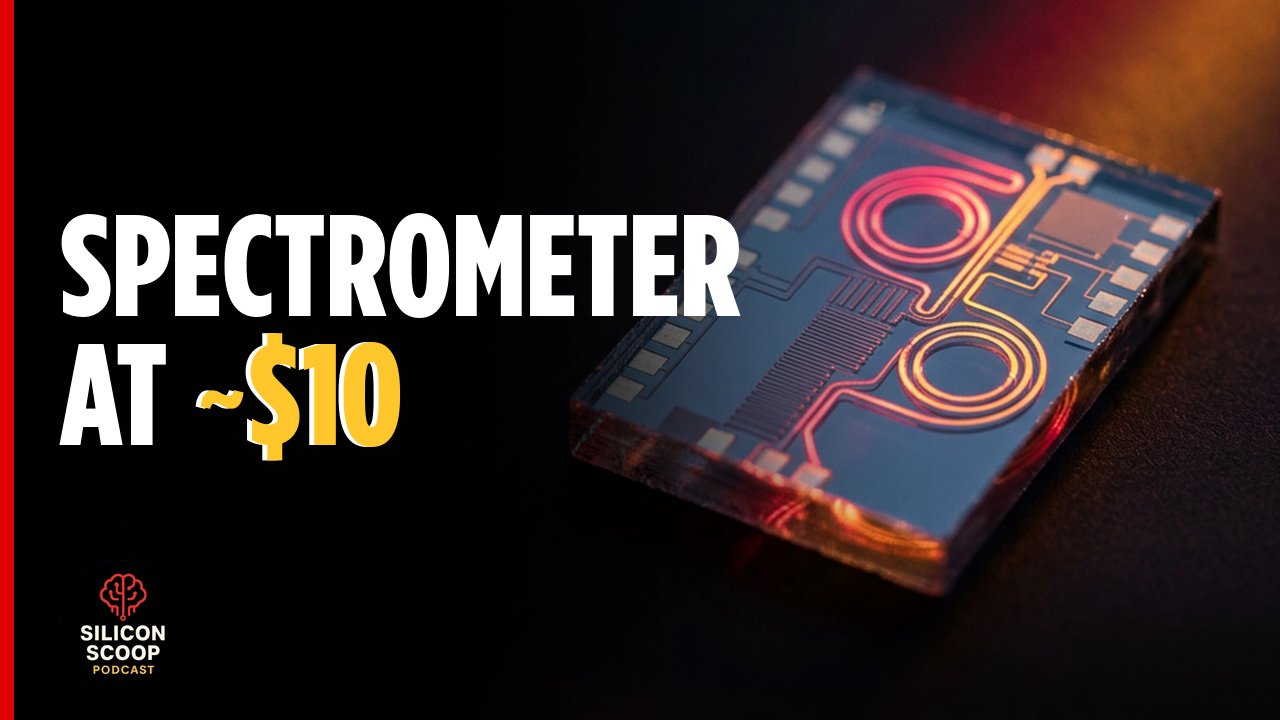
The Cambridge optical spectrometer has an estimated total cost of about US$10. It is centimetres across, and it samples and processes a reading in under 0.4 seconds, according to the Nature Photonics paper. A spectrometer is a tool that reads light to work out what a material is made of. Lab versions are usually large and expensive.
The device comes from the University of Cambridge and GlitterinTech, a start-up founded by the same research group. The team calls it a convolutional spectrometer chip. It uses a mathematical shortcut to read light with less hardware and less computing.
For founders and operators, this could lower the hardware and computing barriers to products that check materials or monitor health. The medical side is much harder. Validation, regulation and the need to work across many different people all stand in the way.
"Estimated" matters here. The US$10 figure is a cost estimate in a research paper, not a price tag on a product you can buy.
How a Convolutional Spectrometer Chip Reads Light
Every material absorbs and reflects light in its own pattern. That pattern is called a spectrum. A spectrometer measures it, and the pattern points to what the material is or how much of a substance is in it.
Small spectrometers have usually paid a price for their size. According to the university's summary of the work, compact designs often have a limited measurement range, lower resolution or lower accuracy. That makes them better at identifying a substance than at measuring it precisely.
The idea in plain words
Most designs either split light into its separate colours or rebuild the spectrum with heavy calculations. The Cambridge team does something different. It performs a mathematical operation called convolution directly on the light as it passes through the chip.
In practice, the device uses a chain of optical parts whose responses repeat in a pattern. Independent coverage from Optics.org names micro-ring resonators as one such part. A micro-ring resonator is a tiny loop that traps certain colours of light. The university's summary also lists unbalanced Mach-Zehnder interferometers, which split light and recombine it to compare the paths.
After the light passes through, a fast Fourier transform recovers the spectrum. That is a standard, quick calculation. Because the relationship between the measurement and the spectrum is linear, the team says the computing load stays low. The paper's lead author, Dr. Chunhui Yao, said in the university's summary that the approach brings "high precision, strong noise tolerance, and very low computational overhead."
Key technical facts
- Platform: a silicon-nitride photonic integration platform, according to the Cambridge engineering announcement of June 8, 2026.
- Range: 1,200–1,700 nm, in the near-infrared. That is about 500 nm of bandwidth, or roughly 2,400 cm⁻¹, per the Cambridge Apollo repository record.
- Speed: under 0.4 seconds for sampling and local processing.
- Electronics: the university's summary says the optics are integrated with onboard electronics.
The team also says the measurement range could, in theory, be extended almost without limit. It says adding more optical components in sequence could raise resolution exponentially. Those are design claims, not measured results in the sources reviewed here.
The team further says the design beats dispersion-based, Fourier-transform and computational-reconstruction spectrometers in several key areas. That is the team's own comparison.
Source: Nature Photonics paper, published April 15, 2026; Optics.org technical coverage, June 10, 2026; University of Cambridge Department of Engineering announcement, June 8, 2026; Cambridge Apollo repository record, June 7, 2026
What the $10 Estimate Does and Does Not Tell You
The paper reports an estimated total cost of about US$10 for a centimetre-scale device. The University of Cambridge announcement repeats the figure when describing possible portable, wearable, industrial and healthcare uses.
That announcement comes from the university, so treat it as company-side reporting rather than an outside audit.
Reading the number carefully
The number is a cost estimate for the device, not a retail price. The sources reviewed here give no line-by-line cost breakdown. They also do not say whether anyone can order the device today.
Still, a centimetre-scale spectrometer at roughly this cost is a striking claim. It would put spectral sensing in the price range of components that product teams add without a long approval process.
A wide temperature range
The device kept working between about -20°C and 80°C, according to the university announcement. That is a wide range for a miniature spectrometer. Small optical sensors can drift when the temperature changes, so a stable reading across that span matters for real products.
The university's summary says this durability could help wearables, factory equipment and outdoor sensors. Professor Qixiang Cheng, who led the project, said the work stands out for "technical readiness" and for being a "fully packaged, robust system."
Why low computing cost matters
Many compact spectrometers need complicated calibration and heavy algorithms to rebuild a spectrum. Those methods can break down when the signal is noisy. The Cambridge design avoids much of that, and the paper reports local processing in under 0.4 seconds.
For a wearable, that means less battery drain and less need to send raw data elsewhere. That is an inference from the reported local processing, not a measured battery result.
Source: Nature Photonics paper, published April 15, 2026; University of Cambridge Department of Engineering announcement, June 8, 2026
Cheap sensors create more data. Automation keeps it from becoming more busywork.
Every new data source, whether from sensors, forms or supplier systems, tends to create another manual step of copying, checking and reporting. Flowgrammer builds business automations that handle those repetitive steps for you, so your team saves hours each week and can grow without adding headcount.
What the Material Tests Showed
The team tested the device on real materials, not only on theoretical measurements. According to the University of Cambridge announcement, the results were:
- 100% classification success for tested plastics, pharmaceuticals, coffee, flour and tea.
- Concentration accuracy of approximately 0.01% in water-based and organic solutions.
The Cambridge Apollo repository record also describes 100% classification success for named solid samples.
Classifying versus measuring
Classification means sorting a sample into a known group, such as "this is flour, not tea." Concentration measurement means finding how much of a substance is present. The second job is harder and needs more precision. The team reports results on both.
A perfect score on a defined set of materials is encouraging. It does not mean the device can identify any unknown substance. A real factory line has more variety, more contamination and more drift than a test set.
The benchtop comparison
The university's summary article also says the device exceeded the performance of commercial benchtop spectrometers in those concentration experiments. I could not match that comparison to a specific retrieved source page, so treat it as the team's claim. A buyer would want to see which instruments were used and how they were set up.
What outside coverage adds
Optics.org covered the device on June 10, 2026. It reported the 1,200–1,700 nm range, the under-0.4-second processing time, the approximately US$10 cost, the 100% classification success and the extended glucose tracking in one participant. That is independent reporting of the team's results, not a separate test of them.
Source: University of Cambridge Department of Engineering announcement, June 8, 2026; Cambridge Apollo repository record, June 7, 2026; Optics.org coverage, June 10, 2026
Noninvasive Glucose Monitoring Sensor: One Participant and Real Limits
The health results are the most eye-catching part of the work. They are also the part that needs the most care.
The reported biomarker errors
The Nature Photonics paper reports mean absolute errors for four human biomarkers. Mean absolute error is the average size of the gap between the device's reading and a reference reading, ignoring direction.
| Biomarker | Mean absolute error |
|---|---|
| Skin moisture | 2.49% |
| Blood alcohol | 1.70 mg/dL |
| Blood lactate | 0.81 mmol/L |
| Blood glucose | 0.363 mmol/L |
According to the university's summary, these were measured under conditions designed to reflect real physiological environments. The paper reports these as completed demonstration results.
Why this is not a glucose meter yet
The extended noninvasive glucose-tracking demonstration involved one participant, according to the paper. That makes it a proof of concept, not a clinical validation study.
The paper also states a clear limit. At the current data scale, neither the multi-participant glucose model nor the single-participant glucose model is transferable to new participants. Differences between individuals weaken the model's correlation. In plain words, a model trained on some people does not yet work reliably on someone new.
The paper says a much larger database would be needed to fix this. The university's summary adds that further testing would be needed before this could become a practical medical product.
What is missing
The expanded research found no independent clinical validation of the glucose results. It found no regulatory clearance. It also found no independent expert consensus that the technology is ready for medical use.
So a noninvasive glucose monitoring sensor built on this chip remains a research direction. The result suggests a possible route toward monitoring blood sugar without piercing the skin. It does not show that the route is ready.
Source: Nature Photonics paper, published April 15, 2026; University of Cambridge Department of Engineering announcement, June 8, 2026
Wearable Spectroscopy Technology: Where a Small Chip Could Fit
The researchers describe a future where accurate optical sensing is a routine feature of everyday devices. Professor Cheng said the aim is "to make spectrometry as ubiquitous as temperature or motion sensing."
That is a vision statement. It is useful for seeing where the team wants to go, but it is not a product roadmap.
Industrial and food uses
The university's summary suggests inexpensive spectrometers could be placed throughout manufacturing facilities. They would check material composition and product quality continuously. Similar sensors could monitor food freshness, identify substances and analyze environmental conditions at a larger scale than today.
These uses match the tests the team actually ran: plastics, pharmaceuticals, coffee, flour, tea and solution concentrations. That makes them the better-supported applications in the evidence reviewed here.
Health and fitness uses
On the health side, the summary says compact sensors might eventually let wearables measure hydration, detect signs of alcohol intoxication, track fitness-related biomarkers and monitor glucose for people with diabetes. The word "eventually" is doing real work. The reported evidence covers skin moisture, blood alcohol, blood lactate and blood glucose in demonstrations only.
Questions founders should ask
Wearable spectroscopy technology has to work on moving bodies, different skin types and long wear times. The sources reviewed here do not settle those questions. Before building a product, a team would want answers to these:
- How well do readings hold up across many people, not just a few?
- What happens to accuracy when a user moves, sweats or wears the device loosely?
- What reference method will regulators accept for each health claim?
- Can the chip be packaged in a way that suits a wrist-worn product?
None of these is a reason to dismiss the work. They are the gap between a strong lab result and a product.
Source: University of Cambridge Department of Engineering announcement, June 8, 2026; Nature Photonics paper, published April 15, 2026
Who Has Checked the Claims, and What the Funding Report Adds
The state of outside review
Independent technical coverage exists. Optics.org supports the architecture, the operating range, the processing time and the reported application results. But its discussion largely reproduces the research team's claims. It is not an external performance audit.
The key limit comes from the paper itself: glucose models cannot be transferred reliably to new participants without a much larger database. No independent expert consensus on medical readiness was identified. If you need that kind of verification, it is not yet available in the sources reviewed here.
A timeline of what has been reported
- April 15, 2026: Nature Photonics published the paper, "Optical convolutional spectrometer" (2026; volume 20, issue 6, page 664).
- June 7, 2026: the Cambridge Apollo repository record for the paper is dated.
- June 8, 2026: the University of Cambridge engineering department announced the potential wearable, industrial and healthcare applications.
- June 10, 2026: Optics.org published its technical coverage.
- July 2026: The Yangtzeer reported a financing round for Glitterin Tech.
These are separate events. The dates should not be read as a sign of delay or speed for any milestone.
The reported financing round
The Yangtzeer reported that Glitterin Tech raised RMB100 million, approximately US$14.7 million, in a pre-Series A round. It said the money was meant for a Shanghai laboratory, hiring and preparation for mass production.
Three cautions apply:
- This is a single trade report. No company filing or final company financing announcement was retrieved to confirm it, so the round's final status is unverified.
- "Preparation for mass production" describes an intended use of funds. It does not mean the chip is in production.
- The sources give no cumulative funding total, so the figure should not be read as the company's total raised.
The same report described Glitterin Tech as a Xuzhou company founded in 2021 and spun out of a Cambridge research team. The university's announcement describes GlitterinTech as a start-up founded by the same research group.
Source: Optics.org coverage, June 10, 2026; Nature Photonics paper, published April 15, 2026; Cambridge Apollo repository record, June 7, 2026; University of Cambridge Department of Engineering announcement, June 8, 2026; The Yangtzeer report on Glitterin Tech financing, July 2026
What This Means for Startups and Small Businesses
You cannot buy this chip today based on the sources reviewed here. Still, the reported numbers point to practical moves.
If you build hardware or industrial tools
- Watch quality control first. The tested materials, such as plastics, pharmaceuticals and food products, map to real inspection jobs. A cheap sensor could make checks possible at more points on a line.
- Plan around the estimate. Treat US$10 as a research-stage cost figure. Ask any partner for a real bill of materials before putting it in a business case.
- Check the temperature claim against your use case. A range of -20°C to 80°C covers many factory and outdoor settings.
If you are in health or wellness
- Do not promise glucose readings. The paper says current glucose models do not transfer to new participants. A product claim built on that would be hard to defend.
- Start with lower-risk signals. Skin moisture and similar measures may be easier to explore than medical claims. The paper still reports errors for them, so test carefully.
- Budget for validation. Larger datasets, clinical studies and regulatory review are the real cost, and none of them is in the US$10.
If you are a buyer or investor
- Separate the layers of evidence. The paper is peer-reviewed. The university announcement is company-side. Optics.org is independent coverage of the team's results. The funding story is one unconfirmed trade report.
- Ask for independent tests. The 100% classification result is for a defined set of materials. Run your own samples before trusting it.
- Track the data question. If the team publishes a much larger multi-person dataset, that would address the main limit the paper names.
If you run a small operation
You may not build sensors at all. But cheaper sensing tends to mean more data to sort, store and act on. Decide early how readings will flow into your reports and alerts, and who reviews them. Manual copying does not scale.
Source: Nature Photonics paper, published April 15, 2026; University of Cambridge Department of Engineering announcement, June 8, 2026; Optics.org coverage, June 10, 2026; The Yangtzeer report on Glitterin Tech financing, July 2026
Frequently Asked Questions
Q: What is the Cambridge optical spectrometer?
A: It is a centimetre-scale convolutional spectrometer developed by the University of Cambridge and GlitterinTech. It reads near-infrared light between 1,200 and 1,700 nm and was described in a Nature Photonics paper published April 15, 2026.
Q: How much does the Cambridge optical spectrometer cost?
A: The paper reports an estimated total cost of about US$10. That is a research cost estimate, not a retail price, and the sources reviewed give no cost breakdown.
Q: What is a convolutional spectrometer chip?
A: It is a spectrometer that applies a mathematical operation called convolution directly to incoming light, using a chain of optical parts with repeating responses. A fast Fourier transform then recovers the spectrum with relatively little computing.
Q: How fast is the convolutional spectrometer chip?
A: The paper reports sampling and local processing in under 0.4 seconds. That timing is for the packaged device described in the paper.
Q: Can this noninvasive glucose monitoring sensor replace a finger-prick test?
A: Not at this stage. The extended glucose tracking involved one participant, and the paper says the glucose models are not transferable to new participants at the current data scale.
Q: How accurate was the glucose measurement?
A: The paper reports a mean absolute error of 0.363 mmol/L for blood glucose. That figure comes from a research demonstration, not a clinical validation study.
Q: Is wearable spectroscopy technology approved for medical use?
A: No regulatory clearance was identified in the sources reviewed. No independent clinical validation of this device's glucose readings was found either.
Q: What materials did the spectrometer identify with 100% success?
A: In the reported tests, it classified plastics, pharmaceuticals, coffee, flour and tea with 100% success. That applies to those tested materials, not to every substance.
Q: Can the spectrometer work in hot or cold conditions?
A: The University of Cambridge announcement says the device stayed operational from about -20°C to 80°C. That is a company-side report of its test range.
Q: Did Glitterin Tech raise funding for this technology?
A: The Yangtzeer reported in July 2026 that Glitterin Tech raised RMB100 million, about US$14.7 million, in a pre-Series A round. No company filing or final company announcement confirming the round was retrieved, so treat it as unverified.
Additional Links
Flowgrammer.ca – 💡 Unlock AI-Powered Automation! Let flowgrammer.ca handle complex workflows so you can focus on growing your business.
Flowgrammers.ca – 💡 Join Toronto's Fastest Growing AI and Business Automation Community.
- SRED Funding Solutions – Maximize your R&D tax credits and secure funding for your innovation.
- Silicon Scoop Podcast – Stay Informed, Stay Ahead!
- Startup Talk Podcast
- Flowgrammer Youtube
- Startup Investor Drinks – Join Toronto’s Startup Community and connect with fellow startup enthusiasts and investors.
- TorontoStarts Startup and Entrepreneur Community – Become a part of Toronto’s thriving startup ecosystem.
- Workhaus – Discover flexible workspace solutions for your business needs.
- Work with The Startup Coach – Get expert guidance and mentorship for your startup journey.
- Reach out to Jon Irwin on LinkedIn – Connect with our co-host and technology expert.