
Silicon Scoop · Technology
Sabrina Pasterski Celestial Holography and Quantum Gravity
Craig Major·November 3, 2026
Sabrina Pasterski celestial holography maps 4D scattering to a 2D theory. See how the spin memory effect in gravity is predicted, not yet observed.
Estimated reading time: 10 minutes
Key Takeaways
- Only a couple of thousand people: Sabrina Pasterski estimated to MIT Technology Review (profile published April 21, 2026) that this many people worldwide can meaningfully discuss her specialized research. This is her personal estimate, not a measured count.
- A precise claim, not just a hologram analogy: Perimeter Institute says celestial holography maps four-dimensional S-matrix elements to correlators in a two-dimensional conformal field theory on the night sky. This applies to spacetimes with vanishing cosmological constant.
- Spin memory is a prediction: The paper "New Gravitational Memories" (published December 14, 2016) predicts a relative time delay between clockwise and counterclockwise orbiting beams. It does not report a detector observation.
- A team effort: Perimeter lists four postdoctoral researchers in the initiative: Yangrui Hu, Bin Zhu, Adam Ball and Sruthi Narayanan. It also names Pasterski as a deputy director of the Simons Collaboration on Celestial Holography.
- No business numbers exist: The retrieved sources identify no financing round, revenue, operating cost or project budget. This is a long-horizon science story, not a product story.
Table of contents
- Why Sabrina Pasterski's Quantum Gravity Work Matters
- Celestial Holography Explained: From Hologram Analogy to a 2D Theory on the Night Sky
- The Spin Memory Effect in Gravity: A Prediction, Not a Measurement
- A Research Hub, Not a Lone Genius: Inside the Celestial Holography Initiative
- From Kit Plane to Quantum Gravity: What the Sources Confirm About Her Path
- What Independent Commentary Says About Celestial Holography, and What Is Missing
- What This Means for Startups and Small Businesses
- Frequently Asked Questions
Sabrina Pasterski told MIT Technology Review that only a couple of thousand people worldwide may be able to meaningfully discuss her specialized research. Meanwhile, Perimeter Institute describes her program as mapping four-dimensional S-matrix elements to correlators in a two-dimensional conformal field theory. That is the core of Sabrina Pasterski's celestial holography work, and it sits at the center of her attempt to connect gravity with quantum physics.
For founders and operators, the story is useful for a different reason than the physics. It shows how difficult, long-horizon research can create future opportunities without being mistaken for a near-term commercial product or operating result. Nobody is selling anything here yet, and the sources do not claim otherwise.
This post explains what the research is, what has been predicted, what has not been observed, and who is involved. It also covers what independent commentary exists and where it stops.
Why Sabrina Pasterski's Quantum Gravity Work Matters
Pasterski is research faculty at Perimeter Institute for Theoretical Physics in Ontario, Canada. Perimeter's profile says she holds a Harvard PhD from 2019, that her Perimeter appointment began in 2021, and that she founded the Celestial Holography Initiative. Perimeter Institute profile
Her main target is quantum gravity. That is the long-running problem of fitting two successful theories together:
- General relativity explains gravity, space and time at large scales.
- Quantum mechanics explains the behavior of very small particles.
Each theory works well in its own area. They are hard to combine in one consistent picture.
In the MIT Technology Review profile, Pasterski describes her work as an attempt to unite general relativity and quantum mechanics. She calls the objective the "source code of the universe." That phrase is her own framing of a research goal, not a claim that the goal has been reached. MIT Technology Review profile, April 21, 2026
The same profile quotes her saying that mathematical frameworks can test the consistency of theories that are otherwise difficult to probe experimentally. That matters here. When you cannot run a direct experiment, careful math becomes one way to check whether an idea holds together.
Source: Perimeter Institute profile of Sabrina Pasterski; MIT Technology Review profile, April 21, 2026
Celestial Holography Explained: From Hologram Analogy to a 2D Theory on the Night Sky
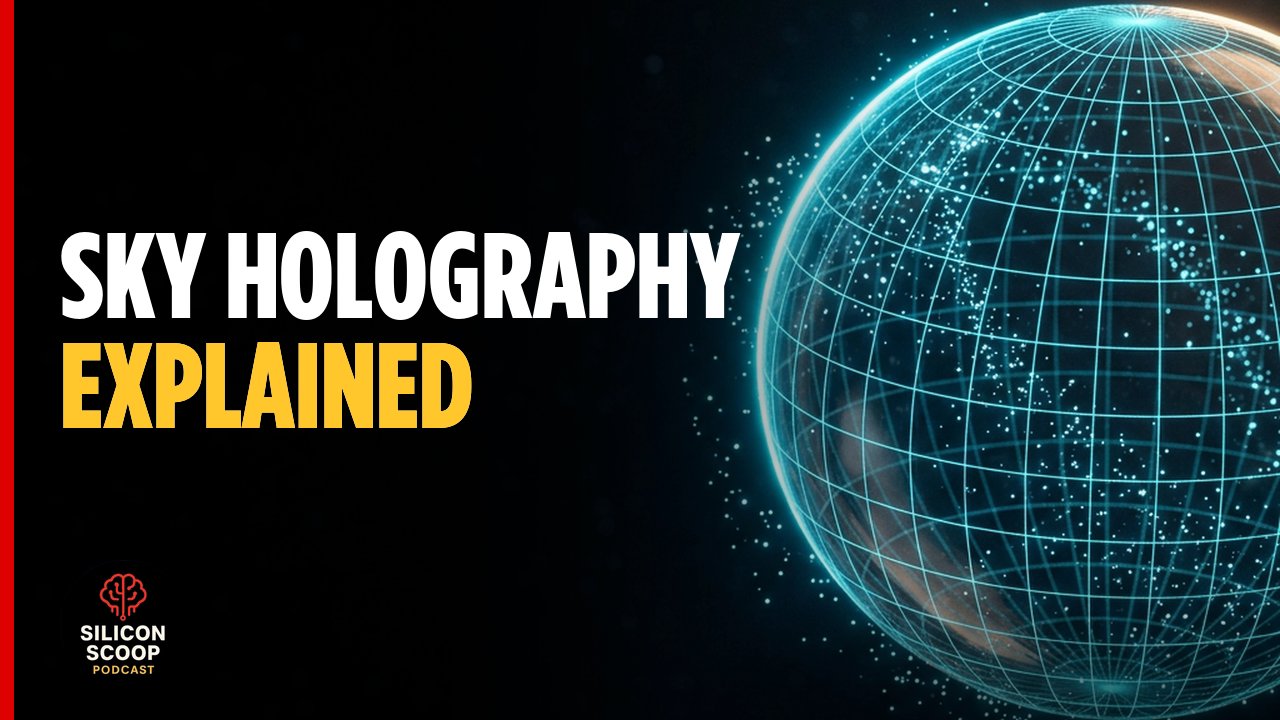
The popular way to explain this field is the hologram analogy. A flat surface can store a three-dimensional image. In the same way, physics in four-dimensional spacetime might be encoded on a distant boundary surrounding the universe. This is the version often used in general-audience profiles.
The analogy is a start, but the initiative's own wording is more exact. Perimeter says that, for spacetimes with vanishing cosmological constant, celestial holography maps four-dimensional S-matrix elements to correlators in a two-dimensional conformal field theory living on the night sky. Perimeter Celestial Holography Initiative page
Here is that sentence in plain words:
- S-matrix elements are numbers that describe what comes out when particles come in and collide. Think of them as the odds of each possible outcome.
- A conformal field theory is a kind of physics theory whose rules stay the same when you zoom in or out.
- Correlators are numbers that show how points in such a theory are linked to each other.
- Vanishing cosmological constant means the universe being modeled is "flat" on large scales, with no built-in expansion energy.
- The night sky here means the sphere of directions around an observer. This is the "celestial" part of the name.
So the claim is that collision data in four dimensions can be rewritten as a two-dimensional theory on that sphere. If that dictionary works, a hard gravity problem might be studied with tools from a simpler setting.
How this differs from the older holographic principle
A Harvard Black Hole Initiative colloquium abstract (May 1, 2023) describes celestial holography as an extension of the holographic principle to asymptotically flat spacetimes. "Asymptotically flat" means spacetimes that look flat far from any source. The abstract adds that the program uses infrared physics to constrain quantum-gravity scattering amplitudes and to identify new symmetries and conservation laws. Harvard Black Hole Initiative colloquium page, May 1, 2023
Infrared physics deals with very low-energy, long-distance behavior. A scattering amplitude is the quantity that gives the odds of a collision outcome. A conservation law says something stays constant, as energy does.
This is a research framework. The sources describe it as a program of ideas under active development. They do not describe it as a confirmed description of our universe.
Where to read the technical versions
The source article lists two technical write-ups for readers who want more depth:
- Pasterski, Pate and Raclariu, "Celestial Holography," a Snowmass 2022 white paper from 2021. DOI link
- Pasterski, "A Chapter on Celestial Holography," in the Handbook of Quantum Gravity (Springer), listed as 2024. DOI link
We link these as further reading only. The facts above come from the Perimeter and Harvard pages.
Source: Perimeter Celestial Holography Initiative page; Harvard Black Hole Initiative colloquium page, May 1, 2023
Stop Repeating the Same Manual Work
Hard problems take years, and the routine work around them should not eat that time. Flowgrammer.ca builds business automation that takes over repetitive tasks like data entry, follow-ups and reporting, so a small team can scale without adding headcount.
The Spin Memory Effect in Gravity: A Prediction, Not a Measurement
The best-known earlier result linked to Pasterski is the spin memory effect. It appears in "New Gravitational Memories," published in the Journal of High Energy Physics on December 14, 2016. The source article's reference list names Pasterski, Strominger and Zhiboedov as authors. Journal of High Energy Physics article, December 14, 2016
Perimeter's profile also says her prior research includes infinite-dimensional S-matrix symmetry enhancements and a gravitational memory effect. That is Perimeter's own description of her work. Perimeter Institute profile
What the paper actually says
The paper makes a theoretical prediction:
- Picture two light beams sent around in opposite directions, one clockwise and one counterclockwise.
- After gravitational radiation passes, the two beams acquire a relative time delay.
- The paper says the delay is caused by radiative angular-momentum flux. In simple terms, that is spin-like motion carried away by gravitational waves.
- The paper connects its formula to the subleading soft-graviton theorem. This is a rule about what happens when very low-energy gravitons are emitted in a collision. A graviton is the hypothetical particle that carries gravity.
The word "memory" fits because the effect is a lasting change left behind after a wave passes. The source article describes it as a permanent distortion or imprint in spacetime. We rely on the paper's narrower statement, which describes the delay between orbiting beams.
What it does not say
The 2016 paper does not report a detector observation. It is a prediction. The source article is also direct about status, saying these concepts currently remain theoretical.
This is the point to hold on to when you read excited coverage. A formula in a peer-reviewed journal is a real result. It is not the same as a measurement of the effect in nature.
Why predictions like this still matter
A prediction gives experimenters something specific to look for. It also ties the math to a concrete picture: beams, delays and radiation. In the source article's framing, these ideas give a roadmap for ongoing investigations into quantum gravity. A roadmap is not a destination, and the sources do not say the destination has been reached.
Source: Journal of High Energy Physics article "New Gravitational Memories," December 14, 2016; Perimeter Institute profile
A Research Hub, Not a Lone Genius: Inside the Celestial Holography Initiative
Popular profiles often frame a scientist as a solitary figure. The institutional record shows something more organized.
Perimeter Institute identifies Pasterski as the founder and principal investigator of the Celestial Holography Initiative. Its profile also lists her as a deputy director of the Simons Collaboration on Celestial Holography. Perimeter Institute profile
The initiative page lists four postdoctoral researchers:
- Yangrui Hu
- Bin Zhu
- Adam Ball
- Sruthi Narayanan
That composition shows the work is run as a collaborative hub, not only as one person's theory project. Perimeter Celestial Holography Initiative page
The 2023 Harvard colloquium abstract supports the same picture. It describes the program as bringing together amplitudes, bootstrap and quantum-gravity research communities. The amplitudes community studies scattering calculations. The bootstrap community uses consistency rules to narrow down which theories are possible. Harvard Black Hole Initiative colloquium page, May 1, 2023
Two cautions apply. First, these are Perimeter's and Harvard's descriptions of the program. They are not independent audits of its success. Second, a team list shows who is involved, not how much has been achieved.
Still, the structure matters. Long-horizon work tends to need a stable group, shared methods and several people who can check each other's math.
Source: Perimeter Institute profile; Perimeter Celestial Holography Initiative page; Harvard Black Hole Initiative colloquium page, May 1, 2023
From Kit Plane to Quantum Gravity: What the Sources Confirm About Her Path
Pasterski's early story is often told through an airplane. MIT Technology Review reports that she spent two years building and modifying a fixed-wing aircraft from a kit, and that she flew it herself by age 16. MIT Technology Review profile, April 21, 2026
This independently supports the broad aircraft milestone. It does not confirm every detail in the other versions of the story. For example, the source article's wording about assembling a kit and flying independently is close to the MIT Technology Review account, but we only repeat the details the profile supports.
The documented academic milestones from the retrieved sources are:
- 2016 (December 14): the spin memory paper is published in the Journal of High Energy Physics.
- 2019: Harvard PhD, according to Perimeter's profile.
- 2021: Perimeter appointment begins, according to Perimeter's profile.
- 2023 (May 1): she gives a colloquium on celestial holography at the Harvard Black Hole Initiative.
- 2026 (April 21): MIT Technology Review publishes its profile.
The source article adds that she graduated from MIT in 2013 with the highest possible grade point average in the physics department. We could not match that claim to any of the retrieved supporting sources, so treat it as the source article's statement and not a verified fact.
The same applies to the common comparison to Einstein. The source article says academic peers frequently make it. None of the retrieved sources documents that comparison, and none establishes that she is objectively "the next Einstein." We leave it as a popular label, not a finding.
Source: MIT Technology Review profile, April 21, 2026; Perimeter Institute profile; Journal of High Energy Physics article, December 14, 2016; Harvard Black Hole Initiative colloquium page, May 1, 2023
What Independent Commentary Says About Celestial Holography, and What Is Missing
Independent commentary on this work is limited. Here is what the retrieved sources do support.
MIT Technology Review presents the research as a long-horizon attempt to reconcile general relativity and quantum mechanics. It quotes Pasterski saying mathematical frameworks can test the consistency of theories that are hard to probe through experiments. It also carries her estimate that only a couple of thousand people worldwide can meaningfully converse about the work. MIT Technology Review profile, April 21, 2026
The source article puts the same idea as "a few thousand experts." The MIT Technology Review wording is "a couple of thousand," so we use that. Either way, it is a personal estimate, not a survey.
Harvard's Black Hole Initiative describes the field as an active convergence of amplitudes, bootstrap and quantum-gravity communities. The page is a colloquium abstract for a talk by Pasterski, so it describes the program from inside the research conversation. Harvard Black Hole Initiative colloquium page, May 1, 2023
What these sources do not establish
- They support the significance and collaborative character of the research.
- They do not establish a consensus that celestial holography is experimentally confirmed.
- They do not show that Pasterski is objectively the next Einstein.
- No independent source we retrieved gives a competing technical assessment. We cannot tell you what skeptics think, because we did not find a skeptical evaluation.
What about money, revenue and costs?
The briefing found no financing round, commercial revenue, operating-cost figure or project budget in the retrieved sources. No regulatory filing or completed financing announcement applies to this research either.
The Perimeter and Harvard pages are institutional descriptions. They are not financial disclosures. So any number you may see online about "funding" or "market size" for this field is not supported by what we reviewed.
Source: MIT Technology Review profile, April 21, 2026; Harvard Black Hole Initiative colloquium page, May 1, 2023; Perimeter Celestial Holography Initiative page
What This Means for Startups and Small Businesses
This is not a story about a product launch. It is a story about patient work on a hard problem. Here are practical lessons, and each one is a reading of the situation, not a claim from the sources.
Separate "interesting" from "investable"
The research is still theoretical. The spin memory effect is a prediction, and celestial holography is a research framework. Treat claims about future technology built on this work as speculation until someone documents a real product, customer or budget.
Be exact about status in your own materials
Notice how much careful wording this topic needs: "predicts," "describes," "proposes," not "proves." Founders can borrow the habit. In pitch decks and updates, keep completed, in progress and planned items clearly apart. Investors and customers trust precise language.
Build a team around the hard problem
The initiative is organized around a principal investigator, a deputy-director role in a larger collaboration and four postdoctoral researchers. For a small business, the parallel is to avoid making one person the single point of knowledge. Document your methods and share the load.
Use credible sources and name them
The best-supported claims here come from a journal paper, institution pages and a magazine profile. When you write about your market, link to the actual document behind each claim. If a fact has no source, qualify it or leave it out.
Free your time for the long-horizon work
Long-term projects lose out when routine tasks fill every day. Automating recurring admin work leaves more hours for the strategic thinking that compounds over years.
Source: Perimeter Celestial Holography Initiative page; Journal of High Energy Physics article, December 14, 2016; MIT Technology Review profile, April 21, 2026
Frequently Asked Questions
Q: Who is Sabrina Pasterski?
A: Sabrina Gonzalez Pasterski is a theoretical physicist and research faculty member at Perimeter Institute in Ontario, Canada. Perimeter says she founded its Celestial Holography Initiative and holds a Harvard PhD from 2019.
Q: What is Sabrina Pasterski celestial holography research about?
A: It studies whether four-dimensional scattering data can be described by a two-dimensional conformal field theory on the night sky. Perimeter states this for spacetimes with vanishing cosmological constant. It remains a theoretical research framework.
Q: What is celestial holography explained simply?
A: It is the idea that physics in four-dimensional spacetime might be rewritten as a theory on a two-dimensional sphere of directions around us. The common hologram analogy is a loose picture of that. The precise version maps S-matrix elements, which describe particle collisions, to correlators in the lower-dimensional theory.
Q: What is Sabrina Pasterski's quantum gravity work trying to solve?
A: It targets the problem of combining general relativity, which explains gravity at large scales, with quantum mechanics, which explains tiny particles. In MIT Technology Review, she describes it as an attempt to unite the two. No source says the problem has been solved.
Q: What is the spin memory effect in gravity?
A: It is a predicted effect in which clockwise and counterclockwise orbiting beams acquire a relative time delay after gravitational radiation. The 2016 paper "New Gravitational Memories" attributes the delay to radiative angular-momentum flux. It does not report an observation.
Q: Has the spin memory effect been observed?
A: The 2016 paper does not report a detector observation. It presents a theoretical prediction. The retrieved sources do not show a confirmed measurement.
Q: Is celestial holography proven?
A: The retrieved sources describe it as a research framework and an active area of work. They do not establish that it is experimentally confirmed, and no independent source we found gives a competing technical assessment.
Q: How many people understand Pasterski's research?
A: She told MIT Technology Review that only a couple of thousand people worldwide can meaningfully converse about it. That is her personal estimate, not a measured figure.
Q: Who works with Pasterski on celestial holography?
A: Perimeter lists four postdoctoral researchers in the initiative: Yangrui Hu, Bin Zhu, Adam Ball and Sruthi Narayanan. Pasterski is also listed as a deputy director of the Simons Collaboration on Celestial Holography.
Q: Is there funding or a commercial product tied to this research?
A: No financing round, revenue, operating-cost figure or project budget was identified in the retrieved sources. The work described is academic research, not a commercial product.
Additional Links
Flowgrammer.ca – 💡 Unlock AI-Powered Automation! Let flowgrammer.ca handle complex workflows so you can focus on growing your business.
Flowgrammers.ca – 💡 Join Toronto's Fastest Growing AI and Business Automation Community.
- SRED Funding Solutions – Maximize your R&D tax credits and secure funding for your innovation.
- Silicon Scoop Podcast – Stay Informed, Stay Ahead!
- Startup Talk Podcast
- Flowgrammer Youtube
- Startup Investor Drinks – Join Toronto’s Startup Community and connect with fellow startup enthusiasts and investors.
- TorontoStarts Startup and Entrepreneur Community – Become a part of Toronto’s thriving startup ecosystem.
- Workhaus – Discover flexible workspace solutions for your business needs.
- Work with The Startup Coach – Get expert guidance and mentorship for your startup journey.
- Reach out to Jon Irwin on LinkedIn – Connect with our co-host and technology expert.