
Silicon Scoop · Technology
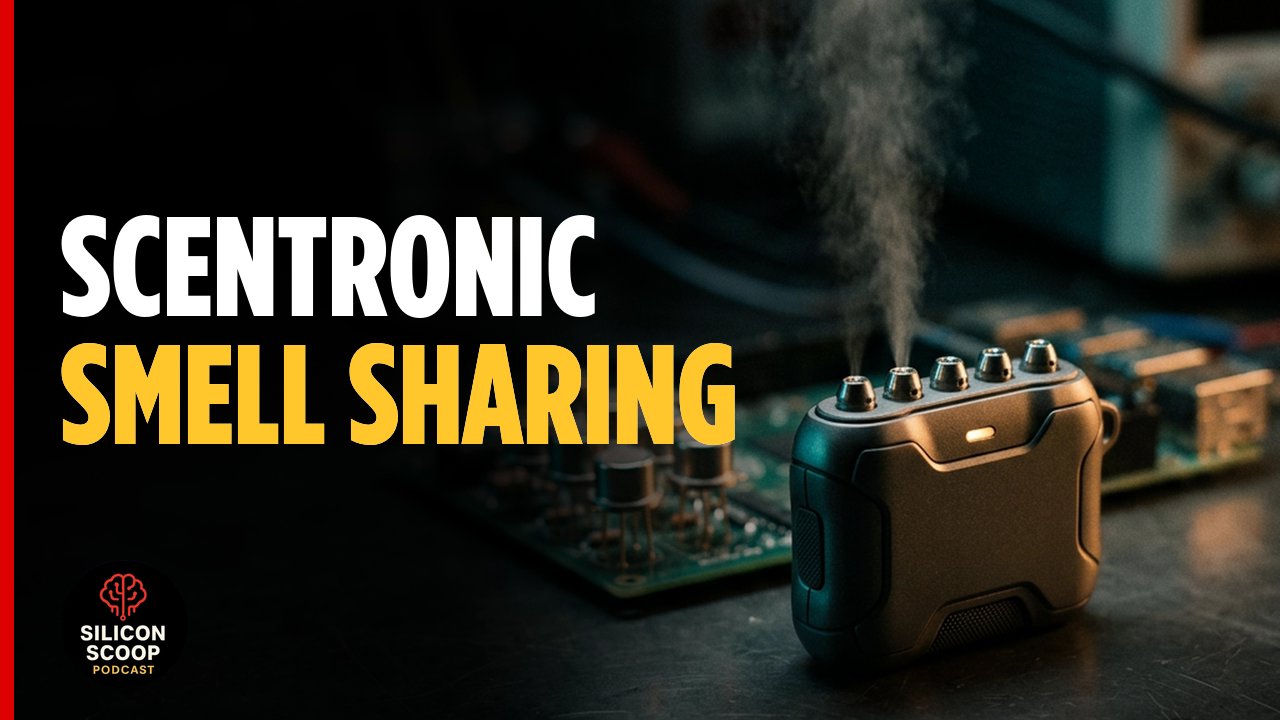
Scentronic Remote Odor Sharing Prototype Tested on Humans
Craig Major·November 3, 2026
Scentronic remote odor sharing pairs an electronic nose with a wearable scent generator. Learn how lab and human results differ in digital scent technology.
Estimated reading time: 10 minutes
Key Takeaways
- Latency: In the Science Advances paper, cloud communication latency ranged from 57 to 76 milliseconds and averaged about 65 ms. A separate alcohol demonstration reported a 0.6-second sensor-to-actuator response.
- Lab versus people: The electronic nose's k-nearest-neighbor classifier scored 100% (endpoint features) and 98% (time series) on held-out lab data. Human tests with up to 16 volunteers scored 58.57%, 72.86% and 71.43%.
- Narrow scope: The system recognizes only five scents (beer, cake, coffee, oranges and red wine). Lead author Chunyu Yang told Reuters it is a research prototype and no company was involved.
- Founder angle: The opportunity looks like narrow, application-specific scent hardware, such as XR accessories or remote sensory testing. The costs and risks include refills, safety validation, calibration, data generalization and clinical regulation.
- Evidence gap: The briefing found no independent expert commentary. It also found no financing round, revenue, price or valuation.
Table of contents
- How Scentronic Remote Odor Sharing Works From Sniff to Mist
- Electronic Nose Odor Recognition: Near-Perfect in the Lab, Limited to Five Scents
- Why Human Tests Scored Far Lower Than the Lab Classifier
- The Wearable Olfactory Interface Runs on Tiny Atomizers, Small Batteries and Heat Limits
- Digital Scent Technology Demos: A Taste Cup, a Headset and Possible Clinical Uses
- No Independent Verdict Yet, and Who Paid for the Research
- What This Means for Startups and Small Businesses
- Frequently Asked Questions
The Scentronic remote odor sharing prototype passed sensor data through the cloud with an average delay of about 65 milliseconds. That figure measures messaging speed, not how well people perceived the scent that came out.
Human testing used up to 16 volunteers. They ranked five ethanol odor intensities correctly 58.57% of the time. They identified five odor categories correctly 72.86% of the time.
For founders and operators, the gap between fast data and imperfect smell is the story. Scentronic points to an opening in narrow scent hardware, but it also shows the costs: refillable liquids, safety checks, calibration, limited training data and possible clinical rules. This post walks through what the researchers built, what the numbers do and do not show, and what a small team could learn from it.
How Scentronic Remote Odor Sharing Works From Sniff to Mist
The system has three parts. An electronic nose, or e-nose, smells a sample. Cloud software passes the result along. A small scent generator releases a matching fragrance somewhere else.
An e-nose is a device with an array of gas sensors. A machine-learning model then decides which known odor the sensor readings look like.
Reuters reported that the e-nose is roughly 6 inches (15 cm) across. It is portable but not designed to be worn. The researchers built several versions of the odor generator, including wristband, necklace and handheld designs.
The scent molecules themselves do not travel over the internet. Only information about the odor travels. The receiving device then recreates the aroma from scented liquids it already holds.
The paper and the press timeline
The study, titled "Scentronic: An artificial intelligence-assisted olfactory interface for remote odor sharing and transmission," was published online in Science Advances on October 21, 2026. The American Association for the Advancement of Science (AAAS) issued a news release the same day. Reuters published its report on October 23, 2026.
According to the paper, the system links the AI-assisted e-nose, wearable piezoelectric odor release and internet-based wireless control. The briefing says the data moved over Wi-Fi through a Google Cloud program.
Yang, an Ohio State University doctoral student, said the system "connects 'smelling something here' with 'recreating the corresponding smell somewhere else.'" He also said that, to the best of the team's knowledge, this is the first study to explore this integration in a compact platform. That is the researchers' own claim, not an independent finding.
What the 65 ms number means
The upload-download latency ranged from 57 to 76 ms and averaged about 65 ms. That covers the cloud messaging step.
A separate alcohol demonstration reported a 0.6-second response from sensor to actuator. Treat these as two different measurements, not one end-to-end delay.
Source: Science Advances paper, full text on PubMed Central, October 21, 2026; AAAS news release on EurekAlert, October 21, 2026; Reuters report by Will Dunham, October 23, 2026
Electronic Nose Odor Recognition: Near-Perfect in the Lab, Limited to Five Scents
The e-nose uses six tin-dioxide metal-oxide semiconductor sensors: MQ-2, MQ-3, MQ-5, MQ-6, MQ-7 and MQ-135. These sensors respond to gases in the air, and each reacts a little differently to each odor.
The initial dataset held 250 samples, with 50 samples for each of five food categories. The briefing's technical summary also lists 200-second sensor recordings and an 80% training, 20% held-out testing split.
What the accuracy scores show
The model type is k-nearest-neighbor (k-NN). It labels a new sample by comparing it with the most similar samples it has already seen.
- Endpoint-feature k-NN: 100% accuracy on the held-out test set.
- Time-series k-NN: 98% accuracy on the held-out test set.
These are controlled laboratory results. They do not show that the device can recognize smells in general.
Five scents, not a smell library
The trained categories are beer, cake, coffee, oranges and red wine. Yang told Reuters the team chose them because they are familiar and have different scent profiles. He said the team has not expanded beyond them.
He also said a broader scent library is possible in principle, but an unlimited repertoire is "far beyond what we have demonstrated." Adding odors means training the e-nose on them and loading matching scented liquids into the generator.
Yang added that real-world recognition is harder because smells often occur in mixtures. Moving toward commercialization, he said, would need a larger and more diverse training dataset.
Source: Science Advances paper, full text on PubMed Central; Reuters report by Will Dunham, October 23, 2026
Connect the Sensor to the Action Without Doing It by Hand
Scentronic's core idea is simple: something happens in one place, and a system triggers a response in another. Many small businesses have the same pattern in daily work, such as a new order, a form entry or an invoice that someone re-types by hand. Flowgrammer builds business automation that handles those handoffs, so you save hours each week and grow without adding headcount.
Why Human Tests Scored Far Lower Than the Lab Classifier
The more telling results came from people. The paper's human testing involved up to 16 volunteers, and the AAAS release gives the same figure. The study used Ohio State University Institutional Review Board protocol #2024H0335.
The reported recognition results were:
- 58.57% for five ethanol intensity levels.
- 72.86% for five single odors.
- 71.43% for five binary odor combinations, meaning two odors mixed.
Preliminary by the authors' own description
The paper calls these preliminary psychophysical demonstrations. Psychophysical testing measures how people perceive a physical stimulus, such as a smell. The paper also notes limitations in its experimental controls.
I would not compare the 100% lab score with the 72.86% human score as if they measured the same thing. One tests a classifier on sensor data. The other tests whether a person can identify a mist released by the actuator.
The two tasks are different, but together they show a gap. Identifying a controlled sample is not the same as reproducing a smell a person perceives correctly.
Yang said this plainly to Reuters: "Recognizing an odor and accurately reproducing it are separate challenges."
Why intensity was the weakest result
Intensity ranking scored lowest at 58.57%. The paper does not, in the material I reviewed, say why. A reasonable reading is that controlling how much scent reaches a nose is hard, but that is my inference, not a finding.
For product teams, the lesson is to test with real people early. A model score on sensor data will not predict what a user perceives.
Source: Science Advances paper, full text on PubMed Central; AAAS news release on EurekAlert, October 21, 2026; Reuters report by Will Dunham, October 23, 2026
The Wearable Olfactory Interface Runs on Tiny Atomizers, Small Batteries and Heat Limits
The scent generator uses piezoelectric atomization. A piezoelectric element vibrates when driven electrically, and that vibration turns liquid into a fine mist.
Near its apparent resonance of about 110 kHz, the paper reported a liquid transfer rate of roughly 0.9 mL/min. Resonance is the frequency at which the vibration is strongest.
Duty rate and runtime
Duty rate is the share of time the atomizer is switched on. Operation lasted more than 35 minutes at a 10% duty rate. At 100% duty rate, it lasted less than five minutes.
The briefing does not say what set that limit. The numbers still show that running the device harder cuts runtime sharply.
Battery and heat
The handheld five-channel actuator used a 3.7-volt, 400-mAh lithium battery. The paper estimates its capacity at about 1.48 watt-hours.
The researchers' estimates for battery life were:
- About 5.2 hours with one channel running.
- About 1 hour with all five channels running at once.
These are estimates, not field-tested results. The briefing's technical summary also lists about 35.8 °C as the hottest measured point after one hour of operation. I could not confirm the test conditions for that figure from the materials I reviewed.
Why a phone could not simply absorb it
Yang told Reuters that a smartphone could connect to a scent-generating accessory. Building everything into the phone would be harder, he said, because reservoirs, electronics and atomizers take up space and add weight. He named miniaturization and convenient refilling as key issues.
He also noted that the current system has not demonstrated a grilling-hot-dog scent or the exact mixture of smells at a tailgate party. Reuters described the idea as a future possibility, not a tested feature.
Source: Science Advances paper, full text on PubMed Central; Reuters report by Will Dunham, October 23, 2026
Digital Scent Technology Demos: A Taste Cup, a Headset and Possible Clinical Uses
The team also showed the platform in other forms. According to the paper, it appeared as a multisensory cup combining five odor channels with five taste actuators. The AAAS release describes a water-filled flavor-simulation cup.
The paper also demonstrated a mixed-reality interface using a Meta Quest 3 headset. These are demonstrations of a research platform. They are not commercial products or validated consumer applications.
Applications the researchers name
The paper and the AAAS release point to several possible uses:
- Remote healthcare.
- Olfactory testing, including clinical olfactory testing.
- Online shopping.
- Virtual or mixed reality.
- Multisensory food experiences.
Yang's own examples to Reuters were sharing the scent of a meal with distant family or friends, more immersive VR and AR, and online shopping where customers sample selected scents remotely.
All of these are possible uses, not proven markets. The AAAS release is a release from the organization that publishes Science Advances, so treat its application list as the authors' framing, not independent validation.
What the system does not do
The researchers say the system classifies odor categories and rebuilds them through preloaded channels. It does not reproduce complete chemical compositions. The paper also says it does not match human or animal odor-discrimination ability.
That matters for anyone picturing a "smell camera." This is closer to a lookup system: recognize a known category, then release a pre-loaded stand-in.
Source: Science Advances paper, full text on PubMed Central; AAAS news release on EurekAlert, October 21, 2026; Reuters report by Will Dunham, October 23, 2026
No Independent Verdict Yet, and Who Paid for the Research
I found no independent analyst, unaffiliated technical expert or competitor commenting on Scentronic. So an independent expert consensus, or disagreement, cannot be established from the retrieved material.
What exists is the peer-reviewed paper, the AAAS release and Reuters reporting. The paper and release support the platform's technical feasibility. Reuters is independent reporting, but it relays the researchers' own assessment of limits and next steps.
Research funding is not company financing
The paper's funding acknowledgments list:
- NSF grants ECCS-2223387 and ECCS-2533576.
- NIH grant R21EB035153.
- DARPA award HR00112410004.
- The Ohio State Chronic Brain Injury Pilot Award Program.
- Sloan Research Fellowship FG-2025-24495.
- Cottrell Scholar Award CS-CSA-2026-007.
- An Ohio State Alumni Grant for Graduate Research and Scholarship.
These are research-support references. They are not company financing or commercial investment.
Yang told Reuters the work was done without a company's involvement. The retrieved sources report no financing round, commercial revenue, product price or valuation.
What to watch next
Yang listed what commercialization would need: more scents in a compact generator, scent fidelity, refillability, durability, manufacturing costs and the safety of repeated exposure to the scented mist. Those are the researchers' stated priorities. No timeline for any of them was reported.
Source: Science Advances paper, full text on PubMed Central; AAAS news release on EurekAlert, October 21, 2026; Reuters report by Will Dunham, October 23, 2026
What This Means for Startups and Small Businesses
Scentronic is a research result, not a market signal. Still, it shows where the work and the risk sit for anyone building in scent.
Practical takeaways
- Pick one narrow job. The prototype handles five scents. A focused product, such as an XR accessory or a remote sensory-testing kit, is more realistic than a general smell device.
- Budget for consumables. Each new odor needs training data and a matching scented liquid. Refills become a recurring cost and a supply task.
- Plan for data growth. The initial dataset was 250 samples across five categories. Yang said real-world use needs larger, more diverse data and mixtures.
- Test with people, not only models. A 100% lab score sat beside human scores of 58.57% to 72.86%. Build user testing in early.
- Treat safety as a product feature. Yang named the safety of repeated exposure to scented mist as a consideration. Expect to document it.
- Watch regulation if you go clinical. The researchers name olfactory testing and remote healthcare as possible uses. My reading is that any health-related claim would likely raise regulatory questions. That is an implication, not something the paper states.
- Respect hardware limits. The five-channel handheld was estimated at about one hour of battery life. Runtime, heat and size will shape any wearable design.
For operators and tech-curious professionals
There is nothing to buy or deploy yet. A sensible step is to track follow-up work: a larger scent set, mixture handling and real-world tests.
If you run an online store or a food business, treat scent as an idea to watch, not a plan to fund. The paper's own limits say reliable use is a long way off.
Source: Science Advances paper, full text on PubMed Central; Reuters report by Will Dunham, October 23, 2026
Frequently Asked Questions
Q: What is Scentronic remote odor sharing?
A: It is a research prototype that links an electronic nose to a wearable scent generator over the internet. The e-nose recognizes an odor, cloud software passes the result along, and a remote device releases a matching scent. The scent molecules themselves are not sent.
Q: Who developed Scentronic?
A: Researchers including Ohio State University doctoral student Chunyu Yang, the lead author, developed it. The study was published in Science Advances on October 21, 2026. Yang told Reuters that no company was involved.
Q: How does electronic nose odor recognition work in this system?
A: Six metal-oxide gas sensors read an odor sample, and a k-nearest-neighbor model matches it to known categories. In the lab, the endpoint-feature version reached 100% and the time-series version 98% on held-out test data. That is a controlled result, not general smell recognition.
Q: Which smells can Scentronic recognize?
A: Five: beer, cake, coffee, oranges and red wine. Yang said the team has not expanded beyond those categories. Adding scents would need new training and matching scented liquids in the generator.
Q: How fast is the cloud connection?
A: Cloud upload-download latency ranged from 57 to 76 milliseconds and averaged about 65 milliseconds. A separate alcohol demonstration reported a 0.6-second sensor-to-actuator response. These are two different measurements.
Q: How accurate were the human tests?
A: With up to 16 volunteers, accuracy was 58.57% for five ethanol intensity levels and 72.86% for five single odors. For five binary odor combinations it was 71.43%. The paper calls these preliminary and notes limits in its experimental controls.
Q: Is this wearable olfactory interface available to buy?
A: No. Yang described it as a research prototype, and the retrieved sources report no product, price or commercial launch. Commercialization would need more data, more scents, and work on durability, cost and safety.
Q: Can digital scent technology send any smell, like a hot dog on a grill?
A: Not with the current system. Yang said it has not demonstrated a grilling-hot-dog scent or the exact mixture of smells at a tailgate party. It can only release scents it has been trained to recognize and loaded with.
Q: Could a smartphone have a built-in scent generator?
A: Yang said a phone could connect to a scent-generating accessory in principle. Building it into the phone would be harder because reservoirs, electronics and atomizers add space and weight. He named miniaturization and convenient refilling as important.
Q: Who funded the Scentronic research?
A: The paper lists NSF, NIH and DARPA grants, plus Ohio State programs, a Sloan Research Fellowship and a Cottrell Scholar Award. These are research-support references, not company financing or commercial investment.
Additional Links
Flowgrammer.ca – 💡 Unlock AI-Powered Automation! Let flowgrammer.ca handle complex workflows so you can focus on growing your business.
Flowgrammers.ca – 💡 Join Toronto's Fastest Growing AI and Business Automation Community.
- SRED Funding Solutions – Maximize your R&D tax credits and secure funding for your innovation.
- Silicon Scoop Podcast – Stay Informed, Stay Ahead!
- Startup Talk Podcast
- Flowgrammer Youtube
- Startup Investor Drinks – Join Toronto’s Startup Community and connect with fellow startup enthusiasts and investors.
- TorontoStarts Startup and Entrepreneur Community – Become a part of Toronto’s thriving startup ecosystem.
- Workhaus – Discover flexible workspace solutions for your business needs.
- Work with The Startup Coach – Get expert guidance and mentorship for your startup journey.
- Reach out to Jon Irwin on LinkedIn – Connect with our co-host and technology expert.