
Silicon Scoop · Technology
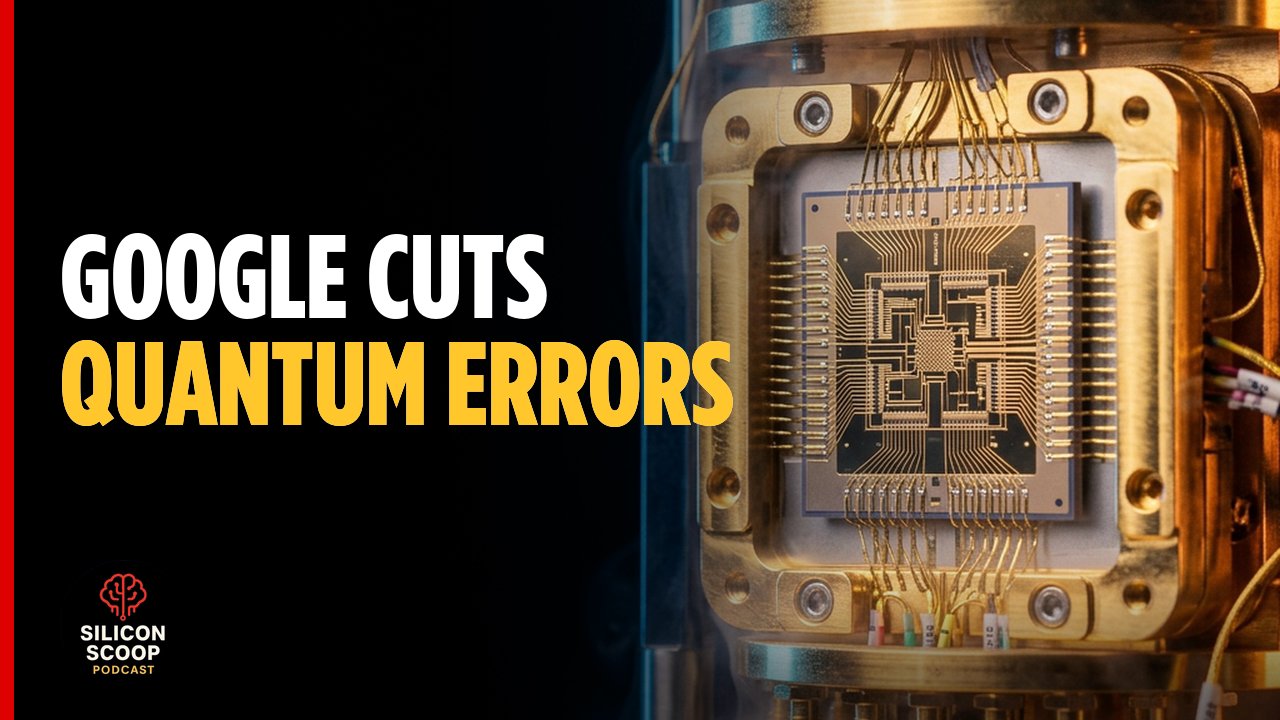
Magic State Cultivation Cuts Errors 40-Fold, Google Says
Craig Major·November 17, 2026
Magic state cultivation on the Google Willow quantum processor cut errors 40-fold, Google says. Learn what the paper shows and what still needs scaling.
Estimated reading time: 10 minutes
Key Takeaways
- Google reports a 40-fold error reduction. On its Willow processor, Google says magic state cultivation cut errors about 40 times compared with uncultivated states.
- T-states reached 99.99% logical fidelity. Google calls this a record for these states. The figure is company-reported, and we found no independent analysis of it.
- The result targets a 20-year bottleneck. Researchers have flagged magic state production as a hard problem since 2004. Google cites estimates that it could eat up to 95% of a quantum computer's capacity.
- The team linked two error-correction codes. It grafted states from a distance-3 color code onto a distance-5 surface code, and Google says the purified states survived the transfer.
- Google says it must still scale. The company says the method needs a larger-scale demonstration before it counts as realistic for practical quantum computing.
Table of contents
- Why T-States Became Quantum Error Correction's Costliest Bottleneck
- How Magic State Cultivation Filters Out Bad Quantum States
- What the Google Willow Quantum Processor Actually Delivered
- The Measurement Glitch That Looked Like Broken Physics
- Color Codes to Surface Codes: The Grafting Step
- What the Science Quantum AI Paper Does and Does Not Prove
- What This Means for Startups and Small Businesses
- Frequently Asked Questions
Google says its magic state cultivation protocol produced T-states with 99.99% logical fidelity on real hardware. It also cut errors about 40-fold compared with uncultivated states. The experiment ran on Google's Willow chip, and Google announced it on October 15, 2026.
Why should a founder care? Making clean "magic" states is one of the biggest costs in building a useful quantum computer. If that cost shrinks, quantum hardware, software and security companies could all move faster. That raises the bar for anyone planning around quantum timelines.
One caution up front. Nearly everything below comes from Google's own announcements. We did not find independent expert analysis, so treat the numbers as company-reported.
Why T-States Became Quantum Error Correction's Costliest Bottleneck
Quantum computers make mistakes all the time. Quantum error correction is the set of tricks that spots and fixes those mistakes while a program runs.
To run useful programs, a quantum computer must perform and error-correct a specific set of operations. One way to do that is to build special resources called magic states. They are called "magic" because they help supply the operations that let a quantum machine go beyond what classical computers can do.
The "T-state" is a common type of magic state. Google's results are stated in terms of T-states, which is why they show up in the numbers below.
A problem researchers have flagged since 2004
According to Google, researchers have named magic state production as a particularly hard bottleneck since 2004. They have spent about 20 years trying to cut its cost.
Two facts explain why it hurts so much:
- It takes huge capacity. Google cites estimates that as much as 95% of a quantum computer's total capacity could go to making high-quality, error-corrected magic states. That leaves little room for the real calculation.
- They get used up. A magic state cannot be reused after it is consumed. That makes it scarce and pushes up the cost of useful work.
Picture a factory where almost all the workers spend their day making one part, and every part is thrown away after one use. That is the shape of the problem.
Source: Google Quantum AI announcement, October 15, 2026
How Magic State Cultivation Filters Out Bad Quantum States
In 2024, Google Quantum AI researchers Craig Gidney, Noah Shutty and Cody Jones took an idea from earlier research and refined it. They developed the approach Google now calls magic state cultivation.
Google describes the method as a filter. It works in a few steps:
- A noisy quantum state is injected into a small region of a quantum chip.
- A series of highly coordinated measurements checks the state for errors.
- Flawed attempts are removed.
- The state that remains is grown, or "cultivated," into an exceptionally pure, low-error state.
- That state can be adapted into a larger, useful encoding.
In plain terms, the method does not try to make every attempt perfect. It throws out the bad ones and keeps the good ones.
What the theory promised
Google says the theory suggested cultivation could substantially shrink the quantum computer needed for practical tasks. Theory is not hardware, though. Google says that showing the method on a real chip took many technical and engineering innovations.
What the earlier paper claims
The cultivation method was described in a paper called "Magic state cultivation: growing T states as cheap as CNOT gates." A CNOT gate is a basic quantum building block. The paper states that cultivation can target error rates between 10^-4 and 10^-9, with "spacetime costs" an order of magnitude lower than prior work. Spacetime cost means the chip area and the time a task needs.
These are the paper's own claims and estimates. They describe what the method targets, not what the Willow experiment measured.
One date caveat applies here. The briefing lists the arXiv page with a date of August 7, 2026. Google's article says the method was developed in 2024 and calls the grafting protocol part of the team's "2024 theory paper." Because those dates conflict, we do not state a posting date for the arXiv paper.
Source: Google Quantum AI announcement, October 15, 2026; arXiv paper page: Magic state cultivation
Cut the manual work before it eats your capacity
Google's cultivation method works by filtering out flawed attempts early so they don't waste the whole system. Your business can do something similar with repetitive tasks like data entry, follow-ups and report building. Flowgrammer.ca builds business automations that remove that manual work, so a small team can handle more without hiring.
What the Google Willow Quantum Processor Actually Delivered
Willow is Google Quantum AI's quantum processor. It is the chip used in this experiment.
Google reports two headline results from the protocol on Willow:
- A 40-fold reduction in errors compared with uncultivated states.
- T-states with a record 99.99% logical fidelity.
What "logical fidelity" means
Logical fidelity measures how accurately an error-corrected quantum state matches the state you meant to make. A score of 99.99% means the state is very close to the target. Google identifies this as a record for T-states.
How Google frames the result
Google calls the work the first demonstration of a practical solution to one of quantum computing's most severe resource bottlenecks. It says the experiment shows, on real hardware, that the crucial magic states can be created efficiently.
Google also says that, along with other algorithmic and engineering advances, the work set a new state of the art in quantum metrology. That is the precise measurement of quantum systems.
A repeat mention on November 2
On November 2, 2026, Google published a follow-up October AI update. It repeated that the Science study showed magic state cultivation works in practice on Willow and cuts errors roughly 40-fold. This is the same company restating its own result. It is not independent confirmation.
Source: Google Quantum AI announcement, October 15, 2026; Google October 2026 AI updates post, November 2, 2026
The Measurement Glitch That Looked Like Broken Physics
The story has a odd twist. In the first tests of the protocol, Google Quantum AI research scientist Emma Rosenfeld saw data that appeared to violate the laws of physics.
Months of checking
The team did not shrug it off. It spent months investigating through:
- Simulations.
- Discussions with colleagues.
- Consistency checks.
Rosenfeld eventually found the cause. The team's standard measurement technique rested on an incorrect assumption. A particular type of laboratory noise was interfering with the benchmark. That noise came from electrical-equipment drift and temperature variation.
Two fixes
The team responded in two ways:
- It added more system controls to reduce the effect of the noise.
- It built a new benchmarking method that tackled the problem more fundamentally. The method uses cultivation itself as a measurement tool.
The lesson for operators is practical. Before a team can trust a result, it has to trust its yardstick. Here, the odd data turned out to be a flaw in how the team measured, and fixing it led to a new way of measuring.
The November 2 Google update does not describe this benchmarking work. The details above come from the October 15 announcement.
Source: Google Quantum AI announcement, October 15, 2026
Color Codes to Surface Codes: The Grafting Step
Error-correction codes are the rule sets that protect quantum information. Google's team showed it can move states between two kinds.
- Color codes are a newer type that suits cultivation well.
- Surface codes are a more established method.
What the team did
The team grafted states from a distance-3 color code onto a distance-5 surface code. "Distance" is a number that reflects how much protection a code offers. Generally, a higher distance means stronger protection.
The grafting protocol first appeared in the team's 2024 theory paper. The new hardware experiment showed that the purified states could survive the transfer. Google says they moved smoothly within its quantum-computing system.
Why it matters
Making a clean state is only half the job. The state also has to fit into the larger machine that will use it. Google describes this as an initial step toward showing that cultivation theory is compatible with its quantum architecture.
Note the word "initial." The demonstration used a small distance-3 code and a distance-5 code, which is far from a full-scale machine.
Source: Google Quantum AI announcement, October 15, 2026
What the Science Quantum AI Paper Does and Does Not Prove
Google says the work was published the same day, October 15, 2026, in the journal Science. The briefing lists the paper title as "Magic state cultivation on a superconducting quantum processor." The article was written by Emma Rosenfeld and Craig Gidney, both at Google Quantum AI.
We did not retrieve the Science paper itself. Our account of its publication rests on Google's announcement.
What is demonstrated
Per Google, these results are completed on hardware:
- The 40-fold error reduction on Willow.
- 99.99% logical fidelity for T-states.
- The distance-3 color code to distance-5 surface code grafting.
What is still open
Google says cultivation must be shown at a larger scale before it can be called realistic for practical quantum computing. It also says many technical challenges remain. The company describes the result as turning a key theoretical idea into an experimentally demonstrated reality.
Google also ties the work to its stated goal of a useful, error-corrected quantum computer that can solve otherwise unsolvable problems. That is a goal, not an achievement.
What independent sources say
The sources we could review are company announcements and a technical paper from the same research effort. We found no independent expert analysis of the result. We also found no strong dissenting analysis, so there is no outside view to report either way.
What we do not know
No funding amount was disclosed in the sources we retrieved. We also have no timeline for when this method could be used in a commercial machine. Google gives none.
Source: Google Quantum AI announcement, October 15, 2026; Google October 2026 AI updates post, November 2, 2026
What This Means for Startups and Small Businesses
Most small companies will never build a quantum chip. But a drop in the cost of error-corrected quantum computing, if it holds up at scale, would ripple through the field. Here is how to think about it without overreacting.
If you build quantum software or tools
- Watch resource estimates. If magic states take up less of a machine, programs may need fewer qubits. Update the cost models in your pitch decks and roadmaps as new numbers appear.
- Track the benchmark story. The Willow team found that lab drift and temperature changes can fool a benchmark. If you test on hardware, build in checks for the same kind of noise.
- Expect faster competition. Google says it has shown a practical fix for a core bottleneck on real hardware. Rivals will likely work on their own approaches.
If you work in security or compliance
- Keep quantum-readiness on the agenda. This result does not mean today's encryption is at risk now. Google says scaling work remains. It does suggest the field is chipping away at a major obstacle.
- Make an inventory. List where your products and vendors use encryption. A list is useful whatever the quantum timeline turns out to be.
If you are a general operator
- Do not buy hype. Vendors may cite this result. Ask whether claims come from independent testing or only from company announcements.
- Separate demonstrated from planned. Google's own wording splits what is shown (a 40-fold error cut on Willow) from what is still needed (larger-scale demonstration).
- Put your attention on near-term wins. Quantum payoffs are not here yet. Automating routine work can pay off now.
Source: Google Quantum AI announcement, October 15, 2026
Frequently Asked Questions
Q: What is magic state cultivation?
A: Magic state cultivation is a method Google Quantum AI developed to make clean "magic" states for quantum computers. It injects a noisy state into a small area of a chip, checks it with coordinated measurements, removes flawed attempts and grows the rest into a low-error state.
Q: What did Google actually announce about magic state cultivation?
A: On October 15, 2026, Google said the technique works on real hardware. On its Willow processor, it cut errors about 40-fold compared with uncultivated states and reached 99.99% logical fidelity for T-states.
Q: What is the Google Willow quantum processor?
A: Willow is Google Quantum AI's quantum processor, the chip used for this experiment. The sources we reviewed do not give more specifications than that.
Q: What are T-states in quantum error correction?
A: T-states are a kind of magic state, a special resource that helps a quantum computer perform operations beyond what classical machines can do. In quantum error correction, T-states must be made with very low error, and that is what Google's protocol targets.
Q: What does 99.99% logical fidelity mean?
A: Logical fidelity measures how accurately an error-corrected quantum state matches the intended state. Google reports 99.99% for its T-states and calls it a record. That figure is company-reported.
Q: Was the result published in Science?
A: Google says the work was published in Science on October 15, 2026, the same day as its announcement. We relied on Google's announcement and did not retrieve the paper itself.
Q: Why are magic states such a big bottleneck?
A: Google says researchers have flagged them as a hard problem since 2004. It cites estimates that up to 95% of a quantum computer's capacity could go to making them, and each state is used up once consumed.
Q: How does the science quantum AI paper connect color codes and surface codes?
A: The team grafted states from a distance-3 color code onto a distance-5 surface code. Google says the purified states survived the transfer and moved smoothly within its system.
Q: Does this mean useful quantum computers are here?
A: No. Google says magic state cultivation must still be demonstrated at a larger scale and that many technical challenges remain. It describes a useful, error-corrected quantum computer as a goal.
Q: Has anyone outside Google confirmed the magic state cultivation results?
A: We did not find independent expert analysis in the sources we reviewed. They were company announcements and a technical paper from the same effort. We found no outside criticism either, so there is no independent view to report.
Additional Links
Flowgrammer.ca – 💡 Unlock AI-Powered Automation! Let flowgrammer.ca handle complex workflows so you can focus on growing your business.
Flowgrammers.ca – 💡 Join Toronto's Fastest Growing AI and Business Automation Community.
- SRED Funding Solutions – Maximize your R&D tax credits and secure funding for your innovation.
- Silicon Scoop Podcast – Stay Informed, Stay Ahead!
- Startup Talk Podcast
- Flowgrammer Youtube
- Startup Investor Drinks – Join Toronto’s Startup Community and connect with fellow startup enthusiasts and investors.
- TorontoStarts Startup and Entrepreneur Community – Become a part of Toronto’s thriving startup ecosystem.
- Workhaus – Discover flexible workspace solutions for your business needs.
- Work with The Startup Coach – Get expert guidance and mentorship for your startup journey.
- Reach out to Jon Irwin on LinkedIn – Connect with our co-host and technology expert.