
Silicon Scoop · Technology
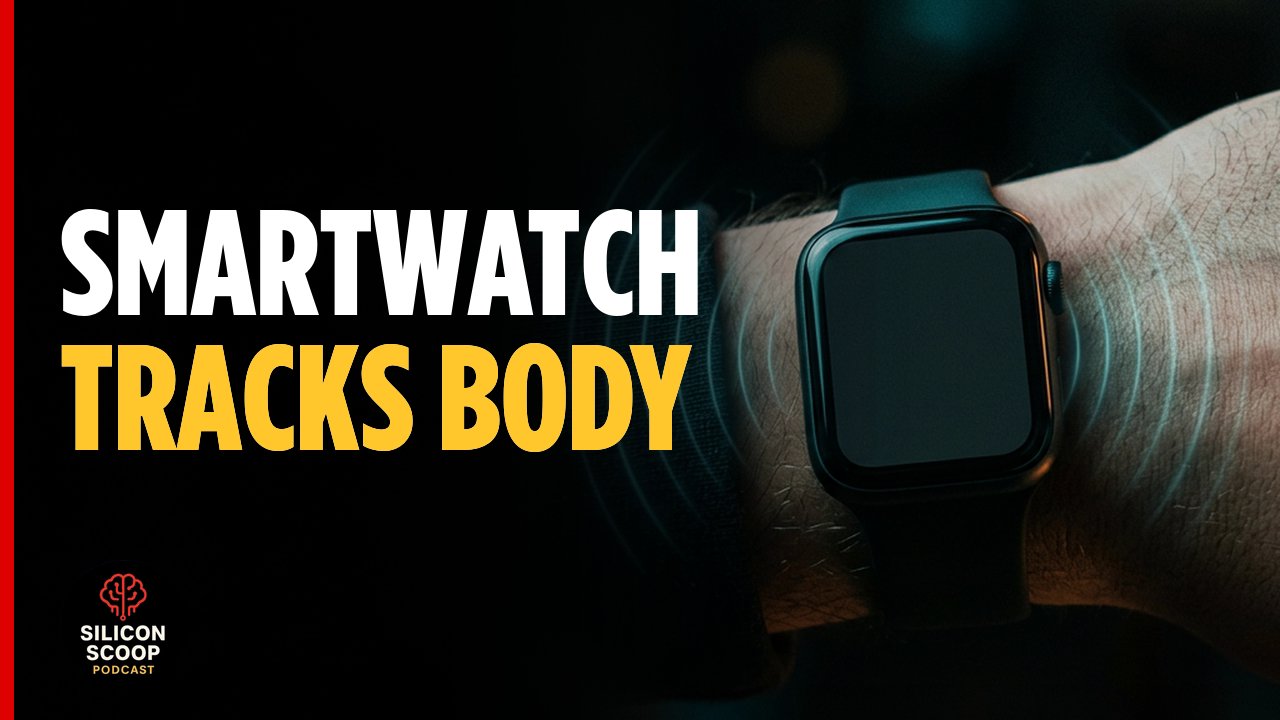
EchoMotion Smartwatch Infers 12 Body Joints With Ultrasound
Craig Major·November 24, 2026
EchoMotion smartwatch research from Cornell infers 12 body joints with ultrasound. Learn how the full body pose tracking works and what it could mean.
Estimated reading time: 10 minutes
Key Takeaways
- 12 joints, one watch: Cornell's EchoMotion estimates the 3D positions of 12 body joints, from head to ankles, using ultrasonic echoes from a smartwatch's built-in speaker and microphone.
- Calibration helps a lot: On an unmodified Samsung Galaxy Watch 6, new users saw average joint error under four inches. A one-time 12-minute calibration cut it by more than one third, to about 2.4 inches, according to Cornell.
- Low power, no camera: Cornell reports about 12 milliwatts of sensing power in the prototype, roughly 40 times less than a wearable camera. A 30-minute Galaxy Watch 6 session used 5% to 6% of the battery.
- Peer-reviewed, but not independently assessed: The paper has an ACM record (DOI 10.1145/3832001) and an accepted-papers listing at UbiComp/ISWC 2026. The sources I found contain no independent expert assessment.
- Still early: Fitness-coaching features and a smartglasses pairing are in development or being explored. They are not shipped products.
Table of contents
- How Full Body Pose Tracking Works on a Single Watch
- What the 12-Minute Calibration Did to the Error Numbers
- Why Ultrasonic Wearable Sensing Appeals: Privacy, Data Size and Battery
- Smartwatch Motion Tracking Outside the Lab: Hallways, Roads and Crowds
- The Paper Trail: Dates, Authors and What Independent Review Is Missing
- What the Cornell Team Says Comes Next: Fitness Agents and Smartglasses
- What This Means for Startups and Small Businesses
- Frequently Asked Questions
An EchoMotion smartwatch setup can estimate where 12 parts of your body are using sound you cannot hear. On a standard Samsung Galaxy Watch 6, Cornell reports that average error per joint was under four inches for new users. A one-time, 12-minute calibration cut that error by more than one third, to about 2.4 inches.
The system comes from Cornell's Smart Computer Interfaces for Future Interactions (SciFi) Lab. It sends ultrasound (sound above human hearing) from the watch and listens for the echoes. A small AI model then turns those echoes into body positions.
Why should founders and operators care? EchoMotion points to a low-cost, privacy-friendly sensing layer. Products in fitness, rehabilitation and extended reality (XR, meaning VR and similar tech) might one day rely less on cameras and dedicated motion hardware. That is a possibility, not a product you can buy today.
This post separates what the researchers measured from what they hope to build. It also notes where the evidence comes from.
How Full Body Pose Tracking Works on a Single Watch
Most smartwatches track the motion of the watch itself. They use accelerometers (which sense movement) and gyroscopes (which sense rotation). Saif Mahmud, the paper's lead author and a Cornell doctoral student, says this is why whole-body tracking has usually needed extra gear. That gear can include smartphones, earbuds or VR headsets.
EchoMotion takes a different route, called active acoustic sensing. The watch makes its own sound and listens for what comes back. Cornell describes it as a sonar-like system.
Here is the basic flow:
- Speakers emit ultrasound. The signals surround the wearer in a sphere of inaudible sound waves.
- Microphones catch echoes. The waves bounce off the wearer's limbs as they move.
- A deep learning model reads the echoes. Deep learning is a type of AI that learns patterns from many examples. Here it turns echo patterns into body positions.
- The output is 12 joints. The ACM paper's abstract says the system infers the 3D positions of 12 body joints.
The team first built its own 3D-printed watch replica. It had a microphone and speaker pair on each side. They collected echo patterns from 10 volunteers who wore it on the nondominant hand and did 18 exercises.
To check accuracy, the researchers compared predicted joint positions with body poses captured by cameras. Cameras served as the reference during testing. The point of EchoMotion is that cameras would not be needed in daily use.
A commercial watch is more limited. Off-the-shelf watches have only a single microphone and speaker pair. So the team also tested on an unmodified Galaxy Watch 6.
Cornell calls this the first time researchers can track a person's entire body movement with ultrasonic waves from an off-the-shelf smartwatch. That "first" is the university's own claim in its announcement. I did not find an independent source confirming it.
Source: Cornell Bowers College news story, November 11, 2026; ACM Digital Library record for EchoMotion
What the 12-Minute Calibration Did to the Error Numbers
The commercial-watch test is where the headline numbers come from. The researchers tested the unmodified Galaxy Watch 6 with 15 new volunteers. These people had not been part of the training data.
For people new to the system, the average error for each joint's location was under four inches. After a one-time, 12-minute calibration, that error fell by more than one third, to about 2.4 inches. Calibration here means a short session in which the wearer helps the system adjust to them.
Those figures come from Cornell's announcement. The ACM abstract adds two formal error measures:
- MPJPE of 5.99 cm. This is mean per-joint position error, the average distance between predicted and reference joint locations. It converts to roughly 2.4 inches.
- MPJRE of 11.92 degrees. This is mean per-joint rotation error, the average angular error in joint orientation.
The ACM abstract reports these for the 15-participant feasibility test on a commercial smartwatch. The Cornell summary does not state them. The 5.99 cm figure is close to the 2.4-inch figure, but the sources I reviewed do not say the two describe the same condition. I would not treat them as identical.
A note on wording: the model was not retrained for other watches. The same AI model, without any retraining, also worked on a Samsung Galaxy Watch 7 and a Google Pixel Watch 3. That is separate from the one-time calibration on the Galaxy Watch 6. Cornell's summary gives no error numbers for the two other watches.
What does 2.4 inches mean in practice? It is useful for coarse movement, like telling a squat from a lunge. It is probably not precise enough for clinical measurements. The researchers describe this as a feasibility result, and the paper's wording is "Towards Full-Body Pose Tracking."
Source: Cornell Bowers College news story, November 11, 2026; ACM Digital Library record for EchoMotion
Turn Manual Busywork Into Automated Workflows
Sensors like the one in this story exist to remove manual effort, and your business has plenty of that too. Flowgrammer.ca builds business automation that handles repetitive tasks such as data entry, follow-ups and reporting. That saves your team hours and lets you scale without adding headcount.
Why Ultrasonic Wearable Sensing Appeals: Privacy, Data Size and Battery
Cornell and the researchers point to three advantages over camera-based tracking. Each one matters for product teams.
Privacy for the wearer and bystanders
Acoustic signals preserve privacy for the wearer and the people around them, according to Cornell's announcement. Nobody has to set up a camera at the gym. Echoes carry movement information, not images of faces or rooms.
Smaller data, cheaper processing
Sound-based sensing generates smaller amounts of data than video. That makes processing easier and cheaper. The model is also lightweight, which means it is small enough to run on modest hardware. Co-author François Guimbretière, a Cornell professor of information science, said small models running on wearables are changing how sensing works in human-computer interaction.
Battery use
Cornell reports that in the prototype, sensing drew about 12 milliwatts. That is roughly 40 times less than a wearable camera. A 30-minute session on a Galaxy Watch 6 used only 5% to 6% of the battery.
These are the university's own figures for a research prototype. The sources I found do not include an independent power test. Still, the direction is clear. A feature that costs a few percent of battery per workout is far easier to ship than one that drains the watch.
Works on watches people already own
Mahmud said the team made significant efforts to make EchoMotion work on commercial devices, so adoption can be very easy. That is his stated goal and expectation. The announcement does not describe a commercial release.
Source: Cornell Bowers College news story, November 11, 2026
Smartwatch Motion Tracking Outside the Lab: Hallways, Roads and Crowds
Lab results often fall apart in the real world. So the team ran a second test with 10 new participants. Each wore a smartwatch and did the same 18 exercises in three settings:
- A small room
- A narrow hallway
- Next to a noisy road
Furniture and ambient noise did not interfere, according to Cornell. That matters because ultrasound can bounce off tables and chairs. Road noise did not throw the system off either.
The hallway caused a slight drop in performance. The cause was echoes coming off other people. Since the system listens to bouncing sound, other moving bodies can add confusing signals.
Mahmud expects the model to improve at reading a wearer's movements, even in crowded places like the subway. He says this would come from training on data from thousands of users instead of dozens. That is an expectation, not a tested result. The paper's tests involved dozens of people, not thousands.
For product builders, this suggests where to be careful. Crowded gyms, group classes and public transit are the hard cases. A private living room or physical therapy room looks like a better early target. That is my reading of the reported results, not a claim from the researchers.
Source: Cornell Bowers College news story, November 11, 2026
The Paper Trail: Dates, Authors and What Independent Review Is Missing
Three documents establish the timeline. They come from three different organizations, and each supports different facts.
- September 30, 2026: The ACM Digital Library record for the paper carries this date. The title is "EchoMotion: Towards Full-Body Pose Tracking with a Single Smartwatch Using Active Acoustic Sensing," with DOI 10.1145/3832001.
- October 8, 2026: The UbiComp/ISWC 2026 accepted-papers page, dated October 8, lists EchoMotion. The listing ties the project to the same DOI and the named authors.
- October 13, 2026: Cornell's announcement says the paper was presented at the ACM joint conference on Pervasive and Ubiquitous Computing and the International Symposium on Wearable Computing (UbiComp/ISWC) in Shanghai on this date.
- November 11, 2026: Cornell published its public announcement, written by Patricia Waldron of Cornell Bowers.
The ACM record shows the work published weeks before Cornell's announcement. So the November news is a university announcement of earlier-published research, not a new release.
Who did the work
The SciFi Lab is directed by Cheng Zhang, an associate professor of information science at Cornell Bowers. Saif Mahmud is lead author. Co-authors named in the announcement are François Guimbretière, Jiwan Kim of KAIST, Tianhong Catherine Yu, Kenny Liang and Vineet Parikh. The National Science Foundation supported the research.
What independent experts say
There is no independent expert consensus to report. The sources I found are Cornell's own announcement, the paper's ACM record and the conference organizers' list. Quotes from Mahmud and Guimbretière come from the research team, so they are not outside validation.
The strongest external check is that the work was accepted at a recognized conference. Other coverage I saw mostly repeats the paper's claims rather than testing them. Independent replication would be the real test, and I found no such report.
Source: ACM Digital Library record for EchoMotion; UbiComp/ISWC 2026 accepted papers list; Cornell Bowers College news story, November 11, 2026
What the Cornell Team Says Comes Next: Fitness Agents and Smartglasses
The paper shows a result. The roadmap is what the team says it is working toward. These items are not finished.
Fitness tracking (in development)
The team is currently developing the technology for fitness tracking. The goal is a personal fitness agent that counts a user's reps. It could also correct their form, for example in a Bulgarian split squat. That is a stated development goal, not a released feature.
Smartglasses pairing (being explored)
The researchers are also exploring EchoMotion together with first-person vision on smartglasses. The aim is to efficiently track objects a person handles. Body tracking from the watch would be combined with what the glasses see.
Daily activity summaries (a stated vision)
Mahmud says that in the very near future, wearables like smartwatches or smartglasses could let a personal agent write a description of your whole day. It would cover what you did and what you ate. He says this project enables the body-tracking part of that vision. This is his forecast, and other parts, like food recognition, are not covered by this work.
Rehabilitation and VR (possible uses)
Cornell says that once EchoMotion is integrated into commercial wearables or VR systems, it could be used to track workouts, daily activities and progress in physical rehabilitation. The word "once" matters. Integration has not happened yet, according to the announcement.
Source: Cornell Bowers College news story, November 11, 2026
What This Means for Startups and Small Businesses
You cannot buy EchoMotion today. The sources do not mention released code, a software kit or a licensing program. But the research shows where wearable sensing is heading, and that has practical value.
Watch for cheaper sensing in fitness and rehab products
Companies building fitness or physical therapy apps often struggle with tracking. Cameras raise privacy worries, and extra sensors raise hardware costs. If acoustic tracking matures, an app could use the watch a customer already owns.
Treat privacy as a selling point
The researchers say acoustic signals preserve privacy and produce smaller data. Gyms, clinics and employers worry about video of customers and patients. A sensing method that avoids cameras could simplify those conversations. Check your own legal and compliance needs first, since sound-based sensing was not evaluated in the sources for regulatory fit.
Plan for calibration in your user flow
The numbers show that a 12-minute calibration made a big difference, cutting error from under four inches to about 2.4 inches. A product built on this idea would need a simple onboarding step. Think about how you would make a 12-minute setup feel worthwhile to a new user.
Test in messy places early
The hallway result shows that crowds can hurt accuracy. If your customers work out in busy spaces, test there before promising results. Start with settings where one person moves alone.
Keep an eye on the research, not just the press release
- Follow the SciFi Lab for updates on fitness and smartglasses work.
- Look for independent replications or follow-up papers.
- Ask whether results hold on more watch models and larger groups.
Prepare your workflows for sensor data
New sensing creates new data to collect, clean and act on. Teams that already have automated pipelines for that data will move faster when the technology is ready. That work is worth starting now, even with today's simpler sensors.
Source: Cornell Bowers College news story, November 11, 2026; ACM Digital Library record for EchoMotion
Frequently Asked Questions
Q: What is the EchoMotion smartwatch system?
A: EchoMotion is a research system from Cornell's SciFi Lab. It uses a smartwatch's built-in speaker and microphone to send and receive ultrasound, then uses AI to estimate body position. It is a research project, not a commercial product.
Q: How does full body pose tracking work with only a smartwatch?
A: The watch emits sound waves that people cannot hear. They bounce off the wearer's limbs, and the microphone picks up the echoes. A deep learning model turns those echo patterns into estimated positions of 12 joints.
Q: How accurate is the EchoMotion smartwatch?
A: On a Galaxy Watch 6 with 15 new volunteers, Cornell reports average joint-location error under four inches. A one-time, 12-minute calibration cut it to about 2.4 inches. The ACM abstract reports an MPJPE of 5.99 cm and an MPJRE of 11.92 degrees.
Q: Which smartwatches work with EchoMotion?
A: The researchers tested an unmodified Samsung Galaxy Watch 6 with new volunteers. Cornell says the same AI model, with no retraining, also worked on a Galaxy Watch 7 and a Google Pixel Watch 3. No accuracy numbers for those two watches were given.
Q: Does ultrasonic wearable sensing drain the battery?
A: Cornell reports the prototype's sensing drew about 12 milliwatts, roughly 40 times less than a wearable camera. A 30-minute session on a Galaxy Watch 6 used 5% to 6% of the battery. These are the researchers' own measurements.
Q: Is acoustic tracking more private than cameras?
A: Cornell says acoustic signals preserve privacy for the wearer and people nearby, and no camera needs to be set up. The system records echoes, not images. Any real product would still need its own privacy review.
Q: Does smartwatch motion tracking with EchoMotion work in crowded places?
A: Not perfectly yet. In a narrow hallway, performance suffered slightly because of echoes from other people. Researcher Saif Mahmud expects more training data from thousands of users to help in places like the subway, but that has not been shown.
Q: Can I buy or download EchoMotion?
A: The sources I reviewed do not mention a public release, app or software kit. Cornell says the team is developing the technology for fitness tracking. Check the SciFi Lab and the ACM paper record for updates.
Q: When was the EchoMotion paper published and presented?
A: The ACM Digital Library record is dated September 30, 2026. The UbiComp/ISWC 2026 accepted-papers page is dated October 8, 2026. Cornell says the paper was presented in Shanghai on October 13, and it announced the work on November 11, 2026.
Q: Has anyone outside Cornell verified the EchoMotion results?
A: I found no independent expert review or replication. The paper was accepted at UbiComp/ISWC 2026 and has an ACM record, which is a form of external validation. Other coverage mostly repeats the paper's claims.
Additional Links
Flowgrammer.ca – 💡 Unlock AI-Powered Automation! Let flowgrammer.ca handle complex workflows so you can focus on growing your business.
Flowgrammers.ca – 💡 Join Toronto's Fastest Growing AI and Business Automation Community.
- SRED Funding Solutions – Maximize your R&D tax credits and secure funding for your innovation.
- Silicon Scoop Podcast – Stay Informed, Stay Ahead!
- Startup Talk Podcast
- Flowgrammer Youtube
- Startup Investor Drinks – Join Toronto’s Startup Community and connect with fellow startup enthusiasts and investors.
- TorontoStarts Startup and Entrepreneur Community – Become a part of Toronto’s thriving startup ecosystem.
- Workhaus – Discover flexible workspace solutions for your business needs.
- Work with The Startup Coach – Get expert guidance and mentorship for your startup journey.
- Reach out to Jon Irwin on LinkedIn – Connect with our co-host and technology expert.