
Silicon Scoop · Technology
Faraday Future Hybrid Patent Issued to Future AIHER
Craig Major·November 24, 2026
Faraday Future hybrid patent No. 12,630,004 went to its Future AIHER subsidiary. See what the 13-claim transmission covers and what remains unproven.
Estimated reading time: 10 minutes
Key Takeaways
- U.S. Patent No. 12,630,004 covers a "Range-Extending Hybrid Transmission System." Faraday Future says it has 13 claims, was filed in June 2025 and was issued in May 2026.
- The company says the patent was granted to its subsidiary Future AIHER, which it says launched in March 2025, not directly to the parent company.
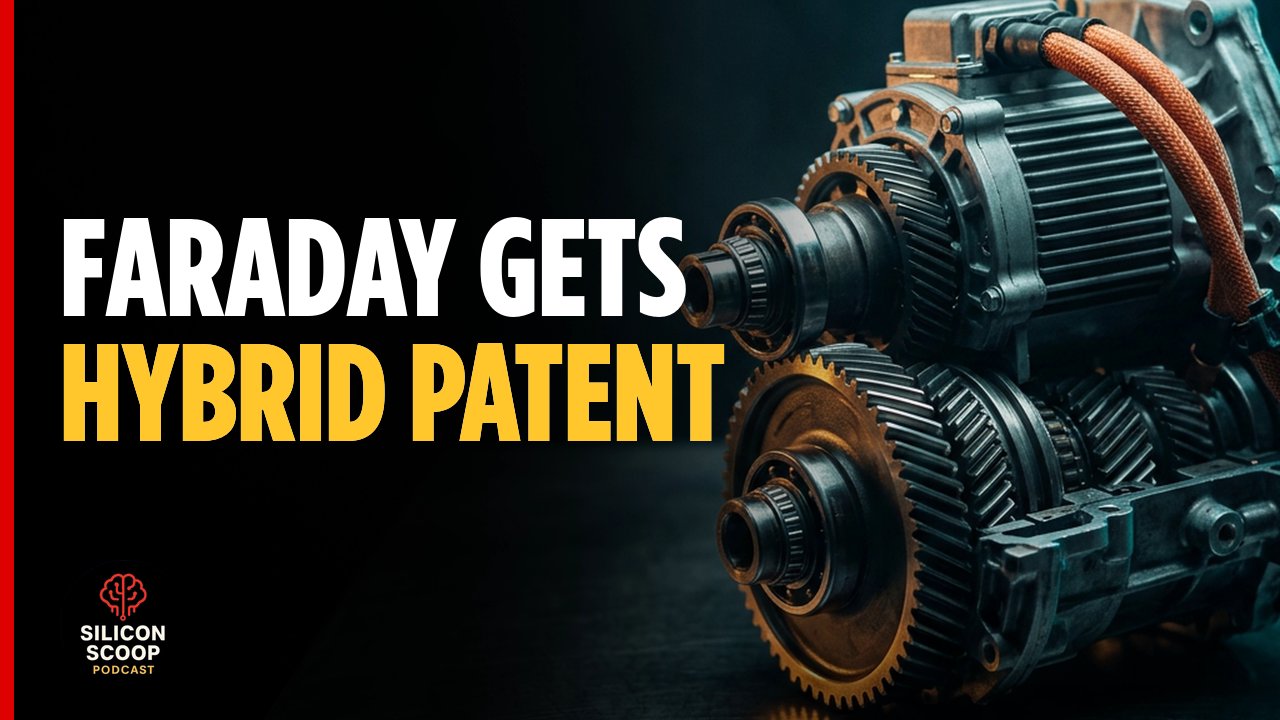
- The design uses multiple shafts and clutches to decouple the engine, generator-motor and drive wheels. Faraday Future says this lets all power sources help drive the car at the same time.
- The patent is company-reported progress, not a tested drivetrain. The briefing found no independent expert analysis, and the real tests of durability, cost and real-world performance are still ahead.
- For founders, the lesson is that a patent can signal roadmap credibility and create leverage before a product ships. It does not replace proof that the product works.
Table of contents
- What the Faraday Future Hybrid Patent Actually Covers
- How a Range-Extending Transmission Separates Engine, Generator and Wheels
- Why the Patent Went to the Future AIHER Subsidiary
- Where the AIHER Powertrain Fits: Two Flagship Ideas and a Future Lineup
- Why This Range-Extending Transmission Is Still Only a Patent
- What This Means for Startups and Small Businesses
- Frequently Asked Questions
Faraday Future says the U.S. Patent Office issued it a patent in May 2026, from an application filed in June 2025, and that the patent contains 13 claims. That is the core of the Faraday Future hybrid patent story. The company announced it as U.S. Patent No. 12,630,004, a "Range-Extending Hybrid Transmission System."
A transmission is the set of parts that moves power from an engine or motor to the wheels. Most hybrids tie those parts together in complicated ways. Faraday Future says its design pulls them apart so each can work on its own or together with the others.
For founders and operators, the story shows how even capital-intensive hardware startups can use patents to create leverage, signal roadmap credibility and differentiate products before mass production. It also shows the limits of that tactic. A patent says "we own this idea." It does not say "this idea works in a car on a cold road."
This post walks through what the company says the patent covers, who holds it, how it connects to the AIHER powertrain effort, and what remains unproven. Almost everything here comes from Faraday Future's own announcements, and the post says so wherever it matters.
What the Faraday Future Hybrid Patent Actually Covers
The company says the U.S. Patent and Trademark Office granted U.S. Patent No. 12,630,004 for a range-extending hybrid transmission system. In its announcement, Faraday Future says the patent has 13 claims. Claims are the numbered statements in a patent that define exactly what the owner can protect.
The company's dates, based on its announcement, are as follows:
- March 2025: Future AIHER launched. The company's launch announcement is dated March 17, 2025.
- June 2025: the patent application was filed.
- May 2026: the patent was issued.
- June 25, 2026: Faraday Future's investor news page lists the announcement of the patent. The Business Wire copy of the release carries a June 26, 2026 date in the research briefing, so the one-day difference is likely a posting or syndication detail.
The briefing gives the filing and issue dates by month only, so no exact day is stated. Counting by month, the gap between filing and issue is about 11 months. No source in the briefing says whether that is fast or slow for this kind of patent, so this post does not judge it.
The lead article that prompted this post says the company "has received" the patent. The company's own announcement is more specific. It says the patent went to the subsidiary Future AIHER. The next sections cover why that matters.
In the company's words, quoted in the lead article from its announcement: "This approach enables strong range extension with weak hybridization, improving power efficiency and performance while reducing the overall complexity of the powertrain." This is a company statement, not an independent finding.
Source: Faraday Future patent announcement via Business Wire; Faraday Future investor news releases page; Future AIHER launch announcement via Business Wire
How a Range-Extending Transmission Separates Engine, Generator and Wheels
Start with the problem the company says it is solving. The lead article says many hybrid and plug-in hybrid systems are mechanically complex, expensive, and sometimes slow to respond when they switch between power sources. They often use intricate arrangements of gears, motors and clutches to blend gasoline and electric power.
Faraday Future describes a different layout. According to the lead article's summary of the patent, the system includes four main pieces:
- A rotary power source, typically an internal combustion engine.
- A generator-motor, a machine that can make electricity or use electricity to turn a shaft.
- A differential connected to the drive wheels. A differential lets the left and right wheels turn at different speeds in a corner.
- Multiple shafts and clutches that control how power flows. A clutch connects or disconnects two spinning parts.
The key idea, in the company's words, is that the patent "provides a simplified hybrid transmission system that decouples the engine, generator-motor, and drive wheels, allowing all power sources to participate in the drive at the same time." "Decouple" means the parts are not locked together all the time.
What decoupling could allow
The lead article describes the operating modes this way:
- The engine does not always have to be mechanically tied to the wheels.
- The generator-motor can add power on its own.
- The engine can make electricity, help drive the vehicle directly, or work alongside the electric motor.
- All sources can work together when maximum performance is needed, or work separately when efficiency matters more.
The article compares it to a team where every player can switch positions depending on the situation. That is a helpful picture, though it is the article's analogy and not a technical test.
What "strong range extension with weak hybridization" means
This phrase comes from the company. The lead article reads it as a vehicle that can reach long driving range without needing an overly complicated hybrid system. In plain terms, the company wants the range benefits of an engine that supports the battery, with fewer moving parts than a full hybrid.
The article also says the company argues the system could be useful in very cold climates, where battery performance often declines. The research briefing does not tie that point to a specific document, so treat it as a company argument that has not been checked independently.
Source: Faraday Future patent announcement via Business Wire
Turn repetitive work into a system that runs itself
Hardware teams win by designing a system once and letting every part do its job without constant hand-offs. Your back office can work the same way. Flowgrammer.ca builds business automation that removes manual data entry, follow-ups and reporting, so you can scale without adding headcount.
Why the Patent Went to the Future AIHER Subsidiary
One detail that the lead article does not stress is who holds the patent. The company says the patent was granted to Future AIHER, its subsidiary, and not directly to the parent company. The company also says Future AIHER launched in March 2025.
The research briefing describes Future AIHER as a separate effort. Faraday Future's earlier company materials describe it as focused on AI extended-range and AI hybrid extended-range powertrain systems. That makes Future AIHER a dedicated home for this technology inside the larger Faraday Future group.
Why a subsidiary structure matters
The sources do not explain why the company chose this structure, so this post does not guess at motives. In general terms, though, putting a technology into its own company can make a few things clearer:
- It shows who owns the intellectual property.
- It gives the technology its own name, which helps with branding.
- It can make licensing or partnering conversations easier to describe.
Those are general business points, not statements from Faraday Future. The sources do not say the company plans to license the patent or sell the technology to others.
Keep the entities straight
It is easy to blur names in this story. Here is a clean way to read them:
- Faraday Future is the California-based EV company and parent.
- Future AIHER is the subsidiary the company says holds the patent.
- AIHER (AI Hybrid Extended-Range Electric Powertrain) is the powertrain platform. The lead article says it launched in 2025, and the company's launch announcement is dated March 17, 2025.
When a headline says "Faraday Future gets a patent," the legal owner, according to the company, is Future AIHER.
Source: Faraday Future patent announcement via Business Wire; Future AIHER launch announcement via Business Wire
Where the AIHER Powertrain Fits: Two Flagship Ideas and a Future Lineup
The patent is expected to become part of the AIHER powertrain platform. A powertrain is the group of parts that makes power and sends it to the wheels. AIHER stands for AI Hybrid Extended-Range Electric Powertrain. The lead article says the platform aims to blend the strengths of conventional hybrids and range-extended EVs.
The company's March 2025 launch materials describe two potential flagship products:
- A super AI hybrid extended-range system.
- A super AI extended-range system.
Both are described as plans or targets, not shipping products. The patent announcement adds that the patented transmission is intended for future use in Faraday Future's vehicle lineup and AIHER system. The sources do not say which of the two flagship ideas would use this specific transmission.
The Super One mention
The lead article says the company plans to integrate the technology into future AIHER-powered models, including versions of its proposed Super One vehicle. The briefing does not tie that statement to a dated source document. Read it as a stated plan, not a production schedule.
No delay should be read into the dates
The dates in this story belong to different things. Future AIHER launched in March 2025. The patent application followed in June 2025. The patent was issued in May 2026. These are separate milestones for a company, a filing and a grant. None of the sources gives a vehicle launch date for the transmission, so there is nothing to compare against and no delay to report.
What an EREV is
The lead article places this work in the category of extended-range electric vehicles, or EREVs. In an EREV, the wheels are mainly driven electrically, and an onboard generator can recharge the battery on long trips. The article says the category is gaining attention because it combines electric driving with that generator.
Source: Future AIHER launch announcement via Business Wire; Faraday Future patent announcement via Business Wire
Why This Range-Extending Transmission Is Still Only a Patent
The lead article is direct on this point: the proposed system "is still only a patent." It shows that the company has secured intellectual property protection for the concept. It does not show that the technology has been proven in large-scale commercial vehicles.
What the company hopes the design delivers
If the technology performs as intended, the lead article says it could help with several challenges facing extended-range electric vehicles:
- Lower manufacturing complexity from a simpler transmission layout.
- Better reliability because there may be fewer tangled parts.
- Lower costs, if the simpler design is cheaper to build.
- Better acceleration and performance, because several power sources can work at once.
- Added range support in the cold, which is the company's argument.
Each item is a hope, not a result. The sources report no test data, no cost figures, no range numbers and no efficiency percentages.
What would count as proof
The lead article says real-world testing, durability validation and cost targets will ultimately decide whether the design delivers. A reader can look for these signs over time:
- Public test results from a third party.
- A named production vehicle that uses the transmission.
- Published cost or weight comparisons.
- Durability data over many miles and many temperature swings.
None of these appears in the sources used for this post.
No independent expert view yet
The available sources are dominated by company statements. The retrieved material contains no independent expert consensus on the patent or the design. Reading the sources together, the patent strengthens Faraday Future's technology story. But the evidence supports only a claimed concept and an intellectual-property milestone, not a validated commercial drivetrain.
That is not a criticism. Most patents are announced long before a product ships. It simply means readers should hold the company's claims as claims until outside engineers or buyers weigh in.
Source: Faraday Future patent announcement via Business Wire; Faraday Future investor news releases page
What This Means for Startups and Small Businesses
You do not need to build a car to learn from this story. The general lessons apply to any company with something hard to copy.
Use IP to tell a clear story
A patent gives you a concrete, dated, numbered fact to point to. Here, that is a patent number, 13 claims and a month of issue. When you talk to investors, partners or customers, a specific document is easier to trust than a vague promise. Just describe it for what it is, an issued protection, and not as proof of performance.
Keep your claims in the right tense
This story is a good model for careful language. The patent is issued. The transmission is intended for future vehicles. The flagship systems are potential. Mixing those tenses is how startups lose credibility. Write "granted," "planned" and "tested" only when each is true.
Think about where the IP lives
The company says the patent sits with a subsidiary built around one technology. If you are building more than one product, ask whether each should have a clear owner, a clear name and a clear record of what it covers. Talk to an IP lawyer before copying any structure, because the right setup depends on your situation.
Build proof on a separate track
A patent and a validated product are two jobs. Plan for both:
- Protect: file early and describe the idea clearly.
- Prove: test, measure and publish results that outsiders can check.
- Price: set cost targets early, since cost is one of the open questions here.
Watch your own complexity
The central pitch of this patent is simplicity: fewer tangled links between parts. The same idea works in a small business. Every manual hand-off, spreadsheet copy and "just ask Sam" step adds friction. Mapping those links and removing the unneeded ones often saves more than adding another tool.
Check what sources really say
When you read a funding, product or patent announcement, ask who wrote it. Here, most of the facts come from the company itself. That is normal, but it means the claims are not yet independently confirmed. Apply the same filter to your own press releases and pitch decks.
Frequently Asked Questions
Q: What is the Faraday Future hybrid patent?
A: It is U.S. Patent No. 12,630,004, titled "Range-Extending Hybrid Transmission System." Faraday Future says the U.S. Patent Office issued it in May 2026 and that it has 13 claims.
Q: Who owns the Faraday Future hybrid patent?
A: The company says the patent was granted to its subsidiary, Future AIHER, not directly to the parent company. Future AIHER launched in March 2025, according to the company's launch announcement.
Q: When was the patent filed and issued?
A: The company says the application was filed in June 2025 and the patent was issued in May 2026. The sources give only the month for each, and the company announced the patent on June 25, 2026.
Q: What is a range extending transmission?
A: It is a set of shafts, clutches and gears that moves power from an engine and an electric machine to the wheels in a vehicle that also has a battery. In Faraday Future's design, the goal is long driving range with a simpler hybrid layout.
Q: How does the range extending transmission decouple the engine from the wheels?
A: The patent uses multiple shafts and clutches so the engine, the generator-motor and the drive wheels are not locked together all the time. Per the company, this lets the engine charge the battery, drive the wheels, or work with the electric motor.
Q: What is the AIHER powertrain?
A: AIHER stands for AI Hybrid Extended-Range Electric Powertrain. The company describes it as a platform that aims to blend the strengths of conventional hybrids and range-extended EVs. The patent is expected to become part of it.
Q: What is Future AIHER, the subsidiary?
A: Future AIHER is the Faraday Future subsidiary that the company says holds this patent. Company materials describe it as focused on AI extended-range and AI hybrid extended-range powertrain systems, and say it launched in March 2025.
Q: Is the patented transmission in a car I can buy?
A: No source in the briefing says so. The company says the technology is intended for future AIHER-powered models, and the lead article mentions versions of its proposed Super One vehicle. Those are plans, not products on sale.
Q: Does the patent prove the design works?
A: No. A patent shows that the company has protection for the concept. The lead article says real-world testing, durability validation and cost targets will decide whether the design delivers.
Q: Have independent experts reviewed the Faraday Future hybrid patent?
A: The retrieved sources contain no independent expert analysis. They are mostly company statements, so the claimed benefits of simplicity, efficiency and cold-weather range support should be treated as the company's claims for now.
Additional Links
Flowgrammer.ca – 💡 Unlock AI-Powered Automation! Let flowgrammer.ca handle complex workflows so you can focus on growing your business.
Flowgrammers.ca – 💡 Join Toronto's Fastest Growing AI and Business Automation Community.
- SRED Funding Solutions – Maximize your R&D tax credits and secure funding for your innovation.
- Silicon Scoop Podcast – Stay Informed, Stay Ahead!
- Startup Talk Podcast
- Flowgrammer Youtube
- Startup Investor Drinks – Join Toronto’s Startup Community and connect with fellow startup enthusiasts and investors.
- TorontoStarts Startup and Entrepreneur Community – Become a part of Toronto’s thriving startup ecosystem.
- Workhaus – Discover flexible workspace solutions for your business needs.
- Work with The Startup Coach – Get expert guidance and mentorship for your startup journey.
- Reach out to Jon Irwin on LinkedIn – Connect with our co-host and technology expert.