
Silicon Scoop · Technology
Fluidic iontronic nanochannels mimic synapses in PNAS study
Craig Major·November 24, 2026
Fluidic iontronic nanochannels use water and salt to mimic synapses in brain inspired computing. Learn what the lab result shows and what it does not.
Estimated reading time: 10 minutes
Key Takeaways
- Tiny device: The artificial synapse in the study measures just 150 by 200 micrometers. Utrecht University presents it as the first evidence that a water-and-salt system can process complex information.
- Dates: The paper went online in PNAS on April 24, 2024. Utrecht University's public coverage followed on April 25, 2024. The article's issue date is April 30, 2024.
- The mechanism: Electrical pulses move ions through a cone-shaped, salt-filled channel. This changes the channel's conductivity, much as synaptic connections strengthen or weaken.
- A tuning clue: Channel length changes how long concentration changes take to fade. That points to channels that hold information for different lengths of time.
- Status: This is a lab demonstration, not a product. Lead author Tim Kamsma calls the efficiency vision speculative, and the sources we found include no independent outside commentary.
Table of contents
- Why Brain-Inspired Computing Needs More Than Solid Materials
- How an Artificial Synapse Made of Water and Salt Works
- What the PNAS 2024 Neuromorphic Paper Reports
- Channel Length Sets How Long the Memory Lasts
- What Is Demonstrated, and What Is Still Speculative
- What This Means for Startups and Small Businesses
- Frequently Asked Questions
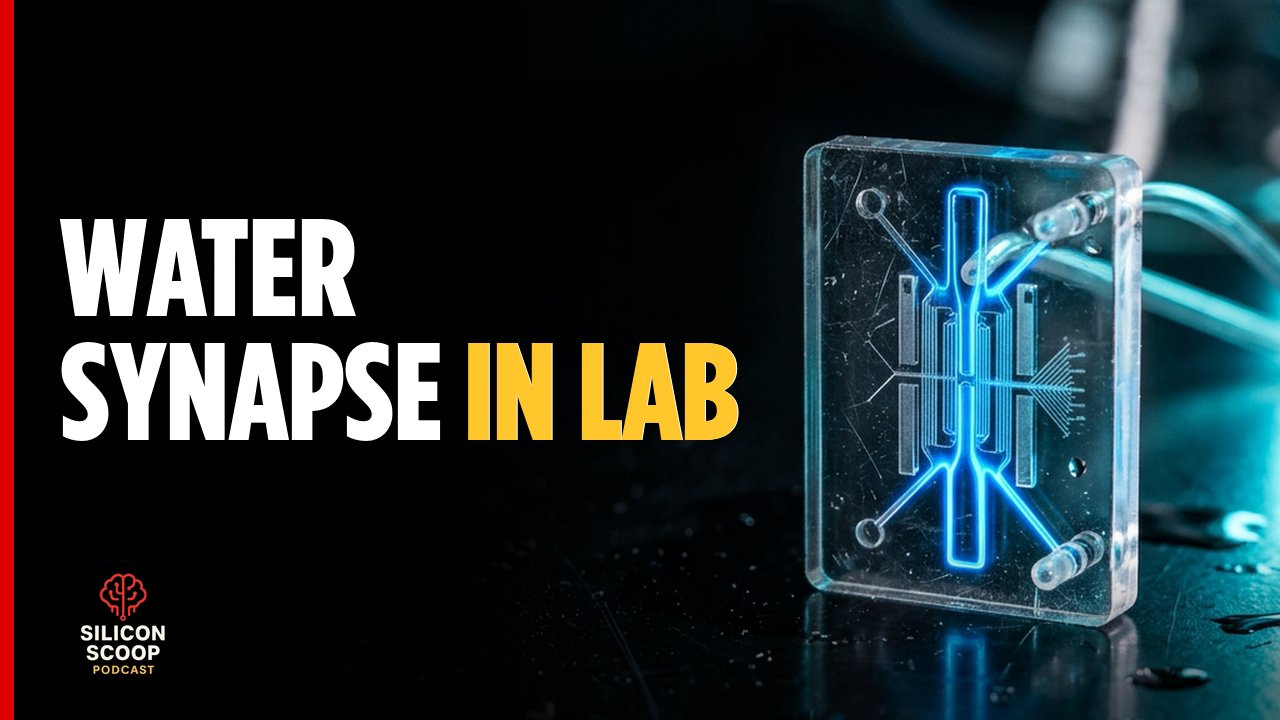
The device reported in PNAS is only 150 by 200 micrometers, yet Utrecht University presents it as the first experimental proof that water and salt can process complex information in an artificial synapse. The paper, "Brain-inspired computing with fluidic iontronic nanochannels," describes a small channel filled with salty water that behaves like a connection between brain cells.
For founders and operators, the relevance is a possible new hardware path toward lower-energy neuromorphic (brain-like) computing. But the field is at proof-of-concept stage. Nothing here is ready to deploy.
This post explains what the team built, what the sources say it shows, and what they do not show. It also covers what a small business can sensibly do with the news today.
Why Brain-Inspired Computing Needs More Than Solid Materials
Scientists have long looked to the human brain to make computers more energy efficient. According to the Utrecht University release, these efforts have led to brain-like computers. Such machines move away from traditional binary processing, which is all ones and zeros. They use analog methods closer to how our brains work.
There is a catch. Our brains run on water and dissolved salt particles called ions. Most brain-inspired computers today rely on conventional solid materials.
The question behind the study
The release asks a simple question. Could we copy the brain more faithfully by using the same medium? That idea sits at the center of a young field called iontronic neuromorphic computing.
Here is what those words mean:
- Iontronic: Relating to circuits that use moving ions, not only moving electrons.
- Neuromorphic: Shaped after the structure or behavior of the nervous system.
- Synapse: The part of the brain that passes signals between neurons.
What already exists
Tim Kamsma is a Ph.D. candidate at Utrecht University's Institute for Theoretical Physics and Mathematical Institute, and the study's lead author. He says artificial synapses that process complex information already exist based on solid materials. The new result is that the same feat can be done with water and salt.
In his words, the team is "effectively replicating neuronal behavior using a system that employs the same medium as the brain."
This is the core of the story. The work does not claim to beat solid-state chips. It shows that a liquid medium can do a job people mostly assumed solids would handle.
Source: Utrecht University release, April 25, 2024 (hosted on Phys.org)
How an Artificial Synapse Made of Water and Salt Works
The Utrecht release describes a device built by scientists in Korea. It is called an iontronic memristor. A memristor is a part whose behavior depends on the signals it received in the past. In other words, it keeps a kind of memory.
The channel
The device uses a cone-shaped microchannel filled with a solution of water and salt. The PNAS abstract adds more detail. The team used easy-to-fabricate tapered microchannels. These embed a conducting network of fluidic nanochannels between a colloidal structure. A colloidal structure is one made of very small particles.
This is where the primary keyword comes from. The nanochannels are tiny passages that carry fluid and ions, and they are what make the device work.
What happens when a pulse arrives
The release describes the process in three steps:
- The device receives an electrical impulse.
- Ions in the liquid migrate through the channel, which changes the ion concentration.
- The channel's conductivity adjusts, depending on the intensity or duration of the impulse.
That third step mirrors how connections between neurons get stronger or weaker. The size of the change in conductance serves as a measurable record of the input signal. So the channel does more than pass a signal along. It holds a trace of what came in.
Why this counts as an artificial synapse
A biological synapse changes its strength based on activity. The device does something similar in a liquid. The sources describe the behavior as synapse-like, and they also say the result shows complex information being processed. We have not seen detailed performance numbers in the material available for this article, so we do not report any.
Source: Utrecht University release, April 25, 2024 (hosted on Phys.org); PNAS article, "Brain-inspired computing with fluidic iontronic nanochannels"
Automate the Work That Does Not Need a Brain
Brain-like computing is a long road, but repetitive busywork is a problem you can fix this quarter. Flowgrammer.ca builds business automation that handles manual tasks like data entry, follow-ups and reporting. That saves your team hours and lets you grow without adding headcount.
What the PNAS 2024 Neuromorphic Paper Reports
The study is titled "Brain-inspired computing with fluidic iontronic nanochannels." It appeared in Proceedings of the National Academy of Sciences (PNAS). Its DOI, a permanent article identifier, is 10.1073/pnas.2320242121.
Who wrote it
The article's lead author is Tim M. Kamsma, identified with Utrecht University. The author list also includes Jaehyun Kim, Kyungjun Kim, Willem Q. Boon, Cristian Spitoni, Jungyul Park and René van Roij.
The Utrecht release says theoretical physicists at Utrecht worked with experimental physicists at Sogang University in South Korea. The records we reviewed do not tell us which author sits at which institution beyond that. So we do not assign affiliations to individual coauthors here.
The timeline
The dates are easy to mix up, so here they are in order:
- April 24, 2024: The paper was published online in PNAS.
- April 25, 2024: Utrecht University's public coverage was published. We saw it hosted on Phys.org.
- April 30, 2024: The PNAS issue date for the article. The PubMed Central record places it in volume 121, issue 18.
The paper was online a day before the university's write-up. The issue date is the formal print placement that came later. It is not a delay or a second announcement.
A note on the sources
The PubMed Central record is an archive entry for the same paper. It corroborates the title and author list. It is not a separate review of the science.
The Utrecht piece is a university announcement. Phys.org hosts it, but the publisher is Utrecht University. So when it says the result is the "first" proof, that is the university's framing of its own researchers' work.
Source: PNAS article page; PubMed Central record of the paper; Utrecht University release, April 25, 2024 (hosted on Phys.org)
Channel Length Sets How Long the Memory Lasts
One side finding may matter most for future design. The Utrecht release says the length of the channel affects how long concentration changes take to dissipate. Dissipate means fade away.
Why that matters
In a brain, some synaptic changes last a short time and others last longer. Both kinds are useful. Short memory helps with fast reactions. Longer memory supports learning.
Kamsma describes the possibility this way: "This suggests the possibility of tailoring channels to retain and process information for varying durations, again akin to the synaptic mechanisms observed in our brains."
Reading the claim carefully
The wording matters here. The measured result is that length changes how long the concentration effect lasts. The tailoring of channels is described as a possibility. It is not shown as a finished design method.
So treat this as a useful design lever, not a proven toolkit. A future team might build many channels with different lengths so each remembers for a different time. The material we reviewed does not report that being built.
A word on the bigger picture
Many brain-inspired computing efforts aim to copy more of the brain's behavior in hardware. A liquid device that has a built-in way to set memory time is one more tool in that effort. It is a tool that has been shown in a single device, not in a large system.
Source: Utrecht University release, April 25, 2024 (hosted on Phys.org)
What Is Demonstrated, and What Is Still Speculative
It helps to split the story into three layers: what was shown, what is hoped for, and what nobody has tested yet.
Demonstrated in the lab
- A water-and-salt device, 150 by 200 micrometers, that mimics synapse behavior.
- Conductivity that changes with the intensity or duration of electrical pulses.
- An effect where channel length changes how long concentration changes persist.
Hoped for
Kamsma says the field is still in its infancy, even though it is growing fast. The envisioned outcome is a computer system far better in efficiency and energy use than today's technology.
He is direct about the limit: whether this vision will come true remains speculative.
He still sees the publication as a significant step forward. In his words, it is "a crucial advancement toward computers not only capable of mimicking the communication patterns of the human brain but also utilizing the same medium." He adds: "Perhaps this will ultimately pave the way for computing systems that replicate the extraordinary capabilities of the human brain more faithfully."
What outside experts say
The material we reviewed is mostly primary or affiliated: the paper itself, its archive record and the university's own release. We did not find independent expert commentary. That means we cannot report an outside consensus, and we cannot report a disagreement either.
So this article rests on what the researchers and their university say. Readers who need a firm investment or engineering judgment should wait for independent analysis and for other labs to report similar results.
What we cannot say
- We cannot say how much energy this approach would save, because the sources give no figures.
- We cannot say when, or whether, it will become a commercial product.
- We cannot say how it compares in speed or cost with solid-state alternatives.
Source: Utrecht University release, April 25, 2024 (hosted on Phys.org); PNAS article page
What This Means for Startups and Small Businesses
Most small businesses will not touch this research directly. But there are practical lessons for founders and operators, especially those near hardware, AI or deep tech.
If you work in hardware or AI infrastructure
- Add it to your watch list, not your roadmap. The result is a demonstrated laboratory result, not a commercial deployment.
- Look for the next signals. Useful ones include follow-up papers, results from other labs, and prototypes that connect many devices.
- Track the energy question. The promise is lower energy use, but this study's sources give no figures. Wait for measured numbers before building a pitch around it.
If you evaluate deep-tech startups or partnerships
- Check the evidence status. Ask whether a claim is a peer-reviewed lab result, a company plan or a product in use. The three get confused often.
- Read who is speaking. A university release about its own researchers' work is useful, but it is not independent review.
- Watch the wording. Phrases like "first proof" and "possibility" describe a start, not a finish.
If you run a regular small business
- Do not wait for new hardware to improve your operations. The tools that save time today are software and automation you can set up now.
- Use news like this to sharpen your questions. When a vendor says its product is "brain-inspired," ask what is actually working today and what is only planned.
- Focus on the manual work. Data entry, follow-ups and reports are costing you hours this month.
A fair summary
The study opens a new option for researchers. For founders, the useful move is to stay informed and stay skeptical. Revisit the topic when independent groups publish results or when a prototype system appears.
Source: Utrecht University release, April 25, 2024 (hosted on Phys.org); PNAS article page
Frequently Asked Questions
Q: What are fluidic iontronic nanochannels?
A: They are extremely small passages filled with liquid, where moving ions (charged particles) carry and shape electrical signals. In the PNAS study, a network of such nanochannels sits inside a tapered microchannel and acts as the core of an artificial synapse.
Q: How does an artificial synapse with water and salt work?
A: The device has a cone-shaped channel filled with salty water. Electrical pulses push ions through it and change the ion concentration. That changes the channel's conductivity, like a connection between neurons getting stronger or weaker.
Q: What did the PNAS 2024 neuromorphic study find?
A: The authors report a water-and-salt device that mimics synapse behavior. Utrecht University describes it as the first evidence that a system using the brain's own medium can process complex information. The paper is "Brain-inspired computing with fluidic iontronic nanochannels."
Q: How big is the device in the study?
A: The Utrecht University release says it measures 150 by 200 micrometers. That is a lab-scale device, not a finished computer chip.
Q: What is brain inspired computing?
A: It refers to computers that borrow ideas from the brain. According to the Utrecht release, they move away from traditional binary processing toward analog methods like those in our brains.
Q: Is this a commercial product?
A: No. The sources describe a demonstrated laboratory result. Lead author Tim Kamsma says it remains speculative whether the vision of far more efficient computers will come true.
Q: When was the paper published?
A: It was published online in PNAS on April 24, 2024. Utrecht University's coverage followed on April 25, and the article's issue date is April 30, 2024.
Q: Who wrote the study?
A: Tim M. Kamsma of Utrecht University is the lead author. Coauthors listed are Jaehyun Kim, Kyungjun Kim, Willem Q. Boon, Cristian Spitoni, Jungyul Park and René van Roij.
Q: Why does channel length matter in this artificial synapse?
A: The Utrecht release says channel length affects how long concentration changes take to dissipate. Kamsma suggests this could allow channels tailored to hold information for different amounts of time, as a possibility rather than a built system.
Q: Have independent experts confirmed the result?
A: We did not find independent expert commentary in the material we reviewed. The sources are the paper, its archive record and Utrecht University's own release, so no outside consensus or disagreement can be reported yet.
Additional Links
Flowgrammer.ca – 💡 Unlock AI-Powered Automation! Let flowgrammer.ca handle complex workflows so you can focus on growing your business.
Flowgrammers.ca – 💡 Join Toronto's Fastest Growing AI and Business Automation Community.
- SRED Funding Solutions – Maximize your R&D tax credits and secure funding for your innovation.
- Silicon Scoop Podcast – Stay Informed, Stay Ahead!
- Startup Talk Podcast
- Flowgrammer Youtube
- Startup Investor Drinks – Join Toronto’s Startup Community and connect with fellow startup enthusiasts and investors.
- TorontoStarts Startup and Entrepreneur Community – Become a part of Toronto’s thriving startup ecosystem.
- Workhaus – Discover flexible workspace solutions for your business needs.
- Work with The Startup Coach – Get expert guidance and mentorship for your startup journey.
- Reach out to Jon Irwin on LinkedIn – Connect with our co-host and technology expert.