
MilliMobile: How Battery‑Free Light‑Powered Microrobots Could Reshape Sensing, Swarms, and Infrastructure Monitoring
MilliMobile: How Battery‑Free Light‑Powered Microrobots Could Reshape Sensing, Swarms, and Infrastructure Monitoring https://torontostarts.com/2026/09/01/millimobile-robot-battery-free-swarms/ Flowgrammer.ca -> https://flowgrammer.ca/ AI News and Resources -> https://flowgrammers.ca OpenClaw Toronto -> https://openclawto.com/ MilliMobile: How Battery‑Free Light‑Powered Microrobots Could Reshape Sensing, Swarms, and Infrastructure Monitoring MilliMobile robot shows how battery-free microrobots powered by light and RF could enable autonomous sensing swarms for smart farms, factories and infrastructure. FLogrammer is your Business Automation Experts - https://Flowgrammer.ca Startup Investor Drinks Toronto - https://startupdrinksto.com/ Toronto’s Startup Community - https://torontostarts.com/ Silicon Scoop Silicon Scoop Podcast - https://torontostarts.com/silicon-scoop/ Apple: https://podcasts.apple.com/us/podcast/silicon-scoop/id1758711826 Spotify: https://open.spotify.com/show/5bAzF0MwV6TtLhJAhvHayI YouTube: https://www.youtube.com/playlist?list=PLj4v-RoA7A-gT62vrEYqh1zCv-0Hj-o5J Startup Talk Startup Talk Podcast -> https://torontostarts.com/startup-talk-toronto-startup-podcast/ Apple -> https://podcasts.apple.com/us/podcast/startup-talk/id1763804003 Spotify -> https://open.spotify.com/show/1siJMILILidHAiAsrX2VBU YouTube: https://youtube.com/playlist?list=PLj4v-RoA7A-jxV5FHs5e61oIsuvUJYmT_&si=LYegRe5GYLKNQ7xL
With Craig Major and Jon Irwin
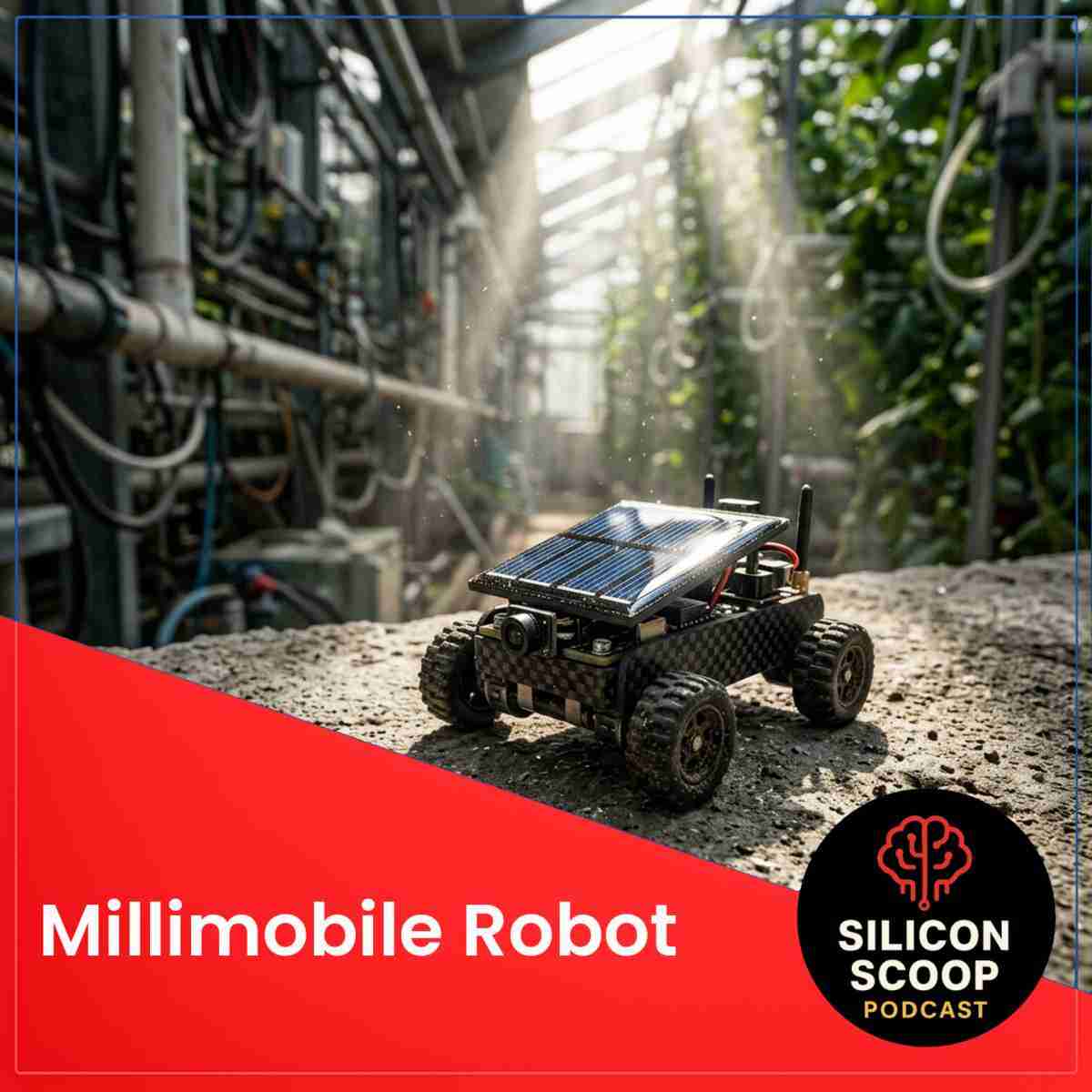
MilliMobile Robot Moves Without a Battery — Here's How
Estimated reading time: 10 minutes
Key Takeaways
- The MilliMobile robot is smaller than a penny, weighs less than a paperclip, and it never needs a battery.
- MilliMobile is the first gram-scale microrobot that can move, sense its environment, run its own computing, and send data wirelessly — all powered entirely by harvested light and radio frequency (RF) energy.
- MilliMobile has been tested on 10 different surfaces, in low indoor lighting, and on RF signals so weak they are barely detectable.
- The key insight behind MilliMobile is intermittent motion, using capacitors to store small bursts of harvested energy and release it in short pulses.
- In the world of smart agriculture, infrastructure inspection, defense, and industrial IoT, this changes what is possible.
Table of contents
- MilliMobile Robot Moves Without a Battery — Here's How
- Key Takeaways
- What Is the MilliMobile Robot and Why Does It Matter for Battery-Free Microrobots?
- The Engineering Behind Light and RF Powered Robots at This Scale
- Autonomous Sensing Swarms — The Real-World Applications
- What the Research Community Says About This Platform
- The Limits and What Comes Next
- Why This Matters for the Future of IoT and Smart Infrastructure
- Frequently Asked Questions
The MilliMobile robot is smaller than a penny, weighs less than a paperclip, and it never needs a battery. Not a rechargeable one. Not a replaceable one. None at all.
Built by researchers at the University of Washington, MilliMobile is the first gram-scale microrobot that can move, sense its environment, run its own computing, and send data wirelessly — all powered entirely by harvested light and radio frequency (RF) energy from the air around it. It was presented at the ACM MobiCom 2023 conference in Madrid, one of the most respected venues in mobile computing research.
This is not a lab trick that only works under perfect conditions. MilliMobile has been tested on 10 different surfaces, in low indoor lighting, and on RF signals so weak they are barely detectable. It still moves. It still communicates. It still senses.
In the world of smart agriculture, infrastructure inspection, defense, and industrial IoT, this changes what is possible. Let's look at exactly how it works, what makes it special, and where it is headed.
What Is the MilliMobile Robot and Why Does It Matter for Battery-Free Microrobots?
Most small robots face the same problem: batteries. They are heavy, they die, and in large deployments, replacing them costs enormous amounts of time and money. For swarms of hundreds or thousands of tiny sensing robots spread across a farm, a factory floor, or a remote pipeline — battery maintenance alone can make the entire idea impractical.
MilliMobile solves this from the ground up.
The robot's chassis measures exactly 10 x 10 millimetres. Its total mass is under 1.1 grams. That is smaller than most insects. Despite that size, it carries a solar cell on top, a Bluetooth chip, temperature and humidity sensors, four light-direction sensors, and two small vibration motors — all working together without a single battery cell.
The key insight behind MilliMobile is intermittent motion. Instead of moving continuously like a traditional motor-driven robot, it uses capacitors to store small bursts of harvested energy — between 47 and 150 µF — and then releases that energy in short pulses to drive its vibration motors. The wheels roll a little. The capacitors charge again. Repeat.
This approach means the robot can operate using less than 100 µW of power — a level so low that indoor light or ambient RF signals can sustain it indefinitely.
Here is what makes that remarkable in context: 100 µW is roughly 10,000 times less power than a typical smartphone consumes while the screen is on. MilliMobile does useful sensing and communication at that level, continuously, with no battery ever needed.
Sources:
- University of Washington news release: University of Washington news release
- ACM MobiCom '23 technical paper: ACM MobiCom '23 technical paper
The Engineering Behind Light and RF Powered Robots at This Scale
Understanding MilliMobile means understanding its three core engineering choices: its body, its power system, and its communication hardware.
The Body
The chassis is laser-machined from carbon fibre and polyimide laminate — two materials chosen because they are stiff, light, and thin. FR4 material (the same stuff used in standard circuit boards) forms the three-spoke wheels, which provide 3 mm of ground clearance. That clearance matters. It lets the robot roll over small pebbles, gaps in concrete, and uneven terrain without getting stuck.
The whole structure is flat and compact, meaning the solar cells on top can capture light from as many angles as possible.
The Power System
MilliMobile harvests energy from two sources:
- Light — Thin-film solar cells made by Microlink Devices sit on top of the robot. These cells can generate enough power even under under-cabinet indoor lighting. In outdoor conditions or brighter indoor environments, they generate significantly more. The robot can begin moving at illuminance levels as low as 20 W/m².
- RF energy — A 908 MHz rectifier circuit captures radio frequency energy from the air. At a ceiling-height transmitter setup of about 2.4 metres, this delivers tens of µW — enough to start motion when light is unavailable. The robot can cold-start (begin working from zero power) at just 7 µA, which is an impressively low threshold that makes it viable in dim or signal-weak environments.
Both sources feed into the capacitor bank. The robot's on-board controller decides when enough charge has built up to trigger a burst of motion or a sensor reading.
The Communication System
MilliMobile uses the nRF52 Bluetooth SoC (system-on-chip), which is a well-known ultra-low-power wireless chip. Here is what it achieves in practice:
- BLE (Bluetooth Low Energy) advertising packets sent every 5 seconds at an average current draw of only ~11 µA
- Long-range coded PHY packets received at up to 700 metres from a base station (with approximately 9% packet delivery rate, which is usable for periodic environmental sensing)
- Robot-to-robot peer communication at up to 140 metres using coded PHY
A 0.5 dBi antenna on the robot communicates with an 8 dBi antenna on the base station. The asymmetry is intentional — you put the more powerful antenna at the fixed base, and keep the robot's antenna tiny and lightweight.
The robot also has four photodiodes arranged around its body to detect the direction light is coming from. This is how it navigates — it turns toward the brightest light source, using light itself as a passive navigation signal. No GPS. No camera. No complex mapping algorithm. Just phototropism, like a plant, but in robot form.
Performance Numbers
- Maximum speed: ~5.5 mm/s (about 19.8 metres per hour in ideal conditions)
- Tested speed over 60 minutes: 10.8 metres covered
- Payload capacity: Up to 3 times the robot's own weight — roughly 3 grams — with only a 25% speed reduction at a 1-gram additional load
- Surfaces tested: 10 types including compact soil, linoleum, concrete, carpet, and wood
Source:
- ACM MobiCom '23 technical paper: ACM MobiCom '23 technical paper
🌱 Your Business Still Runs on Manual Work. It Doesn't Have To.
Stop spending hours on tasks that software can handle in seconds.
Whether you run a small business or manage complex operations, manual workflows quietly eat your most valuable resource — time. Business automation removes repetitive work from your plate so your team can focus on what actually grows the business.
👉 See How Flowgrammer Automates Your Business (Flowgrammer Automates Your Business)
Autonomous Sensing Swarms — The Real-World Applications
A single MilliMobile robot moving 10 metres per hour is interesting. A thousand of them, deployed across a field or factory, communicating with each other and with base stations — that is where the vision becomes genuinely powerful.
Precision Agriculture
Modern farms need constant data: soil moisture, temperature, humidity, and microclimate variation across large areas. Today, this usually means fixed sensor stakes — expensive to deploy, limited in coverage, and dead once their batteries die.
A swarm of MilliMobile-style robots could crawl slowly across a field, powered by sunlight, continuously reporting temperature and humidity data back to a base station. They would never need battery replacement. They could navigate toward the brightest patches of a crop canopy or spread across a dark greenhouse using RF harvesting from a WiFi router.
The University of Washington team specifically identified precision agriculture as one of the primary target markets for this technology. The robot's HDC2010 sensor already reads temperature and humidity — exactly the data farmers need.
Industrial and Infrastructure Inspection
Factories, railways, roads, and bridges all need regular inspection. Much of this inspection today is done manually — a human walks a route, checks equipment, logs readings. That is slow, expensive, and sometimes dangerous.
MilliMobile's ability to operate in RF-rich electromagnetic environments is particularly relevant here. Industrial floors are full of radio signals from manufacturing equipment, WiFi routers, and machine sensors. Rather than interfering with those signals, MilliMobile can harvest them. The more connected the factory, the more energy the robot has to move.
AFCEA's 2024 defense and technology analysis described MilliMobile as a "next big thing in swarm robotics," specifically calling out its suitability for infrastructure inspection and hazardous industrial environments where human presence is risky and battery servicing is impractical.
Defense and Battlefield Sensing
This is the application that defense analysts find most compelling. In contested or hazardous areas, deploying a human to check sensors or replace batteries is a serious tactical and safety problem. A swarm of battery-free microrobots that can be released, navigate using available RF energy or light, and send back environmental or signals-intelligence data over hundreds of metres — that concept directly addresses a real operational need.
Because MilliMobile operates at such low power levels and is physically tiny, it also presents a much smaller detectability signature than traditional sensor platforms.
Source:
- AFCEA signal media analysis: AFCEA signal media analysis
- ACM MobiCom '23 technical paper: ACM MobiCom '23 technical paper
What the Research Community Says About This Platform
The ACM MobiCom '23 paper — published under DOI 10.1145/3570361.3613304 — positions MilliMobile as solving a problem that has blocked microrobotics for years. Previous battery-free robots could either move or sense or communicate. MilliMobile is the first to demonstrate all three simultaneously at gram scale in realistic conditions.
The research team deliberately tested the robot outside of carefully controlled lab setups. Moving across carpet, rough concrete, and compact soil are not clean laboratory tests. They are the kinds of surfaces a real deployment would encounter.
The funding behind the project also signals its broader ambitions. The work was supported by National Science Foundation Graduate Research Fellowships and a NASA Space Grant — both programs tied to long-term U.S. federal priorities around technology development, sustainability, and reducing reliance on conventional power sources.
The environmental angle is also explicitly named in the paper itself. Lithium batteries carry significant environmental costs in production and disposal. At massive IoT scale — billions of sensor nodes — that adds up to an enormous material footprint. Battery-free microrobots like MilliMobile represent one credible path toward distributed sensing infrastructure that does not depend on the lithium supply chain.
Source:
- University of Washington news release: University of Washington news release
- ACM MobiCom '23 technical paper: ACM MobiCom '23 technical paper
The Limits and What Comes Next
It is important to be clear-eyed about what MilliMobile is and is not right now.
Current limitations include:
- Speed — 5.5 mm/s maximum is very slow. For covering large areas quickly, you would need many robots working in parallel, not just one.
- Navigation complexity — The robot navigates toward light. That works well in some environments, but complex indoor spaces, tunnels, or underground infrastructure present harder navigation challenges.
- Packet delivery at range — The 9% delivery rate at 700 metres is usable for infrequent environmental sensing, but it would not support time-sensitive or high-data applications.
- Payload and terrain — While the robot handles 10 terrain types well, very rough outdoor terrain, wet surfaces, or steep inclines remain untested at this scale.
What the research community expects next:
- More efficient energy harvesting circuits, pushing the operating threshold even lower
- More sophisticated on-board navigation, possibly using multiple photodiode readings to build simple local maps
- Swarm coordination protocols where robots share data with each other to cover more ground
- Application-specific sensor payloads — gas detectors, vibration sensors, or acoustic sensors for specific industrial use cases
MilliMobile is a platform and a proof of concept. The most important thing it demonstrates is that the fundamental combination — battery-free power, sensing, computing, and wireless communication at gram scale — is achievable in realistic conditions. The next generation of work builds on that foundation.
Sources:
- ACM MobiCom '23 technical paper: ACM MobiCom '23 technical paper
- AFCEA signal media analysis: AFCEA signal media analysis
Why This Matters for the Future of IoT and Smart Infrastructure
The Internet of Things has a battery problem. Analysts estimate there are already over 15 billion connected IoT devices in the world, and projections for the coming decade push that number dramatically higher. Every one of those devices needs power. Most use batteries. Replacing, recycling, and managing those batteries at scale is already a logistical and environmental challenge — and it will get harder as deployments grow.
MilliMobile represents a different model: sense everything, power nothing deliberately.
Instead of shipping batteries to sensors, you design sensors that live on whatever energy the environment already provides — light, radio signals, even thermal gradients. The sensor works as long as the environment does.
For smart farms, that means sensors that outlast the farm itself. For factories, it means maintenance-free sensing nodes embedded in floors and walls. For infrastructure monitoring, it means putting sensors in locations where no one can easily reach to change a battery — inside concrete pillars, under bridges, along remote pipelines.
The research was clear in 2023. The ACM MobiCom community recognized MilliMobile as a genuine step-change in what battery-free robotic platforms can do. The practical deployments are still coming, but the underlying capability is proven.
Source:
- University of Washington news release: University of Washington news release
Frequently Asked Questions
1. What is the MilliMobile robot?
MilliMobile is a battery-free autonomous microrobot developed by researchers at the University of Washington. It measures 10 x 10 mm, weighs under 1.1 grams, and runs entirely on energy harvested from light and RF signals. It can move, sense temperature and humidity, compute decisions on-board, and communicate wirelessly via Bluetooth.
2. How does MilliMobile move without a battery?
It uses a technique called intermittent motion. Small capacitors (47–150 µF) store harvested energy until there is enough to trigger a short burst from two vibration motors. The robot moves a little, the capacitors recharge, and the process repeats. This allows motion on less than 100 µW of power — well within what indoor light or ambient RF can provide.
3. What energy sources does MilliMobile use?
MilliMobile harvests energy from two sources: thin-film solar cells on its top surface that capture light (even indoor ambient light down to 20 W/m²), and a 908 MHz RF harvesting circuit that captures energy from existing radio signals in the environment. Either source alone can power the robot.
4. How fast can MilliMobile move?
In controlled testing, MilliMobile reached a maximum speed of approximately 5.5 mm/s, covering 10.8 metres over 60 minutes. Speed depends on available light or RF power and the surface type.
5. Can MilliMobile carry anything?
Yes. Despite weighing under 1.1 grams, MilliMobile can carry a payload up to roughly 3 times its own weight — approximately 3 grams — with only a 25% reduction in speed at a 1-gram load. This means it can carry additional sensors or small modules for specific applications.
6. How far can MilliMobile communicate wirelessly?
Using Bluetooth Low Energy long-range coded PHY, MilliMobile can communicate with a base station at up to 700 metres (with ~9% packet delivery rate). Robot-to-robot communication works at up to 140 metres. BLE advertising packets are broadcast every 5 seconds at an average power draw of only ~11 µA.
7. What surfaces can MilliMobile navigate?
The robot was tested on 10 different terrain types including compact soil, linoleum, concrete, carpet, and wood. Its FR4 wheels and 3 mm ground clearance allow it to handle the small gaps and texture variations common on those surfaces.
8. What real-world applications could MilliMobile enable?
The three main target markets identified by researchers and analysts are: precision agriculture (soil and microclimate sensing across fields), industrial and infrastructure inspection (factories, roads, bridges, pipelines), and defense or hazardous environment monitoring (where human presence is risky and battery servicing is impractical). Large-scale IoT deployments where reducing battery dependency is a strategic priority are also a key target.
9. What are the current limitations of MilliMobile?
Current limitations include slow speed (making large-area coverage dependent on deploying many robots), simple light-directed navigation that may struggle in complex or dark environments, a relatively low wireless packet delivery rate at maximum range, and untested performance on very rough, wet, or steep outdoor terrain.
10. Where can I read the original research on MilliMobile?
The peer-reviewed technical paper — "MilliMobile: An Autonomous Battery-free Wireless Microrobot" — was presented at ACM MobiCom 2023 in Madrid. The DOI is 10.1145/3570361.3613304. A copy of the paper is available at a copy of the paper. The University of Washington published an official news release at an official news release. Defense and industry analysis from AFCEA is available at Defense and industry analysis from AFCEA.
Additional Links
Flowgrammer.ca – 💡 Unlock AI-Powered Automation! Let flowgrammer.ca handle complex workflows so you can focus on growing your business.
Flowgrammers.ca – 💡 Join Toronto's Fastest Growing AI and Business Automation Community.
- SRED Funding Solutions – Maximize your R&D tax credits and secure funding for your innovation.
- Silicon Scoop Podcast – Stay Informed, Stay Ahead!
- Startup Talk Podcast
- Flowgrammer Youtube
- Startup Investor Drinks – Join Toronto’s Startup Community and connect with fellow startup enthusiasts and investors.
- TorontoStarts Startup and Entrepreneur Community – Become a part of Toronto’s thriving startup ecosystem.
- Workhaus – Discover flexible workspace solutions for your business needs.
- Work with The Startup Coach – Get expert guidance and mentorship for your startup journey.
- Reach out to Jon Irwin on LinkedIn – Connect with our co-host and technology expert.
Episode transcript
Read the full transcript
Craig: this robot is smaller than a coin, has no battery, and can still move, sense its surroundings, and transmit data. the breakthrough is not that it moves quickly. it absolutely does not. but that it can keep inching forward using tiny amounts of harvested light or deliberately supplied radio energy. the battery is usually the heaviest ticking clock inside a tiny robot. researchers at the university of washington removed that clock entirely and built a gram scale machine that can recharge itself from light, a move in short bursts, and report what it senses. the milli mobile has no battery, no camera, and no sense of urgency, but give it enough light, and this coin sized robot will slowly wander around measuring the world long after your phone has died. what do you think about this robot that never needs to be recharged, john?
Jon: this scares the crap out of me, but let me this is really cool. so imagine that, you're dropping thousands of tiny robots into a forest after a wildfire, inside a collapsed building after an earthquake, or even inside industrial equipment. so instead of carrying batteries that eventually die, these robots are simply, quote, unquote, eating energy that's already around them. sunlight, indoor lights, or even radio waves from wi fi routers, cell towers, or communication systems. and so because they continuously harvest energy from the environment, they can operate for extremely long periods without human in intervention. this is significant. and if they can scale this to large robots, that's gonna be the end of, or that's that's gonna be the end all be all. that's the that's the skynet. that's these that's these terminator robots. right? so it's significant because batteries have always been pretty much the biggest limitation for robotics as far as weights and maintenance and eventually failing. and so by eliminating or dramatically reducing the need for batteries, we're moving to a terminator future where millions of right now, not because these are tiny autonomous robots that quietly could quietly monitor infrastructure. they could collect scientific data. they could inspect dangerous environments or even perform medical tasks inside the human body, which is kinda cool, kinda creepy, which i love. and so i love this. i love that the core innovation here is we're talking about energy harvesting. so, they're using photovoltaic or solar energy from sunlight or rf electromagnetic energy emitted by wireless communication systems. and so the thing is this can't scale, at least not with the technology we have right now, because both sources provide relatively little power individually. and so the engineering challenge is making a robot that consumes even less power than it harvests. i think this is cool, scary, but what do you think about this, craig?
Craig: this is really cool, and the story is not tiny robot moves. small robots already exist. but this is an important combination of battery free power, onboard computation, autonomous steering, environmental sensing, wireless communication, and untethered movement as, you know, this thing is the university of western researchers created this milli mobile, roughly one centimeter square robot weighing under 1.1 grams. like you said, harvest, solar and rf energy, stores it in capacitors, moves through tiny pulses from vibration motors. it can sense light, temperature, humidity, make simple navigation decisions, and transmit data over bluetooth. so this matters because back like you meant, the batteries makes, sensor deployments expensive to maintain. but now if you can deploy these or a bunch of these depending on your environment, you can now sense, say, a much bigger area or whatnot. i remember when i was down at, i'm trying to remember, hp labs down in palo alto, and you had to sign all these agreements, but it's ages ago now. they had this little robot that ran through their server room that was fully automated that had this great big long temperature probe. so it determined the temperature at every point in the server room and adjusted all the acs and fans in real time. so now you start taking that down to the microscopic level or the centimeter level and think about you can get all these sensors. you can detect leaks in basements. you can detect, i don't know, a thousand different things at low, low to no cost, being deployed, and working forever. it sounds amazing. and you're right. it's scary when you start, to scale this up to a higher level. but, you know, once you get to hydrogen and nuclear and limitless power, then it doesn't really matter whether they're they have, this wireless battery capability or not, doesn't it? they're just gonna come for us. yeah.
Jon: so go ahead. oh, go ahead. no. you go ahead. nope. so most people, other than conspiracy theorists, might not realize that our environment is constantly filled with radio frequency energy. go crazy, you conspiracy theorists, about five g and covid and whatever. but we've got tons of like, there's tons of blue if you were to open up a, if you were to have a frequency wave, whatever it's called, and look at all the waves. like, there's tons around you. there's wi fi. there's bluetooth. there's cell. there's television. there's satellite. there's five g, and there's so much. there's even wireless energy now being broadcast, but not not in, like, their test environment. but, researchers are using this miniature antenna called a rectenna, which is a rectifying antenna to capture rf energy and convert it into alternating electromagnetic waves into direct current energy. and so, we're talking microwatts worth of power. but if the robot only requires microwatts to operate, well, then you've got continuous operation. right? think about this concept similar to rfid tags. so i don't know if you guys know this, but rfid tags work as using radio frequency. so the tag itself, when it's sitting there, is it's sitting there without doing anything. once it gets an rf signal, that's when it sends out the information from that tag itself. so it's a it's a little storage tag that has information that is readable or writable. once there is a signal that is, applied to it. so, there's a lot more engineering that's needed to happen here, like, better harvesting, and lower, power usage. but i'm excited for this, but also scared.
Craig: yeah. it's interesting. i love where we're going when we talk about low power because what else could we do with this? you know, in some practical applications, modern farms need constant day, data, soil, moisture, temperature, humidity, microclimate variations. a swarm of milli, mobile style robots could crawl, crawl across a field powered by sunlight, reporting temperature and humidity data back to a station. you could do that in greenhouses. industrial infrastructure and inspection, factories, railways, roads, bridges, all need regular inspection. manually walked by humans today. these could be done by milli mobile robots that are, passing the signals back, defense and battlefield sensing. so there's a lot to be done here, that could be used with this stuff. but we're still in the lab. these aren't fully deployable yet. the speeds are at 5.5 millimeters per second. maximum is very slow. navigation is complex. packet delivery at range and 9% delivery rate at 700 meters is usable for infrequent environmental sensing, but not support for time sensitive stuff. so there's a lot of things that has to improve, but i like it. i think it's cool, and i'm not really, scared of this. i think of it, like a wind up toy that winds itself, itself, one click at a time from the light in the room. not being able to wind up. just click click. so, you know, i think it's really cool.
Jon: yeah.
Craig: and, milli mobile proves that useful robot movement can happen on an energy budget previously associated with tiny sense stationary sensors. the next generation of robots may not charge faster. they may become patient enough to stop needing batteries. would you trust a swarm of nearly invisible robots to inspect your farm, factory, or city infrastructure? let us know in the thoughts below. in the comments below.
More from Silicon Scoop
All episodes
silicon-scoop · October 16, 2026
Meta’s $18 Billion Teen Safety Settlement: Soft Guardrails, Hard Leverage Over TikTok and YouTube
Deep dive on Meta teen safety settlement, social media addiction lawsuit, new Facebook Instagram time limits and pressure on TikTok YouTube age verification.
View episode

silicon-scoop · October 15, 2026
How Claude Mythos Is Reshaping Cryptanalysis: HAWK, AES and the Rise of AI-Driven Crypto Research
Claude Mythos cryptanalysis weakens HAWK post-quantum signature, speeds AES Möbius Bridge attack, and powers CryptanalysisBench benchmark in AI-driven crypto research.
View episode

silicon-scoop · October 14, 2026
Nvidia’s $12.9 Billion Hugging Face Bet: How Controlling the Open-Source Model Hub Reshapes AI Chips, Cloud, And Competition
Nvidia Hugging Face acquisition could reshape open source AI models, AI chip dominance, and the global developer model hub, raising antitrust and neutrality questions.
View episode