
xMEMS XMC-1200: Solid-State Micro Fan That Breaks the Thermal Wall for AI Smart Glasses
xMEMS XMC-1200: Solid-State Micro Fan That Breaks the Thermal Wall for AI Smart Glasses https://torontostarts.com/silicon-scoop/ Flowgrammer.ca -> https://flowgrammer.ca/ AI News and Resources -> https://flowgrammers.ca OpenClaw Toronto -> https://openclawto.com/ xMEMS XMC-1200: Solid-State Micro Fan That Breaks the Thermal Wall for AI Smart Glasses How the xMEMS XMC-1200 solid-state micro fan and µCooling platform transform smart glasses cooling, enabling thinner AI wearables and longer video recording. FLogrammer is your Business Automation Experts - https://Flowgrammer.ca Startup Investor Drinks Toronto - https://startupdrinksto.com/ Toronto’s Startup Community - https://torontostarts.com/ Silicon Scoop Silicon Scoop Podcast - https://torontostarts.com/silicon-scoop/ Apple: https://podcasts.apple.com/us/podcast/silicon-scoop/id1758711826 Spotify: https://open.spotify.com/show/5bAzF0MwV6TtLhJAhvHayI YouTube: https://www.youtube.com/playlist?list=PLj4v-RoA7A-gT62vrEYqh1zCv-0Hj-o5J Startup Talk Startup Talk Podcast -> https://torontostarts.com/startup-talk-toronto-startup-podcast/ Apple -> https://podcasts.apple.com/us/podcast/startup-talk/id1763804003 Spotify -> https://open.spotify.com/show/1siJMILILidHAiAsrX2VBU YouTube: https://youtube.com/playlist?list=PLj4v-RoA7A-jxV5FHs5e61oIsuvUJYmT_&si=LYegRe5GYLKNQ7xL
With Craig Major and Jon Irwin
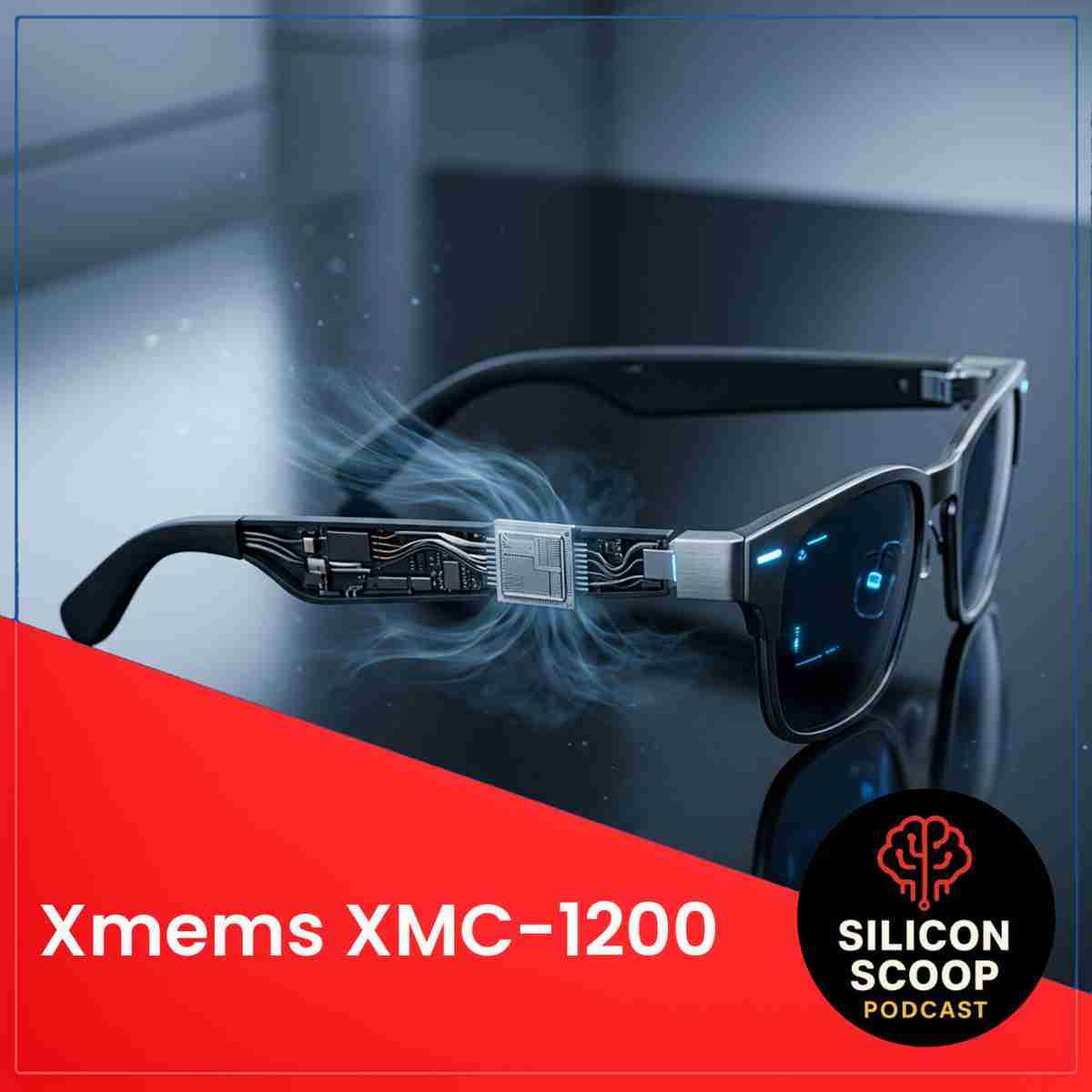
xMEMS XMC-1200 Solid-State Micro Fan Breaks Smart Glasses Cooling
Estimated reading time: 10 minutes
Key Takeaways
- Smart glasses processors generate heat with nowhere for that heat to go.
- The xMEMS XMC-1200 is a piezoelectric solid-state micro fan designed to fit inside a glasses temple arm.
- It draws just 70 milliwatts of power and can drop temperatures by up to 10°C at a 1-watt thermal load.
- If the timeline holds — production-ready by Q4 2027, consumer devices around 2028 — this tiny chip could enable the next generation of AI smart glasses.
Table of contents
- xMEMS XMC-1200 Solid-State Micro Fan Breaks Smart Glasses Cooling
- Key Takeaways
- The Thermal Wall Blocking Smart Glasses from Reaching Their Potential
- How the xMEMS XMC-1200 Works — and Why It Is Different
- The µCooling Platform Behind the XMC-1200
- The XMC-2400 Preview and What It Tells Us About the XMC-1200's Direction
- What This Means for Smart Glasses Product Design
- Strategic Timing and the OEM Opportunity
- What Still Has to Happen Before This Reaches Your Face
- FAQ
Smart glasses have a problem nobody talks about enough. The processors powerful enough to run on-device AI, drive bright see-through displays, and record 2K video generate heat. Real heat. And right now, there is nowhere for that heat to go.
The xMEMS XMC-1200 is a piezoelectric solid-state micro fan built to solve exactly that. It is small enough to fit inside a glasses temple arm, draws just 70 milliwatts of power, and can drop temperatures by up to 10°C at a 1-watt thermal load. If the timeline holds — production-ready by Q4 2027, consumer devices around 2028 — this tiny chip could be the reason the next generation of AI smart glasses finally works the way the demos always promised.
This article breaks down how the XMC-1200 works, what the numbers actually mean, why the thermal problem in wearables is so hard, and what this chip means for the future of AR, XR, and AI glasses.
The Thermal Wall Blocking Smart Glasses from Reaching Their Potential
Before we talk about the solution, it helps to understand just how serious the problem is.
Every modern processor produces heat as a byproduct of computation. In a laptop or phone, that heat can spread across a metal chassis, dissipate through vents, or be moved by a tiny fan. In smart glasses, you have none of those options.
The frame has to be thin. It sits on your face. It cannot get hot enough to burn skin. It cannot be heavy. It cannot have a noisy fan. And yet it needs to run a chip capable of:
- Processing real-time computer vision for AR overlays
- Running on-device AI inference without a cloud connection
- Powering a microdisplay bright enough to see in sunlight
- Recording video at 2K or 4K resolution continuously
Each of those tasks generates heat. Stack them together, and the processor hits its thermal ceiling fast. When that happens, it throttles — it slows itself down to keep from overheating. The result? Dimmer displays, shorter recording sessions, slower AI responses, and a device that feels sluggish.
This is what engineers call the "thermal wall." Several outlets covering the XMC-1200, including VR.org and Gizmodo, have used that exact phrase to describe what currently limits the ambition of smart and XR eyewear. VR.org Gizmodo
The thermal wall is not a software problem. It cannot be patched. It is physics. And until now, nobody had a convincing hardware answer for it.
How the xMEMS XMC-1200 Works — and Why It Is Different
The XMC-1200 is not a miniature version of the spinning fan inside your laptop. It has no rotor. No bearings. No moving parts in the traditional sense.
Instead, it uses piezoelectric MEMS technology — Micro-Electro-Mechanical Systems driven by electrical voltage. When voltage is applied to piezoelectric silicon structures inside the chip, those structures vibrate. That vibration moves air. The whole process happens in a sealed, solid-state package with a footprint of just 46mm² and a thickness of approximately 1mm.
Because the vibrating structures move at frequencies above the range of human hearing, the device operates in near silence. There is no mechanical grinding, no audible whirring — just air movement you cannot hear but can measure.
Here are the core specs for the XMC-1200:
- Footprint: 46mm²
- Thickness: ~1mm
- Typical power draw: ~70mW (when paired with the Astra2 drive ASIC)
- Airflow output: Up to 10 cm³/s
- Back pressure capability: Up to 1,100 Pa
- Cooling performance: Up to 10°C temperature reduction at a 1W thermal load
- Dust and water resistance: IP68 rated
- Production target: Q4 2027
xMEMS press release audioXpress
The IP68 rating deserves special attention. It means the XMC-1200 is built to survive sweat, rain, and dust — the real-world conditions that face-worn electronics deal with daily. That is not a minor engineering footnote. It is a commercial requirement. A cooling chip that fails when you wear your glasses at the gym is not a cooling chip anyone can ship.
The µCooling Platform Behind the XMC-1200
The XMC-1200 sits within xMEMS' broader µCooling platform — a family of solid-state micro cooling components designed to deliver active thermal management in form factors that passive heat spreaders simply cannot match.
Earlier µCooling implementations, tested in XR glasses running at a 1.5W TDP (thermal design power), produced striking results:
- Up to 40% reduction in overall system temperature
- 60–70% improvement in power overhead, meaning roughly 0.6W of extra thermal headroom was unlocked
- Up to 75% reduction in thermal resistance
xMEMS press release audioXpress
These are not lab curiosities. A 0.6W increase in thermal headroom means an OEM can configure their processor to run harder, longer, and brighter without hitting the throttle ceiling. That directly translates to product features users actually want.
The XMC-2400 Preview and What It Tells Us About the XMC-1200's Direction
xMEMS showed the public a larger sibling device, the XMC-2400, at MWC 2026. Understanding that device gives important context for the XMC-1200's roadmap.
The XMC-2400:
- Is 1mm thick
- Draws just 30mW of power
- Delivers 35 cm³/s of airflow — more than three times the XMC-1200's output
- Achieved over a 20°C temperature drop in a 1W smart-glasses demo at MWC
- Carries an IP58 rating
- Has confirmed design wins from OEM partners
- Is expected to appear in a consumer product by end of 2026
The XMC-2400 is targeted at slightly larger or less constrained devices. The XMC-1200, with its smaller 46mm² footprint, is designed for the tightest spaces — the slender temple arms of fashion-forward smart glasses where every cubic millimeter is contested.
Together, these two devices show that xMEMS is building a tiered µCooling product line: different sizes, different airflow outputs, different power budgets, but all sharing the same core piezoelectric MEMS architecture. OEMs can pick the device that fits their specific frame geometry and thermal requirements.
The fact that the XMC-2400 already has design wins and a near-term consumer launch strongly suggests the µCooling platform is past the "interesting research project" stage. It is moving into mass production planning.
Stop Letting Manual Tasks Eat Your Day
Your business runs on decisions, not data entry. Flowgrammer.ca helps growing businesses automate the repetitive work — scheduling, follow-ups, reporting, approvals — so your team spends time on what actually moves the needle.
👉 See How Automation Can Scale Your Business (https://flowgrammer.ca)
What This Means for Smart Glasses Product Design
The XMC-1200 is not just a cooling chip. It is a design constraint remover.
Right now, smart glasses engineers face a brutal set of trade-offs. Want a brighter display? More heat. Want faster AI? More heat. Want longer recording? More heat. The thermal ceiling puts a hard cap on all of it, and the only current workarounds are:
- Use a less powerful processor (worse product)
- Throttle aggressively (worse experience)
- Make the device larger to hold more passive heat mass (less wearable)
- Accept short session times before the device gets too hot (consumer frustration)
A solid-state micro cooling component like the XMC-1200 changes the equation. By actively moving heat away from the processor and microdisplay, it raises the ceiling. Engineers get to keep the slim frame, the powerful chip, the bright display, and the long recording time — without sacrificing comfort at skin contact points.
PCMag and Android Central coverage of the µCooling platform both emphasize that active, in-frame cooling is what enables sustained 2K/4K video recording and stable AI workloads without throttling, while keeping the areas that touch your face at a safe temperature. Android Central
This is also why the IP68 rating matters so much from a product design standpoint. An OEM cannot position their glasses as an all-day wearable if the cooling system requires the user to avoid rain, sweat, or dusty environments. IP68 removes that restriction entirely.
Strategic Timing and the OEM Opportunity
xMEMS is positioning itself as a component supplier, not a consumer brand. That is a deliberate and smart strategic choice.
The company is not trying to build its own smart glasses. It is trying to be the thermal management layer inside everyone else's. Think of it the way Qualcomm supplies processors, or Corning supplies display glass. The brand on the box might say Apple, Google, Meta, or Samsung — but xMEMS wants to be the invisible enabler inside.
The timeline aligns well with where the market is heading:
- XMC-2400 and earlier µCooling parts in consumer products from 2026 onward
- XMC-1200 production-ready by Q4 2027
- Consumer devices featuring XMC-1200 technology expected around 2028
That 2028 window is significant. It corresponds with widely expected major-brand entries into the AI glasses market. Apple's extended reality ambitions, Google's rumored return to glasses-format hardware, and Meta's continued push beyond Ray-Ban Stories all point to a mid-to-late 2020s inflection point for mainstream AI eyewear.
A component that solves the thermal wall problem, meets IP68 durability standards, operates silently, and fits in a 1mm-thick temple arm is exactly what those programs need. xMEMS' µCooling platform, and the XMC-1200 specifically, is timed to be ready when those products are being finalized for production.
Business Wire coverage from xMEMS' CES 2026 appearance confirms the company views the µCooling and Sycamore MEMS loudspeaker technologies together as its core positioning for the next generation of AI wearables — a full audio and thermal stack for OEMs building the next wave of glasses. Business Wire
The Unite.ai analysis of the XMC-1200 launch echoes the broader expert consensus: this technology is being seen across the industry as a key enabler for thinner, more capable AI glasses, with xMEMS well-positioned as a critical supplier at exactly the right moment in the hardware cycle. Unite.ai
What Still Has to Happen Before This Reaches Your Face
It would be wrong to end this analysis without noting what is still ahead.
The XMC-1200 is real. The specs are published. The µCooling platform has demonstrated performance results in test rigs and demo devices. But "production-ready by Q4 2027" means there are still roughly two years of engineering work ahead, and consumer devices deploying the chip come after that.
A few open questions remain:
Integration complexity. Fitting a micro cooling system into an existing glasses design is not trivial. Engineers need to route airflow paths, manage intake and exhaust within a sealed-ish frame, and ensure the thermal benefit actually reaches the hottest components. The specs show what the chip can do in a controlled setup. Real-world integration in a production design is always harder.
Cost at scale. MEMS devices can be expensive at low volumes. The unit economics of µCooling parts at smartphone-level volumes are not yet public. Mass adoption requires a cost per unit that OEMs can absorb without pricing glasses out of reach.
Competitive response. xMEMS is not the only company thinking about this problem. Miniaturized vapor chambers, advanced graphite heat spreaders, and other passive thermal solutions continue to improve. The XMC-1200 needs to stay ahead of passive alternatives that are cheaper and simpler to integrate.
None of these are reasons to be skeptical of the technology itself. The physics work. The demo results are real. But between a strong component specification and a device on a retail shelf, a great deal of engineering and commercial work remains.
FAQ
1. What is the xMEMS XMC-1200?
The xMEMS XMC-1200 is a piezoelectric MEMS solid-state micro fan designed to actively cool the processors and displays inside smart glasses and XR wearables. It is part of xMEMS' µCooling platform. The device has a 46mm² footprint, is approximately 1mm thick, draws around 70mW of power, and can reduce temperatures by up to 10°C at a 1W thermal load.
2. How is the XMC-1200 different from a regular mini fan?
A traditional fan uses a spinning rotor and mechanical bearings. The XMC-1200 has no spinning parts at all. It uses vibrating piezoelectric silicon structures to push air. This means there is no mechanical wear over time, no audible noise (the vibration frequency is above the human hearing range), and no bearings that can fail from shock or dust exposure. It is a solid-state air pump.
3. What does IP68 mean for the XMC-1200?
IP68 is an international standard for dust and water resistance. For the XMC-1200, it means the device can withstand continuous exposure to dust and can survive immersion in water beyond the limits of IP67. In practical terms for smart glasses, it means the cooling system will not fail from sweat, rain, splashes, or dusty environments — all conditions a face-worn device encounters in daily use.
4. What is the µCooling platform?
The µCooling platform is xMEMS' family of solid-state active cooling chips for wearables and compact electronics. The platform includes multiple device variants — such as the XMC-1200 for tight temple-arm spaces and the larger XMC-2400 for devices with slightly more room. All devices in the platform share the same core piezoelectric MEMS architecture, just scaled to different footprints, airflow outputs, and power budgets.
5. What performance results has xMEMS shown for µCooling?
Earlier µCooling implementations in XR glasses running at 1.5W TDP demonstrated up to a 40% reduction in overall system temperature, a 60–70% improvement in power overhead (approximately 0.6W of additional thermal headroom), and up to a 75% reduction in thermal resistance. The larger XMC-2400 device achieved over a 20°C temperature drop in a 1W smart-glasses demo at MWC 2026.
6. When will the XMC-1200 be available?
xMEMS has targeted production readiness for the XMC-1200 in Q4 2027. Consumer devices incorporating the chip are expected around 2028. The larger XMC-2400 is on a faster timeline, with design wins already confirmed and a first consumer product expected by end of 2026.
7. Why do smart glasses need active cooling at all?
Modern smart glasses need to run powerful processors capable of on-device AI inference, bright microdisplays, cameras, and wireless connectivity — all simultaneously and continuously. Each of those components generates heat. When the heat cannot be removed fast enough, the processor throttles to protect itself from overheating, which leads to dimmer displays, shorter recording sessions, slower AI, and poor user experience. Active cooling removes that ceiling.
8. What is the XMC-2400 and how does it relate to the XMC-1200?
The XMC-2400 is a larger sibling device in xMEMS' µCooling family. It is also 1mm thick but delivers 35 cm³/s of airflow — more than three times the XMC-1200's output — while drawing only 30mW of power. It is designed for wearables with slightly more available space. The XMC-1200, with its 46mm² footprint, is optimized for the tightest constraints, like narrow glasses temple arms. Both are built on the same core piezoelectric MEMS technology.
9. Who are the likely customers for the XMC-1200?
xMEMS is positioning itself as a component supplier to OEMs building smart glasses, AR glasses, XR headsets, and AI wearables. The company is not building consumer products itself. Potential customers include any brand developing next-generation AI glasses — companies in the Apple, Google, Meta, and Samsung ecosystem are frequently mentioned in market context, though no specific partnerships have been publicly confirmed for the XMC-1200.
10. Does solid-state micro cooling technology face any challenges before mainstream adoption?
Yes. Three main challenges remain. First, integration complexity — fitting the cooling system's airflow pathways inside a production glasses frame is harder than a controlled demo. Second, unit cost at scale — MEMS devices need to reach a price point that OEMs can absorb in a competitively priced consumer product. Third, competition from improving passive thermal solutions like miniaturized vapor chambers and advanced graphite spreaders, which are simpler and cheaper to integrate. None of these challenges undermine the technology itself, but all of them need to be resolved on the path from specification to retail shelf.
Additional Links
Flowgrammer.ca – 💡 Unlock AI-Powered Automation! Let flowgrammer.ca handle complex workflows so you can focus on growing your business.
Flowgrammers.ca – 💡 Join Toronto's Fastest Growing AI and Business Automation Community.
- SRED Funding Solutions – Maximize your R&D tax credits and secure funding for your innovation.
- Silicon Scoop Podcast – Stay Informed, Stay Ahead!
- Startup Talk Podcast
- Flowgrammer Youtube
- Startup Investor Drinks – Join Toronto’s Startup Community and connect with fellow startup enthusiasts and investors.
- TorontoStarts Startup and Entrepreneur Community – Become a part of Toronto’s thriving startup ecosystem.
- Workhaus – Discover flexible workspace solutions for your business needs.
- Work with The Startup Coach – Get expert guidance and mentorship for your startup journey.
- Reach out to Jon Irwin on LinkedIn – Connect with our co-host and technology expert.
Episode transcript
Read the full transcript
Craig: smart glasses keep promising all day ai, live translation, bright displays, and continuous video, but their processors get too hot before the battery even gives up. x men says its answer is a fan roughly the size of a fingernail thin enough to disappear inside the arm of your glasses. the question is whether a tiny airflow chip generally removes the thermal sealing or simply moves the engineering problems somewhere else. the next ai computing platform may not be held back by chips, batteries, or software. it may be held back by the fact that nobody wants a lot hot computer pressing against their temple. so the x mems has built a one millimeter thin solid state fan designed to stop that from happening. apparently, the missing ingredient in futuristic ai glasses was not better artificial intelligence. it was air conditioning for your face. so x men's has shrunk the active cooling chip to fit inside your glasses arm. what do you think about this? if i remember correctly, you recently bought some ai glasses. is this a concern? how are yours working? do you want a cooling fan in your arm of your glasses?
Jon: so i don't need it in the arm of my glasses. i need it so i didn't buy smart glasses per se. i bought display glasses. so i've got two oled displays that, for i can use it for compute. so i plug in any source. i can put in my phone, my switch two, my laptop, and i've got a 174 inch screen in front of me. and so i would like it to cool those displays because they don't get super hot, but they do get hot. so yeah. but where i see this being, super, super helpful is that, like, we've successfully miniaturized processors, cameras, and batteries. right? and so i feel like by having this fan now shrunk down like that, the processing power is not limited by thermal throttling, if that makes sense. so you can have, faster ai responses, shorter record or longer recording times. you can have brighter displays, reduced battery or increased battery life, and, obviously, comfortable frame temperatures of the frame themselves. but i think that the smart glasses now are limited by, the throttling, of the processors, the thermal throttling of the processors. so i think this is going to really, really help these, the actual smart glasses. i, not the ones that i want, but it could still help the ones that i have as well.
Craig: so it uses piezoelectric silicon membranes rather than a conventional spinning fan. it's consuming around 70 milliwatts while claiming to reduce the temperature by as much as 10 degrees celsius against a one watt heat load. this matters because heat currently forces glass manufacturer to, like you said, limit processor performance, screen brightness, video duration, and wear comfort. what remains unclear is if the component pricing, is performance inside a finished consumer frame, which manufacturers will use. so the xmc 1,200 equipped product will ship around 2028 is the current plan.
Jon: yeah. which isn't that far away. so, the thing is what they're shooting for is, i think, a 10, lower temperatures by 10 degrees under one watt heat load, which i think is huge. it might not sound like a lot, but for electronics, that's enormous. so, like, yeah, you're gonna get maximum clock speeds longer, you're less thermal throttling, improved reliability, a whole bunch of benefits from this. and so it's definitely could help with the displays as well. so, i think this is a game changer as we move forward with these smart glasses and all these display glasses and all that sort of stuff. i hope this gets in before 2028, but i'm sure it won't. i'm sure it'll be delayed, but, i'm excited for this one.
Craig: yeah. early, you cooling test reportedly produced up to a 40% system temperature reduction, a point six watt of additional thermal margin, meaning, you know, you could add, 1.6 watts instead of, you know, one watt, and a 75% reduction in thermal resistance. but these figures originated from xm's testing and modeling rather than an independent, device benchmarks. so keep that in mind. availability, a consumer's can't buy that, but, production readiness target for q four twenty twenty seven, like i said, and available for consumers in 2028. we'll have to see. we we'll have to see if this is going to be some sort of thing that they're gonna wanna put in all sorts of smart glasses or, even, you know, they have hearing aids that are connected to your glasses and stuff. now they have a bunch of things. so, there are probably a lot of other uses for this type of thin electronic cooling system. off the top of my head, i can't think of many, but the xmc 1,200 does not compete complete the smart glass revolution, but it may remove one of the hardest physical barriers standing in its way. the next generation of wearable ai may depend as much on moving 10 cubic centimeters of air as performing trillions of calculations. would active cooling make you more willing to wear ai glasses or putting a fan beside your temple make the whole idea feel even stranger? let us know your thoughts in the chat below.
More from Silicon Scoop
All episodes
silicon-scoop · October 16, 2026
Meta’s $18 Billion Teen Safety Settlement: Soft Guardrails, Hard Leverage Over TikTok and YouTube
Deep dive on Meta teen safety settlement, social media addiction lawsuit, new Facebook Instagram time limits and pressure on TikTok YouTube age verification.
View episode

silicon-scoop · October 15, 2026
How Claude Mythos Is Reshaping Cryptanalysis: HAWK, AES and the Rise of AI-Driven Crypto Research
Claude Mythos cryptanalysis weakens HAWK post-quantum signature, speeds AES Möbius Bridge attack, and powers CryptanalysisBench benchmark in AI-driven crypto research.
View episode

silicon-scoop · October 14, 2026
Nvidia’s $12.9 Billion Hugging Face Bet: How Controlling the Open-Source Model Hub Reshapes AI Chips, Cloud, And Competition
Nvidia Hugging Face acquisition could reshape open source AI models, AI chip dominance, and the global developer model hub, raising antitrust and neutrality questions.
View episode