
DRUM ultrafast camera: how diffraction-gated imaging threatens $100k high-speed systems
DRUM ultrafast camera: how diffraction-gated imaging threatens $100k high-speed systems https://torontostarts.com/2026/08/14/drum-camera-ultrafast-imaging/ Flowgrammer.ca -> https://flowgrammer.ca/ AI News and Resources -> https://flowgrammers.ca OpenClaw Toronto -> https://openclawto.com/ DRUM ultrafast camera: how diffraction-gated imaging threatens $100k high-speed systems DRUM camera revolutionizes ultrafast imaging, using digital micromirror device tech to rival $100k systems and enable high-speed lidar and biomedicine. FLogrammer is your Business Automation Experts - https://Flowgrammer.ca Startup Investor Drinks Toronto - https://startupdrinksto.com/ Toronto’s Startup Community - https://torontostarts.com/ Silicon Scoop Silicon Scoop Podcast - https://torontostarts.com/silicon-scoop/ Apple: https://podcasts.apple.com/us/podcast/silicon-scoop/id1758711826 Spotify: https://open.spotify.com/show/5bAzF0MwV6TtLhJAhvHayI YouTube: https://www.youtube.com/playlist?list=PLj4v-RoA7A-gT62vrEYqh1zCv-0Hj-o5J Startup Talk Startup Talk Podcast -> https://torontostarts.com/startup-talk-toronto-startup-podcast/ Apple -> https://podcasts.apple.com/us/podcast/startup-talk/id1763804003 Spotify -> https://open.spotify.com/show/1siJMILILidHAiAsrX2VBU YouTube: https://youtube.com/playlist?list=PLj4v-RoA7A-jxV5FHs5e61oIsuvUJYmT_&si=LYegRe5GYLKNQ7xL
With Craig Major and Jon Irwin
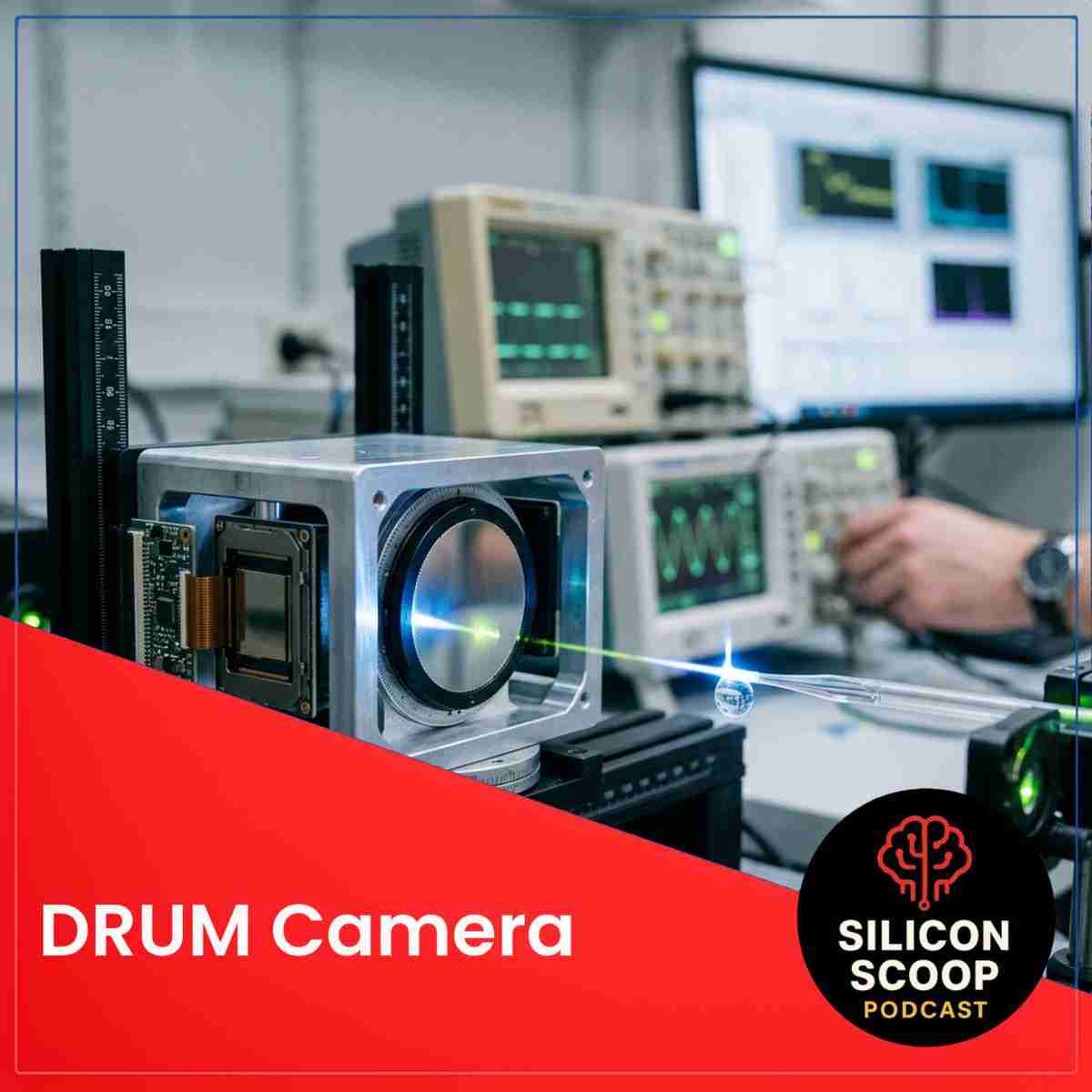
DRUM Camera Makes $100,000 High-Speed Cameras Obsolete
Estimated reading time: 10 minutes
Key Takeaways
- Researchers from the Institut National de la Recherche Scientifique (INRS) in Canada, working alongside Concordia University and Meta Platforms Inc., have built a DRUM camera — a diffraction-gated real-time ultrahigh-speed mapping system — that hits 4.8 million frames per second using parts you could order from a commercial catalog.
- That means a research-grade DRUM system could, in theory, be built for under $10,000 USD — compared to six-figure systems on the market today.
- One of the most forward-looking applications mentioned in the original research is lidar — the laser-based ranging and detection technology that sits at the heart of most autonomous vehicle sensor systems.
Table of contents
- DRUM Camera Makes $100,000 High-Speed Cameras Obsolete
- What Is the DRUM Camera and How Does Ultrafast Imaging Work?
- The Digital Micromirror Device — The Key to Affordable High-Speed Lidar and Imaging
- Stop Running Your Business on Manual Work
- What the DRUM Camera Was Tested On — Real-World Validation
- DRUMS — The Schlieren Extension That Expands DRUM Even Further
- Why the DRUM Camera Threatens the $100,000 High-Speed Camera Market
- High-Speed Lidar, Autonomous Vehicles, and the Bigger Picture
- What Comes Next for DRUM Technology
- Frequently Asked Questions (FAQ)
For decades, capturing the world at millions of frames per second was a privilege reserved for well-funded labs and deep-pocketed corporations. If you wanted to film a laser pulse splitting a water droplet or watch a cavitation bubble grow in real time, you needed a camera that cost as much as a house. That world is changing fast.
Researchers from the Institut National de la Recherche Scientifique (INRS) in Canada, working alongside Concordia University and Meta Platforms Inc., have built a DRUM camera — a diffraction-gated real-time ultrahigh-speed mapping system — that hits 4.8 million frames per second using parts you could order from a commercial catalog. The full technical findings were published in Optica in 2023, and the ripple effects are still spreading across the imaging, biomedical, and autonomous vehicle industries.
This is not a minor tweak to existing technology. This is a fundamental rethink of how high-speed imaging works, who can afford it, and what it can be used for.
What Is the DRUM Camera and How Does Ultrafast Imaging Work?
To understand why the DRUM camera matters, you first need to understand what ultrafast imaging actually is — and why it has always been so expensive.
High-speed imaging means capturing events that happen far too quickly for a normal camera to record. We are talking about things like:
- Laser pulses interacting with biological tissue
- Shock waves moving through fluids
- Plasma channels forming in a fraction of a microsecond
- Cavitation bubbles expanding after a laser fires into water
To freeze these events, a camera must open and close its shutter millions of times per second. Each opening is called a “frame.” A camera that shoots 4.8 million frames per second is opening and closing its shutter nearly five million times in the span of a single second.
Traditional ultrafast cameras — often called streak cameras or compressed ultrafast photography (CUP) platforms — achieved this using highly specialized and expensive optical components. Their price tags routinely exceeded $100,000 USD. Some of the most capable systems cost significantly more. That made them accessible only to elite research institutions and large industrial operators.
The DRUM camera changes this equation entirely. Researchers on the team described it plainly: “Our camera uses a completely new method to achieve high-speed imaging. It has an imaging speed and spatial resolution similar to commercial high-speed cameras but uses off-the-shelf components that would likely cost less than a tenth of today’s ultrafast cameras.”
That means a research-grade DRUM system could, in theory, be built for under $10,000 USD — compared to six-figure systems on the market today.
Source: Lab Manager
The Digital Micromirror Device — The Key to Affordable High-Speed Lidar and Imaging
The most important component inside the DRUM camera is something you have likely already owned without knowing it: a digital micromirror device (DMD).
DMDs are the tiny arrays of microscopic mirrors used inside projectors to create images. Texas Instruments manufactures them at commercial scale. Each mirror in a DMD array can tilt to one of two positions — typically ±12 degrees — and switch between those positions at speeds measured in the tens of kilohertz. Because they are mass-produced for the consumer electronics market, they are comparatively cheap, reliable, and widely available.
The INRS team recognized something clever: if you control the tilt angle of DMD mirrors across an array in a precise, time-varying sequence, those mirrors can act as a diffraction grating — a surface that splits incoming light into multiple replicas, each traveling in a slightly different direction.
Here is how it works step by step:
- Light from a fast event — say, a femtosecond laser firing into water — hits the DMD array.
- The DMD’s mirror pattern changes rapidly, creating what the team calls a “sweeping optical diffraction envelope.”
- Each sweep of the diffraction envelope acts as a time gate, capturing light from a specific moment in time.
- Each time-gated slice of light is sent to a different region of the camera sensor.
- Those slices are then assembled into a sequential ultrafast movie.
The result is a single-shot movie with a sequence depth of seven frames, each separated by roughly 0.37 microseconds, meaning each complete DRUM sequence captures approximately 2.6 microseconds of real time. At 4.8 million frames per second, that is an extraordinary level of temporal detail packed into a single exposure.
One of the most significant design decisions the team made was to ensure that DRUM is compatible with standard CCD and CMOS sensors — the same sensor types already found in millions of scientific and industrial cameras worldwide. This means existing camera hardware could potentially be retrofitted with a DRUM diffraction-gating module rather than replaced entirely. That drastically lowers adoption costs for labs and companies that already have imaging infrastructure in place.
Source: Texas Instruments
Source: Lab Manager
Stop Running Your Business on Manual Work
If the DRUM camera proves anything, it is that doing more with less — smarter tools, lower costs, faster output — is how modern teams win. The same principle applies to your business operations. At Flowgrammer, we help businesses automate their workflows so they stop wasting hours on repetitive tasks and start scaling without adding headcount.
👉 See How Business Automation Works for You (https://flowgrammer.ca)
What the DRUM Camera Was Tested On — Real-World Validation
Publishing a camera specification is one thing. Proving it works in demanding, real-world experimental conditions is another. The INRS team did not simply claim performance numbers — they demonstrated DRUM on some of the most challenging ultrafast phenomena in current scientific research.
Femtosecond Laser Breakdown in Liquid
The first major test involved firing femtosecond laser pulses into distilled water and recording what happens. When an ultra-short laser pulse hits a liquid with enough intensity, it triggers laser-induced breakdown — a rapid, complex process that creates a plasma channel (a streak of ionized matter) followed almost immediately by the formation of a cavitation bubble.
The DRUM camera captured the full evolution of this plasma channel and tracked the growth of the cavitation bubble frame by frame. Crucially, the bubble radii measured in the DRUM footage matched theoretical predictions from established cavitation physics models. That is a strong validation signal — it means the camera is not just fast, it is also quantitatively accurate.
Carbonated Drinks and Bubble Dynamics
The team also used DRUM to image bubble dynamics in carbonated beverages — a useful proxy for studying microfluidics, aeration processes, and liquid behavior under rapid perturbation. While this may sound like a novelty experiment, bubble dynamics in liquids have serious implications for drug delivery, industrial chemical processing, and food science.
Laser Ablation in Biological Tissue
Perhaps the most significant test was imaging laser ablation in single-layer onion cells. Laser ablation — the process of using a focused laser to remove or alter material — is foundational to surgical techniques, including nano-surgery on biological tissue. Capturing these interactions at millions of frames per second, in a biologically relevant sample, opens direct pathways to surgical planning and real-time procedure monitoring.
Lead researcher Jinyang Liang was specific about the long-term vision: “In the long term, I believe that DRUM photography will contribute to advances in biomedicine and automation-enabling technologies such as lidar, where faster imaging would allow more accurate sensing of hazards.”
Co-author Xianglei Liu added: “DRUM photography may even be applied to nano-surgeries and laser-based cleaning applications.”
Source: EurekAlert!
Source: Lab Manager
DRUMS — The Schlieren Extension That Expands DRUM Even Further
The DRUM platform did not stop at direct imaging. Researchers have since introduced a follow-on variant called DRUMS — Diffraction-gated Real-time Ultrahigh-speed Mapping Schlieren photography.
Schlieren imaging is a technique used to visualize refractive index gradients — in simpler terms, it makes invisible differences in density or temperature within a transparent medium visible on camera. This is the same technique used to see heat shimmer above a hot road, or to visualize airflow around aircraft in wind tunnel tests.
By building schlieren contrast into the DRUM framework, researchers have unlocked new application domains:
- Aero-optics: Visualizing how high-speed airflow distorts optical paths, critical for aircraft and missile guidance systems
- Combustion diagnostics: Capturing the early stages of flame ignition and fuel-air mixing at sub-microsecond timescales
- Shockwave studies: Recording the propagation of pressure waves through gases and liquids — relevant for both defense research and industrial safety
DRUMS is a single-shot technique, meaning it captures these complex, non-repeatable events in a single firing — exactly the constraint that makes ultrafast imaging so difficult and so valuable.
Source: Researching
Why the DRUM Camera Threatens the $100,000 High-Speed Camera Market
The commercial implications of DRUM are significant and increasingly recognized across the imaging industry.
The high-speed camera market currently relies on a small number of premium manufacturers — companies that produce cameras for automotive crash testing, scientific research, defense applications, and industrial inspection. Entry-level professional high-speed systems start around $10,000 to $20,000 USD. Systems capable of millions of frames per second routinely sit at $100,000 and above.
DRUM disrupts this structure from multiple directions:
1. Commodity components replace custom optics.
By using DMDs from the projector industry and standard CCD/CMOS sensors, the DRUM architecture avoids the custom-built optical components that drive costs up in streak cameras and other ultrafast systems. Mass production economics apply from day one.
2. Retrofitting is possible.
Because DRUM is compatible with existing CCD and CMOS sensor platforms, system integrators can potentially add diffraction-gating capability to cameras labs already own. This lowers the barrier to adoption further — it is not always a full replacement purchase.
3. New markets open up.
The biggest impact of a low-cost ultrafast camera may not be in displacing existing buyers — it may be in creating entirely new markets. Researchers at universities without large imaging budgets, startups working on autonomous vehicle lidar, medical device companies developing laser-based surgical tools — these groups currently cannot afford ultrafast imaging. DRUM could change that.
As one technology commentator noted, DRUM’s architecture could “erode the premium segment of high-speed camera markets — where $100,000-plus systems remain common — while opening new demand in autonomous driving, robotics, and nano-surgery.”
Source: Fanatical Futurist
High-Speed Lidar, Autonomous Vehicles, and the Bigger Picture
One of the most forward-looking applications mentioned in the original research is lidar — the laser-based ranging and detection technology that sits at the heart of most autonomous vehicle sensor systems.
Lidar works by firing rapid laser pulses and measuring how long they take to bounce back from objects. The faster the system can fire, detect, and process those pulses, the more accurately it can map a three-dimensional environment in real time. Current lidar systems face trade-offs between range, resolution, and cost.
An affordable, ultra-high-speed imaging platform based on DRUM principles could allow lidar sensors to:
- Detect fast-moving hazards — a child running into the road, debris falling from a truck — with greater temporal precision
- Operate at higher frame rates without requiring expensive custom components
- Be integrated into more compact and cost-effective sensor packages
This puts DRUM-based technology directly in the path of one of the fastest-growing hardware sectors in the automotive and robotics industries. Government-backed programs for autonomous vehicle development and biomedical imaging diagnostics — both of which depend on high-speed optical sensing — are natural early adopters.
The fact that DRUM is explicitly built to scale using DMD hardware that already ships by the millions each year means manufacturing risk is low. The same industry infrastructure that produces projectors for classrooms and conference rooms can, in principle, supply the core components for the next generation of lidar sensors and ultrafast diagnostic cameras.
Source: EurekAlert!
Source: Fanatical Futurist
What Comes Next for DRUM Technology
The INRS team has been transparent about both the current limitations and the near-term roadmap for DRUM.
Current limitations:
- The sequence depth is seven frames per single-shot exposure. For many applications, this is sufficient — but some complex, longer-duration events would benefit from deeper frame sequences.
- The system currently captures images in grayscale. Color imaging has not yet been demonstrated in the DRUM architecture.
- Temporal resolution between frames sits at approximately 0.37 microseconds, meaning very fast events that require sub-100-nanosecond discrimination are still better served by streak cameras in some contexts.
Planned developments:
- Increasing both imaging speed and sequence depth beyond current benchmarks
- Developing color imaging capability within the DRUM framework
- Expanding lidar integration for autonomous sensing systems
- Applying DRUM to nano-surgery research and laser-based industrial cleaning
The DRUMS schlieren variant is already in active development, and the broader DMD ecosystem — with kilohertz-scale switching speeds and proven MEMS reliability — provides a solid foundation for commercial scaling.
From a research infrastructure standpoint, the combination of commodity components, sensor compatibility, and a growing library of validated use cases positions DRUM as one of the more credible paths to mainstream ultrafast imaging adoption seen in the last decade.
Source: Lab Manager
Source: EurekAlert!
Frequently Asked Questions (FAQ)
1. What does DRUM stand for in the context of the new camera?
DRUM stands for Diffraction-gated Real-time Ultrahigh-speed Mapping. It describes the core mechanism of the camera: using time-varying optical diffraction — generated by a digital micromirror device — to gate individual frames at different points in time, which are then combined into a high-speed movie from a single exposure.
2. How fast is the DRUM camera exactly?
The DRUM camera captures events at 4.8 million frames per second in a single exposure. Each complete sequence contains seven frames, with each frame separated by approximately 0.37 microseconds, meaning the total duration of a single DRUM movie covers roughly 2.6 microseconds of real time.
3. How much does the DRUM camera cost compared to traditional ultrafast cameras?
Traditional high-speed cameras capable of millions of frames per second typically cost $100,000 USD or more. The DRUM camera uses off-the-shelf components — most notably digital micromirror devices from the commercial projector industry — and its estimated bill of materials is projected to come in at well under one-tenth of that price. That suggests research-grade DRUM systems could be built for under $10,000 USD.
4. Who built the DRUM camera?
The DRUM camera was developed by researchers at the Institut National de la Recherche Scientifique (INRS) in Canada, in collaboration with Concordia University and Meta Platforms Inc. The lead technical author on the Optica paper was Xianglei Liu, and the project was led by Professor Jinyang Liang, who heads the Laboratory of Applied Computational Imaging at INRS.
5. What is a digital micromirror device (DMD) and why is it important to DRUM?
A DMD is an array of microscopic mirrors, each of which can tilt between two positions (typically ±12 degrees) at high speed. DMDs are manufactured at scale for use in projectors and display systems by companies like Texas Instruments. In the DRUM camera, the DMD is used unconventionally: its rapidly changing mirror patterns create a sweeping diffraction grating that acts as a time gate, capturing light from different moments in time onto different parts of the camera sensor.
6. Can the DRUM camera work with existing camera sensors?
Yes. One of the key design choices in the DRUM architecture is that it is compatible with standard CCD and CMOS sensors without compromising their native advantages, including sensitivity. This means existing scientific or industrial cameras could potentially be retrofitted with a DRUM diffraction-gating module rather than requiring an entirely new camera purchase.
7. What experiments were used to validate the DRUM camera?
The research team validated the DRUM camera using three main experimental scenarios: (1) imaging femtosecond laser-induced plasma channels and cavitation bubble growth in distilled water, where bubble radii matched theoretical predictions; (2) imaging bubble dynamics in carbonated beverages as a microfluidics proxy; and (3) imaging laser ablation in single-layer onion cells as a biologically relevant model for nano-surgery applications.
8. What is DRUMS and how does it differ from DRUM?
DRUMS stands for Diffraction-gated Real-time Ultrahigh-speed Mapping Schlieren photography. It is a follow-on variant of DRUM that adds schlieren contrast — a technique for visualizing refractive index gradients in transparent media. While DRUM captures direct images of fast events, DRUMS visualizes invisible changes in density, temperature, or pressure. This makes it applicable to aero-optics, combustion diagnostics, and shockwave studies.
9. What are the main applications being developed for DRUM technology?
The primary application areas under active development include: biomedical imaging (including laser-based nano-surgery and observation of cellular-level laser interactions), high-speed lidar for autonomous vehicles and robotics, microfluidics and pharmaceutical research, industrial laser cleaning and ablation monitoring, aero-optics and combustion diagnostics (through DRUMS), and shockwave visualization in defense and safety contexts.
10. What are the current limitations of the DRUM camera?
The current DRUM prototype has a sequence depth of seven frames per single-shot exposure, which limits its use on longer-duration events. It currently captures grayscale images only — color imaging has not yet been demonstrated. The inter-frame temporal resolution of approximately 0.37 microseconds also means that events requiring sub-100-nanosecond precision may still be better served by streak cameras in some specific research contexts. The research team is actively working to address all three of these limitations in future iterations of the platform.
Additional Links
Flowgrammer.ca – 💡 Unlock AI-Powered Automation! Let flowgrammer.ca handle complex workflows so you can focus on growing your business.
Flowgrammers.ca – 💡 Join Toronto’s Fastest Growing AI and Business Automation Community.
- SRED Funding Solutions – Maximize your R&D tax credits and secure funding for your innovation.
- Silicon Scoop Podcast – Stay Informed, Stay Ahead!
- Startup Talk Podcast
- Flowgrammer Youtube
- Startup Investor Drinks – Join Toronto’s Startup Community and connect with fellow startup enthusiasts and investors.
- TorontoStarts Startup and Entrepreneur Community – Become a part of Toronto’s thriving startup ecosystem.
- Workhaus – Discover flexible workspace solutions for your business needs.
- Work with The Startup Coach – Get expert guidance and mentorship for your startup journey.
- Reach out to Jon Irwin on LinkedIn – Connect with our co-host and technology expert.
Episode transcript
Read the full transcript
Craig: for decades, filming at millions of frames per second required a $100,000 camera that only elite research labs could ever afford. but a massive breakthrough called the drum camera just slashed the price by tagged by 90% using exact same micromirror chip found in standard school classroom projectors. can canadian researchers and meta have built an ultra fast camera hitting 4,800,000 frames per second using cheap off the shelf commercial components. this allows an imaging system that typically costs 6 figures to be construction constructed for under $10,000. this completely democratizes advanced scientific imaging and paves the way for hyper precise, low cost lidar sensors in everyday autonomous vehicles. what do you think about this, john?
Jon: i like this. this is cool. i love that it's canadian too. so let's talk about the problem and how drum changes it. so traditional high speed cameras, they have a brutal engineering challenge. right? so in order to capture millions of frames per second, the sensors themselves must read out enormous amounts of data pretty much instantaneously, and that requires specialized cmos sensors. it requires high bandwidth memory and sophisticated electronics and massive storage systems. so the faster you wanna record, the more expensive the camera becomes. this is why a lot of these scientific grade cameras from manufacturers like phantom, photron, and specialized imaging can cost well over a $100,000. but there's also a trade off between frame rate, resolution, sensitivity, recording duration. so, traditionally, increasing one often then sacrifices another, and this is one of the biggest bottlenecks in high speed imaging. so the genius of drum is that it doesn't primarily rely on a faster sensor, which is super cool. instead, it uses diffraction optics to encode temporal information before the light reaches the camera sensor. so different moments of a fast event are mapped into different spatial locations through a diffraction based gating system. and so the camera captures all this information in a single exposure, and computational reconstruction separates the encoded information into individual frames. so i i'm hesitant on this because we're this is part of a broader trend called computational imaging. so we're getting into reconstruction and things like that, but it's cool because reduce, it does reduce the cost. so rather than solving problems purely with hardware, what researchers are doing and what they did here is they're looking to combine optics, signal processing, computational reconstruction, and machine learning. so, the result is a performance that would traditionally cost you a $100,000. what do you think about this? so what do you think about computational imaging?
Craig: think of this update like trying to capture seven rapid fire photos of a speeding bullet using a single camera. instead of trying to force a physical shutter to mechanically open and close millions of times a second, which breaks the hardware, you place a grid of tiny hyper fast pivoting mirrors right in front of the camera sensor. as the light from the camera fast moving event rushes in, these cameras instantly tilt mirrors instantly tilt in a preprogrammed sequence acting like optical trapdoors that route each microsecond slice of the action to a different corner of the sensor all at once. so, yeah, i think it's cool.
Jon: what do you think about relying more on software reconstruction than actual hardware? do you think we're getting a pure image? or like, my concern is that once we go to software, we run into potential malicious players when it comes to this kind of stuff. right? so
Craig: it's too late for that, isn't it?
Jon: it is late. yeah.
Craig: like, i mean, isn't i every phone camera you is mostly software now?
Jon: pretty much. yeah. you're right.
Craig: yeah. so, i think we're beyond that. so people are gonna be malicious. people are gonna be and we just have to, you know, accept a new world. right? people, use did you hear it?
Jon: we might have covered this with samsung. you know what they did with one of their galaxy s phones is when you took a picture of the moon, actually it used it reconstructed a really clear picture of the moon, so it wasn't the actual picture you took.
Craig: i did not see that. but, yeah, this there you go. i mean yeah. and people say there's two. most of the, pictures of the earth you've seen is not, an actual photo. they're digital reconstructions.
Jon: yeah.
Craig: so, you know, is this techno technology dangerous in, a fraud or sure. but look at ai image generation and video generation now. do we even need these $10,000 cameras to create stuff that people are you know? so people
Jon: are making movies on their iphones. right? so you guys might have heard craig at the start saying meta was involved in this. this. right? so why meta? why was meta involved? so meta has invested heavily in advanced computer vision, augmented reality, as we know, virtual reality, and machine perception technologies. so, ultra fast imaging, it has potential in arvr sensing, spatial computing, motion tracking, next generation lidar, like you said, autonomous systems. so this collaboration, it definitely has commercial implications for future sensing technologies. you combine this with the color lidar, you've got a crazy system.
Craig: absolutely. and to validate the camera could accurately measure real world physic dynamics physical dynamics, researchers didn't just fire lasers. they literally used a system to film the chaotic microsecond level explosion of bubbles inside an ordinary carbonated soft drinks to map fluid microdynamics. so the drum camera turns a 100,000 luxury research tool into a $10,000 commodity, proving that clever engineering with mass produced components will always disrupt the overpriced legacy hardware. now that this tech is poised to radically drop the price of autonomous vehicle sensors, would you just trust a self driving car more knowing it tracks the road 4,800,000 frames per second, or are you still keeping your hands firmly on the wheel? let us know in the chat below.
More from Silicon Scoop
All episodes
silicon-scoop · October 21, 2026
China’s Brain-Mapping Chip Redefines Real-Time Cortical Reconstruction
China’s brain mapping chip uses phase-change memristors and in-memory computing for real-time cortical reconstruction, boosting diagnosis and surgery.
View episode
silicon-scoop · October 20, 2026
UltraRAM’s Quantum Leap: How Quinas Is Turning Universal Memory Into Commercial Silicon
UltraRAM and Quinas Technology push universal memory toward commercial silicon, scaling quantum-powered storage for neuromorphic computing and AI.
View episode

silicon-scoop · October 19, 2026
OpenAI’s Jalapeño Chip Stakes a Claim Against Nvidia Blackwell in Real-World AI Inference
OpenAI Jalapeno chip challenges Nvidia GB300 Blackwell with InferenceX AI benchmark results, reshaping AI inference accelerator efficiency and latency.
View episode