
Nanodiamond Smart Cooling Textiles: From Lab Breakthrough to Next-Gen Climate-Adaptive Apparel
How nanodiamond cooling textiles and smart cooling fabrics using nanodiamond-coated cotton are reshaping thermal conductive textiles and energy-efficient apparel.
With Craig Major and Jon Irwin
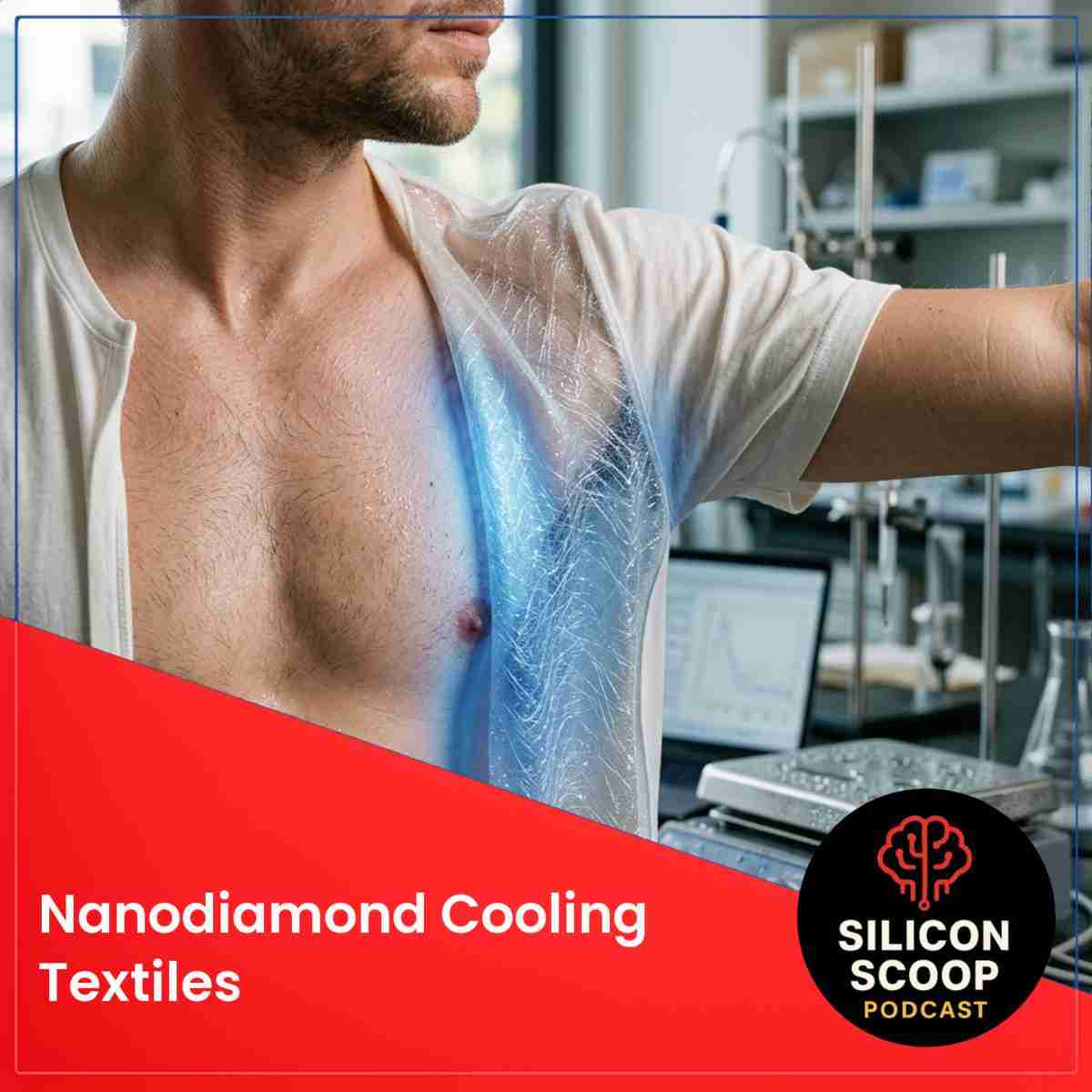
Nanodiamond Cooling Textiles Are Changing How We Stay Cool
Estimated reading time: 10 minutes
Key Takeaways
- The fabric can lower the temperature a person feels by 2 to 3°C, and it could cut air-conditioning energy use by 20 to 30% for people who wear it regularly.
- Researchers at RMIT University in Australia have figured out how to coat ordinary cotton fabric with these microscopic carbon particles.
- Nanodiamond cooling textiles are no longer a science fiction concept.
- The process uses a technique called electrospinning.
- The nanodiamond-polyurethane coating slightly reduces air permeability and moisture absorption in the fabric.
Table of contents
- Nanodiamond Cooling Textiles Are Changing How We Stay Cool
- What Are Nanodiamonds and Why Do They Matter for Smart Cooling Fabrics?
- How RMIT Built the Nanodiamond-Coated Cotton Fabric
- Beyond Cooling: The Multifunctional Promise of Thermal Conductive Textiles
- Where Nanodiamond Cooling Textiles Could Actually Be Used
- The Market Behind the Material
- Hurdles Still Standing Between the Lab and Your Wardrobe
- The Bigger Picture: Why This Technology Fits the Moment
- FAQ: Nanodiamond Cooling Textiles
The way we manage body heat is getting a serious upgrade — and it starts with diamonds.
Not the kind you wear on your finger. We're talking about nanodiamonds: particles so small they're measured in billionths of a meter. Researchers at RMIT University in Australia have figured out how to coat ordinary cotton fabric with these microscopic carbon particles, and the results are hard to ignore. The fabric can lower the temperature a person feels by 2 to 3°C, and it could cut air-conditioning energy use by 20 to 30% for people who wear it regularly.
Nanodiamond cooling textiles are no longer a science fiction concept. They're moving from lab benches to real-world testing, and the materials science community is paying close attention.
This article breaks down exactly how the technology works, what the research actually shows, where it could go next, and why the global market is betting billions on nanodiamond-based materials over the next decade.
---
What Are Nanodiamonds and Why Do They Matter for Smart Cooling Fabrics?
Before we get into the fabric itself, it helps to understand what nanodiamonds actually are.
Nanodiamonds are tiny carbon particles, typically 4 to 10 nanometers in diameter, that share the same crystal structure as a natural diamond. They're produced mainly through a process called detonation synthesis, where carbon-rich explosives are detonated in a controlled environment. The shock wave creates intense heat and pressure that forces carbon atoms into the diamond lattice structure.
Here's why that matters for smart cooling fabrics:
- Thermal conductivity: Natural diamond is one of the best heat conductors on the planet, with a thermal conductivity of around 2,000 W/mK. Even nanoscale diamond particles carry strong thermal conductive properties. Thermal conductive coatings for electronics packaging that use nanodiamond fillers achieve 8 to 12 W/mK, compared to just 1 to 2 W/mK for standard polymer coatings. nanodiamonds market report
- Biocompatibility: Unlike some nanomaterials that raise health concerns, nanodiamonds are widely considered non-toxic and safe for skin contact, which is a critical feature for wearable textiles.
- Mechanical strength: Adding nanodiamonds to a material increases its durability and abrasion resistance.
- Surface chemistry: Nanodiamonds can be functionalized — meaning their surfaces can be chemically modified — to achieve additional properties like hydrophilicity (water attraction), UV resistance, and antimicrobial behavior.
These combined traits make nanodiamonds a uniquely attractive material for textile engineers who want a fabric that does more than just cover the body. They want fabrics that actively manage heat.
It's worth comparing nanodiamonds to graphene oxide, another carbon nanomaterial often discussed in smart textile research. Graphene oxide has excellent thermal properties too, but it's significantly more expensive to produce at scale. Nanodiamonds, by contrast, are cheaper to manufacture and are already used in industrial coatings, lubricants, and electronics applications. That existing supply chain gives nanodiamond cooling textiles a commercialization edge. nanodiamonds research for smart cooling fabrics
---
How RMIT Built the Nanodiamond-Coated Cotton Fabric
The RMIT University team, led by researchers including Shadi Houshyar and colleagues, published their core findings in the journal Polymers for Advanced Technologies (DOI: 10.1002/pat.6222). The paper details exactly how the coating was made and how it was tested.
The Coating Method
The process uses a technique called electrospinning. In simple terms, a polymer solution — in this case, polyurethane — is loaded into a device that uses an electric field to pull the polymer into ultra-thin fibers. These fibers are collected on a surface, in this case, a piece of cotton fabric, forming a nanofibrous mat.
The key twist: nanodiamonds are mixed into the polyurethane solution before electrospinning. So as the nanofibers are laid down on the cotton, the nanodiamonds become embedded throughout the coating.
Critically, this coating is applied to one side only — the inner surface of the fabric that faces the skin. This asymmetric design is deliberate and central to why the fabric works so well.
How the One-Sided Coating Creates a Thermal Advantage
Here's the clever physics at play:
- The inner (coated) side, facing the skin, has a lower thermal resistance. This means heat from the body moves through the fabric and escapes into the surrounding air more easily and quickly.
- The outer (uncoated) side, facing the environment, maintains similar thermal resistance to regular cotton. This means ambient heat from a hot day has a harder time penetrating inward toward the skin.
The result is a fabric that essentially has two different personalities depending on which direction heat is flowing.
The research team measured this using a Sweating Guarded Hot Plate (SGHP) — a laboratory instrument that simulates the heat and moisture output of human skin. This is the gold standard for testing thermal performance in textiles. The SGHP results confirmed that the nanodiamond-coated cotton showed measurably lower thermal resistance from the skin side outward, while resistance from the outside inward remained close to untreated cotton. Polymers for Advanced Technologies (DOI: 10.1002/pat.6222)
What the Hotplate Test Showed
NewAtlas reporting on the research adds a striking visual detail. When treated fabric samples were placed over a 100°C hotplate for 10 minutes and then allowed to cool for another 10 minutes, they released 2 to 3°C more heat through the coated side compared to untreated cotton. That temperature difference might not sound dramatic, but in thermal comfort science, 2 to 3°C is significant — it's the difference between feeling comfortable and feeling sticky and overheated. diamond-coated cotton cooling
The Breathability Trade-Off
No technology is perfect, and the RMIT team is transparent about the trade-offs. The nanodiamond-polyurethane coating slightly reduces air permeability and moisture absorption in the fabric. This makes sense — you're adding a layer of material that wasn't there before.
However, the researchers concluded that these reductions stayed within acceptable comfort ranges. The fabric doesn't feel suffocating. The coating is nanofibrous, meaning it's porous enough to allow airflow and moisture movement, just slightly less than pure uncoated cotton. For most real-world use cases — summer clothing, sportswear, light workwear — these trade-offs are manageable. diamond-coated cotton cooling
---
Stop Losing Hours to Manual Work
Every minute your team spends on repetitive tasks is a minute not spent growing your business. At Flowgrammer, we build custom automation systems that remove the manual bottlenecks from your operations — so your business can scale without scaling your headcount.
👉 See How Business Automation Works for You (https://flowgrammer.ca)
---
Beyond Cooling: The Multifunctional Promise of Thermal Conductive Textiles
One of the most exciting aspects of nanodiamond cooling textiles isn't just the cooling performance. It's everything else that comes along with it.
Research from the same RMIT research ecosystem, published in MRS Bulletin, explored nanodiamond–polyaniline (ND-PANI) nanocomposite smart textiles. This work revealed that when nanodiamonds are incorporated into textile coatings, they can simultaneously provide:
- UV resistance — blocking harmful ultraviolet radiation from the sun
- Improved mechanical properties — making fabric tougher and more resistant to tearing and wear
- Hydrophilicity — attracting and managing moisture at the fabric surface
- Antimicrobial behavior — inhibiting the growth of bacteria and fungi
- Abrasion resistance — helping the fabric survive repeated use and washing cycles
This means the next generation of thermal conductive textiles won't just be cooling fabrics. They'll be multifunctional protective layers that simultaneously regulate temperature, resist UV, fight microbes, and last longer than conventional textiles. MRS Bulletin
The Superhydrophilic Wool Finding
A related study published in Langmuir — also from the broader RMIT research ecosystem — demonstrated that functionalized nanodiamonds can make wool superhydrophilic by adding polar groups to the fiber surface and increasing its microscopic roughness. This dramatically improves moisture wicking.
Why does that matter for cooling textiles? Because managing sweat is just as important as managing heat. A fabric that can rapidly pull moisture away from skin while also conducting heat outward would offer superior comfort in hot and humid environments. The combination of enhanced moisture wicking and active thermal management is a compelling target for future nanodiamond-coated cotton and nanodiamond-coated wool products. Langmuir
---
Where Nanodiamond Cooling Textiles Could Actually Be Used
The RMIT researchers and independent commentators have identified several high-value application areas where this technology makes real sense.
Sportswear and Athletic Performance
Athletes generate enormous amounts of body heat. A fabric that pulls heat away from the skin faster than conventional polyester or cotton blends could meaningfully improve comfort during high-intensity activity. It could also help reduce the rate of core temperature increase during outdoor summer sports — with real safety implications for endurance athletes.
Firefighting and Protective Equipment (PPE)
This is one of the most compelling use cases. Firefighters work in extreme heat environments. A nanodiamond-enhanced underlayer beneath a firefighter's outer shell garment could help manage body heat buildup more effectively, improving endurance and reducing heat stress. The addition of UV resistance and antimicrobial properties from the nanodiamond coating adds further value for PPE applications. nanodiamonds research for smart cooling fabrics
Outdoor Summer Clothing and Climate-Adaptive Apparel
For everyday consumers living in hot climates, a summer shirt that keeps you 2 to 3°C cooler without needing batteries, electronics, or refrigerant is a genuinely attractive product. As global average temperatures continue to rise, demand for climate-adaptive apparel — clothing that actively helps the wearer manage thermal discomfort — is expected to grow. Nanodiamond cooling textiles are a strong candidate to serve this market.
Building Materials and Interior Textiles
The thermal management principles that work in clothing could also be applied to upholstery, curtains, and wall textiles inside buildings. A coated fabric that slows ambient heat penetration while allowing internal heat to escape could reduce cooling loads in homes and offices.
Biomedical and Healthcare Interfaces
In medical settings, patient comfort during extended bed rest or rehabilitation is an ongoing challenge. Smart cooling fabrics used in hospital bedding or wound dressings could improve patient comfort and potentially reduce skin breakdown risks in patients who are unable to move freely.
---
The Market Behind the Material
The commercial context for nanodiamond cooling textiles is stronger than many people realize.
The global nanodiamonds market is expected to grow at a compound annual growth rate (CAGR) of 11.9% from 2025 to 2030, reaching approximately USD 722.1 million by 2030. Looking further out, the broader nano diamond market is projected to rise from USD 1.9 billion in 2025 to USD 5.4 billion by 2034 at a CAGR of 12.4%. nano diamond market nano diamond market
This growth is being driven by demand across several sectors:
- Electronics and thermal management — nanodiamond fillers in thermal interface materials and coatings for chips and circuit boards
- Lubricants and industrial coatings — nanodiamonds reduce friction in mechanical systems
- Biomedical applications — drug delivery, imaging agents, and antimicrobial coatings
- Advanced textiles — the emerging segment that includes cooling fabrics
The fact that nanodiamonds already have a robust production infrastructure and growing demand from multiple industries means that the supply chain for scaling nanodiamond cooling textile production is more developed than it would be for a brand-new nanomaterial with no prior commercial applications. This reduces one significant barrier to market entry.
---
Hurdles Still Standing Between the Lab and Your Wardrobe
The RMIT research is genuinely promising, but it's important to be clear-eyed about what still needs to happen before nanodiamond cooling textiles reach mass market shelves.
Washing Durability
The most immediate challenge is wash durability. In real-world use, clothing gets washed repeatedly — sometimes dozens or hundreds of times over its lifespan. The nanodiamond-polyurethane coating needs to withstand repeated laundering without flaking off, losing adhesion, or degrading in thermal performance. Research on this specific question is ongoing.
Breathability Standards
The slight reduction in air permeability noted in the RMIT research needs to be more rigorously benchmarked against established textile comfort and performance standards. For sportswear and PPE in particular, breathability specifications are tightly defined, and manufacturers need standardized test data to comply with industry requirements.
Scaling Up Production
Electrospinning is well-established as a lab and pilot-scale process, but scaling it to industrial textile production volumes while maintaining coating uniformity and nanodiamond distribution is a non-trivial engineering challenge. Cost per unit area needs to come down for mass-market apparel to be viable.
Regulation and Safety Standards
No specific executive orders or named legislation currently target nanodiamond cooling textiles directly. However, nanomaterials in consumer products — especially those in close contact with skin — are subject to increasing regulatory scrutiny in the European Union, the United States, and other markets. Manufacturers will need to demonstrate safety under long-term dermal exposure conditions before these textiles can be widely sold. Polymers for Advanced Technologies (DOI: 10.1002/pat.6222)
Cost
Nanodiamonds are cheaper than graphene oxide, but they're still more expensive than conventional textile additives. The cost premium needs to be justified by performance benefits that consumers and institutional buyers are willing to pay for. For PPE and sports performance applications, where buyers are already accustomed to paying a premium for functional benefits, this is more achievable. For everyday summer clothing, it's a bigger hurdle.
---
The Bigger Picture: Why This Technology Fits the Moment
The timing of nanodiamond cooling textile research is not accidental.
Global average temperatures are rising. Urban heat islands are intensifying in major cities. Millions of people in hot climates already struggle with thermal discomfort during summer months, and air conditioning — the dominant solution today — is enormously energy intensive. Buildings account for roughly 40% of global energy use, and air conditioning is one of the fastest-growing segments of that.
If a garment worn by a person allows their thermal comfort to be maintained at a room temperature 2 to 3°C higher than they would otherwise tolerate, the projected 20 to 30% reduction in air-conditioning energy use cited by RMIT's researchers represents a meaningful contribution to energy efficiency. At scale — across millions of workers in offices, factories, and public spaces — that energy saving compounds significantly.
Nanodiamond cooling textiles sit at the intersection of materials science, energy efficiency, and climate adaptation. That's a powerful combination for attracting research funding, commercial investment, and policy support over the coming decade.
---
FAQ: Nanodiamond Cooling Textiles
1. What exactly are nanodiamond cooling textiles?
Nanodiamond cooling textiles are fabrics — typically cotton or wool — that have been coated with nanodiamonds: tiny carbon particles that share diamond's crystal structure and high thermal conductivity. The coating helps the fabric move body heat away from the skin more quickly while slowing the penetration of ambient heat from the outside. The result is a fabric that keeps the wearer measurably cooler than regular uncoated fabric.
2. How much cooler do they actually make you feel?
Research from RMIT University found that nanodiamond-coated cotton can lower the perceived skin temperature by approximately 2 to 3°C compared to untreated cotton. In controlled laboratory tests using a Sweating Guarded Hot Plate, the coated fabric released 2 to 3°C more heat through the coated (skin-facing) side than uncoated cotton. Polymers for Advanced Technologies (DOI: 10.1002/pat.6222)
3. Does wearing this fabric actually save energy on air conditioning?
According to RMIT's researchers, the projected energy saving is 20 to 30% in air-conditioning use for people who wear the fabric regularly. This is because the wearer can remain thermally comfortable at a higher ambient room temperature, meaning the air conditioner doesn't need to work as hard. This projection is based on thermal performance data from lab testing; real-world energy savings at scale would depend on adoption rates and usage patterns. Polymers for Advanced Technologies (DOI: 10.1002/pat.6222)
4. Is the coating safe to wear against skin?
Nanodiamonds are widely considered biocompatible and non-toxic, and they have been studied in biomedical research including drug delivery and imaging. However, for consumer textiles worn in close contact with skin, long-term dermal exposure data and regulatory review will be needed before these fabrics are approved for mass-market sale. Current research indicates no known safety concerns specific to nanodiamond-coated textiles. MRS Bulletin
5. Does the coating affect how breathable the fabric is?
Yes, slightly. The nanodiamond-polyurethane nanofibrous coating reduces both air permeability and moisture absorption somewhat. However, the RMIT research team found that these reductions stayed within acceptable comfort ranges. The nanofibrous nature of the coating keeps it porous, so airflow and moisture movement are not eliminated — just slightly reduced. diamond-coated cotton cooling
6. How is the coating applied to the fabric?
The coating is applied using a process called electrospinning. Nanodiamonds are mixed into a polyurethane polymer solution, which is then drawn by an electric field into ultra-thin fibers that are deposited directly onto one side of the cotton fabric. The result is a thin nanofibrous mat that bonds to the fabric surface with the nanodiamonds embedded throughout. Polymers for Advanced Technologies (DOI: 10.1002/pat.6222)
7. Can nanodiamond coatings do anything beyond cooling?
Yes. Research on related nanodiamond textile systems shows that the coatings can also provide UV resistance, improved mechanical strength and abrasion resistance, antimicrobial behavior, and enhanced moisture wicking (hydrophilicity). This makes future nanodiamond fabrics potentially multifunctional — not just cooling textiles but protective, durable, and hygiene-enhancing garments as well. MRS Bulletin Langmuir
8. What industries are most likely to adopt this technology first?
Expert commentary and market analysis point to sportswear, firefighting and protective equipment (PPE), outdoor and military apparel, and healthcare textiles as the most likely early adopters. These sectors already pay premium prices for high-performance functional textiles, making the cost premium of nanodiamond coatings more commercially acceptable. Mass-market summer clothing is a longer-term target. nanodiamonds research for smart cooling fabrics
9. How big is the nanodiamond market, and can it support large-scale textile production?
The global nanodiamonds market is forecast to reach approximately USD 722.1 million by 2030 at a CAGR of 11.9%. The broader nano diamond market is projected to grow from USD 1.9 billion in 2025 to USD 5.4 billion by 2034 at a 12.4% CAGR. Nanodiamonds already have an established production infrastructure supplying electronics, lubricants, and coatings industries, which provides a foundation for scaling up supply to meet textile manufacturing demand. nano diamond market nano diamond market
10. When will nanodiamond cooling textiles be available to buy?
There is no confirmed commercial launch date as of 2026. The RMIT research is still progressing through testing and development stages. Key hurdles that need to be resolved before mass-market availability include washing durability, cost reduction, breathability standards compliance, and regulatory safety approval for consumer textiles. Specialty applications in PPE and sportswear could see earlier commercial development, potentially within the next three to five years, depending on investment and industry partnerships. Polymers for Advanced Technologies (DOI: 10.1002/pat.6222) diamond-coated cotton cooling
Additional Links
Flowgrammer.ca – 💡 Unlock AI-Powered Automation! Let flowgrammer.ca handle complex workflows so you can focus on growing your business.
Flowgrammers.ca – 💡 Join Toronto's Fastest Growing AI and Business Automation Community.
- SRED Funding Solutions – Maximize your R&D tax credits and secure funding for your innovation.
- Silicon Scoop Podcast – Stay Informed, Stay Ahead!
- Startup Talk Podcast
- Flowgrammer Youtube
- Startup Investor Drinks – Join Toronto’s Startup Community and connect with fellow startup enthusiasts and investors.
- TorontoStarts Startup and Entrepreneur Community – Become a part of Toronto’s thriving startup ecosystem.
- Workhaus – Discover flexible workspace solutions for your business needs.
- Work with The Startup Coach – Get expert guidance and mentorship for your startup journey.
- Reach out to Jon Irwin on LinkedIn – Connect with our co-host and technology expert.
Episode transcript
Read the full transcript
Craig: diamonds may eventually do more than empty your wallet. they could help you cool your body. our mit researchers coated one side of cotton with a nano diamond infused fibers and produce a measurable heat transfer advantage, but the headline gets well ahead of what's actually been tested. rmit researchers embed carboxylated nanodiamonds in polyurethane coating and applied it to one side of cotton. test showed lower thermal resistance from the coated side and faster heat release from the untreated cotton side, which would be useful in summer clothing or protective underlayers. but this is... this research first published in 2023, not commercial launch. and the study did not show that human wear is felt two or three degrees cooler. their largest unanswered question is whether the coating can become durable, comfortable, and affordable clothing. what do you think about this, john?
Jon: yeah. so let's talk... let's just... i think this is really cool. there's tons of potential applications like sportswear, summer clothing, protective uniforms, firefighter undergarments. there's a bunch. but let's talk about what exactly are nanodiamonds. so they're carbon particles whose internal atomic structure resembles diamond. and diamond consists of carbon atoms arranged primarily in an s p q bonded crystalline lattice. so that extremely stiff lattice transmits vibrations known as photons very efficiently, which is why bulk diamond has exceptionally high thermal conductivity. so in other words, diamond is really good at moving heat. and so what the researchers are trying to do, they're trying to borrow that property without using macroscopic pieces of diamond. so at nano scale dimensions, diamond particles can instead be dispersed through polymers and coatings. and so what rmit is emphasizing is that nano diamonds can be comparatively inexpensive and can be manufactured using methods including detonation synthesis. and so despite the name, this isn't a luxury apparel where you're gonna be... you're just gonna be shining like a diamond. it's closer to an engineered carbon nanomaterial additive. and so how do they do this? so this is one of the most interesting parts. so the researchers used a process called electrospinning where they first treated the cotton with an adhesive layer. they then prepare a solution containing nano diamonds plus polyurethane plus a solvent. and so an electrical field is then used to draw that solution into extraordinary thin polymer fibers. then those nanofibers collect on the cotton surface producing a web like coating, and the material subsequently is cured so that the coating becomes attached to the textile. and so instead of replacing cotton entirely, they therefore turn conventional cotton into a composite textile. so essentially have a cotton substrate plus a polyurethane nanofiber plus nano diamond thermal pathways. and that could potentially be, much easier to commercialize than inventing an entirely new fiber and re... reinventing the textile supply chain around it. and so i'm i'm going away by this. i think this is really cool. i like the the biggest application i like for is firefighter garments because they can get extremely hot and all that sort of stuff. so i'm curious as a couple things. what is the durability, and, how long till it's, commercialized? but what are your thoughts, craig? what do you think about this? you're on mute.
Craig: we didn't talk about the hot plate test. so, the new atlas reporting on the research adds a striking visual detail. when treated fabric samples were placed over a 100 degree hot plate for ten minutes and then allowed to cool for another ten minutes, they released two to three degrees more heat, through the coated side compared to the untreated cotton. the temperature difference might not sound dramatic, but in thermal comfort signs, two to three degrees is significant. it's a difference between feeling comfortable and being sticky and overheated. i don't know if this, is gonna be enough or, much helpful for firefighters except for maybe, you know, like under armour or whatnot just to keep them slightly cooler. but, you know, i don't know how much two to three to cooler... degrees is gonna help them in their circumstance, but, you know, it can't hurt, i guess.
Jon: yeah. and and it's... yeah. this is this is really cool. the thing is the one thing that it cannot, like, it cannot violate thermodynamics. right? so conduct... con... conductive cooling works best when the environment is cooler than the person. so, you're right. the, the, it might not be a good use for firefighters, but it could be good for athletes, outdoor workers, different things like that, and, potentially, uv protection. so i know i've got some under armour shirts that have this built in u v... uv protection, but imagine having, this, this garment that also cools, but also is uv protected. and i did find something in the article about, about the washing. so, apparently, after 50 washing machine cycles, the coating starts to crack. so they definitely have to work on that as far as for our commercial, durability.
Craig: absolutely. it seems like it's a cool start. it definitely... the idea of three to five degrees is potential with these is amazing, and we'll have to see because, you know, we don't think about this too much, but cooling is one of the fastest growing and largest demands of power, that's happening in the world today. so if we can start by cooling down individuals and then maybe longer term think about how we could apply these types of things to bigger things, can we do something similar with housing or other things that we need to keep cooling where we have a, inner coating that, transfers heat or cool or whatever it is out, not in, and vice versa, especially something that could be electrically charged to switch from season to season, like in canada. but when we talk about graphene where the structure of the product can change, this becomes very interesting. you start mixing these together and say, well, in the summertime, i'm letting the heat out of my house. in the wintertime, i'm letting the cold out of the house kind of thing. well, it'd be interesting to see if that's possible, but i love the idea of the cooler where it'll be, you know, potentially high performance athletic. we could see this really starting to appear with professional athletes. yeah. and they'll probably end up being hand washed by the trainer or somebody so they last, 20 games or whatnot or a season or what have you. where they're not... where they're willing to pay, you know, a few thousand dollars for a shirt for somebody, to keep them a little bit cooler on the field to get that bit extra performance out of them. right? so yeah. i see this starting to happen. and then when it happens at that level, it eventually makes itself down as more people find out different ways and add a slight different coating or whatnot, make it cheaper, faster, more durable, and not you're off to the races. so i'm very excited about this. the global nano diamond market is expected to grow at a compound annual rate of 11.9 from 2025 to 2030, reaching approximately 722,000,000 usd in 2030. so this is growing, you know, for... they're using it across several sectors, electro... electronics and thermal management, lubricants and industrial coatings, biomedical applications, and advanced textiles. so this market for the use of these nano diamonds is really growing, and i really love this cooling thing. so it'd be interesting to see yeah. where this goes. so the verdict is promising material science with no proven consumer product yet. the diamond is doing something useful, but the real breakthrough will be making the coating survive laundry day. would you rather see this technology in sportswear, everyday clothing, or firefighter equipment like my friend john here says? let us know in your comments below.
More from Silicon Scoop
All episodes
silicon-scoop · October 21, 2026
China’s Brain-Mapping Chip Redefines Real-Time Cortical Reconstruction
China’s brain mapping chip uses phase-change memristors and in-memory computing for real-time cortical reconstruction, boosting diagnosis and surgery.
View episode

silicon-scoop · October 20, 2026
UltraRAM’s Quantum Leap: How Quinas Is Turning Universal Memory Into Commercial Silicon
UltraRAM and Quinas Technology push universal memory toward commercial silicon, scaling quantum-powered storage for neuromorphic computing and AI.
View episode

silicon-scoop · October 19, 2026
OpenAI’s Jalapeño Chip Stakes a Claim Against Nvidia Blackwell in Real-World AI Inference
OpenAI Jalapeno chip challenges Nvidia GB300 Blackwell with InferenceX AI benchmark results, reshaping AI inference accelerator efficiency and latency.
View episode